Biodun Iginla, BBC News

Biodun Iginla, BBC News
Showing posts with label Alara Berrak and Biodun Iginla. Show all posts

Thursday, November 28, 2019

ANALYSIS: Turkey’s Syria move


Over here
Turkey’s Syria move highlights America’s tactical nukes in Europe

by Alara Berrak and Biodun Iginla, The Economist Intelligence Unit News Analysts
There are still 150 or so of the things
EuropeNov 30th 2019 edition


Germany owns no nuclear weapons. It renounced the very idea when it reunified in 1990. But if war were to break out in Europe today, German pilots could clamber into German planes, take off from Büchel Air Base in Rhineland-Palatinate and drop nuclear bombs on Russian troops.
The Luftwaffe can do that thanks to nato’s nuclear-sharing scheme, under which America quietly stations nuclear bombs across five countries in Europe. The arrangement is decades old. But it has raised questions for some time—and clashes involving one of those nuclear hosts, Turkey, are making matters worse. As nato leaders gather in London for a summit next week, Turkey’s bombs will be on many minds.
In 1950 America moved its first bombs to Britain. In the subsequent decades it stashed a vast trove of nuclear weapons across Europe, numbering over 7,000 at their peak in 1971. Many were small devices known as tactical, or non-strategic, nuclear weapons. They were capable of exploding with yields of as little as a fraction of a kiloton—far smaller than the 15-kilotonne bomb dropped on Hiroshima. The smallest of them could fit into a backpack.
Today only about 150 remain. These are b61 free-fall bombs whose yield can be set anywhere from a third of a kilotonne to more than 170. They remain in American custody in peacetime and could be released only by a presidential order—but European pilots still train to drop them. Italy and Turkey are thought to have the most, perhaps 60 to 70 each, with smaller numbers in Belgium, Germany and the Netherlands.
The bombs that most worry American officials are stored in vaults at Incirlik air base in southern Turkey, a few hours by road from the Syrian border. During a military coup in 1960 and a diplomatic spat in 1975, America considered removing the bombs. During the failed coup against President Recep Tayyip Erdogan in 2016, Incirlik hosted the refuelling tankers that allowed renegade f-16 fighter planes to threaten Istanbul and Ankara. Mr Erdogan’s regime responded by cutting power to the base and arresting its commander.
That prompted alarm in Washington about the security of its weapons and the risk that they could become hostages in the strained relationship with Turkey. Senior officers were sent to Incirlik, only to conclude that the bombs did not need to be removed. The warheads can be armed only by a code, and the vaults are automatically sealed if power is cut off, giving American forces time to fight their way onto the base if required. Nevertheless, in recent years America has considered spiriting away the bombs and replacing them with dummies.
Nukes were taken out of Greece in 2001 and from Ramstein air base in Germany in 2005. Pulling bombs out of Incirlik would remove vulnerable targets and implicit leverage. But if done clumsily it could worsen the diplomatic crisis and even prompt Mr Erdogan to pursue a nuclear-weapons programme of his own, something he hinted at in September. It would also restart a fraught debate over the presence of b61s elsewhere in Europe.
Opposition to nuclear-sharing has been simmering in Germany, in particular. Although Angela Merkel, Germany’s chancellor, has defended the practice, her coalition partners over the past decade have repeatedly asked for the bombs to be withdrawn. Keeping them is tricky for technical reasons, too. Europe’s current dual-capable aircraft (dca)—those wired up to carry nukes as well as ordinary bombs—are approaching the ends of their lives. Belgium, Italy and the Netherlands are all buying America’s f-35 as a replacement, but Germany ruled this out in January.
That was partly in deference to France, which wants to build its own next-generation warplane with Germany. The Luftwaffe could instead buy the f-18, an older American dca. Or it could retrofit the European-built Typhoon to accommodate b61s. But as well as being expensive and time-consuming, that would expose European technology to American eyes. And neither plane is especially stealthy.
Nor is Incirlik the only cause for security concerns. In 2008 an American air-force review concluded that most European bases hosting weapons did not meet its standards. Support buildings, fencing, lighting and security systems were all deemed in need of repair. Two years later, peace activists entered a base in Belgium and roamed near its b61 vaults for an hour.

Timebombs

If the bombs are politically troublesome and vulnerable, why keep them in Europe at all? Some nato planners fear that if Russia attacked an ally like Estonia and then conducted a limited nuclear strike to stave off a Western counter-attack, it would not make sense for the alliance to respond with “strategic” weapons—those on longer-range missiles and aircraft that have much higher, city-destroying yields. Smaller bombs like the b61s are thought to allow a proportional response.
It is not entirely clear that the enemy would appreciate the distinction, however. And the military case for b61s is dubious for other reasons. The planes—if not destroyed on the ground—would struggle to get through Russian air defences. So America would probably use stealth bombers dispatched from across the Atlantic or submarine-launched missiles armed with a new low-yield warhead built under the Trump administration. nato acknowledges that its “supreme guarantee” is provided by American, British and French strategic forces in this way, rather than by the Europe-based b61s.
In truth, the purpose of the nuclear-sharing scheme is more political than practical. The aim is to create a tangible and symbolic link between America and Europe. Allies who enjoy American nuclear protection must share the moral burden of nuclear use—and the cost of potential retaliation. At the same time, Europeans get a larger (if still modest) say in how American nukes might be used. That is thought to assuage their fear of abandonment.
That reassurance comes at a price. President Barack Obama toyed with the idea of bringing the bombs home, but ultimately deferred the decision. Instead, he authorised a $10bn programme to extend their lives and increase their accuracy. The total cost of American tactical nuclear weapons will run to $25bn between 2017 and 2046, about $1bn a year. And if Turkey’s relationship with allies continues to crumble, Europeans may feel less soothed than alarmed by the several megatonnes of weaponry sitting at Incirlik. ■
This article appeared in the Europe section of the print edition under the headline "Turkey’s Syria move highlights America’s tactical nukes in Europe"
Reuse this contentThe Trust Project

Tuesday, November 12, 2019

ANALYSIS AND BREAKING: American Islamic State suspect 'stranded on Turkey border'


An alleged IS member stands in a no man's land at the border between Turkey and Greece near Pazarkule, on 11 November 2019Image copyrightDHA/DHA/AFP VIA GETTY IMAGES
Image captionThe deported man is allegedly a captured member of the Islamic State group
by Alara Berrak and Biodun Iginla, BBC News Analysts, Istanbul
A US citizen suspected of being an Islamic State militant is stranded on the border between Greece and Turkey, after Turkey expelled him.
The alleged militant was deported on Monday as Turkey launched a drive to repatriate captured jihadist fighters held in its prisons.
Greek police said they refused him entry when he tried to cross the border near the Greek town of Kastanies.
The man is reported to have spent the night stuck between the two borders.
He has been named by Turkey's Demiroren News Agency as Muhammed Darwis B and is said to be a US citizen of Jordanian descent.
A Turkish official told AFP news agency that he had refused to be returned to the US and instead asked to be sent to Greece.
On Tuesday he was still stuck on a strip of road between the two countries and witnesses said he had been trying to shout to reporters on the Turkish side.
The fate of foreign IS fighters has been a key question since the defeat of the group in territory it controlled in Syria and Iraq.
Turkish President Recep Tayyip Erdogan has indicated that 2,500 such militants are in prison in Turkey.
According to the George Washington University Program on Extremism, 82 Americans are known to have travelled abroad to join jihadist groups since 2012. Of those, 19 have returned - 15 men and four women - and 13 have been charged.
A spokesperson from the US State Department said it was "aware of reports of the detainment of a US citizen by Turkish authorities" but had no further comment due to privacy considerations.
Presentational grey line

Unfinished business since defeat of IS

Analysis box by Frank Gardner, security correspondent
There can be few more graphic illustrations than this of the unfinished business left over from the US-led Coalition's military campaign to defeat IS.
More than 70 countries got together to defeat and dismantle the jihadist caliphate that had terrorised huge swathes of Iraq and Syria. But as with other military campaigns in the Middle East, they failed to plan sufficiently for the aftermath.
Following the final battle against IS at Baghuz in Syria in March, thousands of IS fighters and their dependants were interned in camps. Turkey, which has been arresting IS members for years, now has around 2,000 of them in its prisons.
Turkey, Iraq and the Kurdish authorities all want Europe and the West to hurry up and take back their citizens but so far governments have been extremely reluctant to do so, partly for fear that prosecutions may fail.
Turkey's current expulsions now threaten to force them into action.
Presentational grey line

Who else has Turkey deported?

Turkey's interior ministry said it had also deported a Dane alleged to be an IS member on Monday. Danish authorities said their citizen had been arrested on arrival in Copenhagen.
Germany said one of its citizens had also been expelled.
Turkey said more than 20 other European suspects, including 11 French citizens, two Irish nationals and several more Germans, are in the process of being repatriated to their countries of origin.
Turkey has not confirmed whether those being repatriated were seized in Syria, or in Turkish territory.
Some IS members and their relatives were captured in north-eastern Syria in October, when Turkey launched a cross-border operation against the Kurdish-led Syrian Democratic Forces (SDF) there.
At the time, the SDF said it was holding more than 12,000 suspected IS members in seven prisons in the area, at least 4,000 of them foreign nationals.
Relatives of suspected IS militants were also being held at a number of camps for displaced people - the largest of which, al-Hol, housed almost 70,000 people.

Why is Turkey deporting people?

Turkey has long accused Western countries of refusing to take responsibility for citizens who joined Islamic State.
Germany, Denmark and the UK have repeatedly stripped people of citizenship for allegedly joining jihadist groups abroad, in a bid to block their return.
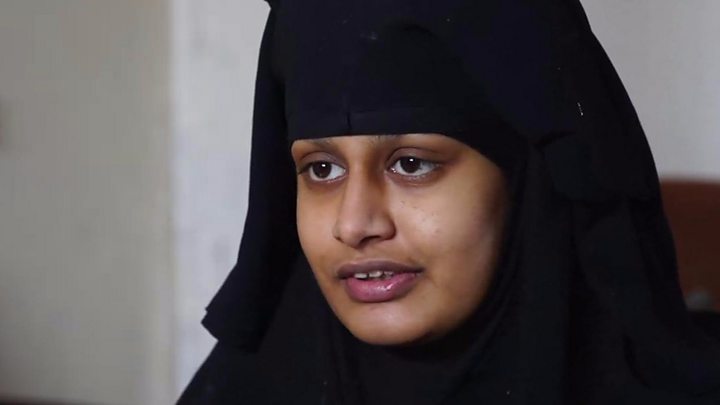
The UK is said to have withdrawn citizenship from more than 100 people - among them the IS recruit Shamima Begum, who left London as a teenager.
Media captionShamima Begum told the BBC she never sought to be an IS "poster girl"
On 6 October, the White House released a statement following its withdrawal from Syria saying it had urged "France, Germany, and other European nations, from which many captured ISIS fighters came, to take them back, but they did not want them and refused".
The White House said Turkey would now be responsible for all ISIS fighters captured in the area.
On Tuesday UN chief Antonio Guterres called for international co-operation to resolve issues around foreign jihadists, saying it was not up to Syria and Iraq "to solve the problem for everyone".

How will the repatriations work?

A French foreign ministry source told AFP news agency last week that suspected jihadists were often returned to France from Turkey under a 2014 agreement.
"Jihadists and their families are regularly sent back to France and arrested as they leave the plane. Most of the time it is done secretly. The news is not published, or released much later," the source said.
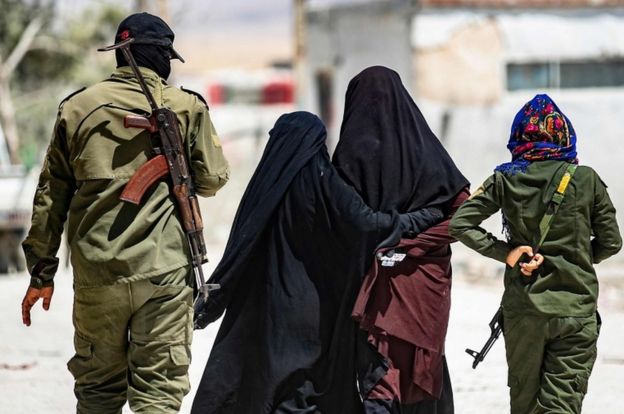
A security patrol escorts women, reportedly wives of Islamic State (IS) group fighters, in the al-Hol camp in north-eastern SyriaImage copyrightAFP/GETTY IMAGES
Image captionA security patrol escorts women, reportedly wives of Islamic State group fighters, at a camp in Syria
Germany's interior ministry said this week that "it did not wish to oppose the return of German citizens".
A German foreign ministry official confirmed that legal proceedings involving at least three men, five women and two children were under way in Turkey.
On Monday a court in the Netherlands ruled that the country should take back the children of Dutch women who joined IS - but not necessarily their mothers.
Some 23 Dutch women and their 56 children are currently being held in detention camps in Syria, AFP reports.
It is unclear whether Turkey will be able to repatriate IS suspects who have had their home citizenships revoked.

More on this story