Biodun Iginla, BBC News

Biodun Iginla, BBC News
Showing posts with label Antigua. Show all posts

Saturday, July 14, 2018

In storm-hit Barbuda, China fills void left by Western 'neglect'


by Renee Celeste and Biodun Iginla, France24, CODRINGTON (ANTIGUA AND BARBUDA)


    © AFP/File | A steel drum band celebrated a Chinese-funded program to replace roofs ripped from more than 300 Barbuda homes by Hurricane Irma last September

    CODRINGTON (ANTIGUA AND BARBUDA) - 
    Steel drums carry a jubilant rendition of "Guantanamera" over the ruins of Barbuda's capital Codrington, as dignitaries and residents mark the latest bit of progress in the island's grueling struggle to recover from Hurricane Irma.
    The event celebrated a Chinese-funded program to replace roofs ripped from more than 300 homes by the powerful storm that damaged or destroyed nearly every building on the tiny island when it roared through on September 6 last year.
    The project has enabled hundreds of families to return home from sister island Antigua as Barbuda continues the daunting process of rebuilding the 62 square mile (160 square kilometer) isle, where a scant five percent of homes escaped damage.
    But it has also burnished the image of China at a time when some in the region, including the tiny archipelago's prime minister, complain that US and European aid have fallen short.
    The $2 million repair project marks a "new model of assistance" from the Chinese government, said Ambassador Wang Xianmin.
    The challenge of rebuilding after Irma has been enormous: an estimated 60 percent of Barbudans were left homeless; the island's electrical system was devastated; potable water was scarce.
    While the Chinese contribution was a relative drop in the ocean compared to the estimated $220 million needed, locals say they at least followed through, while other promises of aid have proved frustratingly elusive.
    - Glad to be home -
    Edith Griffin had spent nine months living in a tent with her family by the time her Codrington home was finally repaired last week.
    "It's so comfortable to be back home," she told us at France24..
    William Beazer was similarly relieved to have the tarp covering his shattered house replaced with sturdy new galvanized steel.
    Bit by bit, life has edged closer to normal. As families start returning, the island's children inject a buzz into the air.
    A primary school still awaits repairs, medical services have yet to be fully restored, and debris still lines the streets -- a painful reminder of the low-lying island's continued vulnerability as peak hurricane season approaches.
    "The problem is, there's nowhere to put it," one man said of the omnipresent debris.
    But there have been tangible improvements even in the space of a few weeks, said Kerrie Hall, a spokeswoman for the United Nations Development Program (UNDP), which oversaw the roof restorations.
    - 'The mood has lifted' -
    "The clean-up crews have made a huge difference," Hall said. "What's wonderful, too, is that the mood has lifted here; everyone is so much happier."
    Exceeding the target of repairing 250 homes in five months was no easy task, said UNDP project manager Paola Solda.
    "It was extremely difficult to coordinate the movement of materials to Antigua and then on to Barbuda. Very rough seas meant we often had to postpone supplies, and electricity and water still pose challenges," she said.
    One young mother, Avelyn Thomas, now has a new roof over her home but still no windows. Given the pervasive mosquitoes, she and her two sons, aged seven and 10, are sleeping at her mother's house for now.
    Even so, after months in an Antigua shelter, Thomas said they are "loving" being back in familiar environs.
    Barbuda Council chairman Wayde Burton said residents are "very thankful" for the roofs, installed by 20 local contractors.
    But he also highlighted how much remains to be done, saying the hospital and police station are still not fixed, and emergency hurricane shelters are not ready -- which the island's government denies.
    Gaston Browne, prime minister of Antigua and Barbuda, acknowledged the "extremely daunting" task of rebuilding.
    - China was 'among the first' -
    When the government pleaded for help in Irma's immediate aftermath, Browne said "China was among the first to respond."
    For years, China has been expanding its presence in the Caribbean, providing loans, donations or investment to build roads, port facilities, government buildings and even stadiums.
    Analysts say when US private investment in the area waned after the financial crisis of 2008, Chinese investment surged.
    Last month, Antigua and Barbuda became the first country in the eastern Caribbean to sign a memorandum of agreement to work with China's ambitious "Belt and Road Initiative," establishing closer trade and diplomatic ties.
    Beijing is "filling the void" left by the US, Browne said.
    "They treat us with benign neglect," the prime minister said of American officials. "I guarantee the US did not give us $100,000 after Irma."
    A fact sheet provided by USAID said the United States had provided $800,000 for "interventions in Antigua and Barbuda and Dominica" as part of $21.6 million spent on regional hurricane recovery. It did not provide a breakdown for Barbuda.
    Other pledges of help, said Browne, included five million euros ($5.8 million) from Europe and three million pounds ($4 million) from Britain.
    "We have not been able to avail ourselves of those funds, and it's not for lack of trying," he said.
    "Venezuela, despite its problems, gave us $3 million, and Cuba, one of the poorest countries, gave us rice and sugar and sent a vessel here."
    But 10 months after Hurricane Irma laid the island to waste, Barbuda's weary residents seem unconcerned about who precisely paid to fix their roofs.
    They are just happy to be home.

    Thursday, September 7, 2017

    Hurricane Irma causes devastation in the Caribbean


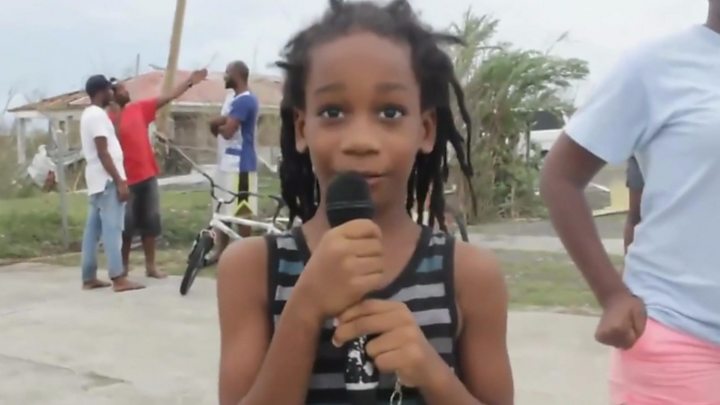
    Media caption"It was like a horror movie" - Residents of Barbuda describe the destruction wrought by Hurricane Irma
    by Renee Celeste and Biodun Iginla, BBC News, St Johns, Virgin Islands
    Hurricane Irma has caused widespread destruction across the Caribbean, reducing buildings to rubble and leaving at least nine people dead.
    The small island of Barbuda is said to be "barely habitable". Officials warn that St Martin is almost destroyed, and the death toll is likely to rise.
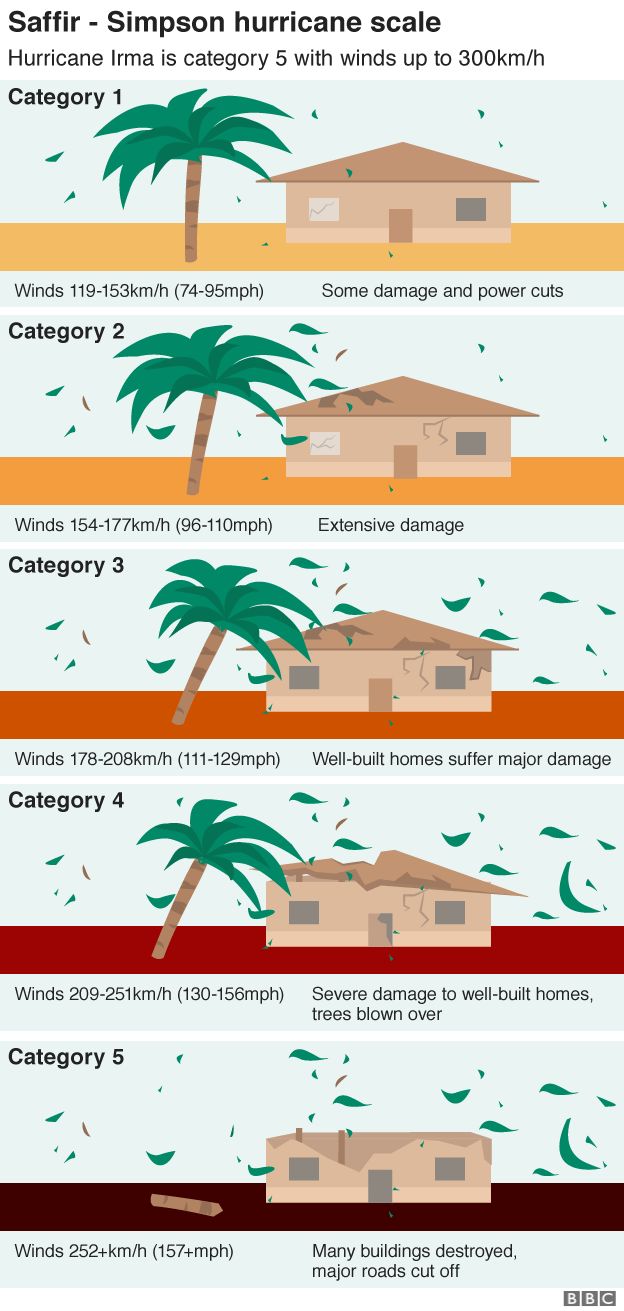
    Irma is a category five hurricane, the highest possible level.
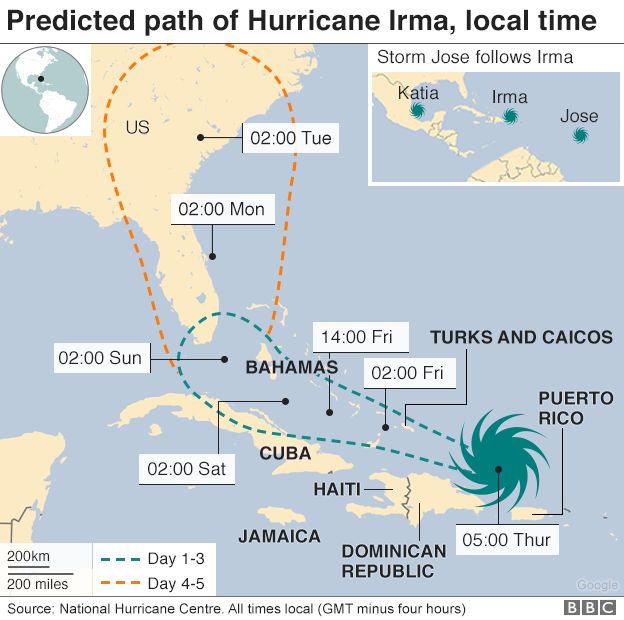
    It is currently north of the Dominican Republic, heading towards Turks and Caicos.
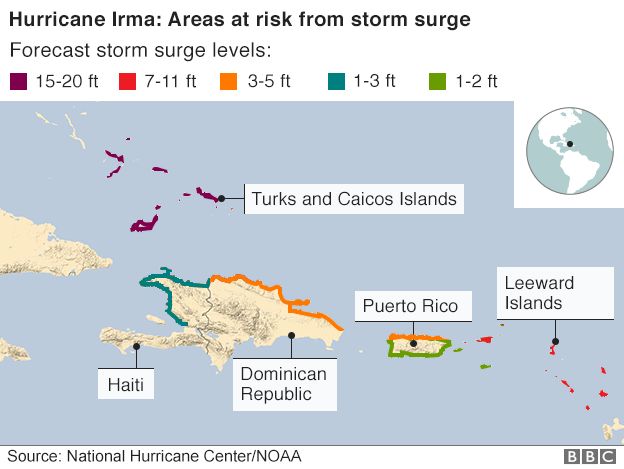
    The low-lying Turks and Caicos islands, a British overseas territory, are said to be at risk of a storm surge, with the possibility of destructive waves up to 6m (20ft) higher than usual.
    Virginia Clerveaux, director of the Turks and Caicos Department of Disaster Management and Emergencies, told the BBC that even inland areas could be inundated.
    "We are now trying to remind them [the people of the islands] that this is a category 5, and in the history of the Turks and Caicos islands this is the largest storm we have ever been impacted or threatened by.
    "So there is a need to ensure that we have maximum preparations in place... We have been saying to persons to ensure that they are prepared, ensure they can shelter safely, they have sufficient food and drinking water for two to three days."
    Meanwhile, the head of the US emergency agency has said that Hurricane Irma will have a "truly devastating" impact when it hits southern coastal areas of the United States.
    Media captionThe island of Barbuda is "barely habitable", says PM Gaston Browne
    "The majority of people along the coast have never experienced a major hurricane like this," Federal Emergency Management Agency (Fema) chief Brock Long told CNN.
    The most powerful Atlantic storm in a decade, Irma has sustained wind speeds of 285km/h (180mph).

    What are the worst-hit areas?

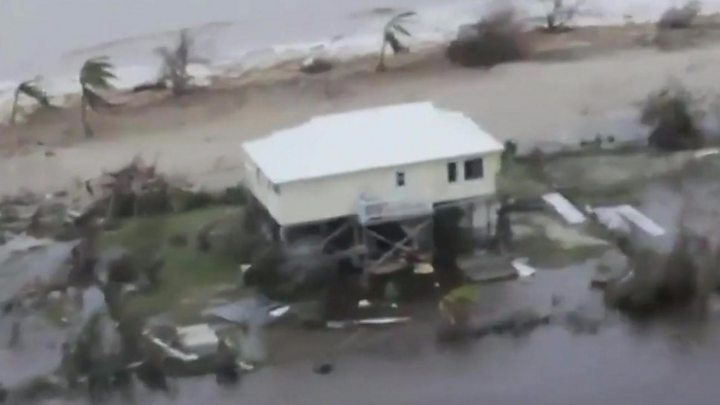
    Hurricane Irma first struck the dual-island nation of Antigua and Barbuda. At least one death, of a child, was reported on Barbuda, where Prime Minister Gaston Browne said about 95% of the buildings had suffered some damage.
    "It's absolute devastation," he said after flying over the island, home to some 1,600 people. "The island is literally under water. In fact, I'm of the view that, as it stands now, Barbuda is barely habitable."
    He told the BBC that 50% of the Barbuda population were now homeless and that it would cost $100m (£80m) to rebuild the island.
    However, Antigua, with a population of 80,000, escaped major damage, with no loss of life, he said earlier.
    map
    St Martin, an island that comprises the French territory of Saint-Martin and the Dutch section Sint-Maarten, suffered terrible damage.
    French officials have confirmed at least four deaths in Saint-Martin, down from an earlier reported death toll of eight.
    "It's an enormous catastrophe - 95% of the island is destroyed," top local official Daniel Gibbs said of Saint-Martin.
    Sint-Maarten's airport, the third largest in the Caribbean, has been seriously damaged.
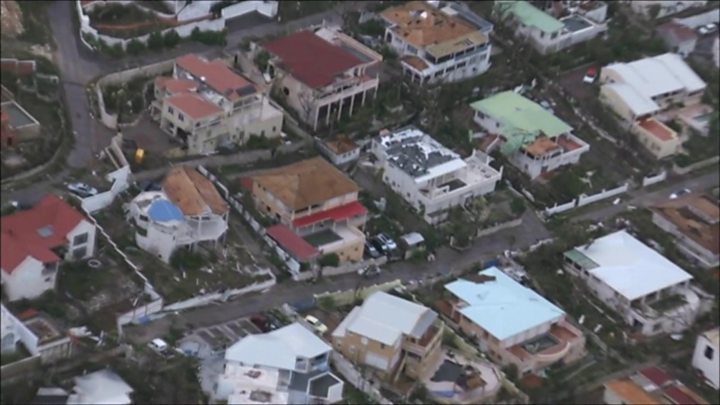
    Media captionAerial footage from the Dutch ministry of defence revealed the extent of the devastation in Sint-Maarten
    The Dutch defence ministry said: "The picture is of many uprooted trees, houses without roofs and pleasure boats on land."
    The Dutch navy has sent two ships from nearby Aruba and Curacao to assist locals but they have had trouble docking, according to media in the Netherlands.
    Dutch Prime Minister Mark Rutte said: "The island is not reachable at this point because of the huge damage to the airport and the harbour."
    French Interior Minister Gerard Collomb said efforts were under way to get supplies to Saint-Martin and Saint Barthélemy.
    "There is massive destruction. We'll concentrate our first efforts so that in the next hours people can get access to food and drinking water," he told reporters.
    At least three people had died in Puerto Rico, the governor's office said.
    The US territory's capital, San Juan, saw waves of up to 30ft. More than 6,000 residents are in shelters, and many more are without power.

    Where else has been hit?

    British overseas territories Anguilla and the British Virgin Islands were also caught in the extreme weather.
    At least one death has been reported on Anguilla, a local official confirmed.
    Media captionHurricane Irma heads for Turks and Caicos
    One Anguilla resident told the BBC the island looked as if it had been struck by a nuclear bomb, with roofs torn off many of the main buildings, including the hospital.
    Some residents complained that the UK response was inadequate.
    British Defence Secretary Michael Fallon said the UK had already positioned a landing ship, RFA Mounts Bay, in the disaster zone and its personnel were helping local authorities restore water and sanitation, supply shelter to those made homeless, and offer medical assistance if required.
    Sir Michael said he had now ordered the deployment of a task group to the region and a second vessel, the helicopter carrier HMS Ocean, was being sent.
    "Government is working together to support those affected by some of the strongest storms ever seen," he said in a statement. "We know people need help, we have prepared for this and we are putting those plans into action."
    BBC graphic

    En route to the US

    US President Donald Trump said he and his aides were monitoring Irma's progress. "But it looks like it could be something that will be not good," he told reporters at the White House. "Believe me, not good."
    Projections suggest it could hit the state of Florida on Sunday.
    Officials started evacuations of tourists and residents of Florida Keys, a resort archipelago.
    Flights to and from several airports in Florida were being suspended, while Orlando's international airport said that commercial flights would stop from 17:00 local time on Saturday.
    A state of emergency had been declared for Florida, Puerto Rico and the US Virgin Islands, mobilising federal disaster relief efforts.

    Islands still at risk from Irma

    Dominican Republic
    • Population: 10.2 million
    • Key facts: major tourist destination, shares island of Hispaniola with Haiti
    • Hurricane prediction: Irma expected to pass close by
    Haiti
    • Population: 10.2 million
    • Key facts: on the same island as the Dominican Republic; devastated by an earthquake in 2010
    • Hurricane prediction: not directly in the hurricane's path, but remains on alert
    Turks and Caicos
    • Population: 31,500
    • Key facts: enjoys one of the more dynamic economies in the region thanks to upmarket tourism, offshore finance and fishing
    • Hurricane prediction: the low-lying region is at risk of a storm surge with destructive waves up to 6m (20ft) higher than usual possible
    Cuba
    • Population: 11 million
    • Key facts: one of the world's last planned economies; a producer of sugar, tobacco and coffee, with a big tourism industry
    • Hurricane prediction: Tropical storm conditions expected to begin on Thursday night (local time)
    Bahamas
    • Population: 350,000
    • Key facts: an archipelago of more than 700 islands and islets, which attracts millions of tourists per year
    • Hurricane prediction: warnings for north-west, south-east and centre; some areas have risk of storm surge of up to 6m (20ft)

    Are there more hurricanes to come?

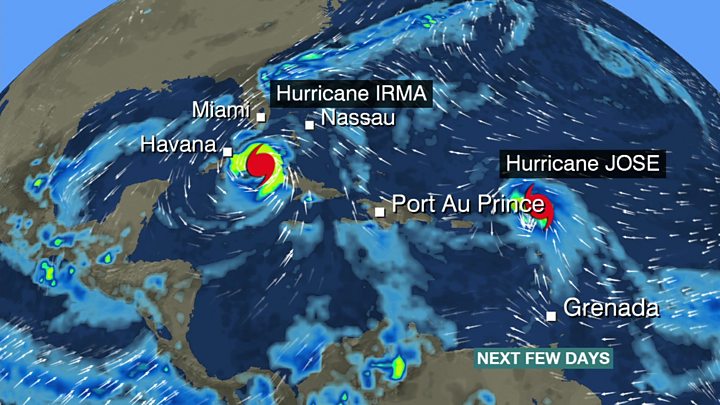
    Another storm, Jose, further out in the Atlantic behind Irma, swelled to category one hurricane strength and could be near major hurricane strength on Friday, according to the US National Hurricane Center.
    Forecasters say Jose is expected to pass close to the Leeward islands, a collective name for islands from Dominica to Puerto Rico. Its exact path is as yet unclear but winds are not expected to be as strong. However, it may hit areas already devastated by Irma.
    Storm Katia, in the Gulf of Mexico, was also upgraded to hurricane status, and a warning was in effect for the coast of the Mexican state of Veracruz.
    Seeing multiple storms developing in the same area of the Atlantic in close succession is not uncommon at this time of year. Rarer though is the strength of the hurricanes.
    Hurricane Harvey made landfall in the US as a category four less than two weeks ago. Irma is expected to be at least category four when it arrives in the US.
    There have never been two category four storms making landfall on the US mainland within the same season, since records began.
    Graphic showing the hurricane scale. Irma is in the top category, five

    Are you in the region? Are you a holidaymaker unable to get a flight home or a resident who has been preparing for Hurricane Irma? If it is safe for you to do so, share your experiences by emailing haveyoursay@bbc.co.uk.
    Please include a contact number if you are willing to speak to a BBC journalist. You can also contact us in the following ways:

    More on this story