Biodun Iginla, BBC News

Biodun Iginla, BBC News
Showing posts with label Beira. Show all posts

Sunday, March 24, 2019

BREAKING: 'Lots of dead', 'water full of snakes': cyclone survivors recount


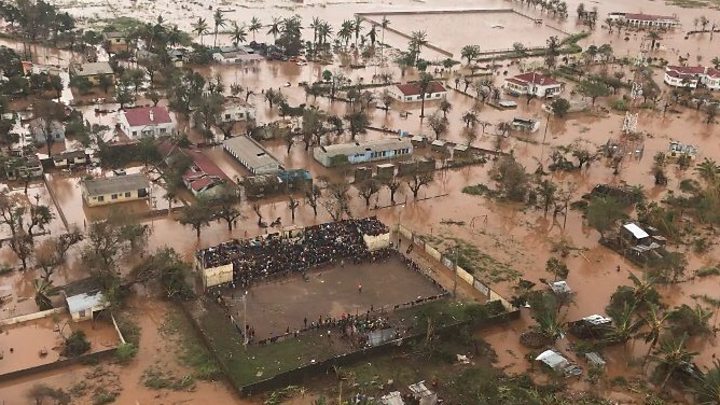
Survivors seek safety on the roof of a house submerged by floods in Mozambique's Buzi town
Survivors seek safety on the roof of a house submerged by floods in Mozambique's Buzi town Survivors seek safety on the roof of a house submerged by floods in Mozambique's Buzi town AFP/File
ADVERTISING
Búzi (Mozambique) 
"It was very scary, we were running in all direction, the water was full of snakes," recalls 39-year-old Otelea Jose after arriving from one of the areas worst hit by southern Africa's deadly cyclone.
Jose had been in Buzi, home to nearly 120,000 people, and moved to higher ground fleeing the raging flood waters unleashed by powerful cyclone Idai 10 days ago.
ADVERTISING
But soon it was not high enough.
She survived by scaling onto the roof of a local administrator's office, but 446 other of her compatriots were not so lucky.
Authorities fear the toll will be more than 1,000 in one of the worst storms to hit southern Africa.
Jose lives in Beira, which was also smashed by Idai, but had gone to Buzi to visit her mother.
Now she has to check if her husband, left behind in Beira, is safe.
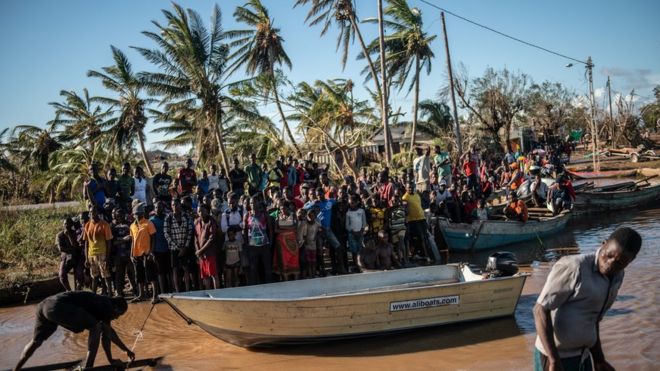
She spoke at Beira port just after disembarking from a boat from Buzi where many people had by the weekend started picking up pieces of their lives as the waters receded and the sun came out.
Survivors are not only dealing with immediate needs of food, shelter and healthcare.
Joaquin Joao Chidja, 16, managed to salvage prized possessions: family photos. He dries them on the roof of a commercial building where he climbed when flood waters rapidly rose.
- 'Water covered everything' -
Joao Zakaria, 42, is still haunted by the viciousness of the cyclone which also left a trail of destruction in neighbouring Zimbabwe where more than 250 people were killed, and bridges and roads ripped apart.
There are "lots of dead (people), we can't even count", he says.
Zakaria vividly remembers the velocity of the water as it swept past his neighbourhood and mourns on behalf of his neighbour.
"There was a man, he had 40 cows and he lost all of them. Forty! Imagine. Everybody lost everything,"he says.
The father of four, who survived by climbing up a tree, remembers the floods back in the year 2000 that claimed 800 lives, saying that was nothing compared to Idai.
"I have never seen anything like that, even the elders have never experienced something like that, it?s new.
" In 2000 there was flooding but (the water) was up to the shoulder-level only.
"But this time ...the water covered everything," he says.
But as a rainbow appears in the sky, more people start to venture outside into the wet and muddy streets of Buzi -- 30 kilometres southwest of Beira -- to try pick up pieces of their lives.
Some mop thick layers of mud off the floors of their homes while others dry wet laundry on sagging electricity power lines that were blown down by the force of the cyclone which produced wind gusts of close to 200 kilometres per hour (120 mph).
Around 2,000 people have been rescued from Buzi, a town which aid agencies feared had been wipped out by the floods.
strs-sn/bp

Friday, March 22, 2019

BREAKING: Cyclone Idai: Cholera cases reported in storm-hit Mozambique


People stranded by Cyclone Idai wait for rescue by the Indian Navy on March 22Image copyrightGETTY IMAGES
Image captionThousands of people are still awaiting rescue from flooded areas across in southern Africa

by Susan Peterson and Biodun Iginla, BBC News, Beira, Mozambique
A week after the flooded Mozambican port of Beira was hit by Cyclone Idai, cases of cholera have been recorded, a humanitarian aid group said on Friday.
The International Federation of Red Cross and Red Crescent Societies (IFRC) warned of the risk of other outbreaks, already noting an increase in malaria.
The storm has so far killed 557 people across Mozambique, Zimbabwe and Malawi, but the death toll is expected to rise.
Idai made landfall near Beira with 177km/h (106 mph) winds on 14 March.
Aid workers are slowly delivering relief but conditions are said to be extremely difficult, with some areas completely inaccessible and a scarcity of helicopters.
Some 1.7 million people are said to be affected across southern Africa, with no electricity or running water in areas where homes have been swept away and roads destroyed by the floods.
"There is growing concern among aid groups on the ground of potential disease outbreaks," the IFRC statement said. "Already, some cholera cases have been reported in Beira along with an increasing number of malaria infections among people trapped by the flooding."
Cholera, which is endemic in Mozambique, is spread by water contaminated by sewage, and can kill within hours if left untreated.
"There's stagnant water, it's not draining, decomposing bodies, lack of good hygiene and sanitation," Henrietta Fore, the head of Unicef who is in Mozambique, told AFP news agency.


Media caption'It has become an inland sea'

"We are running out of time, it is at a critical point here," she said, warning that hygiene and safe drinking water were absolute priorities.
"The scale of this crisis is staggering," Elhadj As Sy, the head of the IFRC, said after seeing Beira, which was home to 500,000 people.
"We can't forget that it is an intimate and human crisis. Tens of thousands of families have lost everything. Children have lost parents. Communities have lost schools and clinics."
A spokesperson for the World Food Programme (WFP) said the aid effort was "slow to start, [but]... is now accelerating, thankfully."
"We are not yet where it needs to be," he told AFP.
The United Nations has released $20m (£15m) from its emergency fund, and on Friday its chief made a personal appeal for more international support.
Aid groups said Mozambique has borne the brunt of flooding from rivers that flow downstream from neighbouring countries. At least 65,000 people are sheltering in 100 temporary sites, many of which are in "desperate conditions", according to the UN.
Many people are said to have not yet received emergency rations, with some still clinging to rooftops and trees.

More on this story