Biodun Iginla, BBC News

Biodun Iginla, BBC News
Showing posts with label Chelsea Manning. Show all posts

Friday, May 24, 2019

ANALYSIS: Does Assange indictment set dangerous precedent for journalists?


For many, "freedom of speech is unconditional," as the placard says, and that includes for WikiLeaks founder Julian Assange
For many, "freedom of speech is unconditional," as the placard says, and that includes for WikiLeaks founder Julian Assange AFP/File
ADVERTISING
New York 
Does the indictment of WikiLeaks founder Julian Assange under the US Espionage Act for publishing classified military and diplomatic documents threaten the constitutional right to freedom of the press?
Many legal experts fear it does, and say journalists could find themselves facing similar charges if they try to protect their sources.
"What he is accused of doing is exactly what professional journalists do every day -- seeking, receiving and publishing important information about our government," said Sonja West, a law professor at the University of Georgia.
"When it comes to the Espionage Act, this is a line that press advocates have been closely watching, and the Trump administration just crossed it."
Sixteen of the 17 new charges against the 47-year-old Australian unveiled Thursday by the US Justice Department are related to obtaining and disseminating classified information.
The military documents and diplomatic cables were obtained by former Army intelligence analyst Chelsea Manning, who was sentenced in 2013 under the Espionage Act to 35 years in prison over the leaks.
In a bid to head off a stampede of criticism from press freedom groups, Assistant Attorney General John Demers said: "Julian Assange is no journalist."
Ben Rhodes, a former senior official in the administration of Barack Obama, agrees.
"This is not journalism," Rhodes said on his "Pod Save the World" podcast.
"Julian Assange has essentially been operating at least in recent years as an extension of Russian intelligence. His motivation behind what he's doing is not transparency," he said. "It's on behalf of a very specific agenda."
But others note that the events date back to 2010, long before the 2016 presidential election campaign, when WikiLeaks published documents about the Democratic Party obtained by Russian intelligence.
"For the first time in the history of our country, the government has brought criminal charges against a publisher for the publication of truthful information," said Ben Wizner of the American Civil Liberties Union.
"This is an extraordinary escalation of the Trump administration's attacks on journalism, and a direct assault on the First Amendment."
- Bound for the Supreme Court? -
For Floyd Abrams, a prominent constitutional law specialist, "the question, I think, should not be whether Assange is a journalist but whether the First Amendment protects his conduct."
Indeed, the amendment is seen as the bedrock worldwide for the defense of media rights.
"If Julian Assange is convicted... the concern is that there will be no meaningful principle to distinguish the rejection of the First Amendment argument for him from the application of the First Amendment defense to the mainstream media," explains Mary-Rose Papandrea, a professor at the University of North Carolina School of Law.
"There actually isn't a very good way of defining who counts as a journalist these days," she said.
"There never has been, but particularly with the internet, anybody can be a journalist, anybody can be a third party that receives information from a source."
The indictment also raises questions about the precise scope of the Espionage Act, which was passed in 1917 -- shortly after the United States entered World War I -- to prevent leaks of confidential information during wartime.
"What makes the indictment against Assange so concerning is that it exposes just how vulnerable journalists are under the Espionage Act," West said, saying the law is written "very broadly."
The Obama administration targeted leaks from within the government like no White House before it, but did not indict any journalists under the law, and also elected not to file such charges against Assange.
Before Obama took office, a handful of people, including at least one journalist, were charged with violating the Espionage Act for obtaining and publishing classified information, but each time, the cases were dropped.
An editor has never been charged. Some say Assange would fall under that title at WikiLeaks.
Papandrea says she believes the Assange case will end up in the US Supreme Court, which has yet to consider the constitutionality of the law.
"If the US can prosecute a foreign publisher for violating our secrecy laws, there's nothing preventing China, or Russia, from doing the same," the ACLU's Wizner warned.

Monday, May 13, 2019

ANALYSIS: Julian Assange: from political asylum to prison


WikiLeaks founder Julian Assange is fighting extradition to the United States, while Swedish authorities are reopening an investigation into a rape allegation
WikiLeaks founder Julian Assange is fighting extradition to the United States, while Swedish authorities are reopening an investigation into a rape allegation AFP/File
ADVERTISING
Paris 
WikiLeaks founder Julian Assange is fighting extradition to the United States to face charges over the 2010 publication of thousands of classified documents.
Swedish prosecutors decided Monday to reopen his investigation for alleged rape in 2010, which he denies and says is a pretext for his US transfer,
ADVERTISING
Here is a timeline of events since Assange first hit the headlines in 2010 :
- 2010: arrest warrant -
- July to October: The WikiLeaks whistleblowing website releases 470,000 classified military documents concerning US diplomacy and the wars in Afghanistan and Iraq. It later releases a further tranche of more than 250,000 classified US diplomatic cables.
- November: A Swedish prosecutor issues a European arrest warrant for Assange over sexual assault allegations involving two Swedish women. Assange denies the claims, saying the women consented.
- December: He turns himself in to police in London and is arrested pending a ruling on the Swedish request for his extradition. A week later he is released on bail and calls the allegations a smear campaign.
- 2011: extradition ruling -
- February: A British judge rules that Assange can be extradited to Sweden. He launches an appeal.
- 2012: refuge at embassy -
- June: He takes refuge in Ecuador's embassy in London to avoid extradition and applies for political asylum.
British police say he is subject to arrest for breaching the conditions of his 2010 bail, which included staying at his bail address overnight.
- August: Ecuador grants Assange asylum and he begins his almost seven-year stay and in the Ecuadorian embassy in London
- 2016: UN appeal -
- January: Ecuador rejects a request by Swedish prosecutors to question Assange over the sexual assault allegations.
- February: The UN Working Group on Arbitrary Detention says Assange has been "arbitrarily detained".
- 2017: sex case closed -
- January: WikiLeaks says Assange could travel to the United States to face investigation if his rights are guaranteed. This comes after one of the site's main sources of leaked documents, military intelligence analyst Chelsea Manning, is granted clemency.
- May: Swedish prosecutors drop the seven-year sex assault investigation, frustrated by the failure to have him extradited. The lawyer for one accuser calls the decision "a scandal".
- December: Ecuador grants Assange nationality but is blocked by Britain from according him diplomatic status.
- 2018: embassy tensions -
- January: Ecuador says it is seeking a mediator to resolve the "untenable" situation.
- February: Assange loses a bid to have his British arrest warrant cancelled on health grounds.
- March: Ecuador cuts off his communications -- including use of the internet or a mobile phone -- alleging he broke an agreement on interfering in other countries' affairs. It warns further breaches will lead to "termination of asylum".
- October: Assange sues the Ecuador government for violating his "fundamental rights" but the case is thrown out. His communications are partially restored.
- November: US prosecutors inadvertently disclose the existence of a sealed indictment against Assange.
- 2019: arrest -
- April 2: Ecuador's President Lenin Moreno says Assange has "repeatedly violated" the conditions of his asylum.
- April 10: Ecuador cancels his citizenship.
- April 11: British police arrest Assange at the embassy, saying Ecuador had informed them that his asylum had been withdrawn. He is held for breaching his 2010 bail conditions and also on a US extradition request.
- May 1: Assange is sentenced to 50 weeks in jail for breaching bail.
- May 2: The legal process for his extradition to the US starts in a London court, Assange vowing to resist.
- May 13: Swedish prosecutors say they are reopening the 2010 rape investigation.
YOU MAY ALSO LIKE

Friday, April 12, 2019

ANALYSIS: Wikileaks: Document dumps that shook the world


WikileaksImage copyrightEPA/GETTY IMAGES
by Tamara Kachelmeier and Biodun Iginla, BBC News Technology Analysts, London
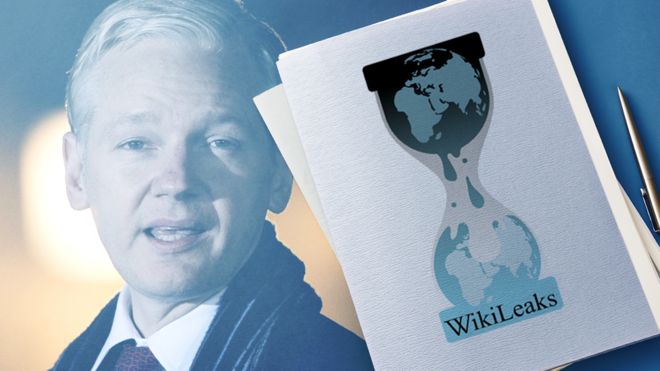
Wikileaks founder Julian Assange was arrested on Thursday at Ecuador's London embassy, where he had been granted asylum since 2012.
The United States alleges that he conspired with Chelsea Manning to access classified information on Department of Defense computers. He could be jailed for up to five years.
Since it launched in 2006, Wikileaks has become renowned for publishing thousands of classified documents covering everything from the film industry to national security and wars.
Presentational grey line

The helicopter attack

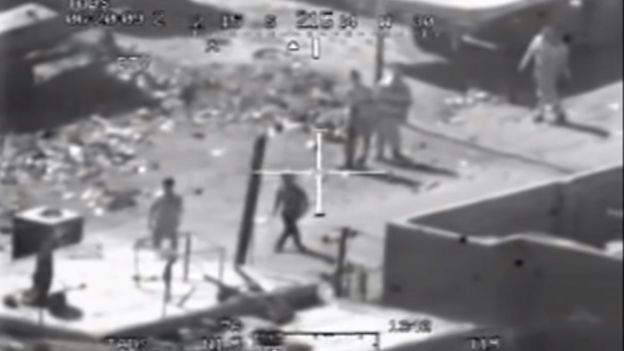
Helicopter video from WikileaksImage copyrightWIKILEAKS
Image captionHelicopter footage was posted on Wikileaks
In 2010, Wikileaks published a video from a US military helicopter showing the killing of civilians in Baghdad, Iraq.
A voice on the transmission urged the pilots to "light 'em all up" and the individuals on the street were fired at from the helicopter.
When a van arrived on the scene to pick up the wounded, it too was fired at.
Reuters photographer Namir Noor-Eldeen and his assistant Saeed Chmagh were both killed in the attack.
Presentational grey line

US Army Intelligence

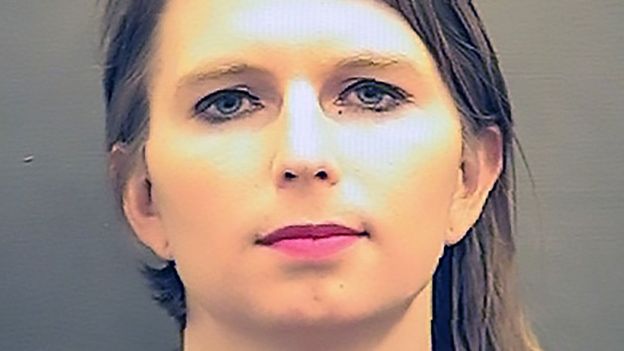
Wikileaks has published hundreds of thousands of documents leaked by former US Army intelligence analyst Chelsea Manning.
Documents relating to the war in Afghanistan revealed how the US military had killed hundreds of civilians in unreported incidents.
ADVERTISEMENT
Chelsea Manning was jailed for the leaksImage copyrightAFP
Further documents from the Iraq war revealed that 66,000 civilians had been killed - more than previously reported. The documents also showed that prisoners had been tortured by Iraqi forces.
Among the leaks were more than 250,000 messages sent by US diplomats. They revealed that the US wanted to collect "biographic and biometric" information - including iris scans, DNA samples and fingerprints - of key officials at the UN.
Presentational grey line

9/11 pager messages

About 573,000 intercepted pager messages sent during the 9/11 terror attacks in the United States were published by Wikileaks.
The messages include families checking up on their loved ones and government departments reacting to the attacks.
"President has been rerouted won't be returning to Washington but not sure where he will go," one message said.
Presentational grey line

Democrat emails

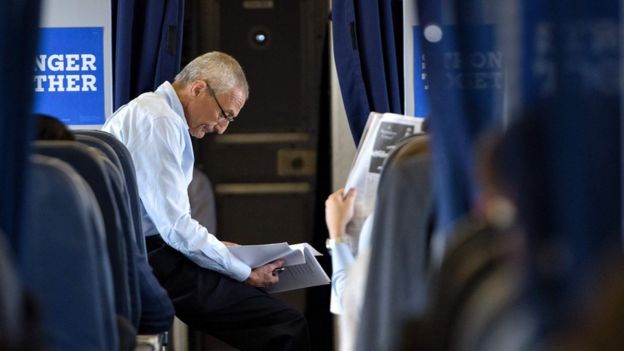
Wikileaks published thousands of hacked emails from the account of Hillary Clinton's campaign boss John Podesta, in the run-up to the US presidential election in 2016.
In the emails, Mr Podesta called Mrs Clinton's election rival Bernie Sanders a "doofus" for criticising the Paris climate change agreement.
John PodestaImage copyrightAFP
The emails also suggested that a CNN contributor tipped off the Clinton campaign about a question that was going to be asked during a debate hosted by the broadcaster.
The timing of the leaks led to accusations that Wikileaks was deliberately trying to discredit Mrs Clinton.
The site also published leaked information from Republican Sarah Palin's Yahoo email accounts in 2008.
Presentational grey line

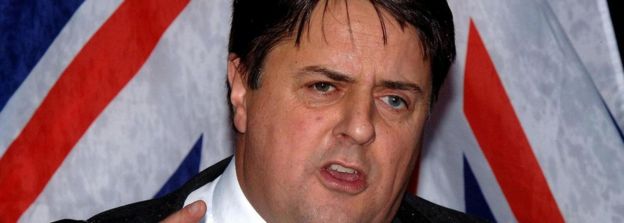
British National Party members

In 2008, Wikileaks published the names, addresses and contact information of more than 13,000 members of the British National Party.
The political party's manifesto proposed banning immigration from Muslim countries and encouraging some UK residents to return to "their lands of ethnic origin".
Nick GriffinImage copyrightPA
Image captionNick Griffin, pictured in 2006
A former member was later fined £200 for the leak.
Presentational grey line

The Sony Pictures hack

A leak of more than 170,000 emails and 20,000 documents from movie studio Sony Pictures was published on Wikileaks in 2015.
The entertainment company suffered a cyber-attack weeks before releasing The Interview, a film that poked fun at North Korea.
The emails revealed that actresses Jennifer Lawrence and Amy Adams received a lower fee than their male co-stars in American Hustle.
There were also messages from producers and executives insulting celebrities such as Angelina Jolie.
Leonardo DiCaprio was called "despicable" for turning down a role in a Sony Pictures film.
Mr Assange said the emails were in the public interest because they showed the inner working of a multinational company and were "at the centre of a geo-political conflict".

More on this story