
 AFP
European Council President Donald Tusk has called on the UK to come up with a "serious response" on what will happen to EU citizens in Britain after Brexit.
"We need guarantees," he said in Brussels as 27 EU leaders backed the bloc's Brexit negotiating guidelines.
The rights of EU citizens to live, work and study in the UK is one of three topics they want dealt with in the first phase of Brexit talks.
Negotiations will start after the UK election on 8 June.
Mr Tusk put citizens' rights centre stage at a news conference after EU leaders - minus UK PM Theresa May - nodded through the guidelines in a matter of minutes.
"Over the past weeks, we have repeatedly heard from our British friends, also during my visit in London, that they are ready to agree on this issue quickly," he said.
"But I would like to state very clearly that we need real guarantees for our people to live, work and study in the UK.
"The same goes for the Brits," living on the European continent, he continued.
UK citizens living in EU countries and non-UK EU citizens living in Britain are estimated at 4.5 million.
 EPA
The EU's negotiating guidelines, first proposed by Mr Tusk in March, list citizens' residency rights, settling Britain's financial commitments to the EU and avoiding a "hard" border between the Irish Republic and Northern Ireland as the three top issues needing agreement in what are termed "separation talks".
Only once "sufficient progress" is made on these topics can talks touch on the UK's future relationship, including any trade deal, with the EU.
The UK government, however, has pushed for parallel negotiations on trade.
Applause
Speaking after the summit, European Commission President Jean-Claude Juncker again stressed that separation talks could not run in parallel with talks on a future trade deal with the UK, backing the line taken by German Chancellor Angela Merkel as she arrived in Brussels.
EU officials said leaders burst into applause as the negotiating stance was waved through at the summit.
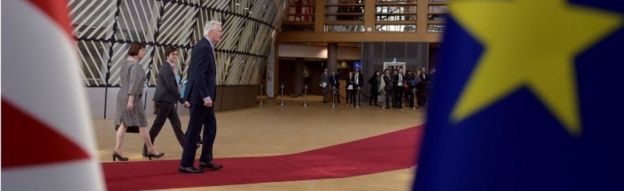
EU leaders and officials were keen to stress the EU's unified position on Brexit. Chief negotiator, Michel Barnier, said: "We are ready... we are together."
Common purpose: Chris Morris in Brussels
 REUTERS
The fact that the guidelines approved today haven't changed all that much in the past month shows that the EU's claim to have a unified position on Brexit is more than skin deep.
The other 27 countries do see a common purpose in sticking together; and if anything the main changes in language - on a single financial settlement and on the rights of EU citizens in the UK - toughen up the conditions that the UK will have to meet.
Of course there are differences of emphasis in different national capitals - Poland is understandably more concerned than most about the rights of its citizens in the UK because there are so many of them; the Dutch are eager to start talks on future trade relations with the UK sooner rather than later, but they also want to ensure that the UK pays its divorce bill in full.
For now the emphasis on unity is real, and the determination for the EU to negotiate as one should not be underestimated in London.
Speaking earlier, French President François Hollande said there would inevitably be "a price and a cost for the UK - it's the choice that was made".
"We must not be punitive, but at the same time it's clear that Europe knows how to defend its interests, and that Britain will have a weaker position in the future outside Europe, than it has today within Europe."
On the issue of the UK's financial obligations, EU officials estimate that Britain faces a bill of €60bn (£51bn; $65bn) because of EU budget rules. UK politicians have said the government will not pay a sum of that size.
Britain certainly won't tamely accept that it has to pay a huge divorce bill - but it's likely to find the Europeans united on the concept if not the precise amount, the BBC's Kevin Connolly in Brussels says.
UK Brexit Secretary David Davis said in response that both sides wanted the negotiations to be conducted with goodwill.
But he added: "There is no doubt that these negotiations are the most complex the UK has faced in our lifetimes. They will be tough and, at times even confrontational".
Brexit timetable:
- 29 April - EU leaders (excluding the UK) meet in Brussels to adopt Brexit negotiating guidelines
- 7 May - French voters decide between Emmanuel Macron and Marine Le Pen as their next president
- 8 June - UK parliamentary election - Brexit talks to start soon after the vote
- 24 September - German parliamentary election, with Mrs Merkel seeking a fourth term
- 29 March 2019 - Deadline for ending talks on UK exit terms (any extension requires agreement of all member states)
- May or June 2019 - European Parliament election (without UK)
- Ratification - Any Brexit deal requires ratification by all EU's national parliaments and European Parliament
 AP


