Biodun Iginla, BBC News

Biodun Iginla, BBC News
Showing posts with label European Economic Community. Show all posts

Saturday, May 18, 2019

ANALYSIS: The European Union: 60 years of twists and turns


And so it begins
And so it begins INTERCONTINENTALE/AFP
ADVERTISING
Paris 
From economic union via the euro to a migration crisis and Brexit, here is a look at 60 years of ups and downs in the European Union.
- Birth of a European bloc -
ADVERTISING
On May 9, 1950 French foreign minister Robert Schuman unveils proposals for an economic union between France and West Germany.
A year later six countries -- Belgium, France, West Germany, Italy, Luxembourg and The Netherlands -- establish the European Coal and Steel Community (ECSC).
- Towards the EU -
On March 25, 1957 the same six sign the Treaty of Rome that establishes the European Economic Community, a common market.
It takes effect a year later, establishing key European institutions: the Council of Ministers, the executive European Commission and the Parliamentary Assembly, which later becomes the European Parliament.
The first parliamentary elections by direct universal suffrage take place in 1979.
Britain, Denmark and Ireland join the EEC on January 1, 1973. They are followed by Greece in 1981, Portugal and Spain in 1986, and Austria, Finland and Sweden in 1995.
On February 7, 1992 the Maastricht Treaty is signed, laying the foundation for a single European currency.
In January 1993 a single market allowing the free movement of goods, services, people and capital becomes reality.
The EEC becomes the European Union on November 1, 1993.
It is only in March 1995, however, that travellers in some EU member states will be able to travel without showing their passports under the Schengen accord that drops some internal border controls.
- Euro and enlargement -
Euro banknotes and coins go into circulation in 12 countries on January 1, 2002, replacing national currencies such as the deutschmark, franc, lira and peseta.
Britain, Denmark and Sweden, however, decide to keep their national currencies.
In the aftermath of the fall of the Berlin Wall in 1989, the EU on May 1, 2004 swells to 25 members, taking in Cyprus, the Czech Republic, Estonia, Hungary, Latvia, Lithuania, Malta, Poland, Slovakia and Slovenia.
Bulgaria and Romania join in 2007, and Croatia becomes the 28th member in 2013.
- Crises -
Storm clouds gather in 2005 as French voters reject a draft European constitution, as proposed in the Treaty of Lisbon. Three days later, Dutch voters do the same.
Shocked European leaders manage to get the treaty ratified in 2009 with provisions designed to improve the functioning of the enlarged EU institutions.
In November 2009 Athens reveals a sharp rise in its public deficit, unleashing a financial crisis across the eurozone.
First Greece, then Ireland, Portugal, Spain and Cyprus seek aid from the EU and the International Monetary Fund, which demand strict fiscal discipline in return.
Several heads of government fall as austerity measures provoke a popular backlash.
Just as it begins to emerge from the financial crisis, Europe is hit by its most serious migration crisis since the end of World War II with the arrival of hundreds of thousands of asylum seekers peaking in 2015.
EU leaders fail to work out a joint action plan.
- Divorce with Britain -
In the biggest blow to the union, Britain on June 23, 2016 votes 52 percent in favour of quitting the EU, putting itself on course to become the first country to quit.
It comes with the bloc weakened by the rise in populism and euroscepticism.
After three years of disagreement and delays over the divorce terms, the deadline for Brexit is pushed back to October 31, 2019.

Monday, January 14, 2019

ANALYSIS: Brexit: Your simple guide to the UK leaving the EU


  • 13H:27  GMT/UTC/ZULU January 14, 2019
Related Topics
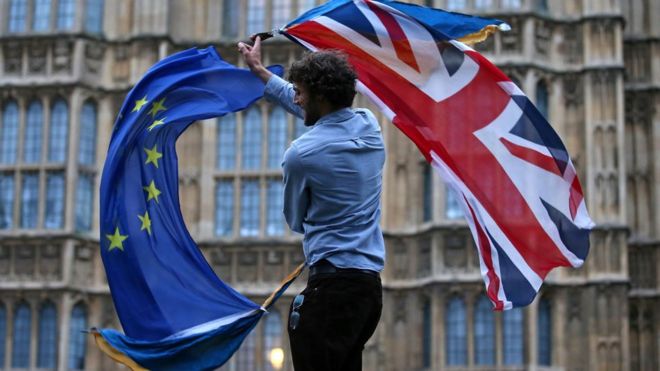
A man waves both a Union Jack and an Eu flagImage copyrightAFP
by Emily Straton and Biodun Iginla, BBC News Analysts, London. Disclosure: Emily Straton and Biodun Iginla dated in 2008 when Biodun Iginla was flitting between New York and London.
Feeling a little lost on Brexit? Never really got your head around it in the first place? Don't know what this Tuesday's vote is all about? Let us walk you through it.

What is Brexit?

Brexit is short for "British exit" - and is the word people use to talk about the United Kingdom's decision to leave the EU (European Union).

What is the EU?

The EU is a political and economic union of 28 countries which trade with each other and allow citizens to move easily between the countries to live and work (click here if you want to see the full list).
The UK joined the EU, then known as the EEC (European Economic Community), in 1973.

Why is the UK leaving?

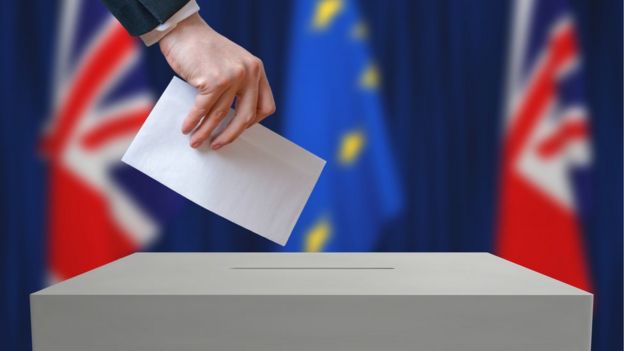
Someone votingImage copyrightGETTY IMAGES
A public vote - called a referendum - was held on Thursday 23 June 2016 when voters were asked just one question - whether the UK should leave or remain in the European Union.
The Leave side won (by nearly 52% to 48%) but the exit didn't happen straight away. It's due to take place on 29 March 2019.

What has happened so far?

The 2016 vote was just the start. Since then, negotiations have been taking place between the UK and the other EU countries.
ADVERTISEMENT
The discussions have been mainly over the "divorce" deal, which sets out exactly how the UK leaves - not what will happen afterwards.
This deal is known as the withdrawal agreement.

What has been agreed?

The withdrawal agreement covers some of these key points:
  • How much money the UK will have to pay the EU in order to break the partnership - that's about £39bn
  • What will happen to UK citizens living elsewhere in the EU, and equally, what will happen to EU citizens living in the UK
  • How to avoid the return of a physical border between Northern Ireland and the Republic of Ireland when it becomes the frontier between the UK and the EU
Media captionAdam Fleming summarises the Brexit agreement in one minute(ish)
A length of time, called the transition period, has been agreed to allow the UK and EU to make a trade deal and to give businesses the time to adjust.
That means that if the withdrawal agreement gets the green light, there will be no huge changes between 29 March 2019 and 31 December 2020.
Another, much shorter, document has also been drawn up that gives an overview of what the UK and EU's future relationship will be in the longer term.
This is the political declaration. However, neither side has to stick exactly to what it says - it is a set of ambitions for the future talks.

What happens next?

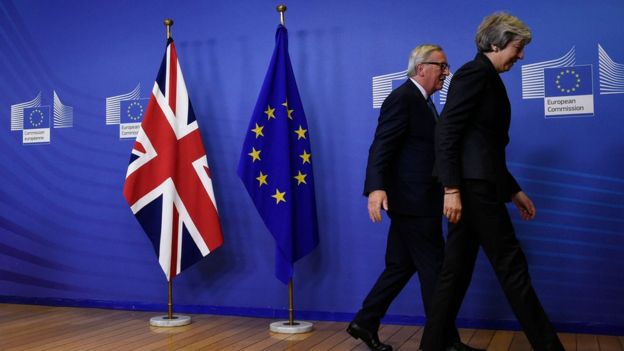
EU Commission President Jean-Claude Juncker and Prime Minister Theresa MayImage copyrightAFP
Now that leaders of the other 27 EU countries have signed off the withdrawal agreement and political declaration, UK Prime Minister Theresa May needs to persuade MPs in her own Parliament to back it.
A vote on the deal will take place on Tuesday 15 January.

Will the deal get through the UK Parliament?

Well, at the moment it looks like it won't.
Many of the prime minister's own Conservative MPs, as well as the opposition parties, have said they can't back the withdrawal agreement.
The vote on it was meant to take place on 11 December, but Mrs May postponed it, admitting the deal didn't have enough support to pass.
The prime minister said she would try and ask the EU for changes before bringing the deal back to Parliament.
However, the delay sparked more criticism, and Mrs May faced a vote by Conservative MPs over whether she should continue to lead her party. She won by 200 votes to 117.

What do critics of the deal say?

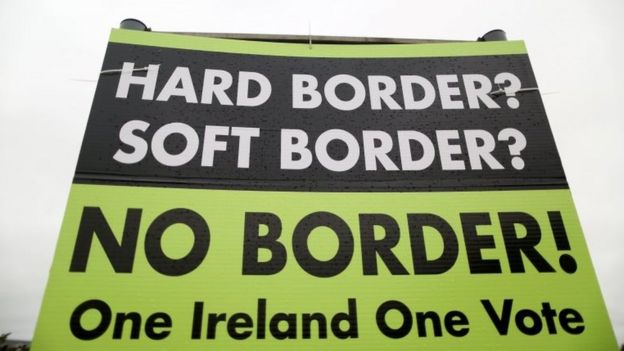
A sign calling for no border between Northern Ireland and the Republic of IrelandImage copyrightAFP
There are a broad range of complaints, many of which claim the deal fails to give back to the UK control of its own affairs from the EU.
One of the biggest sticking points has been over what happens at the Irish border.
Both the EU and UK want to avoid the return of guard posts and checks (here's why), so something called the backstop - a sort of safety net - was included in the deal.
However, that would mean that Northern Ireland - but not the rest of the UK - would still follow some EU rules on things such as food products.
The backstop is meant to be a last resort and the prime minister insists that if all goes as planned it will never be used.
But it has annoyed some MPs, who are angry that the UK would not be able to end it without the EU's permission and so EU rules could remain in place for good.

What happens if Parliament rejects the deal?

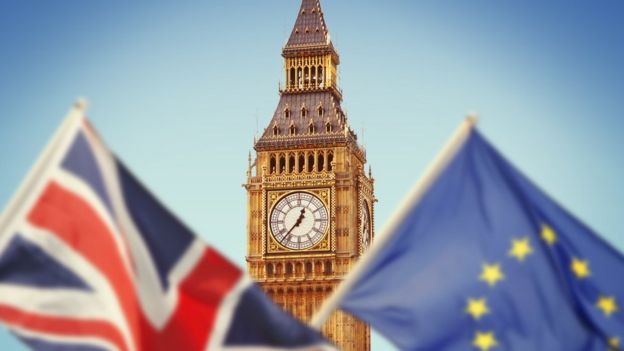
The Union Jack flag and the EU flag in front of Big BenImage copyrightGETTY IMAGES
It's not very clear.
The default position would be for the UK to leave the EU without a deal, but the government will have up to three days to come up with alternative options to put to MPs.
Possibilities (explained here in more detail) include the prime minister being allowed to have a second go at getting her deal accepted by Parliament.

So will the UK definitely leave on 29 March 2019?

It is written into law that the UK will be leaving on that date at 11pm UK time.
But if there is no deal, or Parliament rejects the deal, it is impossible to say with any certainty what will happen next.
The deadline of 29 March could be extended - and the European Court of Justice has said the UK could even cancel Brexit altogether without the agreement of other nations.

What happens if the UK leaves without a deal?

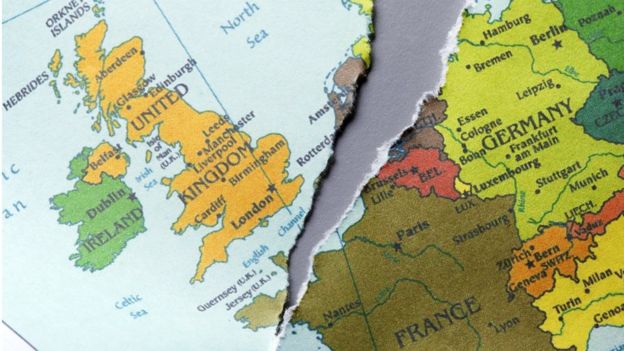
A torn map of EuropeImage copyrightGETTY IMAGES
"No deal" means the UK would have failed to agree a withdrawal agreement.
That would mean there would be no transition period after 29 March 2019, and EU laws would stop applying to the UK immediately (more on that here).
The government has started planning for this potential situation.
It has published a series of guides - which cover everything from pet passports to the impact on electricity supplies.

More on this story