An attack on Saudi Arabia that triggered the biggest jump in oil prices in almost 30 years was carried out with Iranian weapons, a Saudi-led coalition said on Monday, as President Donald Trump said the United States was “locked and loaded” to hit back.
Smoke is seen following a fire at an Aramco factory in Abqaiq, Saudi Arabia, September 14, 2019 in this picture obtained from social media. VIDEOS OBTAINED BY REUTERS/via REUTERS
* The attack on Saturday was a reciprocal measure by “Yemeni people” to assaults on their country, Iranian President Hassan Rouhani said.
* Yemen’s Iran-aligned Houthi group, which is battling a Saudi-led coalition in Yemen, claimed responsibility for the attacks on Saturday on sites run by state-owned Saudi Aramco.
* Oil prices jumped roughly 12% on Monday after the attack sliced the kingdom’s production in half and intensified concerns of retaliatory actions in the Middle East. Prices initially surged about 20%, with Brent crude posting its biggest intraday gain since the 1990-1991 Gulf crisis, before pulling back as various nations said they would tap emergency supplies to keep the world supplied with oil.
* U.S. Secretary of State Mike Pompeo ruled out Yemeni involvement and accused Iran of leading the attacks.
* Trump said the United States, which is embroiled in a row with Iran over its nuclear ambitions, was “locked and loaded” for a potential response.
ADVERTISEMENT
* Russia said it was unacceptable to discuss possible retaliation and said that using the incident to increase tensions around Iran was counterproductive.
* An Iranian Revolutionary Guards commander said U.S. bases and aircraft carriers were within range of Iranian missiles, after Washington blamed Iran.
* Israel is prepared for the possibility it might be drawn into any U.S.-Iranian confrontation over a strike on the Saudi oil plant, Prime Minister Benjamin Netanyahu said on Monday.
* Sunni Muslim Saudi Arabia has previously accused Shi’ite Muslim Iran, which lies across the Gulf, of carrying out attacks on its oil facilities, charges Tehran denies. Riyadh has not blamed any party for Saturday’s strikes.
* Analysts said benchmark Brent, now trading at around $68 a barrel, could hit $100 if Riyadh failed to quickly bring back supply.
* The Organization of the Petroleum Exporting Countries is assessing the impact but says it is too early for members to take any action on raising production or holding a meeting, the UAE energy minister and other sources said.
ADVERTISEMENT
* Saudi Aramco’s full return to normal oil output volumes “may take months”, two sources said on Monday.
* Saudi Arabia usually ships more than 7 million bpd of oil to global destinations and has for years served as the market’s supplier of last resort.
* Saudi Aramco has been seeking to prepare for a share sale that would make it the world’s largest listed company.
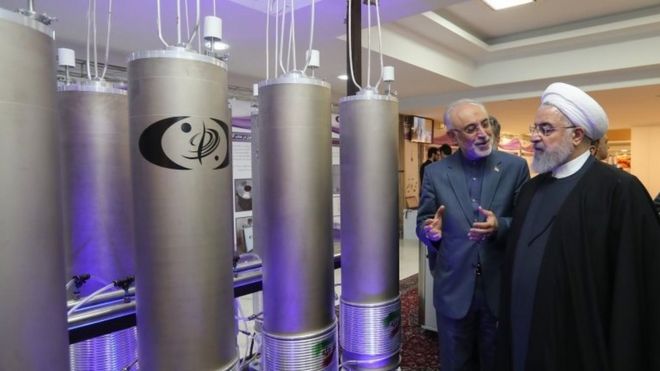
For nearly four years Iran’s path to a nuclear weapon was blocked. The deal it signed with America and other powers in 2015 limited its nuclear programme to civilian uses, such as power-generation, and subjected them to the toughest inspection regime in history. The experts agreed that Iran was complying and that its nuclear activities were contained. But then President Donald Trump ditched the nuclear deal and Iran resumed stockpiling low-enriched uranium. It is now poised to breach the 300kg cap set by the agreement. Iran may hesitate before crossing that line, but it is also threatening to increase the enrichment level of its uranium, bringing it closer to the stuff that goes into a bomb.
Fortunately, Iran is not about to become a nuclear-weapons power. Its breakout time is over a year. But it is once again using its nuclear programme to heap pressure on America. That adds an explosive new element to an already-volatile mix. America accuses Iran of attacking six ships in the Strait of Hormuz since May. On June 20th Iran shot down an American spy drone. America insisted the aircraft was above international waters, not Iran’s, and sent warplanes to strike back. Ten minutes before they were due to hit targets inside Iran Mr Trump called them off and contented himself with a cyber-attack instead.
Neither Mr Trump, nor America’s allies, nor Iran wants a big new war in the Middle East. Yet Mr Trump’s strategy of applying “maximum pressure” on Iran is making the prospect more likely—because each side, issuing ever-wilder threats, could end up misreading the other’s red lines. The president’s room for manoeuvre is shrinking. As Iran turns more belligerent, calls for action will grow, not least from his own party (see article). Before things escalate out of control, both sides need to begin talking. That is not as unlikely as it sounds.
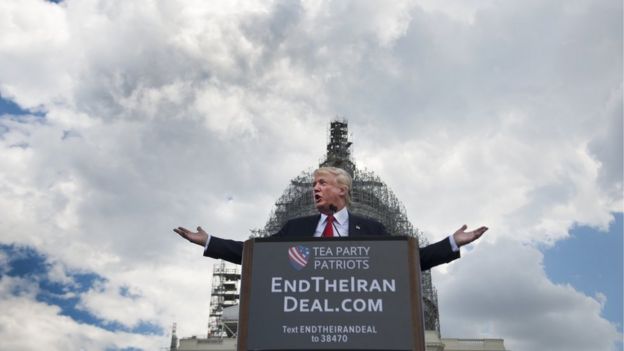
Mr Trump’s Iran strategy is based on the premise that Barack Obama gave too much away too easily when he negotiated the deal in 2015. Last year the president set out to get better terms by reneging on the agreement and reimposing the sanctions that have crippled Iran’s economy. This, his advisers argue, will force a weakened Iran to accept a new deal that lasts longer than the old one, most of which expires by 2030. They also want curbs on Iran’s missile programme and an end to its violent meddling in the region. Mike Pompeo, the secretary of state, sees recent Iranian aggression as a sign that the strategy is working.
Hard-hitting sanctions brought Iran to the negotiating table in 2015, but they are unlikely to lead to the transformation Mr Trump wants. One reason is that he has discredited Hassan Rouhani, Iran’s president and a champion of the nuclear deal. Hardliners are now calling the shots. Another is that America is acting alone. In 2015, in a rare moment of international unity, it had the support of its European allies as well as Russia and China.
Maximum pressure comes with extra risks, to boot. The mullahs and their Islamic Revolutionary Guard Corps want to prove their mettle by showing that Mr Trump’s actions have costs—for everyone. On top of the attacks on ships and drones, Iranian proxies have hit pipelines in Saudi Arabia and are suspected of having struck Iraqi bases hosting American troops. If sanctions are not lifted, Iranian officials may resort to closing the Strait of Hormuz, through which one-fifth of the world’s oil passes.
Hawks like John Bolton, Mr Trump’s national security adviser, retort that if Iran wants war, that is what it will get—especially if it shows signs of dashing for a nuclear bomb, which could trigger disastrous proliferation in the Middle East. But this is the riskiest calculation of all. Having pulled out of a working deal, America may not win the backing of European allies for strikes. China and Russia would vehemently oppose any action at all.
Perhaps sanctions or war will cause the regime to crumble. But that is hardly a strategy: Cuba has resisted sanctions for decades. More probably, a defeated Iran would heed the lesson of nuclear-armed North Korea and redouble its efforts to get a bomb. Attacking Iran’s nuclear facilities would not destroy its know-how, as even Mr Bolton admits. If, as is likely, Iran barred international inspectors, its programme would move underground, literally and figuratively, making it very hard to stop.
The alternative to today’s course is talks between America and Iran. Just now that looks far-fetched. Iran’s foreign ministry says American sanctions imposed on Ayatollah Ali Khamenei, the supreme leader, and other top officials this week mark “the permanent closure of the path of diplomacy”. Mr Rouhani has suggested that the White House is “mentally handicapped”—after which Mr Trump threatened “obliteration”.
But optimists will remember similar clashes between America’s president and Kim Jong Un, North Korea’s despot, before they met in Singapore and “fell in love”, as Mr Trump put it. When he is not threatening to annihilate the mullahs, Mr Trump is offering to talk without preconditions and to “make Iran great again”. He does not want the prospect of war in the Middle East looming over his re-election campaign. Likewise, in Iran the economy is shrinking, prices are rising and people are becoming fed up. Pressure is growing on Mr Khamenei to justify his intransigence. Love could yet bloom.
America might coax Iran back to the table with a gesture of good faith, such as reinstating waivers that let some countries buy Iranian oil. Iran, in turn, could promise to comply with the nuclear deal again. Behind the scenes, its leaders have expressed a willingness to sign something like the old agreement with additions—such as extending parts of the deal beyond 2030. Negotiations would never be easy; the Iranians are infuriating to deal with. But that would let the president claim victory, as he did with the United States-Mexico-Canada Agreement, which his administration signed last year and which looks a lot like its predecessor, the North American Free Trade Agreement.
What of a deal that also curbs Iran’s missile programme and restrains it in the region? As Mr Trump seems to realise, biting everything off in one go is unrealistic. A new deal cannot solve all the problems posed by Iran or normalise ties with America after decades of enmity. It may not even lift all America’s sanctions. Neither did the first agreement. But, if done right, a deal would put Iran’s nuclear programme back in a box, making it easier to tackle all those other problems without causing a war. ◼
SHINZO ABE hoped this was a moment for diplomacy. His visit to Tehran this week, the first by a Japanese prime minister since the Islamic revolution in 1979, was meant to reduce tensions between America and Iran. After a meeting with Iran’s president, Hassan Rouhani, Mr Abe warned that the region could “accidentally” slip into conflict. And then, a few miles off Iran’s southern coast, came an illustration of how that might happen.
On June 13th two tankers in the Gulf of Oman sent distress calls after they had been damaged by large explosions. The Front Altair, flagged in the Marshall Islands and owned by Frontline, a Norwegian shipping company, was hauling a cargo of naphtha, an oil derivative, from Abu Dhabi; the Kokuka Courageous, registered in Panama and operated by the Japanese company Kokuka Sangyo, was laden with methanol. Both were bound for Asian ports. Photos from Iranian news agencies showed a fire burning on the starboard side of the Front Altair. The plume of black smoke overhead was thick enough to appear in satellite images. One-fifth of the world’s supply travels through the Strait of Hormuz, an important chokepoint for international shipping.
This is the second time in just over a month that tankers have been damaged in the Gulf. On May 12th four ships anchored off Fujairah, a port in the United Arab Emirates (UAE), had holes blown in their hulls. A preliminary investigation suggests that they were damaged by limpet mines. The latest explosions caused far more damage, forcing crews to evacuate both ships as they were underway. It will take weeks to probe what happened, amid reports of torpedoes being used. But the explosions do not seem accidental. The president of Kokuka Sangyo said the Kokuka Courageous vessel was “attacked” twice in a three-hour period.
Nor is it likely that two sets of explosions, weeks apart and in the same area, were mere coincidence. Though a UAE-led investigative team did not assign blame for last month’s sabotage, it said an unnamed “state actor” carried it out. America has blamed Iran for both sets of attacks. Iran, which is a regional rival of the UAE and Saudi Arabia, both American allies, has denied responsibility and hints that the latest explosions were orchestrated by its rivals. “Suspicious doesn’t begin to describe what likely transpired,” tweeted Iran’s foreign minister, Muhammad Javad Zarif, on June 13th.
Iran has in the past threatened to close the Strait of Hormuz if it were ever attacked. Some will see the strikes against ships in the area as a veiled warning of its readiness to make good on its threat. Messrs Zarif and Rouhani probably understand that attacking regional shipping would be to play with fire. But they do not call all of the shots in Iran. They are stuck in an internal battle with Iran’s ruling mullahs, who are more distrustful of the West, and their Revolutionary Guards, who back local forces in Syria and Yemen that have fought against Emirati- and Saudi-backed forces. Iran has a history of irregular warfare that allows it to maintain a measure of plausible deniability. In the 1980s it fought the so-called tanker war with Iraq. The conflict ravaged international shipping.
Tensions in the region have been rising since last spring, when Donald Trump withdrew from the deal, signed in 2015, that loosened sanctions on Iran in exchange for limits on its nuclear programme. Mr Trump reimposed sanctions and added new ones, in effect cutting Iran off from the global economy. After a year of abiding by the agreement, a bid to win European sympathy, Iran last month said it would begin enriching uranium in excess of the prescribed limits. Mr Rouhani warned that he would abrogate other provisions unless other signatories—Britain, France, Germany, Russia, China and the European Union—helped his country bypass American sanctions, which is unlikely to happen. Critics of Mr Trump’s approach have long warned that economic distress would lead Iran to lash out.
For the Arab states across the Gulf, these latest explosions fit into a troubling pattern. In May, two days after the Fujairah incident, two blasts in the centre of Saudi Arabia, 700km north of the Yemeni border, damaged an oil pipeline that carries crude across the kingdom. On June 12th a rocket hit the international airport in Abha, a Saudi city 200km from the Yemeni border, injuring 26 people. Both attacks were carried out by the Houthis, a Shia militia that controls large parts of Yemen and is fighting a Saudi-led coalition there. A United Nations panel of experts has said that Iran supplied weapons to the Houthis, including drones and missiles, though the group does not always act at Iran's behest.
But Saudi Arabia and its allies have tried not to escalate directly a conflict that would wreak havoc on their oil exports, and thus their economies. The UAE has been particularly circumspect in its public statements about last month’s sabotage (though in private officials evince little doubt about Iran’s involvement). If there is to be a response, they would like it to come from America. Mr Trump’s hawkish national security adviser, John Bolton, has long supported regime change in Iran, and even military action against it. But the president, as ever, is erratic, toggling between fiery threats and offers of dialogue. He is reported to have given Mr Abe a message to pass to Iran’s supreme leader, Ali Khamenei (who declined to reply). “We do not believe at all that the US is seeking genuine negotiations with Iran; because genuine negotiations would never come from a person like Trump,” said Ayatollah Khamenei.
Mr Trump has already bolstered America’s military presence in the region. Last month he rushed an aircraft-carrier strike group to the region. Those vessels have not transited the Strait of Hormuz, an effort to avoid further tension. They will probably step up their patrols; an American destroyer picked up some sailors from the stricken tankers (Iran says it rescued some too). The Pentagon is deploying an extra 1,500 troops to bases in Qatar, Bahrain and Iraq, and Mr Trump is invoking emergency powers to override congressional objections and sell weapons to Saudi Arabia and the UAE.
All sides insist they do not want war. But even if they are sincere, good intentions go only so far. The Gulf states (and their American protector) cannot tolerate threats to shipping. Mr Abe was right to push for diplomacy between America and Iran. But his visit, and the events that overshadowed it, underscore how difficult that will be.
Iran has pulled out of key commitments under the 2015 international nuclear deal, a year after it was abandoned by the US.
President Hassan Rouhani said Tehran would keep enriched uranium stocks in the country and not sell them abroad.
He also threatened to resume production of higher enriched uranium in 60 days.
The accord is aimed at curbing Iran's nuclear ambitions in return for sanctions relief, but Iran-US tensions have risen since Washington quit.
Iran's economy has since been hit by renewed US sanctions.
The announcement comes after US Secretary of State Mike Pompeo made an unscheduled visit to Iraq, and a US aircraft carrier was deployed to the Gulf region.
US officials have reported threats to US forces and their allies from Iran, but have given few details about the exact nature of the threat.
The landmark nuclear deal agreed by Iran and the five permanent members of the UN Security Council - the US, UK, France, China and Russia - plus Germany (the P5+1) - was thrown into flux when President Trump announced the US withdrawal one year ago.
ADVERTISEMENT
The value of Iran's currency has since been pushed to record lows, its annual inflation rate quadrupled and foreign investment driven away.
Despite this, Iran has upheld its commitments to the deal, according to inspectors from the International Atomic Energy Agency (IAEA) - the body charged with monitoring Iran's nuclear activity.
European backers of the deal, who oppose reinstating sanctions, have been trying to find ways to salvage it. This includes the establishment of a special payments system to help international companies who want to continue trading with Iran to bypass sanctions.
But they have also warned Iran that it must continue to comply with all aspects of the deal, especially the elements relating to nuclear activity.
However, under the deal - known as the Joint Comprehensive Plan of Action (JCPOA) - Iran stated that it would treat any reintroduction of sanctions "as grounds to cease performing its commitments... in whole or in part".
Why is there such hostility between the US and Iran?
Tensions between the US and Iran can be traced back to Iran's Islamic Revolution in 1979, which overthrew the pro-Western Shah and established a radical anti-US regime in its place.
President Trump has taken a particularly hard line towards Iran since he took office in 2016.
His administration wants to renegotiate the nuclear deal and widen its scope so that it also curbs Iran's ballistic missile programme and "malign" activities in the Middle East.
In response to the US ending the sanctions waivers, Iran repeated threats to block the strategic Strait of Hormuz, a critical passageway for the world's oil exports. However, it has not done so before and experts see this move as unlikely.