Biodun Iginla, BBC News

Biodun Iginla, BBC News
Showing posts with label Hurricane Florence. Show all posts

Monday, September 17, 2018

Millions of chickens drown in Florence floodwaters, manure pits damaged

September 18, 2018  06H:32  GMT/UTC/ZULU TIME
CHICAGO/LOS ANGELES - U.S. food companies kept slaughter plants shut on Monday in southeastern states swamped by Hurricane Florence as catastrophic flooding killed nearly 2 million chickens, collapsed the walls of at least two hog manure pits, and made stretches of major roads impassable.
Florence, which has dumped up to 36 inches (91 cm) of rain on North Carolina since Thursday, was interrupting supply lines around the state and into neighboring South Carolina. Meteorologists have warned that the worst is yet to come as rivers rise. North Carolina is a top U.S. producer of poultry, hogs and tobacco. Agriculture contributes $87 billion to the state’s economy, making it the state’s No. 1 industry.
Two North Carolina hog waste pits were structurally damaged, four were inundated with water and seven had discharges, according to the North Carolina Department of Environmental Quality.
SPONSORED
More than 3,000 lagoons in the state were unaffected, the North Carolina Pork Council said.
When manure pits overflow, there is a risk that water supplies will be contaminated with bacteria like salmonella and e. coli.
Smithfield Foods Inc [SFIL.UL] runs the world’s biggest hog plant in Tar Heel, North Carolina, near a junction where I-95 traffic has been disrupted. Smithfield closed the plant on Thursday and Friday and an employee said it was still closed on Monday. The company did not respond to requests for comment.
About 1.7 million broiler chickens that independent suppliers were raising for Sanderson Farms Inc, were killed in the floodwaters, the third-largest U.S. poultry producer said on Monday.
Some 30 poultry farms housing about 211,000 chickens each in the area of Lumberton, North Carolina, were isolated by floods, and Sanderson Farms was unable to get feed trucks to them.
“Losses of live inventory could escalate if the company does not regain access to those farms,” Sanderson Farms said in a statement. The company said it was assessing damage from the storm and warned that losses would weigh on quarterly results.
On Monday, the North Carolina Department of Transportation advised against travel in the southern, central and eastern parts of the state, noting that several sections of I-95 and I-40, which are major trucking arteries, were flooded. The South Carolina Department of transportation said sections of I-95 were closed near the North Carolina line. U.S. railroad operator CSX Corp, which services the area, advised customers that shipments traveling through the I-95 corridor would experience delays. CSX said it was assessing damage from the storm. “When it comes to moving product, there’s obviously challenges with major routes like I-95, I-75 and I-40 being closed and having to detour around that,” Perdue Farms spokesman Joe Forsthoffer said.
Last week, Perdue Farms shut poultry processing plants in Rockingham, North Carolina, and Dillon, South Carolina, and kept them offline on Monday because of road closures and power outages, Forsthoffer said.
“It just wasn’t safe to ask people to come in,” said Forsthoffer, who added that the privately held chicken producer would monitor road conditions to determine when it can resume slaughtering. He said a small number of poultry died on the company’s farms.
Commodity handler Cargill Inc [CARG.UL] closed an animal-feed facility in Roanoke, Virginia, and another facility in Fayetteville, North Carolina, that handles salt, oils and grains, because they are in active flood zones, spokeswoman April Nelson said on Monday. A third facility in Charlotte, North Carolina, was also closed and due to reopen on Tuesday, she said. On Tuesday, North Carolina Agriculture Commissioner Steve Troxler will attempt to survey farms from a helicopter, Ashby said.

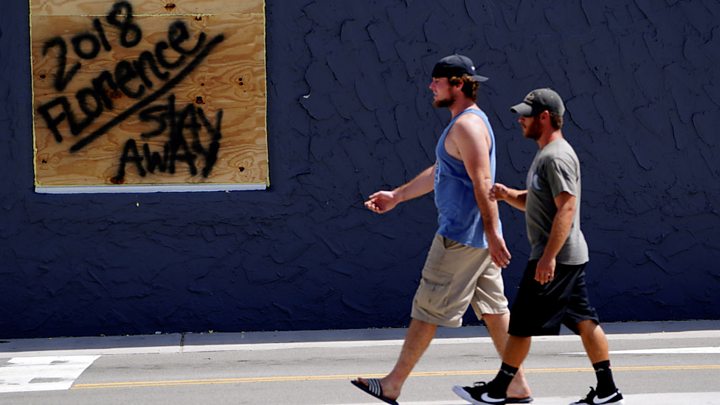
Friday, September 14, 2018

First fatalities of Florence: Mother and child killed as Florence swamps Carolinas

September 14, 2018  22H:33  GMT/UTC/ZULU TIME
WILMINGTON, N.C. - A mother and infant were killed in Wilmington when a tree fell on their house as Hurricane Florence crashed into North Carolina on Friday, swamping streets with torrential rain and a powerful storm surge.
Police said they were the first confirmed deaths directly related to storm, while the child’s father was taken to the hospital. CNN showed the scene, a small brick house. In Pender County, North Carolina, one woman died after she suffered a heart attack and paramedics were unable to reach her due to blocked roads authorities said.
After landfall, Florence slowed to a pace that meant it would plague the area with days of flooding. The hurricane’s storm surge - the wall of water it pushed in from the Atlantic - “overwhelmed” the town of New Bern at the confluence of the Neuse and Trent rivers, North Carolina Governor Roy Cooper said.
“To those in the storm’s path, if you can hear me, please stay sheltered in place,” he said at a news conference in Raleigh, adding that Florence would “continue its violent grind across the state for days.”
No storm-related deaths or serious injuries were reported in the hours immediately after Florence hit but authorities said more than 60 people, including many children and pets, had to be evacuated from a hotel in Jacksonville, North Carolina, after strong winds caused parts of the roof to collapse.
The center of the hurricane’s eye came ashore at about 7:15 a.m. EDT (1115 GMT) near Wrightsville Beach close to Wilmington, North Carolina, with sustained winds of 90 miles per hour (150 kph), the National Hurricane Center (NHC) said.
By 1:50 p.m. (1750 GMT) the winds had dropped to 75 mph (120 kph) and the center was moving west at a 6 mph (10 kph), the NHC said, and parts of North and South Carolina would get as much as 40 inches of rain (1 meter).
SPONSORED
Cooper said Florence was set to cover almost all of North Carolina in several feet of water. As of Friday morning, Atlantic Beach, a town on the state’s Outer Banks barrier islands, already had received 30 inches (76 cm) of rain, the U.S. Geological Service said. Twenty inches (50 cm) were reported by early Friday afternoon in the town of Oriental.
The NWS predicted Florence could drop up to eight months’ worth of rain in two or three days.
GRAPHIC - Hurricane Florence to pummel U.S. Southeast for days: tmsnrt.rs/2oZFKSb
Authorities in New Bern, a town of about 30,000 people dating to the early 18th century, said more than 100 people had to be saved from floods and that the downtown area was underwater. Calls for help kept coming in as the wind picked up and the tide arrived, said city public information officer Colleen Roberts.
A vehicle navigates a flooded Ocean Boulevard during Hurricane Florence in North Myrtle Beach, South Carolina, U.S. September 14, 2018. REUTERS/Randall Hill
“These are folks who decided to stay and ride out the storm for whatever reason, despite having a mandatory evacuation,” she said. “These are folks who are maybe in one-story buildings and they’re seeing the floodwaters rise.”
Video reports from several towns in the Carolinas showed emergency personnel wading through rippling thigh-high floodwaters in residential neighborhoods.

‘IT’S INSANE’

Florence also blew down trees, including one that went through the roof of Kevin DiLoreto’s home in Wilmington. He said all roads leading to his neighborhood were blocked by fallen trees.
“It’s insane,” he said in a phone interview. “Everybody laughs at the fact that this storm got downgraded ... but I’ve never seen tree devastation this bad.
“Afterwards, I’m going to drink a bottle of whiskey and take a two-day nap, but right now I’m walking the neighborhood and making sure my neighbors are fine, because nobody can get in here.”
More than 634,000 homes and businesses were without power in North and South Carolina early on Friday, utility officials said. Utility companies said millions were expected to lose power and restoration could take weeks.
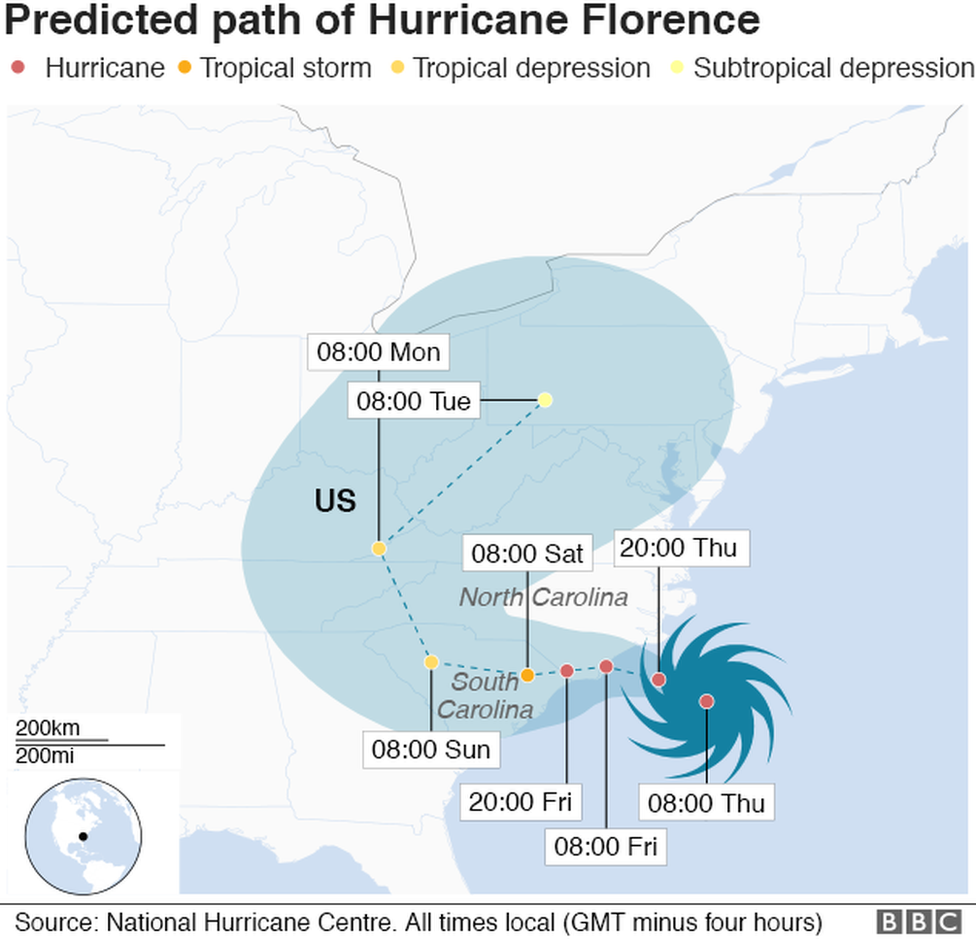
Florence had been a Category 3 hurricane with 120 mph winds on Thursday but dropped to Category 1 before coming ashore. It is expected to move across parts of southeastern North Carolina and eastern South Carolina on Friday and Saturday, then head north over the western Carolinas and central Appalachian Mountains early next week, the NHC said. Significant weakening is expected over the weekend.
Slideshow (22 Images)
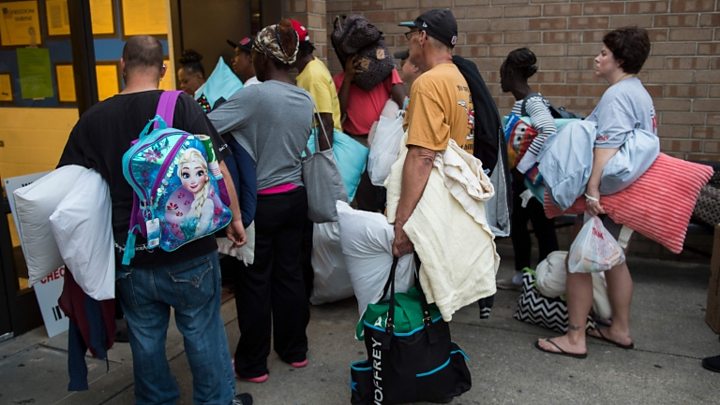
About 10 million people could be affected by the storm and more than 1 million were ordered to evacuate the coasts of the Carolinas and Virginia. Some of those who stayed went to shelters while others stuck it out in their homes.
Maysie Baumgardner, 7, and her family sheltered at the Hotel Ballast in downtown Wilmington as Florence filled the streets with floodwaters.
“It looks heavy outside,” she said. “I’m a little bit scared right now, but I have my iPad and I’m watching Netflix.”
Florence was one of two major storms on Friday. In the Philippines, evacuations were under way with Super Typhoon Mangkhut expected to hit on Saturday in an area impacting an estimated 5.2 million people.

Thursday, September 13, 2018

BREAKING: Hurricane Florence could kill 'a lot of people'


September 14, 2018  00H:22  GMT/UTC/ZULU TIME
Related Topics
Media captionWhy do people ignore hurricane warnings?
by Rochelle van Amber and Biodun Iginla, BBC News, Washington
Hurricane Florence, which is nearing the US East Coast, could kill "a lot of people", officials warn.
The Federal Emergency Management Agency (Fema) says storm surges could bring catastrophic flooding to inland areas.
Nearly 1.7m people along the coastlines of North Carolina, South Carolina and Virginia have been ordered to evacuate.
Strong winds and heavy rains have already begun lashing North Carolina's coastline, leading to some early flooding.
Some 11,000 power outages had already been reported in the state. Reuters news agency reports.
Florence is projected to make landfall on Friday at 08:00 local time (12:00 GMT).
And though it has been downgraded to a category two storm with 105mph (165km/h) winds, Fema administrator Brock Long said it remained "very dangerous".
He has warned that storm surges could cause "feet of rain not inches" of rainfall in the Carolinas and Virginia.

Why isn't the downgraded storm less of a threat?

Mr Long told Thursday morning's news conference that while Florence's wind speed had dipped, its wind field had expanded and total rainfall predictions were unchanged.
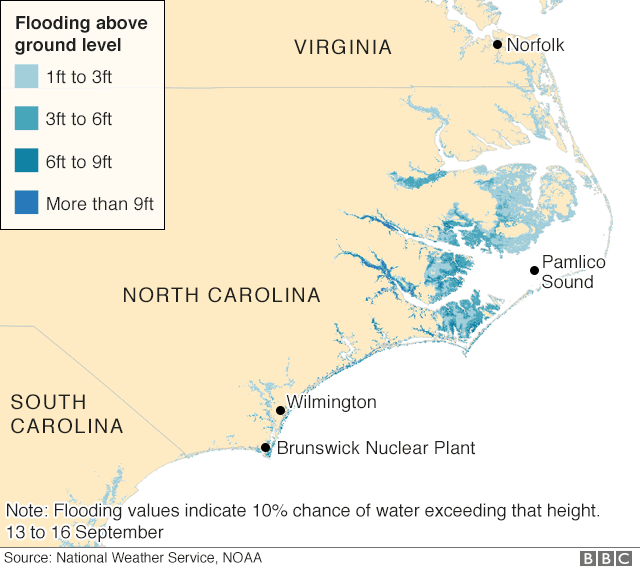
Map
Presentational white space
Floodwaters may rise up to 13ft (4m) as rivers see their flows "reversed", meteorologists have warned.
ADVERTISEMENT
"So this is a very dangerous storm," said Mr Long. "Inland flooding kills a lot of people unfortunately and that's what we're about to see."
"Your time is running out," he warned those who had not yet heeded the warning to evacuate. "The ocean is going to start rising."
Presentational white space
"Your time to get out of those areas in storm surge inundation is coming to a close. I cannot emphasise that enough."
He said that people living near rivers, streams and lowland areas in the region were most at risk.
Media captionPeople have left homes and taken precautions ahead of the hurricane

What's the situation on the ground?

The centre of Hurricane Florence was about 110 miles (180km) east of Wilmington, North Carolina, at 14:00 local time (18:00 GMT) on Thursday.
The latest weather predictions show the storm slowing to a near standstill as it pummels the coast with "copious amounts of rain" from Thursday night to Saturday, said Mr Long.
Predicted path of Hurricane Florence
Parts of the Carolina coast are expecting 20-30 (50-75cm) inches of rain, with isolated regions seeing up to 40in of downpour.
Myrtle Beach, South Carolina, is imposing a 12-hour curfew from 19:00 local time on Thursday.
Petrol stations in the area are reporting shortages and energy companies predict that one to three million homes and businesses may lose power.
Over 1,400 flights have been cancelled, according to FlightAware.com, as most of the coastal region's airports are closed to ride out the storm.
Presentational white space
North Carolina Governor Roy Cooper warned people: "Today the threat becomes a reality."
Emergency workers are arriving from other parts of the US to aid in rescues.
The Coast Guard has shallow-water response boats ready to help trapped residents.

Is global warming to blame?

The relationship between climate change and hurricanes is a complex one.
Warmer seas power hurricanes. So as the temperature of ocean water goes up, we might expect the intensity of hurricanes to increase in future.
A hotter atmosphere can also hold more water, so this should allow hurricanes to dump more water on affected areas.
But there are so many factors that contribute to these rare events, it has been difficult to tease out clear trends from the data.
presentational grey line
Are you in the area? How are you preparing for the hurricane? Let us know by emailing haveyoursay@bbc.co.uk.
Please include a contact number if you are willing to speak to a BBC journalist. You can also contact us in the following ways:
Or use the form below
Your contact details
If you are happy to be contacted by a BBC journalist please leave a telephone number that we can contact you on. In some cases a selection of your comments will be published, displaying your name as you provide it and location, unless you state otherwise. Your contact details will never be published. When sending us pictures, video or eyewitness accounts at no time should you endanger yourself or others, take any unnecessary risks or infringe any laws. Please ensure you have read the terms and conditions.

Related Topics

More on this story