Biodun Iginla, BBC News

Biodun Iginla, BBC News
Showing posts with label IT systems. Show all posts

Monday, February 12, 2018

You and your apps: A culprit for financial site glitches--analysis

February 12, 2018  13H:34  GMT/UTC/ZULU TIME
BOSTON - Jittery investors and their smartphones stressed out leading U.S. online financial sites last week as heavy volatility shook markets, technology analysts said.
Traders work on the floor of the New York Stock Exchange, (NYSE) in New York, U.S., February 9, 2018. REUTERS/Brendan McDermid
Major firms including Vanguard Group, TD Ameritrade Holding Corp (AMTD.O) and Fidelity Investments reported service slowdowns on their websites amid heightened demand from clients.
For many firms an issue was the growing adoption of financial apps on mobile devices, which make it much easier for clients to check their balances or watch market indexes. That created greater network loads, even when clients were not looking to trade.
“The app is in their hands and they can check it as they get out of the car. That’s different than what many systems were built for,” said Kendra Thompson, a managing director for Accenture, which advises big asset managers on technology.

Delays were magnified as frustrated consumers returned repeatedly, conditioned by social media to expect a quick informational hit.
“Access troubles beget more traffic,” she said.
Rich Bolstridge, chief strategist for financial services at cloud services provider Akamai Technologies Inc, (AKAM.O) described the wide adoption of mobile apps in finance as “the number one factor in the riskier situation that brokers and investment firms face today,” as customers get used to logging in with the ease of a thumbprint.
Richer graphics and video on company websites also put IT systems under pressure.
Akamai shared data with Reuters showing how at one investment firm, traffic to its homepage surged on Feb. 5 and Feb. 6. It spiked at 9:50 a.m. EST (1450 GMT) on Tuesday when it ran to four times where it stood at the same point a week earlier, and remained higher than usual on Feb. 7-8.
AMTD.ONASDAQ
+0.00(+0.00%)
AMTD.O
  • AMTD.O
  • AKAM.O
Bolstridge said traffic may have eased off as people got used to the market volatility during the trading week, the worst in two years for U.S. stocks.
“My best guess would be that people were a little bit numb to the news,” he said.
Vanguard spokesman John Woerth said rising smartphone use played a role in the heavy online traffic the firm faced on Feb. 5, when some clients had trouble logging in to its website.
“It is now easier than ever to get market updates on your smartphone and be impelled to act on market movements. Impulse is an investor’s worst enemy, and we caution investors from succumbing to emotion,” he said.
TD Ameritrade spokeswoman Kim Hillyer said the firm received unprecedented traffic last week, slowing down one of its mobile apps on Feb. 5 and creating a 45-minute period of slowness on its trading website the next morning. She said the company reminded customers they could use other options, such as another mobile app it offers.

Tuesday, June 27, 2017

BREAKING: Global ransomware attack causes turmoil

  • June 28, 2017  00H:07  GMT/UTC/ZULU TIME
  •  
  • From the sectionTechnology

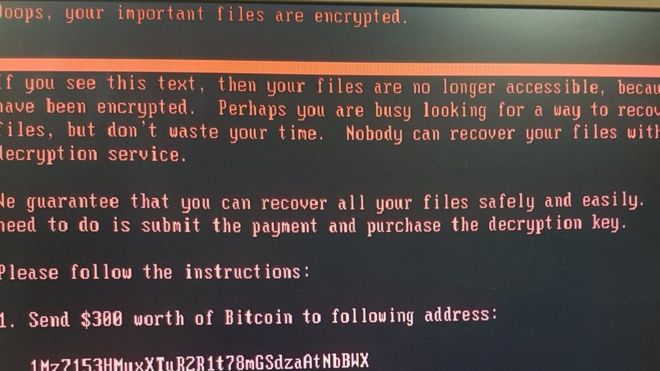
ScreenshotImage copyrightSCREENSHOT
Image captionMany reports suggest that screens around the world are getting this message, indicating a ransomware attack is to blame.

by Tamara Kachelmeier and Biodun Iginla, BBC News Technology reporters, New York/Ventimiglia (Italy)
Companies across the globe are reporting that they have been struck by a major ransomware cyber-attack.
British advertising agency WPP is among those to say its IT systems have been disrupted as a consequence.
The virus, the source of which is not yet known, freezes the user's computer until a ransom in untraceable Bitcoin is paid.
Ukrainian firms, including the state power company and Kiev's main airport, were among the first to report issues.
The Chernobyl nuclear power plant has also had to monitor radiation levels manually after its Windows-based sensors were shut down.
The Russian anti-virus firm Kaspersky Lab said its analysis showed that there had been about 2,000 attacks - most in Ukraine, Russia and Poland.
The international police organisation Interpol has said it was "closely monitoring" the situation and liaising with its member countries.
Experts suggest the malware is taking advantage of the same weaknesses used by the Wannacry attack last month.
"It initially appeared to be a variant of a piece of ransomware that emerged last year," said computer scientist Prof Alan Woodward.


Media captionWhat is ransomware?

"The ransomware was called Petya and the updated version Petrwrap.
"However, now that's not so clear."
Kaspersky Lab reported that it believed the malware was a "new ransomware that has not been seen before" despite its resemblance to Petya.
As a result, the firm has dubbed it NotPetya. Kaspersky added that it had detected suspected attacks in Poland, Italy, Germany, France and the US in addition to the UK, Russia and Ukraine.
Andrei Barysevich, a spokesman for security firm Recorded Future, told us at the BBC that such attacks would not stop because cyber-thieves found them too lucrative.
"A South Korean hosting firm just paid $1m to get their data back and that's a huge incentive," he said. "It's the biggest incentive you could offer to a cyber-criminal."
A bitcoin wallet associated with the outbreak has received several payments since the outbreak began. The wallet currently holds almost 3.3 bitcoins (£6,175; $7,920).
An email address associated with the blackmail attempt has been blocked by German independent email provider Posteo.
It means that the blackmailers have not been able to access the mailbox.
Problems have also affected:
  • the Ukrainian central bank, the aircraft manufacturer Antonov, and two postal services
  • Russia's biggest oil producer, Rosneft
  • Danish shipping company Maersk, including its container shipping, oil, gas and drilling operations
  • a Pennsylvania hospital operator, Heritage Valley Health System, which reported its computer network was down, causing operations to be delayed - but it is not yet clear if it was subject to the same type of attack
  • Spanish food giant Mondelez - whose brands include Oreo and Toblerone - according to the country's media
  • Netherlands-based shipping company TNT, which said some of its systems needed "remediation"
  • French construction materials company St Gobain
  • US pharmaceuticals-maker Merck and the local offices of the law firm DLA Piper - a sign in the firm's Washington DC office said: "Please remove all laptops from docking stations and keep turned off - no exceptions."
The attacks come two months after another global ransomware assault, known as Wannacry, which caused major problems for the UK's National Health Service.
Veteran security expert Chris Wysopal from Veracode said the malware seemed to be spreading via some of the same Windows code loopholes exploited by Wannacry. Many firms did not patch those holes because Wannacry was tackled so quickly, he added.

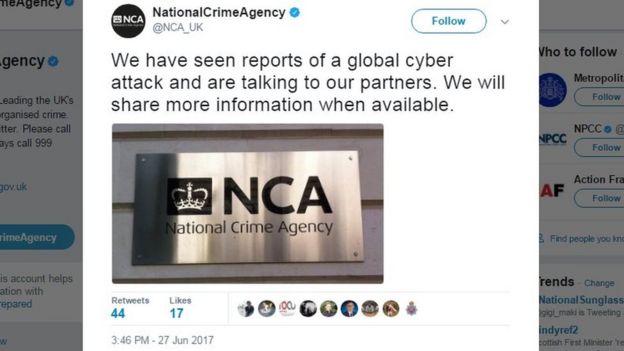
NCA tweet reads: Image copyrightTWITTER/@NCA_UK
Image captionThe UK's National Crime Agency is investigating the threat

Those being caught out were also industrial firms that often struggled to apply software patches quickly.
"These organisations typically have a challenge patching all of their machines because so many systems cannot have down time," he said. "Airports also have this challenge."
Copies of the virus have been submitted to online testing systems that check if security software, particularly anti-virus systems, were able to spot and stop it.
"Only two vendors were able to detect it so many systems are defenceless if they are unpatched and relying on anti-virus," he said.

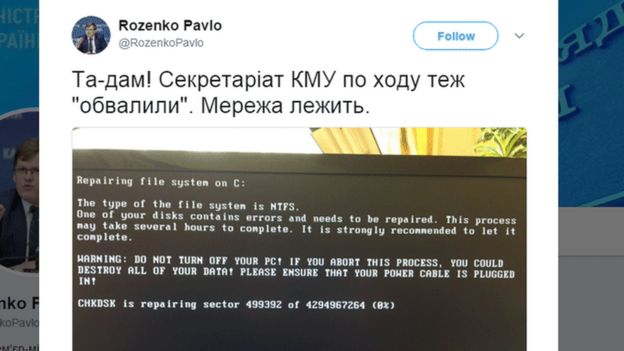
Ukraine's deputy prime minister tweets a photo appearing to show government systems being affected, with the caption Image copyrightTWITTER/@ROZENKOPAVLO

Ukraine seems to have been particularly badly hit this time round.
Reports suggest that the Kiev metro system has stopped accepting payment cards while several chains of petrol stations have suspended operations.
Ukraine's deputy prime minister has tweeted a picture appearing to show government systems have been affected.
His caption reads: "Ta-daaa! Network is down at the Cabinet of Minister's secretariat."

Have you been affected by this ransomware attack? Email haveyoursay@bbc.co.uk.
Please include a contact number if you are willing to speak to a BBC journalist. You can also contact us in the following ways:
Or use the form below
Your contact details
If you are happy to be contacted by a BBC journalist please leave a telephone number that we can contact you on. In some cases a selection of your comments will be published, displaying your name as you provide it and location, unless you state otherwise. Your contact details will never be published. When sending us pictures, video or eyewitness accounts at no time should you endanger yourself or others, take any unnecessary risks or infringe any laws. Please ensure you have read the terms and conditions.

Related Topics