A picture taken on July 21, 2019, shows Iranian Revolutionary Guards patrolling around the British-flagged tanker Stena Impero anchored off the Iranian port city of Bandar AbbasMIZAN NEWS AGENCY/AFP
The man behind the audio of Iran's seizure of a British-flagged tanker in the Gulf says the episode played out over a chaotic 20-40 minutes while a UK warship raced in from an hour away -- too far to be of any help.
The HMS Montrose "really didn't have much chance of having an impact on the scene," said Philip Diacon, head of Dryad Global, a London-based shipping risk management company.
Diacon refused to discuss how he obtained the audio of Friday's high-seas drama over the Stena Impero.
But he said the entire exchange was conducted over an open channel -- number 16 -- which is used globally by military and commercial vessels to send out calls.
Britain's helplessness in the situation has seen Foreign Secretary Jeremy Hunt get accused of devoting too much time to his ongoing UK leadership bid and not enough to his diplomatic duties.
Diacon agreed that "this obviously did, to an extent, catch the UK by surprise".
"The shipping industry was not really prepared for this."
Diacon said his global clients were starting to look for alternatives to using British-flagged vessels in the Gulf.
Almost a fifth of the world's oil passes through the 21-mile (33-kilometre) strait between Iran to the north and the United Arab Emirates to the south.
"Normally it's the British-flagged, US-flagged and Saudi-interest vessels that are the most likely to be targeted," Diacon said.
He said it takes at least a month for shippers to complete the paperwork needed to have their vessels registered under a different national flag.
He said most were now looking to China -- a major player in the Gulf region that Iran views as an important ally.
"We are starting to see talk of moving to Chinese-flagged vessels," said Diacon.
"Oil will continue to flow. The Iranians have no interests in disrupting other nations."
- 'Warships are not the answer' -
Diacon pointed out that about a hundred tankers go through the Strait of Hormuz in any 24-hour period and that accompanying each one was simply impossible at this stage.
The United States is pressing other nations to join it in a proposed Gulf convoy system that was last used during the "Tanker War" of the late 1980s.
But Britain and other European governments are cautious.
They fear the convoys could spark a broader military operation that could result in all-out war.
"All governments will be under extreme pressure now to do something," Diacon said.
But "you need a lot of assets to do it effectively and you need buy-in from nations to support it," he said.
The UK government did not take its "eye off the ball" over the seizure of a UK-flagged oil tanker in the Gulf on Friday, the chancellor told us at the BBC.
Philip Hammond said the UK has been working closely with US and European partners in response to Iran's actions.
But ex-Tory party leader Iain Duncan Smith said the Stena Impero's capture was a "major failure" for the UK.
Iran's foreign minister said only "prudence and foresight" would reduce tensions between Iran and Britain.
The 23 crew members, who are Indian, Russian, Latvian and Filipino, have now been taken off the ship for "questioning", Iran's Press TV has reported.
Charts showing the ship was in Omani waters when it was captured prove its seizure was in "clear violation of international law", the UK Chamber of Shipping said.
But Mr Duncan Smith told us at the BBC that there are questions to be raised about the British government's behaviour.
He said the detention of a tanker carrying Iranian oil two weeks earlier ought to have served as a warning British vessels in the Gulf needed protection.
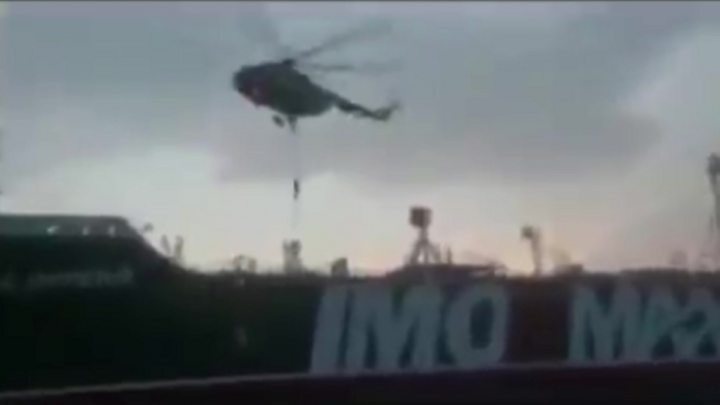
Media captionFootage released by Iran's Revolutionary Guard-affiliated Fars news agency appears to show Stena Impero being seized
The MP said he understood the US had offered the UK "assets" to support its shipping and they were not taken up.
"This is a major failure and the government has to answer that charge very quickly indeed."
Defence minister Tobias Ellwood told Sky the Royal Navy was too small to manage the UK's interests around the globe but had not been negligent in protecting its ships.
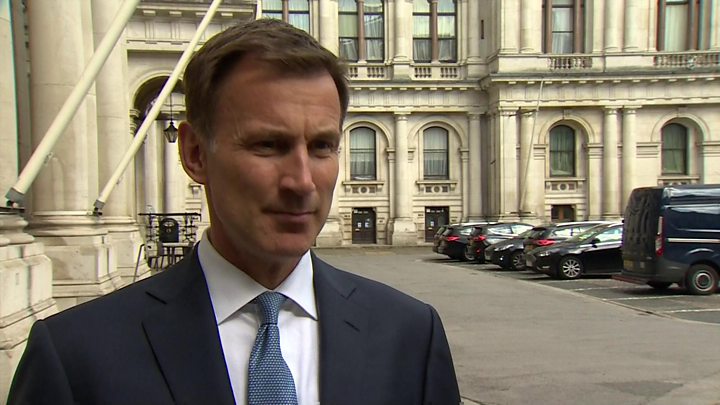
Foreign Secretary Jeremy Hunt earlier said Iran viewed this as a "tit-for-tat situation" but "nothing could be further from the truth".
Labour shadow justice minister Richard Burgon said the UK should avoid becoming Donald Trump's "sidekicks" and warned a US-backed conflict with Iran could be worse than the Iraq War.
What happened?
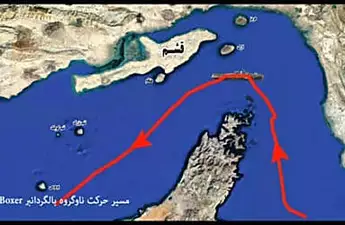
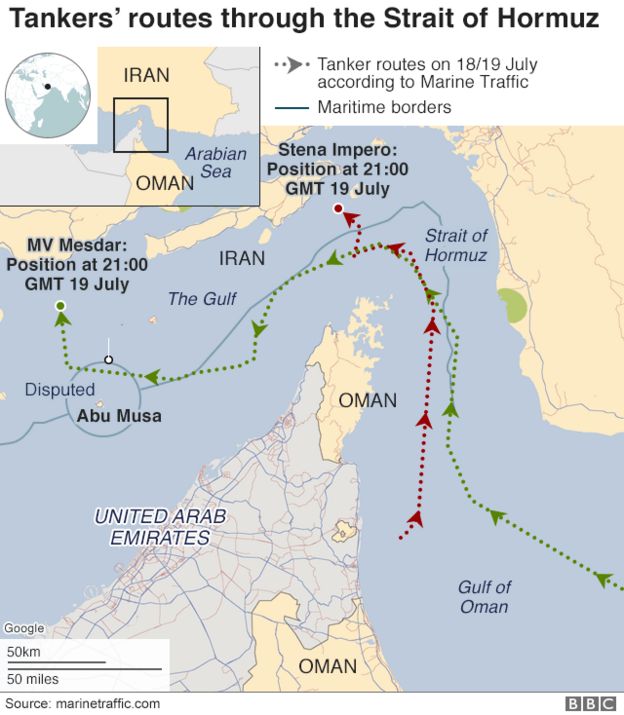
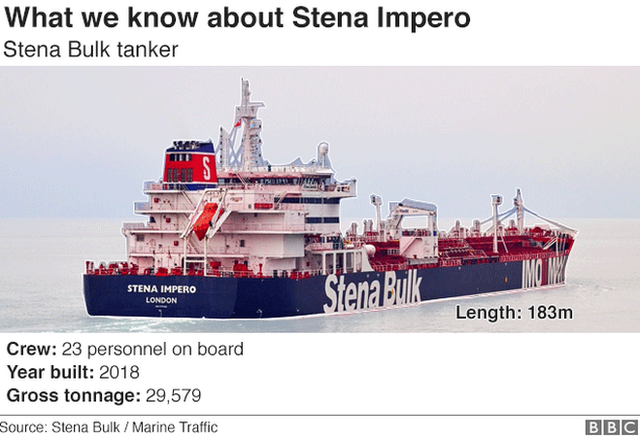
On Friday, the Stena Impero was seized by the Iranian Revolutionary Guard in the Strait of Hormuz after Tehran said it was "violating international maritime rules".
A second tanker, the British-owned MV Mesdar, was also boarded by armed guards but released.
Video released by Iran's Revolutionary Guard-affiliated Fars news agency appeared to show the moment the tanker was raided.
HMS Montrose was alerted but it was too far away to stop the seizure.
Iran's state-run IRNA news agency said the tanker was captured after it collided with a fishing boat and failed to respond to calls from the smaller craft.
But Mr Hunt said it was seized in Omani waters in "clear contravention of international law" and forced to sail into Bandar Abbas port in Iran.
The tanker's owners, Stena Bulk, said it has made a formal request to visit the crew members.
The seizure of the Stena Impero comes two weeks after Royal Marines helped seize Iranian tanker Grace 1 off Gibraltar, because of evidence it was carrying oil to Syria in breach of EU sanctions.
He said Iran guarantees the security of the Gulf and the Strait of Hormuz, and insisted its action were to "uphold international maritime rules".
Iran's ambassador to London has warned the UK against escalating tensions.
Hamid Baeidinejad said in a tweet: "This is quite dangerous and unwise at a sensitive time in the region. Iran however is firm and ready for different scenarios."
Media captionWhy does the Strait of Hormuz matter?
What's the background to tensions in the Gulf?
Relations have been deteriorating between Iran and the UK and US.
In April, the US tightened sanctions it had re-imposed on Iran after withdrawing from a 2015 nuclear deal.
Last week, the UK said Iranian boats also attempted to impede a British oil tanker in the region before being warned off by HMS Montrose but Iran denied this.
International reaction
The White House said Friday's incident was the second time in more than a week the UK had been "the target of escalatory violence" by Iran.
US Central Command said it was developing a multinational maritime effort in response to the situation.
France and Germany called on Iran to release the Stena Impero.
Diplomatic solution 'will be complicated'
A diplomatic solution to this crisis is going to be complicated, not least because Britain's relationships with its traditional partners - the US and the Europeans - are under strain.
Diplomatic pressure - action at the UN or tough economic sanctions - requires the building of a coalition.
Think back to the collective action taken against Moscow in the wake of the murder of a British woman by Russian agents in Salisbury.
The US and Britain's Nato and European allies all expelled Russian diplomats in an impressive show of solidarity.
But will the same solidarity be shown towards Tehran?
France and Germany have given London rhetorical support. President Trump is standing beside his British ally.
But the US and the EU are fundamentally at loggerheads over the fate of the nuclear deal with Iran and what many European capitals see as a thinly disguised US policy that seeks regime change in Tehran.


![[Photos] This is What Happened When His Wife Met the Gorilla He Raised](https://images.outbrainimg.com/transform/v3/eyJpdSI6ImJiMGQzYmMzNWMyOTg0MDY4MDI3ZWQ4OTY1ZDA1ZWM4ZTY0Yzg0ZDZlZWZhYTQ3MDA1NGIwNTA0MTI4YzFjODUiLCJ3IjoyMzAsImgiOjE1MCwiZCI6MS41LCJjcyI6MCwiZiI6NH0.webp "[Photos] This is What Happened When His Wife Met the Gorilla He Raised")


![Hilarious T-shirt Fails You Have to See to Believe! [Gallery]](https://images.outbrainimg.com/transform/v3/eyJpdSI6ImQ4NGZlNGNjYWY2YmQyOWVmZmM3MDZhZDU4ZGIzMzgyNzc2NTFlYzg1MmM5Y2I5ZmVmODY2MzJjNDExZmYwYjEiLCJ3IjoyMzAsImgiOjE1MCwiZCI6MS41LCJjcyI6MCwiZiI6NH0.webp "Hilarious T-shirt Fails You Have to See to Believe! [Gallery]")

![[Photos] US Navy Warships: The Navy's New Battleship Is A Beast!](https://images.outbrainimg.com/transform/v3/eyJpdSI6ImM4MmM3MzlkNWQzZmM2MjY0Nzk5YmNkMDdkNDI1YmNhM2Q5ZTNlYzBiZmMwN2E1NzYxYWM0NDkwODk2MmI2NTIiLCJ3IjoyMzAsImgiOjE1MCwiZCI6MS41LCJjcyI6MCwiZiI6NH0.webp "[Photos] US Navy Warships: The Navy's New Battleship Is A Beast!")









![[Photos] Dads Left Alone With Baby Go Viral](https://images.outbrainimg.com/transform/v3/eyJpdSI6IjE2YTg3NDM5M2IxZWRkZTlmNjBjYmZjNjc0NTFkYjk3NmM0YWNkNmQ3OGI1NGFmMmFjZDJhZDc3NTVjZWMyYjUiLCJ3IjoxNjAsImgiOjkwLCJkIjoxLjUsImNzIjowLCJmIjo0fQ.webp "[Photos] Dads Left Alone With Baby Go Viral")
![[Photos] The Wealthiest Actor Of All Time Is In Game Of Thrones](https://images.outbrainimg.com/transform/v3/eyJpdSI6ImYzOWVmZjlhY2M5NTdjNDkyODRlNDkzOWY1ZDU1YWRjYTdmYmZhMzA1NmEzY2MyMzY1YTNlMDc2ZWRhMDU0ZjIiLCJ3IjoxNjAsImgiOjkwLCJkIjoxLjUsImNzIjowLCJmIjo0fQ.webp "[Photos] The Wealthiest Actor Of All Time Is In Game Of Thrones")
![[Photos] Shipwreck Found Off Of North Carolina Confirmed To Be Blackbeard's](http://www.pastfactory.com/history/discovery-of-blackbeards-ship/?utm_campaign=ojq-d-us-n-es-0-190624-pa-ob-a4-em&utm_term=3_ojq.jpg&utm_source=ob&utm_medium=$section_id$-ob&utm_content=004c29a6c5014b6a9b75483d7fb8de6589&obOrigUrl=true "[Photos] Shipwreck Found Off Of North Carolina Confirmed To Be Blackbeard's")
