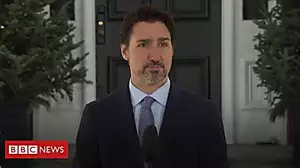
OTTAWA - A clearly unhappy Canadian Prime Minister Justin Trudeau on Monday said people defying advice to isolate themselves to fight a coronavirus outbreak should “go home and stay home” or face sanctions.
Canada's Prime Minister Justin Trudeau attends a news conference as efforts continue to help slow the spread of coronavirus disease (COVID-19) in Ottawa, Ontario, Canada March 23, 2020. REUTERS/Blair Gable
Trudeau also said the federal government would offer an additional C$5 billion ($3.4 billion) line of credit for farmers and agricultural producers to help them through a crisis that is battering the economy.
The number of people in Canada diagnosed with the coronavirus rose to 1,474 on Monday from 1,430 on Sunday, and the death toll stayed at 20, medical officials said.
Although Ottawa and the 10 provinces have urged Canadians to stay at home, and in some cases put limits on gatherings, Trudeau said too many people were still disregarding the advice.
“We’ve all seen the pictures online of people who seem to think they are invincible. Well, you’re not,” Trudeau said.
ADVERTISEMENT
“Enough is enough. Go home and stay home ... we’re going to make sure this happens, whether by educating people more on the risks or by enforcing the rules if that’s needed,” he told a daily news conference outside his residence, where he has been confined since his wife was diagnosed with the virus.
Federal and provincial officials said on Sunday that people ignoring advice to self-isolate or avoid large groups could be fined or even arrested.
Trudeau is due to speak to the provincial premiers later on Monday to coordinate the messaging on self-isolation. All the provinces have imposed some sort of state of emergency.
He also said he would discuss with them what the federal government could do under the 1988 Emergencies Act, which allows Ottawa to impose strict limits on the movement of people.
Officials said last week that using the act would be a last resort. Trudeau reiterated that “we haven’t taken anything off the table”.
ADVERTISEMENT
Legislators are due to return to Ottawa on Tuesday to pass a package of stimulus measures and tax relief worth a total of C$82 billion.
Trudeau, who says more steps to help the economy are coming, also said Ottawa would defer C$173 million in federal loans to farmers and invest C$192 million into vaccine research and production.
A number of US states have ordered shutdowns with one in five Americans soon set to be under a "stay at home" order.
Connecticut and New Jersey are joining Illinois and California in ordering residents to stay at home in order to combat the spread of coronavirus.
New York State has ordered non-essential businesses to close.
The virus has claimed nearly 230 lives in the US and infected more than 18,500 people.
Globally more than 270,000 patients have tested positive for the respiratory illness and more than 11,000 have died.
What measures are the states taking?
On Friday, Connecticut, Illinois and New York state announced measures directing tens of millions of people to stay at home. The restrictions order most workplaces to close and require residents to remain inside except for trips to grocery stores, pharmacies and gas stations.
In New York, Governor Andrew Cuomo restricted public gatherings and ordered all "non-essential workers" to stay at home. The measures come as confirmed coronavirus cases in New York reached 7,000 - the highest of any US state.
"These provisions will be enforced," Mr Cuomo told reporters. "These are not helpful hints."
New York and the neighbouring states of New Jersey, Connecticut and Pennsylvania also issued a joint order on Friday for the closure of all "personal care" businesses, such as hair and nail salons and piercing and tattoo parlours.
All outdoor team sports such as basketball games are also banned under the measures, which take effect on Sunday night.
The announcement comes after California Governor Gavin Newsom issued a similar order, telling all residents to stay at home. He estimated more than half of the 40 million people in his state would contract Covid-19 in just the next two months.
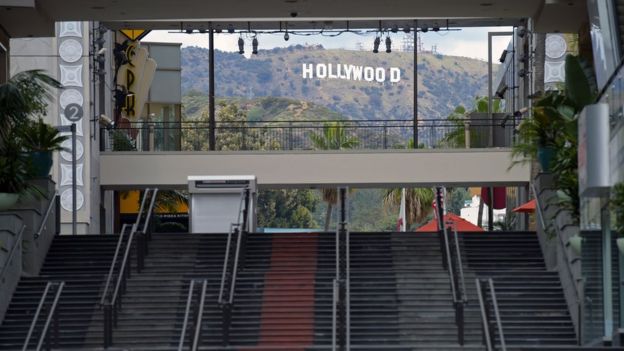
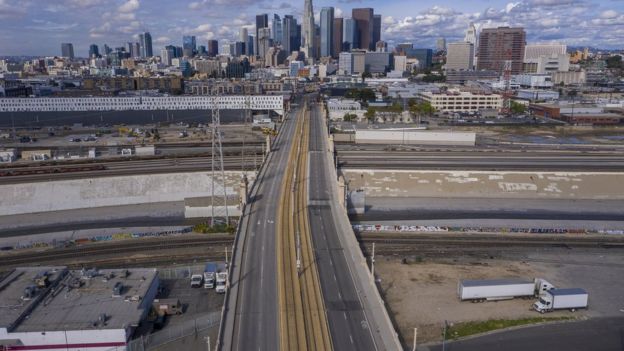
Images from Los Angeles show some of the city's most famous landmarks completely deserted while the freeways are almost empty.
Image copyrightGETTY IMAGESImage captionImages from Los Angeles show some of the city's busiest spots left completely empty
Illinois has also ordered all residents indoors with exceptions to shop for food and medicine or take exercise.
Nevada announced its own ban on non-essential businesses on Tuesday. In Hawaii, bars and clubs have been ordered to close and social gatherings have been limited to groups of 10, according to the New York Times.
President Trump has so far ruled out any nationwide lockdown.
He said during a press conference on Friday: "I don't think we'll ever find (a US shutdown) necessary". He added that the US was "winning" the war against the virus.
As both the number of cases and the global death toll continued to soar, many countries and regions took new measures on Friday, including:
Spain: The government warned that army patrols would catch people outside without good reason
Bavaria: Germany's second most populous state became the first state in impose a lockdown
France: Police said patrols at Paris railway stations had been reinforced to stop people going on trips for the weekend
Indonesia: A state of emergency will be in force in the capital Jakarta from Monday - bars, cinemas and many other businesses will be shut down.
Life goes on
By Sophie Long, BBC News, Los Angeles
These may be the most restrictive measures to be put in place in modern Californian history, but in Los Angeles life goes on and the streets are far from empty.
In a city famous for its gridlocked rush-hour traffic, cars are moving more freely past the palm trees on Sunset Boulevard. In Hollywood cyclists still overtake joggers and families still go out for a stroll. But these could all be seen as essential excursions.
People have been told that those who work in critical sectors should still go to work. Busses are still running and grocery stores, pharmacies and banks are all still open.
But many people are staying at home and friends and neighbours are keeping their distance. Restaurants and bars closed their doors days ago, but now all gatherings outside the home have been banned and there is no indication when the restrictions will be lifted.
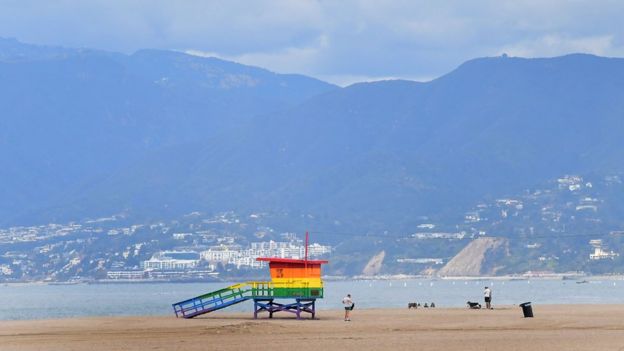
Image copyrightGETTY IMAGESImage captionLike a scene from a disaster movie, a road in Los Angeles is almost empty as the lockdown bitesImage copyrightGETTY IMAGESImage captionVenice Beach in Los Angeles on the first day of lockdown
Why has the US restricted border traffic with Mexico and Canada?
Also on Friday, the US suspended all non-essential traffic across its borders with both Mexico and Canada.
The curbs take effect at midnight on Saturday but will not affect trade, Secretary of State Mike Pompeo said.
President Donald Trump said on Friday: "In normal times, these massive flows [of immigrants] place a vast burden on our healthcare system, but during a global pandemic, they threaten to create a perfect storm that would spread the infection to our border agents, migrants and to the public at large."
Hours after he spoke, the White House announced that a staff member in Vice-President Mike Pence's office had tested positive for coronavirus, though a spokeswoman said the unnamed patient did not come into close contact with Mr Pence or Mr Trump.
Earlier this week President Trump announced that the border with Canada would be closed to non-essential traffic "by mutual consent".
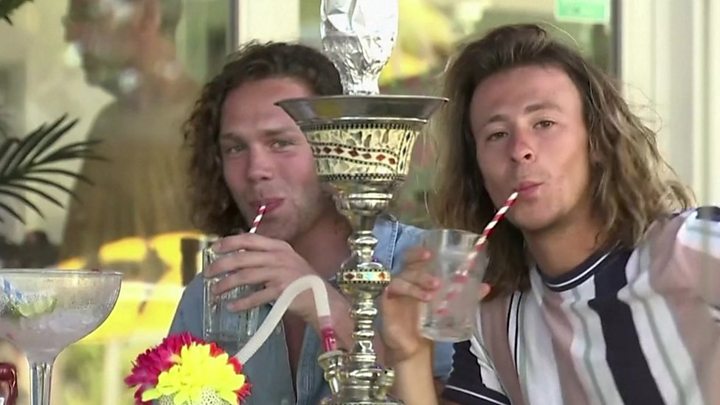
Media captionStudents on spring break defy Covid-19 warnings
During Friday's news conference, Mr Pompeo said the restrictions would take effect on Saturday and also apply to Mexico. They are due be in place for at least 30 days.
US citizens "should arrange immediate return" unless they intend to remain abroad for some time, Mr Pompeo said.
Acting Homeland Security Secretary Chad Wolf said the US was "working with both our Canadian partners as well as our Mexican partners".
He added: "We want to make sure cargo continues, trade continues, healthcare workers continue to be able to traverse that border. But tourism, some recreational activities and other things need to stop during this crisis."
The announcement comes as Canadian Prime Minister Justin Trudeau said asylum seekers crossing into the country on foot from the US would be turned back as part of the border shutdown.
How have the president's businesses been affected?
According to US media, Mr Trump's Mar-a-Lago golf club in Palm Beach, Florida, has closed following an order by the state's governor to shut all bars and restaurants.
A spokesperson for the Trump Organization would not confirm the mothballing of the resort, but told CNN: "Various facilities are temporarily closed given local, state and federal mandates.
"We anxiously await the day when this pandemic is over and our world-class facilities can reopen."
Mr Trump's hotel in Las Vegas has already closed after coronavirus restrictions were introduced by the governor of Nevada.
The president's hotels in New York and Washington DC remain open, though more than 200 staff have reportedly been laid off as their occupancy rate plunges amid the pandemic.
The bar and restaurant of the Trump International Hotel in the nation's capital have shut in response to a virus-containment directive from the city authorities.







![[Gallery] These Four Sisters Decided To Surprise Their Parents While They Were On Vacation](https://images.outbrainimg.com/transform/v3/eyJpdSI6IjAwZmZiM2YyMjc1ZDhiZWRmYmI3OTM2NWQ0NWNmYTBkOWVlYTlkODBlOTAzMmQ2NzdhMTM5Y2JhOWYxNGIyNzgiLCJ3IjoxNjAsImgiOjkwLCJkIjoxLjUsImNzIjowLCJmIjo0fQ.webp "[Gallery] These Four Sisters Decided To Surprise Their Parents While They Were On Vacation")