Biodun Iginla, BBC News

Biodun Iginla, BBC News
Showing posts with label Nancy Pelosi. Show all posts

Sunday, March 15, 2020

ANALYSIS: U.S. eyes aid for airlines; sees no domestic travel curbs for now

March 16, 2020  07H17  GMT/ZULU
WASHINGTON - U.S. Treasury Secretary Steven Mnuchin on Sunday said he was in close touch with Congress about helping U.S. airlines weather a massive downturn in business due to sweeping travel restrictions aimed at containing the coronavirus.
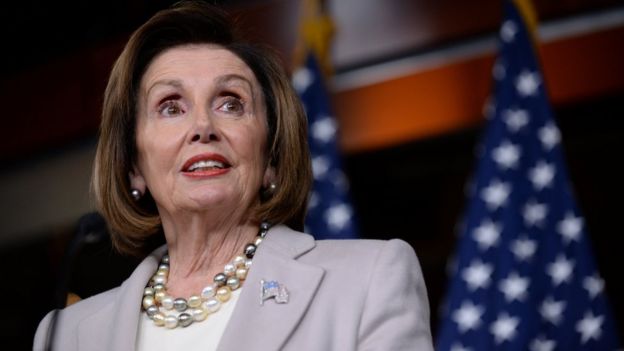
Mnuchin told ABC News’ “This Week” program he was talking with U.S. House of Representatives Speaker Nancy Pelosi about measures this week to help airlines and other sectors reeling from a collapse in demand due to the coronavirus pandemic.
“We need to focus on the airline industry. This is an unprecedented situation,” he told the ABC program. “The president is going to use all the tools that are in the toolbox, and we will work with Congress on a bipartisan basis.”
“The Speaker and I are already in conversations about airlines, which (are) critical to us, hotels, cruise ships, more SBA lending, more liquidity, some type of stimulus,” he added.
ADVERTISEMENT
Delta Air Lines Inc (DAL.N) on Sunday said it will halt service to London from Detroit and Dublin flights from New York after the White House announced it was imposing new travel restrictions on United Kingdom and Ireland.
American Airlines Inc (AAL.O) on Saturday said it plans to cut 75% of its international flights through May 6 and ground nearly all its widebody fleet.
Delta, American Air Lines and United Airlines, the three largest U.S. airlines, are in talks with the U.S. government about potential assistance, but no details have emerged.
White House economic adviser Larry Kudlow told CBS’s “Face the Nation” program the administration would discuss “a number of new proposals” for the airlines with U.S. lawmakers this week, but gave no details.
ADVERTISEMENT
Top U.S. infectious diseases expert Anthony Fauci on Sunday warned Americans that the coronavirus outbreak could get worse before it gets better, but said he did not expect the United States to restrict domestic travel in the near future.
Fauci, director of the National Institute of Allergy and Infectious Diseases, told ABC News’ “This Week” program he was confident the U.S. government was doing everything needed to contain the outbreak and avert a worst-case scenario.
The disease has infected some 156,465 people have been around the world, and 5,838 have died, according to a Reuters tally. The United States has reported at least 59 deaths.
Fauci told ABC that early U.S. moves to block travel from China had helped, as would new restrictions on travel from Europe. He said there had been some discussion on the president’s coronavirus task force about limiting travel within the United States, but he did not see that happening for now.
“They’ve been discussed, but not seriously,” he said. “I don’t see that right now in the immediate future. But remember, we are very open-minded about whatever it takes.”
Slideshow (6 Images)
Mnuchin told “Fox News Sunday” the government would focus on shoring up the airline, hotel and cruise ship industries, but insisted that would not amount to any kind of “bailout.”
“If you’re providing liquidity to good businesses that just need liquidity for three to six months, where you’re taking collateral and you have security, that’s not a bailout,” he said.

Wednesday, November 6, 2019

ANALYSIS: Gordon Sondland’s testimony: Republicans

by Melissa Gruz and Biodun Iginla, The Economist Intelligence Unit Political News Analysts


Impeach cobbler
Gordon Sondland’s testimony forces Republicans to shift arguments

The evolution of the defence, from “no quid pro quo” to “quid pro so?”
United States


STEVE SCALISE, the House Minority Whip, brought a visual aid to the House floor in the run-up to a vote formalising the impeachment inquiry. It depicted the Red Square’s onion domes, and blasted the Democrats’ “37 Days of Soviet-Style Impeachment Proceedings”. Though the Soviet Union lacked a constitutional mechanism whereby freely elected legislators could censure and remove the country’s executive, following months of open hearings and a public trial, Mr Scalise’s point was that the impeachment process—which has so-far operated behind closed doors—is some kind of show trial.
That is one of two main defences of President Donald Trump offered by congressional Republicans. The other is that there was no quid pro quo in withholding military aid to Ukraine, as Mr Trump himself has repeatedly asserted. This implies that asking for foreign help in an American election is perfectly fine; the impeachable conduct would be demanding something in return. Both these lines are starting to fray.
The first was always rather weak. Just as a criminal trial involves a grand jury gathering information to determine whether to indict, an impeachment inquiry involves the House doing the same. Closed-door hearings have long been a feature of congressional oversight. Nancy Pelosi, the House speaker, has given Republicans the full House vote that they long demanded. And next week open hearings begin.
The second defence has grown difficult to sustain as witness after witness has testified, under oath, that there was in fact a quid pro quo. Gordon Sondland, America’s ambassador to the EU, is the newest member of this chorus line. Mr Sondland had previously testified that he never talked to Ukrainian officials about opening an investigation, that he never thought there was any precondition attached to the military aid, and that he “didn’t know why” it was delayed.
In a revision released on November 5th, Mr Sondland wrote that testimony from William Taylor, America’s top diplomat in Ukraine, and Tim Morrison, until recently the National Security Council’s top adviser on Russia and Europe, had “refreshed my recollection”. Mr Sondland said he now recalls a conversation with Andriy Yermak, an adviser to Ukraine’s president, Volodymyr Zelensky, “where I said that resumption of US aid [to Ukraine] would likely not occur until” Mr Zelensky made the “public anti-corruption statement” demanded by Mr Trump. He said he had “no reason to question the substance” of Mr Morrison’s recollection that aid “might be conditioned on a public statement reopening” an investigation into the firm that employed Joe Biden’s son.
Mr Trump’s defenders have consequently shifted, arguing that foreign policy routinely involves quid pro quos, and that even if Mr Trump engaged in one, it is not impeachable conduct. “Get over it,” as Mr Trump’s chief of staff, Mick Mulvaney, told reporters in October. That appears to be the argument that Republicans are carrying into the next, public phase of the impeachment process. Lindsey Graham, who chairs the Senate judiciary committee and therefore could play an important role in the trial of the president in the Senate, offered another approach—less a defence than a shrug. “I’ve written the whole process off,” he told CBS, a news network. “I think this is a bunch of BS.”
Reuse this contentThe Trust Project

Thursday, October 31, 2019

BREAKING: Trump impeachment: House to vote on how inquiry should proceed


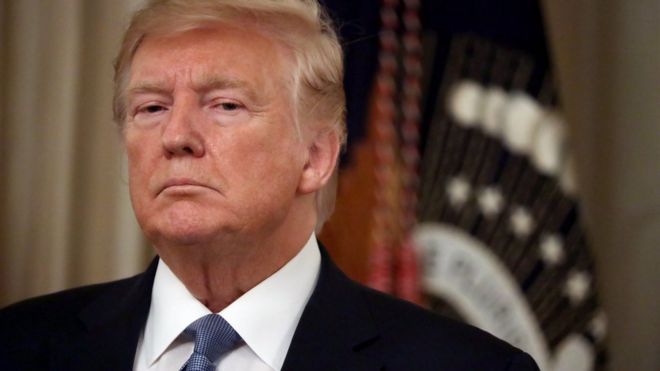
US President Donald Trump at a ceremony at the White House on 30 OctoberImage copyrightGETTY IMAGES
Image captionPresident Trump has called the impeachment inquiry a "witch hunt"
by Melissa Gruz and Biodun Iginla, BBC News, Washington
The US House of Representatives is set to vote on how the impeachment inquiry into President Donald Trump should proceed.
The resolution to be voted on sets out a more public phase of the process and is not a ballot on whether or not to impeach the president.
The measure also sets out the rights Mr Trump's lawyers would have.
This will be the first formal test of support for the inquiry in the Democratic-controlled House.
President Trump is accused of trying to pressure Ukraine into investigating unsubstantiated corruption claims against his political rival, Joe Biden, and his son who worked with Ukrainian gas company Burisma.
Mr Trump denies wrongdoing and calls the impeachment inquiry a "witch hunt".
Republicans have criticised Democrats for the closed hearings up to this point, in which Republican lawmakers have also taken part. But Democrats insist they were needed to gather evidence ahead of the public stage of the inquiry, and deny allegations they have been secretive.
The debate is expected to start at 09:00 (13:00 GMT). Democrats, who have 234 of the 435 seats in the House, need a simple majority to approve the resolution.

What does the resolution say?

Earlier this week, Democrats in the House released an eight-page document setting out a two-stage process for the next phase of the inquiry.
In the first stage, the House Intelligence Committee would continue its investigations and hold public hearings. It would have the right to make public transcripts of depositions taken in private.
Media captionTrump impeachment: Last week was the most dramatic so far
In the second stage, a public report on the findings would be sent to the House Judiciary Committee which would conduct its own proceedings and report on "such resolutions, articles of impeachment, or other recommendations as it deems proper".
President Trump's lawyers would be allowed to take part in the Judiciary Committee stage. Republicans on the committees would be able to subpoena documents or witnesses although they could still be blocked as both committees are controlled by Democrats.
Democrats are planning public hearings to be held in coming weeks and are considering the possibility of drafting articles of impeachment against the president.

What's behind the impeachment inquiry?

At the heart of the impeachment inquiry, which was announced by House Speaker Nancy Pelosi last month, is a phone call on 25 July between Mr Trump and Ukrainian President Volodymyr Zelensky.
US House Speaker Nancy Pelosi speaks during a news conference on Capitol Hill on 17 OctoberImage copyrightREUTERS
Image captionHouse Speaker Nancy Pelosi announced the impeachment inquiry last month
A rough transcript of the call shows Mr Trump asking Mr Zelensky to investigate unsubstantiated corruption claims against Joe Biden, a leading Democratic candidate to challenge Mr Trump for the White House next year, and his son, Hunter.
The Trump-Zelensky phone call was the subject of a complaint by a whistleblower, whose identity has been closely protected by lawmakers. On Wednesday, a conservative author named a CIA officer as the whistleblower.
Presentational grey line

Quick facts on impeachment

  • Impeachment is the first part - the charges - of a two-stage political process by which Congress can remove a president from office
  • If the House of Representatives votes to pass articles of impeachment, the Senate is forced to hold a trial
  • A Senate vote requires a two-thirds majority to convict - unlikely in this case, given that Mr Trump's party controls the chamber
  • Only two US presidents in history - Bill Clinton and Andrew Johnson - have been impeached, but neither was convicted and removed
  • President Richard Nixon resigned before he could be impeached
Presentational grey line

What else is happening?

Also on Thursday, Tim Morrison, who served as top adviser on Russia and Europe at the National Security Council, is expected to testify. He was one of the officials authorised to listen in on Mr Trump's call with the president of Ukraine, and unexpectedly resigned from his position on Wednesday.
Meanwhile, House investigators invited former US National Security Adviser John Bolton to testify on 7 November. His lawyer, Charles Cooper, told US media his client was not willing to appear voluntarily but that he was ready to accept a subpoena - or legal summons to compel testimony - on Mr Bolton's behalf.
US media say Mr Bolton was alarmed by a back-channel operation in Ukraine carried out by President Trump's private lawyer, Rudy Giuliani, who acknowledged last month having asked Ukraine to investigate Mr Biden.

More on this story