Biodun Iginla, BBC News

Biodun Iginla, BBC News
Showing posts with label Narendra Modi. Show all posts

Friday, December 13, 2019

US, UK warn on travel to NE India after clashes


ADVERTISING
Guwahati (India) 
Washington and London issued travel warnings for northeast India as opponents of a new citizenship law geared up for more protests Saturday, following days of clashes that saw two people killed and dozens injured.
Many in the far-flung, resource-rich region fear the new legislation will grant citizenship to large numbers of immigrants from neighbouring Bangladesh, who they accuse of stealing jobs and diluting the region's cultural identity.
No major incidents were reported overnight in Guwahati in Assam state, the epicentre of the protests, where two were shot dead and 26 hospitalised this week after security forces fired blank and live rounds, medical staff said.
ADVERTISING
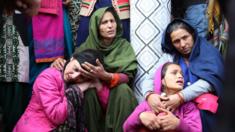
The funeral procession of 18-year-old Sam Stafford, who was killed in the firing, took place on Friday and was attended by hundreds of angry and distraught mourners who shouted "Long live Assam" in Dispur, the state capital adjoining Guwahati.
"We were watching news all day on TV about the protests when my nephew left home in the evening. We asked him not to go but he went with his friends," the student's aunt Julie Stafford told us at France24. 
Authorities announced a curfew in place in Guwahati would be lifted from 9am to 4pm Saturday.
But some protest groups said they planned to defy the curfew with more demonstrations planned for the afternoon and evening.
Samujjal Bhattacharya from the All Assam Students Union, which has been at the forefront of the protests, told us at France24 that the group would continue its fight against the new law "in the streets and in the court".
- 'Exercise caution' -
Prime Minister Narendra Modi and Japanese counterpart Shinzo Abe postponed a summit that had reportedly been due to be held in Guwahati from Sunday, and the United States and Britain warned their nationals to "exercise caution" if travelling to the wider northeast region.
Other smaller protests against the new law erupted elsewhere around India Friday, with riot police clashing with hundreds of mostly student protestors in New Delhi and demonstrators setting fire to buildings at a railway station in West Bengal, officials said.
Rallies were also held in Kerala and Karnataka in the south as well as in Modi's home state Gujarat in the west.
The Citizenship Amendment Bill (CAB) -- approved this week -- allows for the fast-tracking of applications from religious minorities from Pakistan, Afghanistan and Bangladesh, but not Muslims.
For Islamic groups, the opposition and rights organisations, it is part of Modi's "Hindutva" Hindu nationalist agenda to marginalise India's 200 million Muslims.
Modi denies this and says that Muslims from the three countries are not covered by the legislation because they have no need of India's protection.
The passage of the bill sparked angry scenes in both houses of parliament this week, with one lawmaker likening it to anti-Jewish legislation by the Nazis in 1930s Germany.
The chief ministers of several Indian states -- West Bengal, Punjab, Kerala, Madhya Pradesh and Chhattisgarh -- have said they will not implement the law.
Friday, March 8, 2019

ANALYSIS: Facts and alternative facts between India and Pakistan


An Indian paramilitary trooper stands guard in front of closed shops in Srinagar in March
An Indian paramilitary trooper stands guard in front of closed shops in Srinagar in March AFP/File
ADVERTISING
New Delhi 
India and Pakistan have retreated from the brink of possible war but an information conflict still rages over their tit-for-tat air strikes and an aerial dogfight between the nuclear-armed arch rivals.
A suicide bombing on February 14 killed 40 troops and was the deadliest attack in Kashmir on Indian forces in a 30-year insurgency by militants wanting independence or to be part of Pakistan.
ADVERTISING
Delhi has long accused Islamabad of supporting the insurgents and the attack was claimed by Pakistan-based militant group Jaish-e-Mohammed (JeM).
India and Washington say Islamabad uses groups like JeM as proxies to attack India, which despite repeated "crackdowns" manage to resume their activities.
Here is a brief summary of what both countries, which have fought three wars since 1947, have said in recent days about their most serious standoff in years.
- '250 dead' -
India launched air strikes on February 26 on what it called a JeM training camp at Balakot inside Pakistan, 12 days after the suicide bombing.
Vijay Keshav Gokhale, Indian foreign secretary, hours after its pre-dawn air raid said the target of the "pre-emptive strike" was "jihadis" in the "biggest training camp of JeM".
Gokhale said "a very large number of JeM terrorists, trainers, senior commanders and groups of jihadis who were being trained for fidayeen (suicide) action were eliminated".
While the Indian government has given no official statement about the numbers of dead, Indian local media ran several source-based reports claiming as many as 350 killed.
Leading politicians linked to Prime Minister Narendra Modi's ruling Bharatiya Janata Party (BJP) including notably BJP president Amit Shah put the death toll at 250.
Some of those asking for proof -- such as opposition politicians accusing Modi of using the crisis to boost his standing ahead of looming elections -- have gotten short shrift.
In the next raids, "opposition parties raising these questions can be tied under the jets... so that they can look at the targets," thundered junior foreign minister V.K Singh.
- Just trees? -
Pakistani officials have said that Indian warplanes did breach its airspace, dropping what military spokesman Major General Asif Ghafoor described as "payloads" near Balakot.
But Islamabad has denied there was any damage or casualties.
"Once again (the) Indian government has resorted to a self serving, reckless and fictitious claim," Foreign Minister Shah Mehmood Qureshi said.
Local residents reported hearing explosions in the night, but said only one person was injured and that no infrastructure was destroyed.
The army escorted reporters to the area, but independent reporting by multiple local and international outlets who visited the site also found no evidence of a major terrorist training camp -- or of any infrastructure damage at all.
A France24 reporter visited what his Pakistani military escort and locals said was the site and saw a crater, two trees snapped in half and three mud houses, one of which had a collapsed wall.
France24 has not independently verified if any JeM training camps are nearby. Some media have reported that a madrassa run by JeM was in the vicinity, but undamaged.
The Atlantic Council's Digital Forensic Research Lab said that open-source satellite imagery indicated "only impacts in the wooded area, with no damage being visible to the surrounding structures."
Pakistan has even -- perhaps tongue-in-cheek -- floated the possibility of lodging a complaint against India for "eco-terrorism" for killing of "dozens" of trees.
- Dogfight -
A further bone of contention is the air raid by Pakistani aircraft into Indian airspace and the subsequent aerial dogfight in the skies over Kashmir on February 27.
Pakistan said it shot down two Indian planes, one falling on the Pakistani side of the Line of Control frontier and the other on the Indian side.
Initially Pakistan said it had captured two Indian pilots but the military later clarified it had just one pilot in custody.
Attacking Pakistani "disinformation", India's Air Vice Marshal R.G.K Kapoor said India had lost just one plane, whose pilot was captured -- and later released -- by Pakistan.
Kapoor also said an Indian Mig21 had shot down one Pakistani F16, crashing on the Pakistani side, but Islamabad denied this.
"The fact... is that Indian army units had reported sighting two parachutes falling (in Pakistani Kashmir), which were of two F-16 pilots (from) the aircraft that was shot down by (a) Mig21," Kapoor said.
- 'Open space' -
Pakistan said its planes had crossed the Line of Control (LoC), their de-facto border, in broad daylight and locked on to six targets to show they could, but then hit "open space" instead.
But India rejected this too, saying that Pakistan had intended to attack Indian military installations but had been "foiled" by its aircraft.
"Although PAF bombs have fallen in the Indian army formation compounds, they were unable to cause any damage to our military installations," Kapoor said.

Monday, February 18, 2019

ANALYSIS AND BREAKING AND UPDATE: Pulwama attack: Four Indian soldiers killed in Kashmir gun battle


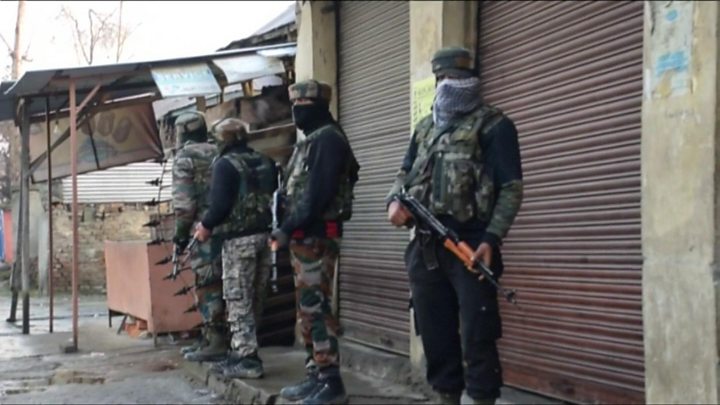
Media captionIndian troops patrol the area where the attack took place
by Susan Kumar and Biodun Iginla, BBC News Analysts, Delhi
Four soldiers have been killed in Indian-administered Kashmir in a gun battle with militants, police say.
The clash occurred in Pulwama district, where more than 40 Indian paramilitary police were killed in a suicide attack on Thursday, raising tensions between nuclear-armed India and Pakistan.
A civilian and two alleged militants were also killed as Indian troops searched for suspects.
Meanwhile Pakistan recalled its ambassador for consultations.
India had already recalled its top diplomat from Pakistan in the wake of Thursday's attack - in which it said the Pakistani state was complicit.
Pakistan denies any role in the bombing, which was claimed by a group based on its soil - Jaish-e-Mohammad (JeM)

What's happening in Pulwama?

Police say two militants who were trapped in Pinglena village were killed in Monday's operation. Both are JeM members and one is a Pakistani national, authorities said.
Heavy gunfire has been heard, and Indian security officials are appealing to villagers to stay indoors.
Police told BBC Urdu that when they fired "warning shots" at the house where the alleged militants were hiding, they fired back. One officer critically injured was taken to hospital.
The owner of the house was killed during the exchange of fire, police added.
Indian security forces have been hunting for militants with suspected links to JeM following Thursday's bombing, which saw a vehicle packed with explosives ram a convoy of 78 buses carrying Indian security forces.
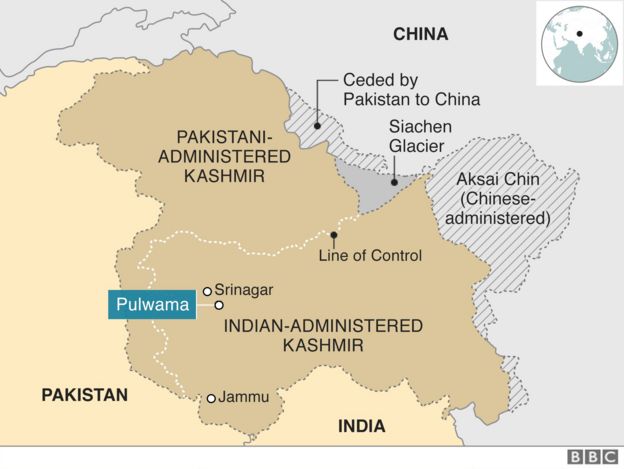
map
The suicide bomber was identified as a local Kashmiri aged between 19 and 21.
More than 20 people were detained on Sunday, according to police.

How high are tensions?

Kashmir has been a flashpoint between India and Pakistan since independence.
Both countries claim all of Muslim-majority Kashmir but control only parts of it. They have fought two wars and a limited conflict in the region.
Thursday's attack was the deadliest attack against Indian forces since an Islamist-led insurgency began in 1989. It sparked anti-Pakistan protests in some Indian cities and angry mobs targeted Kashmiri students and businessmen.
Mobile internet services in Indian-administered Kashmir were cut over the weekend and the Indian government has pulled security normally provided to at least five Kashmiri separatist leaders.
Isolated incidents of students from Kashmir being beaten up or evicted from their accommodation in northern Indian states have also been reported.
India's Central Reserve Police Force (CRPF) offered help to students in need, but also warned of false reports.
In broader terms, there has has been a spike in violence in Indian-administered Kashmir since Indian forces killed a popular militant in 2016. Significant numbers of young men have joined the insurgency in recent years and the funerals of well-known militants draw huge crowds who want to pay respects to "martyrs".
India has been accused of using excessive force to control protests with thousands of people suffering eye injuries or being blinded by pellet guns.

How might India retaliate?

Indian Prime Minister Narendra Modi, who is facing an election later this year, has vowed a strong response and says he will give the military free rein.
The last time an attack on Indian forces close to this magnitude occurred in Kashmir was in 2016, when 19 soldiers were killed at a base. In response to that, India carried out "surgical strikes" which involved Indian soldiers crossing the de facto border to hit Pakistani posts.
Media captionWhy has 2018 seen a spike in violence in Indian-administered Kashmir?
This time analysts say heavy snow in the region could make that kind of limited ground response impossible. But there are fears that going further, for example with air strikes, could lead to Pakistani retaliation and a significant escalation.
So far India has focused on retaliation by economic and diplomatic means. It has revoked Pakistan's Most Favoured Nation trading status, raised customs duties to 200% and vowed to isolate it in the international community.
Presentational grey line

Despite tensions Pakistan is calm

By Secunder Kermani, BBC Pakistan correspondent
The threat of Indian military action has not provoked widespread concern amongst the general public in Pakistan. Previous attacks by militants like JeM, believed to have close links to the intelligence services, have been seen as attempts by the Pakistani military to prevent the civilian government developing too friendly a relationship with India.
However, since Imran Khan was elected as prime minister here, many have begun to believe both the army and his administration were united in wanting to improve cross border ties.
Whether Pakistan was involved in the attack or not, it seems unlikely concerted action will now be taken against JeM. Its leader has been in "protective custody" since another attack in 2016, but still regularly releases audio messages to followers.
The group has in the past been a useful tool for Pakistan's intelligence services wanting to foment unrest across the border, and authorities may now be reluctant to confront them, in case they turn against the Pakistani state as some of their members have done in the past.

More on this story