Biodun Iginla, BBC News

Biodun Iginla, BBC News
Showing posts with label Obstruction of justice. Show all posts

Friday, April 19, 2019

ANALYSIS: Mueller report: key takeaways from the Trump-Russia probe


Joshua Roberts, REUTERS | Special Counsel Robert Mueller departs after briefing US senators on his investigation into potential collusion between Russia and the Trump campaign on Capitol Hill in Washington, US, on June 21, 2017.
US President Donald Trump may not have obstructed justice, but it wasn't for lack of trying, according to the long-awaited report by Special Counsel Robert Mueller that details multiple efforts Trump made to curtail the probe.
ADVERTISING
Mueller’s report, the result of a 22-month investigation into Russian meddling in the 2016 US elections, found no criminal conspiracy between Trump's campaign and Russia, but could not reach a concrete legal conclusion on whether the US president obstructed the investigation.
The 448-page report takes the American public inside the room with Trump as he expressed fear that the special counsel would end his presidency and made several attempts to get the people around him to curtail the probe.
FRANCE 24's Philip Crowther reports from Washington
Ultimately, Mueller found Trump's inner circle saved him from himself. They refused to carry out orders that could have crossed the line into obstructing justice.
ADVERTISING
Here are some key takeaways from the report.
  • Trump tried to influence the Russia probe
Mueller details several instances in which Trump or his campaign engaged in potential obstruction of justice.
Some occurred in public. Others behind closed doors. Trump ordered his White House counsel to try to have Mueller removed. He directed his former campaign manager to deliver a message to then-Attorney General Jeff Sessions to make a public statement calling the investigation "very unfair". He also wanted Sessions to announce that Trump had done "nothing wrong" and to say that the investigation's scope had been limited.
But people around Trump either refused or quietly allowed the matters to drop.
"The president's efforts to influence the investigation were mostly unsuccessful, but that is largely because the persons who surrounded the president declined to carry out orders or accede to his requests," the special counsel wrote.
  • No collusion, but no exoneration
The special counsel did not find a criminal conspiracy between the Trump campaign and the Russian government to interfere in the 2016 presidential election. He did not recommend charging any Trump associates as agents of the Russian government or with campaign finance violations.
But on the question of obstruction, Mueller said there was evidence on both sides of the question. He said some of Trump's actions related to potential "garden variety" obstruction.
"If we had confidence after a thorough investigation of the facts that the president clearly did not commit obstruction of justice, we would so state. Based on the facts and the applicable legal standards, we are unable to reach that judgment," Mueller wrote.
  • 'End of my presidency'
Trump's legal team has claimed "complete vindication" by the report, emphasizing that there was no evidence of collusion.
"FOR THE HATERS AND RADICAL LEFT DEMOCRATS – GAME OVER," the president wrote in a message on Twitter that, not for the first time, imitated the iconography of fantasy series "Game of Thrones."
But the report describes in detail a president driven to interfere in the probe out of fear that it would "call into question the legitimacy of his election" and his own uncertainty that his family or associates may have violated the law.
In one particularly dramatic moment, Mueller reported that Trump was so agitated at the special counsel's appointment on May 17, 2017, that he slumped back in his chair and declared: "Oh my God. This is terrible. This is the end of my presidency. I'm f---ed."
Mueller wrote that on multiple occasions Trump did things that were "capable of exerting undue influence over law enforcement investigations." Some of that was in private, one-on-one encounters that witnesses relayed to the special counsel.
But the president's public acts also raised questions that they could have led witnesses to feel intimidated or alter their testimony, moves that Mueller said were equally threatening to the "justice system's integrity."
  • Ignorance of the law was a defence
That was the case for Donald Trump Jr. and a Trump Tower meeting with a Russian lawyer.
In June 2016, Trump Jr. agreed to take the meeting despite it being described in emails as part of a Russian government effort to help his father. Trump Jr. was looking for dirt that could be used against Democratic presidential candidate Hillary Clinton.
The meeting raised questions about whether Trump Jr. and others violated the federal ban on foreign contributions to American political campaigns.
But Mueller, who interviewed many of the participants in the meeting, said he didn't find that he could bring a case.
The special counsel wrote that it was unlikely the government could prove that Trump, Jr. and others in the meeting "had general knowledge that their conduct was unlawful".
  • Mueller felt he couldn’t charge Trump – even in secret
The report reveals some of Mueller's reasoning behind why he didn't reach a conclusion on the question of obstruction.
He says that he would have exonerated Trump if he could have, but he wasn't able to given the evidence he uncovered. Still, Mueller said that the Justice Department's opinion that a sitting president couldn't be indicted meant he also couldn't recommend Trump be criminally charged, even if he made the recommendation in secret.
That's because Trump could not defend himself during a public trial while in office.
In announcing the release of the redacted report, Attorney General William Barr said he asked Mueller during a meeting in early March about the matter. Mueller replied that he didn't recommend charges against Trump solely because a sitting president cannot be indicted, Barr said.
Barr: 'White House fully co-operated with the investigation'

Monday, April 16, 2018

Analysis--James Comey against the president

Lies, ties and the law

by Rachel Rubin and Biodun Iginla, The Economist Intelligence Unit Political News Analysts, Washington DC

The former FBI director says Donald Trump is morally repugnant
IN A televised interview on April 15th, James Comey tore into the president who sacked him as FBI director last year. Donald Trump, he said, in an appearance intended to publicise his forthcoming book, “lies constantly”, runs his administration like a mob boss, treats and speaks of women like they are “pieces of meat” and is, for these and other reasons, “morally unfit” to be president.
Mr Trump also has “average size” hands, “orange” skin, hair that appears on close inspection to be real, but which must “take a heck of a lot of time in the morning” to arrange, and always wears his ties too long, said Mr Comey, whose projected self-image as a dispassionate and dutiful public servant has always been undermined by a relish for political drama.

Latest stories

See more
The president, characteristically, had got his defence in early. Hours before the interview was broadcast on ABC, he referred to Mr Comey on Twitter as a “slimeball” for the second time in three days. He also said Mr Comey, a former Republican, though he was appointed to run the FBI by Barack Obama, should be jailed for leaking classified information and lying to Congress about the circumstances that led to his sacking. Mr Comey, wrote the president, was “the WORST FBI Director in history, by far!” 
Partisans of both stripes will find vindication in this. Mr Trump’s followers, conditioned to see Mr Comey as representative of a “deep state” plot against their insurgent leader, will hear his personal contempt for the president as establishment hauteur. They will also make much of Mr Comey’s acknowledgement that he knew of no solid evidence that the Trump team colluded with Russian, despite having presided over an FBI investigation into the question. Everyone else will sympathise with Mr Comey’s view of the president’s character; even if some may question his priorities in ramping up a personal feud that will guarantee him record-breaking book sales but further weaken what remains of his reputation for impartiality. As Mr Comey is a potential witness in a possible obstruction of justice charge against Mr Trump, arising from Robert Mueller’s enquiries into the president’s decision to sack Mr Comey for refusing to quash the Russia investigation, that is a potential setback for justice.
In a searching five-hour interview, for which ABC published the transcript in full, Mr Comey provided no important revelations. His comment on possible collusion aside, he said little about Russia or Mr Mueller’s investigation. He said his sacking could amount to evidence of obstruction but not whether he thought it had. He did, however, provide some compelling new details of an earlier political controversy—his role in managing the investigation into Hillary Clinton which helped to undermine her candidacy.
Three months before the 2016 election, the FBI’s investigation into Mrs Clinton’s unusual email arrangement as secretary of state had run into the sand. Yet instead of merely announcing that the then Democratic presidential candidate would face no charge, Mr Comey held a press conference in which he accused Mrs Clinton of “extreme carelessness”. A couple of weeks before the election, he further announced that the FBI was, in effect, reopening its investigation into her. The calamitous effect these interventions appear to have had on Mrs Clinton’s standing in the polls suggest they may have cost her the election. The fact that Mr Comey meanwhile kept quiet about a coterminous counter-espionage investigation into the Trump campaign appears to be a clear double standard. Yet in his interview, Mr Comey persisted in justifying his behaviour, more painstakingly than he had previously, by presenting himself as a sacrificial lamb for his agency’s reputation.
The fact that President Barack Obama had suggested the case against Mrs Clinton was overblown, and indications of bias in favour of Mrs Clinton from Loretta Lynch, the then attorney-general, had compelled him, he suggested, in effect to over-compensate. “My view was…that in rare cases, you should offer transparency so the American people can take a look at what you did and know that it was done in an honest, competent, independent way.” Yet if this was intended to insulate the FBI against charges of political interference, it had the opposite effect. Democrats accused Mr Comey of bias; so did Mr Trump, on the basis that his harsh words against Mrs Clinton indicated that there was more to the allegations against her than the FBI director was otherwise letting on.
In an environment of hyper-partisanship, the more conspicuous any government agency makes itself, the more politicised it will almost inevitably seem. Mr Comey made the FBI far more prominent in the 2016 election than it needed to be, and the agency has paid a price for that in the cynical assault Mr Trump has launched on it ever since. Mr Mueller, who has neither spoken publicly nor permitted any leaked information, since his appointment as special council, offers a more compelling example of how to practice law enforcement in a partisan cauldron.
Mr Comey, for all his apparent faults, including an over-sized ego, a dogged refusal to admit fault and rotten political judgement, is an impressive, upright public servant. There is no equivalence between his lapses and the moral affronts of the president he correctly diagnoses. But if only Mr Comey had behaved more as Mr Mueller does. He could have spared the world a lot of trouble.

Saturday, March 17, 2018

BREAKING: Andrew McCabe: Ex-FBI deputy director gave notes to Russia inquiry


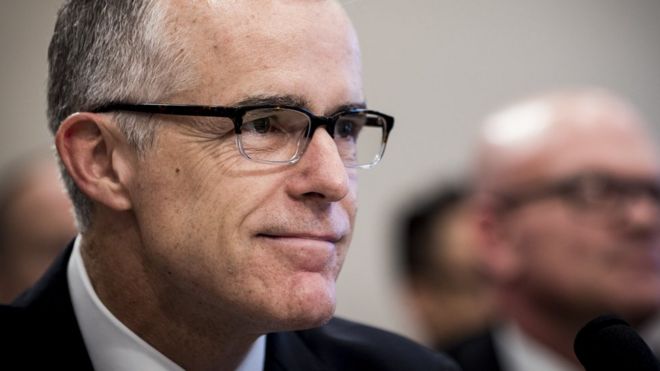
Close-in shot of Andrew McCabe testifying before a House Appropriations subcommittee in June 2017Image copyrightGETTY IMAGES
Image captionMr McCabe was fired on Friday, two days short of his expected retirement date
by Rachel Rubin and Biodun Iginla, BBC News, Washington DC
Ex-FBI deputy director Andrew McCabe has given memos about conversations he had with President Donald Trump to an inquiry into alleged Russian meddling in the 2016 election, US media say.
They say the memos could support allegations that the president sought to obstruct justice.
Mr McCabe was fired from the FBI on Friday following an internal inquiry. Mr Trump had accused him of bias.
The president has also dismissed the Russia investigation as a "witch hunt".
The investigation is led by special counsel Robert Mueller, himself a former FBI director. He has so far indicted 19 people.

Why was McCabe fired?

Mr McCabe had been under internal investigation by the FBI and had already stepped down from his deputy post in January pending the review.
He was sacked just two days short of his 50 birthday on Sunday, when he was expected to retire with a federal pension.
Attorney General Jeff Sessions said the "extensive and fair investigation" had concluded that Mr McCabe "made an unauthorised disclosure to the news media and lacked candour - including under oath - on multiple occasions".
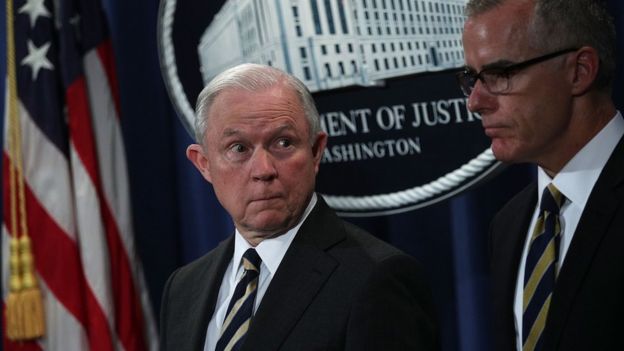
Jeff Sessions (left) looks at Andrew McCabe during a July 2017 news conferenceImage copyrightGETTY IMAGES
Image captionThe White House said it would leave the decision to fire Mr McCabe (right) to Mr Sessions (left)
Although the decision to fire Mr McCabe was made by Mr Sessions, Mr Trump had criticised him for months.
He has publicly pointed to donations that Mr McCabe's wife, a Democrat, received from a Clinton ally when she ran unsuccessfully for the state Senate in 2015 as evidence that Mr McCabe was politically biased.
In December Mr Trump tweeted: "FBI Deputy Director Andrew McCabe is racing the clock to retire with full benefits. 90 days to go?!!!"
He welcomed the news of his dismissal almost immediately after Mr Sessions announced it, calling the move a "great day for democracy".

What could the memos say?

News that Mr McCabe had kept records of his conversations with Mr Trump and FBI Director at the time James Comey emerged on Saturday.
US media say the memos will support Mr Comey's account of the circumstances of his dismissal last May.
Media captionComey's most revealing moments
Mr Comey has testified that Mr Trump had asked him for his "loyalty" and requested he drop an inquiry into his former National Security Advisor Michael Flynn.
He too has said he kept contemporaneous notes of his dealings with the president.
"I am being singled out and treated this way because of the role I played, the actions I took, and the events I witnessed in the aftermath of the firing of James Comey," his response said.
The statement alleges that the justice department report recommending his firing was "accelerated" after he indicated that he would corroborate Mr Comey's version of events.

What else happened on Saturday?

Mr Trump continued posting about Mr McCabe's departure on social media, saying there had been "leaking, lying and corruption" at the FBI, as well as the defence and state departments.
Mr Comey, who is due to release a book, said that American people would soon be able to judge for themselves "who is honourable or not" after the president again criticised him on Saturday.
Separately, the president's lawyer John Dowd issued a statement saying it was time for the special counsel's investigation to end.
In an email response to a request for comment from The Daily Beast website, Mr Dowd said he prayed that Acting Attorney General Rod Rosenstein would follow the "brilliant and courageous example" set by Mr Sessions to bring the investigation to an end.
He initially said the statement was made on behalf of the president, before walking back and saying the comments were made in a personal capacity.
The statement provoked an angry response from Democrats.
The statement was echoed by Sen Patrick Leahy, who said the Senate Judiciary Committee should hold a hearing on the "attempted politicisation of the FBI".
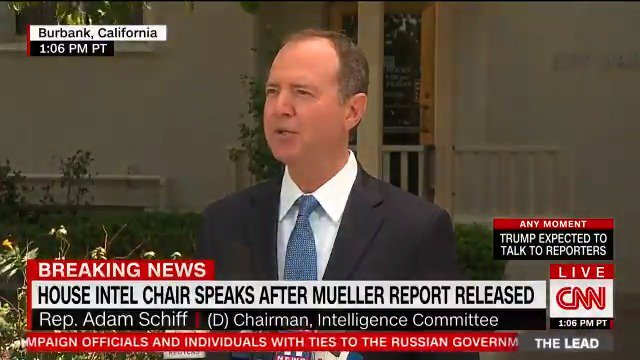
Democratic Congressman Adam Schiff tweeted: "Obstruction of justice is no less a threat to our democracy when done in the open than behind closed doors."

More on this story