
November 20, 2019 01H:17 GMT/ZULU
HONG KONG - Some anti-government protesters trapped inside a Hong Kong university on Wednesday tried to flee through the sewers, where one student said she saw snakes, but firemen prevented further escape bids by blocking a manhole into the system.
Reuters witnesses said fewer than 100 protesters remained inside the Polytechnic University, surrounded 24 hours a day by riot police, after more than 1,000 were arrested beginning late on Monday.
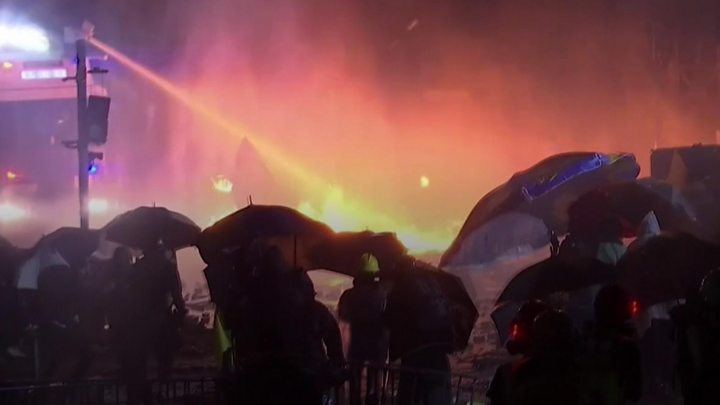
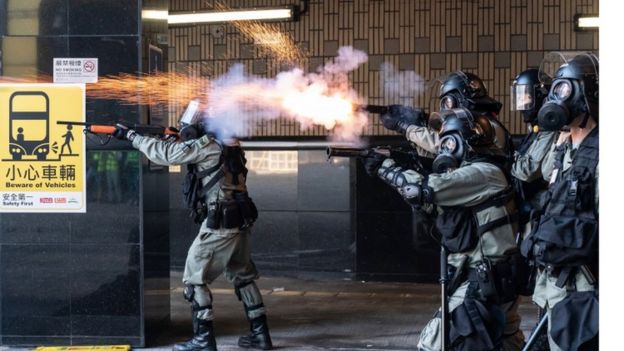
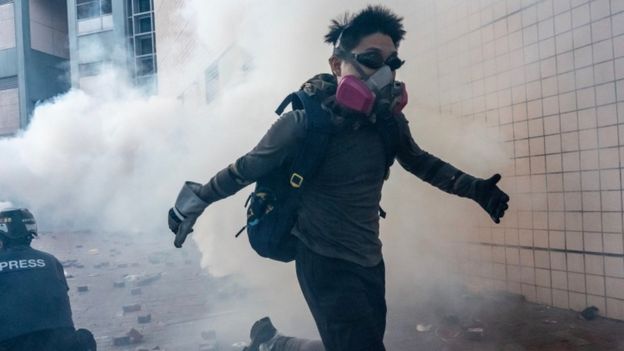
Some surrendered while others were held during escape attempts that included trying to clamber down ropes to waiting motorbikes on Monday night, with protesters throwing petrol bombs and police responding with tear gas, rubber bullets and water cannon.
“I told my mom when the police started storming that I wasn’t leaving. I told her: ‘I want a democratic society and you are not willing to stand up and fight for it’,” Jack, 21, an accounting and finance student, said on Wednesday.
“She wrote back with a crying emoji,” he said. “My parents just keep saying they love me, and to keep healthy.”
The streets were quiet on Tuesday and Wednesday.
Protesters, wearing waterproof boots and carrying torches, resurfaced inside the campus after unsuccessfully probing the sewers - where fast-rising water levels are also a hazard - for a way out during the night.
Police said six people were arrested on Wednesday - four while removing a manhole cover outside the campus and two climbing out.
Firefighters, whom the students let on to the campus, were in place to stop any further attempts, blocking the only feasible entrance into the sewer system in an underground car park on campus.
“The sewer was very smelly, with many cockroaches, many snakes. Every step was very, very painful,” said Bowie, 21, a student at Hong Kong University who was forced to turn back.
ADVERTISEMENT
“I’d never thought that one day I would need to hide in a sewer or escape through sewers to survive.”
The university on the Kowloon peninsula is the last of five that protesters had occupied to use as bases from which to disrupt the city over the past 10 days, blocking the central Cross-Harbour Tunnel and other arteries.
“This mission is a loss,” said Brutus, 21, who became a protest frontliner in August. He and his girlfriend were taking a break to eat an orange, a Snickers bar and hard-boiled eggs in one of the classrooms.
“After all of the things that happened, I don’t think protesters taking control of the universities was a good option. We don’t have gear like the police. We are not well-organized like the police.”
Brutus said he also felt bad about damage to the university. Breaking the CCTV cameras was fine, he said, because that was about protecting people. But other damage was wrong – especially to the library.
“We are here to learn. Now we can’t pass those books to the students coming in next year. That is a great loss.”
He and his girlfriend left to look for a way to escape.
ROTTEN FOOD
Police said nearly 800 people had left the campus peacefully by late on Tuesday and they would be investigated, including nearly 300 under the age of 18. At least 24 were seen walking out on Wednesday.
Hong Kong leader Carrie Lam has called for a humane end to a siege that saw the most intense clashes since the protests escalated more than five months ago.
Police said they had no plans to storm the campus, now wrecked and daubed with graffiti, parts of it stinking of petrol used to make Molotov cocktails and rotten food, with broken glass everywhere.
“Ideas are bulletproof,” was spray-painted in a few places.
ADVERTISEMENT
Demonstrators are angry at what they see as Chinese meddling in freedoms promised to Hong Kong when the then British colony returned to Chinese rule in 1997. They say they are responding to excessive use of force by police.
The unrest marks the most serious popular challenge to Chinese President Xi Jinping since he came to power in 2012.
Police have made more than 5,000 arrests in connection with the protests since June.
Chinese leaders say they are committed to Hong Kong’s “one country, two systems” formula for autonomy and have accused foreign countries, including the United States and Britain, of stirring up trouble.
Ties between China and those two countries came under strain over Hong Kong on Wednesday.
The U.S. House of Representatives passed two bills aimed at supporting the protesters and sending a warning to China about human rights, sending them to the White House for President Donald Trump to sign or veto amid delicate trade talks with Beijing.
The House voted 417 to 1 for the “Hong Kong Human Rights and Democracy Act,” which passed the Senate unanimously on Tuesday.
The legislation, which has drawn condemnation from Beijing, would require the State Department to certify at least once a year that Hong Kong retains enough autonomy to qualify for the special U.S. trading consideration that helped it become a world financial center.
It also would provide for sanctions against officials responsible for human rights violations in Hong Kong.
The House passed by 417 to 0 a second bill, which the Senate also approved unanimously on Tuesday, to ban the export of certain crowd-control munitions to Hong Kong police forces. That measure bans the export of items such as tear gas, pepper spray, rubber bullets and stun guns.
Before the votes, Beijing vowed to take counter-measures to safeguard its sovereignty and security.
British Foreign Secretary Dominic Raab condemned China’s treatment of Simon Cheng, a former employee of Britain’s Hong Kong consulate, who said secret police beat him seeking information about the protest movement.
ADVERTISEMENT
“We were shocked and appalled by the mistreatment he suffered while in Chinese detention, which amounts to torture,” Raab said.
A Chinese foreign ministry spokesman said Cheng had been detained for 15 days and had admitted his offences. All of his legal rights were safeguarded, the spokesman said.













![[Photos] They Definitely Regret These Hilarious Tattoos](https://images.outbrainimg.com/transform/v3/eyJpdSI6IjdkYTlkYTM3N2YzM2M5ZmY1NmEwMDVmMTE4YmI2NzUzYTkwMWU4ZDY4MWZhNTFmNzUwNDZjZWU0ZTlkN2MzZjUiLCJ3IjoxNjAsImgiOjkwLCJkIjoxLjUsImNzIjowLCJmIjo0fQ.webp "[Photos] They Definitely Regret These Hilarious Tattoos")
