Biodun Iginla, BBC News

Biodun Iginla, BBC News
Showing posts with label Rail. Show all posts

Saturday, February 9, 2019

Analysis: The giant Chinese companies shaping the world's industries


CRRC, the world's largest train maker, is not the only industrial behemoth to emerge from China
CRRC, the world's largest train maker, is not the only industrial behemoth to emerge from China dpa/AFP/File
ADVERTISING
Paris 

It was fear of being dominated by a Chinese behemoth that sparked an attempt by large French and German rail companies to join forces to create an European industrial champion.
The merger by Alstom and Siemens was vetoed by the EU on Thursday, but concerns about the overwhelming power of vast, often state-backed Chinese companies is not limited to the rail industry.
ADVERTISING
Here are some of areas in which Chinese companies control a large piece of the global market.
- Rail -
China's state-backed CRRC is the world's largest train manufacturer, with locomotives and wagons ordered across the globe from Boston to Philadelphia, Cambodia to Colombia, and customers including the iconic London Underground and Germany's Deutsche Bahn.
Its annual revenues of 26 billion euros (29 billion dollars) alone outweigh the three Western heavyweights Bombardier, Siemens and Alstom, each of which brings in around nine billion a year.
- Agrichemicals -
The state-owned ChemChina became one of the world's seeds and pesticide producers when it acquired Swiss pesticide giant Syngenta for $43 billion in 2017, putting it in competition with Monsanto and DowDupont.
It was the biggest overseas acquisition by a Chinese firm yet, ahead of the $15.1 billion purchase of Canada's Nexen Energy by China's state oil firm CNOOC in 2013.
ChemChina also controls Italian tyremaker Pirelli and German machinery firm KraussMaffei.
- Energy -
The state-run China National Nuclear Corp (CNNC) launched its locally developed Hualong One nuclear reactor in 2015 to compete with French and US models, selling to Argentina and Pakistan.
Chinese solar panel manufacturers Jinko, Trina and Solar dominate the global market.
And Chinese oil companies -- CNOOC, CNPC and Sinopec -- are investing heavily even as their global rivals cut spending.
- Aviation -
China's state-owned plane-maker Comac expects to deliver its first home-made passenger jet to a customer in 2021, as it seeks to challenge the dominance of Boeing and Airbus.
The company says it has received a thousand orders for its 168-seater C919 plane.
- Food -
The state-owned food giant COFCO is playing an increasing role in world grain trading after purchasing the agricultural arm of Singaporean commodities trader Noble as well as Dutch Nidera.
China's WH Group became the world's largest pork producer in 2013, when it purchased major US pork and hot dog producer Smithfield Foods Inc.
- Drones -
Founded by a Chinese university student in 2006, DJI has become the world's top civilian drone maker with 70 percent of the market, outpacing its French rival Parrot.
- Smartphones -
Chinese smartphone makers are taking a larger slice of the global market, with Huawei at 15 percent, Xiaomi 8.7 percent and Oppo 8.1 percent.
Phone sales by Huawei and Oppo surged by 30 percent last year, defying a downward trend that hit rivals Apple and Samsung.
- Home appliances -
China's Haier Group is the world's leading manufacturer of home appliances with around 10 percent of the market, ahead of rivals Whirlpool and Electrolux.
Haier even purchased the appliances arm of US giant General Electric in 2016.
- Batteries -
Chinese firm CATL, which supplies batteries for car titans Volkswagen, Ford and Daimler, is battling with Japan's Panasonic for the world's lithium electric car battery top spot.
Its production capacity will increase fivefold by 2020 due to a mammoth new factory in China, and the firm has announced a huge factory in Germany to supply European customers.
- Freight -
The state-owned Cosco Group is the world's third biggest shipping company with 50 container ports across the globe, including Greece's Piraeus and Spain's Bilbao.

Monday, January 15, 2018

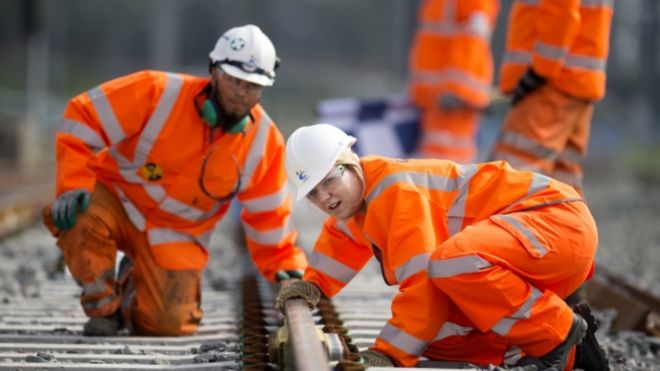
Carillion collapse raises job fears


Carillion workersImage copyrightCARILLION
by Selina O'Grady and Biodun Iginla, BBC News Business reporters, London
Construction giant Carillion is to go into liquidation, threatening thousands of jobs.
The move came after talks between the firm, its lenders and the government failed to reach a deal to save the UK's second biggest construction company.
Carillion ran into trouble after losing money on big contracts and running up huge debts.
Its failure means the government will have to provide funding to maintain the public services run by Carillion.
"All employees should keep coming to work, you will continue to get paid. Staff that are engaged on public sector contracts still have important work to do," said government minister David Lidington said.
Carillion is involved in major projects such as the HS2 high-speed rail line, as well as managing schools and prisons.
It is the second biggest supplier of maintenance services to Network Rail, and it maintains 50,000 homes for the Ministry of Defence.
Carillion chairman Philip Green said it was a "very sad day" for the company's workers, suppliers and customers.
The company has 43,000 staff worldwide - 20,000 in the UK. It is not clear yet how those staff will be affected.
Some of Carillion's contracts will be taken on by other firms and some could be renationalised, according to BBC business editor Simon Jack.
Thousands of current and former staff have money in Carillion pension funds. Those funds will now be managed by the Pension Protection Fund (PPF).
The PPF said it was aware news of the liquidation would "raise serious concerns for all people involved".
"We want to reassure members of Carillion's defined benefit pension schemes that their benefits are protected by the PPF."

Carillion's government projects

  • HS2 Building part of the high-speed rail line between London, Birmingham, Leeds and Manchester
  • MoD homes Maintains 50,000 homes for the Ministry of Defence
  • Schools Manages nearly 900 buildings nationwide
  • Network Rail Second largest supplier of maintenance services
  • Prisons Holds £200m in prison contracts
PA
Shadow business secretary Rebecca Long-Bailey said Labour wanted a full investigation into the government's dealings with Carillion: "This company issued three profit warnings in the last six months, yet despite those profit warnings the government continued to grant contracts to this company."
She added that she did not want the government to take on the contracts that were loss-making, while selling the profitable ones to other private companies.

'Disastrous news'

Bernard Jenkin, the Conservative chairman of the House of Commons Public Administration Committee, said: "This really shakes public confidence in the ability of the private sector to deliver public services and infrastructure."
He said there needed to be a change of "mindset" at companies that do a lot of work for the taxpayer.
"You've got to treat yourself much more as a branch of the public service, not as a private company just there to enrich the shareholders and the directors," he said.
"Ironically, Whitehall tends to do contracts with companies that it always does contracts with, because that's the safe thing to do - that's the perception. A great many small and medium-sized companies feel excluded."
Mick Cash, the general secretary of the Rail, Maritime and Transport (RMT) union, said: "This is disastrous news for the workforce and disastrous news for transport and public services in Britain.
"RMT will be demanding urgent meetings with Network Rail and the train companies today with the objective of protecting our members jobs and pensions."
Rehana Azam, national officer of the GMB union, said: "What's happening with Carillion yet again shows the perils of allowing privatisation to run rampant in our schools, our hospitals and our prisons."

Are you employed by Carillion? What are your concerns? You can share your experience by emailing haveyoursay@bbc.co.uk.
Please include a contact number if you are willing to speak to a BBC journalist. You can also contact us in the following ways:
  • WhatsApp: +44 7555 173285
  • Tweet: @BBC_HaveYourSay
  • Text an SMS or MMS to 61124 (UK) or +44 7624 800 100 (international)
or
Or use the form below
Your contact details
If you are happy to be contacted by a BBC journalist please leave a telephone number that we can contact you on. In some cases a selection of your comments will be published, displaying your name as you provide it and location, unless you state otherwise. Your contact details will never be published. When sending us pictures, video or eyewitness accounts at no time should you endanger yourself or others, take any unnecessary risks or infringe any laws. Please ensure you have read the terms and conditions.

Related Topics

More on this story