Biodun Iginla, BBC News

Biodun Iginla, BBC News
Showing posts with label Russians. Show all posts

Monday, June 3, 2019

ANALYSIS: Drowning in waste, Russians fume over lack of recycling


Piles of trash at the Moscow region's Timokhovo solid waste landfill can be seen from many kilometres away.
Piles of trash at the Moscow region's Timokhovo solid waste landfill can be seen from many kilometres away. AFP
ADVERTISING
Moscow 
Roman Yudakov points in the distance to a stinking mountain of trash looming over the Russian capital and sighs: "Take a look at our pyramid!"
The rubbish towers above the Timokhovo dump outside Moscow, one of the biggest in Europe. Authorities plan to build an incinerator to burn some of the trash, but Yudakov and other activists are fighting for it to be recycled instead.
ADVERTISING
"The priority of the authorities is to burn, rather than sort (waste for recycling). Nobody is ready to do that," says the 36-year-old electrician as he flicks his cigarette butt in the direction of the 157-metre (515-feet) high dump east of Moscow.
Open since the late 1970s, Timokhovo receives dozens of lorries every day from the capital some 80 kilometres (50 miles away).
Since 2013, residents have complained of foul sulphurous smells and worry that effluents are polluting ground water. The authorities acknowledged the smell comes from the dump, but say it is now safe because of a filtration system. Activists however dispute this claim.
Just seven percent of rubbish is recycled in Russia, according to official data. This falls far below France's 43 percent or Germany's 68 percent achieved in 2017, according to Eurostat.
The majority of household waste in Russia ends up in locations like Timokhovo, whose trash pile can be seen from many kilometres away.
In recent years, waste management has emerged as a subject of heated debate as residents of towns surrounding Moscow have protested against dumps filled to over capacity or catching on fire.
Authorities came up with the idea of unloading some of the local landfills and taking the waste from Moscow, which produces 15 percent of Russia's garbage, to the Arkhangelsk region in the north.
The new landfill project launched in the region 1,000 kilometres (621 miles) from the capital caused unprecedented demonstrations and led to clashes between local protesters and construction workers and security guards.
- 'Need change in mentality' -
With the issue emerging as a major cause of public discontent, President Vladimir Putin in December announced that the recycling rate will increase to 60 percent by 2024 with the help of 200 new waste sorting centres.
But campaigners for recycling have reacted with scepticism, saying all centralised attempts at` recycling have failed in the past, and only private initiatives can be effective.
"They pretend to talk about recycling. I've seen an ad on the subway and opinion polls on the subject, but for the moment the government is not rushing to support us," says Alyona Rudyuk, who runs a small recycling centre in Moscow.
The centre opened in November and is part of a network launched by an environmental association Sobirator. Every day, dozens of Muscovites come here to drop off their sorted packaging.
Sobirator also has a truck that collects rubbish in various Moscow neighbourhoods, advertising pickup points via social media or even coming straight to a person's home for a fee.
Natalia Umnova chose that option after collecting and sorting recyclables on the balcony of her flat for several months.
"We checked the (recycling) centres nearby, but they were either closed or only accepted one type of waste," she says.
To take recycling to a wider scale, there are a lot of challenges to overcome, mostly stemming from a lack of enthusiasm at the government level, says Sobirator founder Leonid Sinitsyn.
"We can show people how to do (recycling) but we can't solve the problem, so we need a change in mentality and in the law," he says.
- 'Garbage reform' -
So far government efforts appear to have had the opposite effect.
A so-called "garbage reform" kicked into action in January was supposed to make waste management more transparent, but in effect hiked waste disposal fees for already struggling Russians, fuelling more public ire.
"It's the price of (consumer) packaging that should increase, not the fees," says former MP Maxim Shingarkin, who was one of the reform's authors. "And as long as people are angry, they will not be motivated to recycle."
Moscow regional government said in a comment to us at France24 that increased fees go toward new sorting bins and rising transport costs following the closure of overflowed waste landfills.
In addition, three recycling centres opened last year and nine more are under construction, and more than 700,000 school children have attended special classes on the benefits of recycling, it said.
Despite these efforts, Shingarkin suspects that Moscow's main regional waste disposal operator may simply lack the motivation to develop recycling.
The company RT-Invest, partly owned by the state corporation Rostec, is also involved in building four waste incinerators around the capital, which Shingarkin believes is a conflict of interest.
"Sorting and recycling rubbish would mean there is less rubbish to burn," he said.
RT-Invest denied any lack of enthusiasm for recycling, saying the eight sorting centres it is constructing are "in its interests."
"It's only after sorting the waste that the non-reusable items will be sent to the incinerator," spokeswoman Yevgenia Sokolova said.

Friday, May 25, 2018

BREAKING: FBI says Russians hacked hundreds of thousands of routers

May 25, 2018  23H:32  GMT/UTC/ZULU TIME
The FBI warned on Friday that Russian computer hackers had compromised hundreds of thousands of home and office routers and could collect user information or shut down network traffic.
FILE PHOTO: A man types on a computer keyboard in front of the displayed cyber code in this illustration picture taken on March 1, 2017. REUTERS/Kacper Pempel/Illustration
The U.S. law enforcement agency urged the owners of many brands of routers to turn them off and on again and download updates from the manufacturer to protect themselves.
The warning followed a court order Wednesday that allowed the FBI to seize a website that the hackers planned to use to give instructions to the routers. Though that cut off malicious communications, it still left the routers infected, and Friday’s warning was aimed at cleaning up those machines.
Infections were detected in more than 50 countries, though the primary target for further actions was probably Ukraine, the site of many recent infections and a longtime cyberwarfare battleground.
In obtaining the court order, the Justice Department said the hackers involved were in a group called Sofacy that answered to the Russian government.
Sofacy, also known as APT28 and Fancy Bear, has been blamed for many of the most dramatic Russian hacks, including that of the Democratic National Committee during the 2016 U.S. presidential campaign.
Earlier, Cisco Systems Inc (CSCO.O) said the hacking campaign targeted devices from Belkin International’s Linksys, MikroTik, Netgear Inc (NTGR.O), TP-Link and QNAP.
An FBI official told us at Reuters that the kinds of devices known to be affected by the hack were purchased by users at electronic stores or online.
However, the FBI was not ruling out the possibility that routers provided to customers by internet service companies could also be affected, the official added.
Cisco shared the technical details of its investigation with the U.S. and Ukrainian governments. Western experts say Russia has conducted a series of attacks against companies in Ukraine for more than a year amid armed hostilities between the two countries, causing hundreds of millions of dollars in damages and at least one electricity blackout.
CSCO.ONASDAQ
+0.03(+0.07%)
CSCO.O
  • CSCO.O
  • NTGR.O
The Kremlin on Thursday denied the Ukrainian government’s accusation that Russia was planning a cyber attack on Ukrainian state bodies and private companies ahead of the Champions League soccer final in Kiev on Saturday.
“The size and scope of the infrastructure by VPNFilter malware is significant,” the FBI said, adding that it is capable of rendering peoples’ routers “inoperable.”
It said the malware is hard to detect, due to encryption and other tactics.
The FBI urged people to reboot their devices to temporarily disrupt the malware and help identify infected devices.
People should also consider disabling remote-management settings, changing passwords and upgrading to the latest firmware.

Monday, February 12, 2018

Russians killed in clash with U.S.-led forces in Syria

February 12, 2018 22H:31  GMT/UTC/ZULU TIME
MOSCOW  - Russian fighters were among those killed when U.S.-led coalition forces clashed with pro-government forces in Syria this month, former associates of the dead said on Monday.
A U.S. official has said more than 100 fighters aligned with Syrian President Bashar al-Assad died when coalition and local coalition-backed forces thwarted a large attack overnight on Feb. 7.
Russia’s Defence Ministry, which supports Assad’s forces in the Syrian civil war, said at the time that pro-government militias involved in the incident had been carrying out reconnaissance and no Russian servicemen had been in the area.
ADVERTISING
But at least two Russian men fighting informally with pro-government forces were killed in the incident in Deir al-Zor province, their associates told us at Reuters on Monday.
One of the dead was named as Vladimir Loginov, a Cossack from Russia’s Kaliningrad exclave. Maxim Buga, a leader of the Cossack community there, said Loginov had been killed around Feb. 7 along with “dozens” of other Russian fighters.
The other man killed was named as Kirill Ananiev, described as a radical Russian nationalist. Alexander Averin, a spokesman for the nationalist party he was linked to, told us at Reuters that Ananiev had been killed in shelling in the same fighting on Feb. 7.
Reuters was unable to independently confirm either man’s death.
Grigory Yavlinsky, a veteran liberal politician who is running for president in elections next month, called on President Vladimir Putin to disclose how many Russians had been killed in Syria and in what circumstances.
“If there was large-scale loss of life of Russian citizens, the relevant officials, including the commander-in-chief of our armed forces (Putin), are obliged to tell the country about it and decide who carries responsibility for this,” Yavlinsky said in a statement released by his Yabloko party.

Monday, April 10, 2017

Syria war: US missiles 'took out 20% of aircraft'


  • April 10, 2017  23H:50  GMT/UTC/ZULU TIME
  •  
  • From the sectionMiddle East
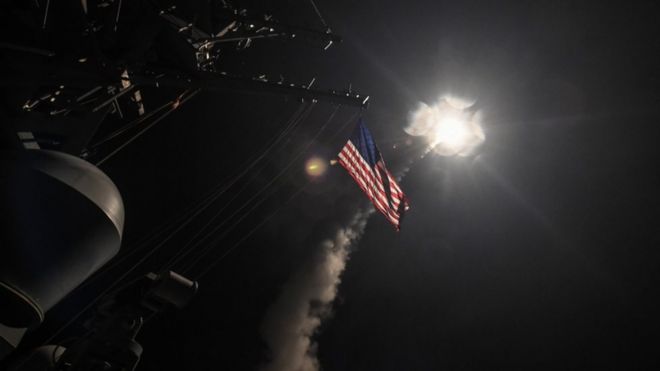
The US fired 59 cruise missiles at the Shayrat airbaseImage copyrightGETTY IMAGES
Image captionThe US fired 59 cruise missiles at the Shayrat airbase
by Rachel Rubin and Biodun Iginla, BBC News, Washington DC
A US air strike in response to a suspected chemical attack damaged or destroyed 20% of Syria's operational aircraft, the US has said.
Defence Secretary James Mattis said Syria would be "ill-advised ever again to use chemical weapons".
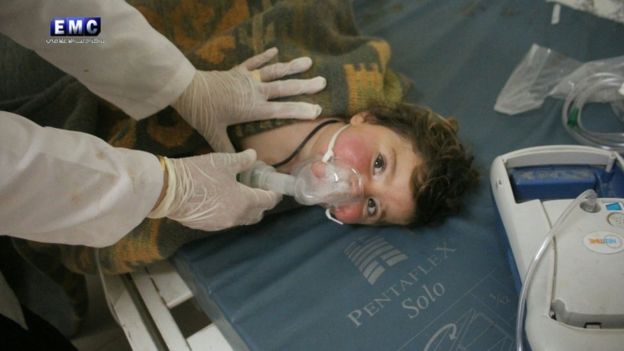
Syria has denied a chemical attack on the rebel-held town of Khan Sheikhoun last week that left 89 people dead.
G7 nations are meeting in Italy to discuss policy and how to persuade Russia to abandon its Syrian ally.
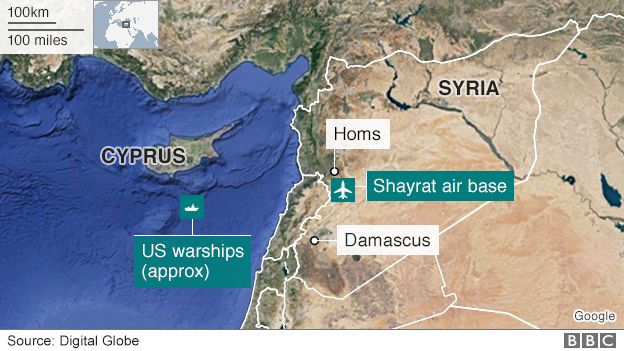
The US fired 59 cruise missiles at Syria's Shayrat airbase last Thursday, following the suspected chemical attack a day before.
Mr Mattis said the "measured response" by the US had "resulted in the damage or destruction of fuel and ammunition sites, air defence capabilities and 20% of Syria's operational aircraft".
He added: "The Syrian government has lost the ability to refuel or rearm aircraft at Shayrat airfield and at this point, use of the runway is of idle military interest."
The suspected chemical attack in Khan Sheikhoun last week left 89 people deadImage copyrightEPA
Image captionThe suspected chemical attack in Khan Sheikhoun last week left 89 people dead and many hurt
The Syrian military admitted significant material damage but a Russian defence ministry spokesman said only six Syrian Air Force MiG-23s, plus a number of buildings, were destroyed and that only 23 of the missiles had reached Shayrat.
Mr Mattis said the strike had shown the US would "not passively stand by while [Syrian President Bashar al-Assad] murders innocent people with chemical weapons".
White House spokesman Sean Spicer said further strikes were on the table.
"The sight of people being gassed and blown away by barrel bombs ensures that if we see this kind of action again, we hold open the possibility of future action," he said.
Map showing location of Shayrat air base
Meanwhile, the Associated Press news agency quoted a senior US official as saying that the Russians knew of the chemical attack, because a drone had been flying over a hospital in Khan Sheikhoun as victims sought help. Hours later a jet bombed the hospital in what the US believed was an attempt to cover up the attack, the agency said.

What is being discussed at the G7?

The two-day meeting of foreign ministers in Lucca in Tuscany is aiming to hammer out a unified approach to the Syria conflict.
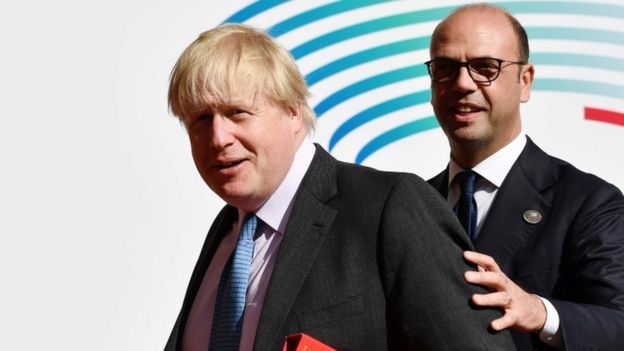
UK Foreign Secretary Boris Johnson said the message from the meeting should be clear - that Russian President Vladimir Putin must be made to abandon his support for Mr Assad.
Boris Johnson (L), with Italian Foreign Minister Angelino AlfanoImage copyrightAFP
Image captionBoris Johnson said sanctions on the Syrian and Russian militaries were being discussed
"He's toxifying the reputation of Russia by his continual association with a guy who has flagrantly poisoned his own people," Mr Johnson said.
He said the meeting would be "discussing the possibility of further sanctionscertainly on some of the Syrian military figures and indeed on some of the Russian military figures who have been involved in co-ordinating the Syrian military efforts".
Russia is already under a raft of sanctions imposed by the US and EU in response to the annexation of Crimea and the crisis in eastern Ukraine.
These would be the first sanctions against Russian figures over Syria if they were to be adopted, but it is far from clear they will be.
US Secretary of State Rex Tillerson heads from Lucca to Moscow on Tuesday, and will want to confront the Russians with a unified set of demands.
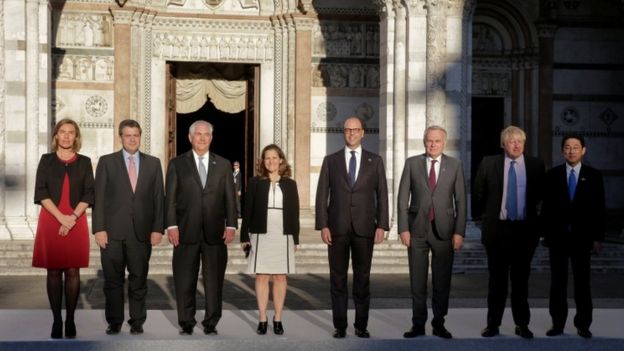
High Representative for Foreign Affairs Federica Mogherini, German Foreign Minister Sigmar Gabriel, US Secretary of State Rex Tillerson, Canada's Foreign Affairs Minister Chrystia Freeland, Italy's Foreign Minister Angelino Alfano, France's Foreign Minister Jean-Marc Ayrault, Britain's Foreign Secretary Boris Johnson and Japanese Minister of Foreign Affairs Fumio KishidaImage copyrightREUTERS
Image captionThe G7 foreign ministers pose for a family photo in Lucca
However the G7, which groups Canada, France, Germany, Italy, Japan and the UK along with the United States - with the EU also represented - is still seeking clarification of Washington's policy on Syria.
Mr Tillerson strongly criticised Russia for failing to prevent Syria from carrying out the suspected chemical attack.
But he also said there had been "no change to our military posture" in Syria following the US airbase strike and that Washington's "first priority" in Syria was to defeat so-called Islamic State (IS).
Media captionMoscow newspaper: "We believed in you comrade Donald."
Russia says the US has failed to provide evidence that Syria has chemical weapons.
Russia and Iran, President Assad's key military backers, are also threatening retaliation if there are any further American air strikes.