Biodun Iginla, BBC News

Biodun Iginla, BBC News
Showing posts with label Thaksin Shinawatra. Show all posts

Sunday, March 24, 2019

ANALYSIS: Thailand's turbulent political history


Royal Thai soldiers cast their ballots at a polling station in Bangkok
Royal Thai soldiers cast their ballots at a polling station in Bangkok AFP
ADVERTISING
Bangkok 
Violent demonstrations, multiple coups and a cryptic election eve message from the king.
Thailand's unpredictable political history has few rivals.
ADVERTISING
The country's election Sunday is the first since a 2014 coup.
Here is a brief look at two turbulent decades in Thai politics.
- 'Lost decade' -
2001 - Policeman-turned-billionaire telecoms magnate Thaksin Shinawatra wins at the polls promising social welfare schemes.
2003 - A brutal war on drugs kills upwards of 2,500 people. A year later a crackdown in the Muslim-majority Deep South sparks a renewed insurgency.
2005 - Thaksin repeats electoral triumph, heading up the first civilian administration to complete a four-year term in a history rattled by army takeovers.
2006 - While at the UN in New York, Thaksin is toppled in bloodless coup. A period of protests and violent clashes ensues and historians dub the prolonged instability the "Lost Decade".
- Yellow and Red -
2008 - Thaksin is convicted in absentia on corruption charges he says are politically motivated and flees into self-exile.
Anti-Thaksin protesters known as "Yellow Shirts" storm Bangkok's airports, shutting them down for over a week to protest a Thaksin ally as premier -- who is soon removed.
Democrat leader Abhisit Vejjajiva becomes prime minister after a parliamentary vote.
2009 - Pro-Thaksin "Red Shirts" storm a regional summit hosted by Thailand demanding elections and forcing participants to flee by helicopter and boat.
2010 - More than 90 people are killed as the army -- led by current junta leader Prayut Chan-O-Cha -- opens fire on Red Shirts protesting in downtown Bangkok.
2011 - Fresh elections in 2011 see Thaksin's younger sister Yingluck emerge as Thailand's first female prime minister.
2014 - Anti-Yingluck demonstrators hold months-long protests that turn violent. A snap 2014 election is annulled and military seizes power.
- Junta delays, holds vote -
2016 - Junta leader Prayut oversees a crackdown on dissent and wins a referendum to change the constitution.
Thailand mourns the death of revered King Bhumibol Adulyadej, who was seen as a figure of unity over a seven-decade reign.
2017 - Yingluck flees the country to avoid negligence charges and joins brother in self-exile.
2018 - Junta announces elections for next year after repeated delays, lifting hopes as new parties emerge.
2019 - Thai King Maha Vajiralongkorn shuts down shock prime ministerial candidacy of older sister Princess Ubolratana, who stood for the Thaksin-linked Thai Raksa Chart party.
March 23, 2019 - On eve of vote, the king sends another message to Thai citizens, urging them to support "good people" and not those who create "chaos".

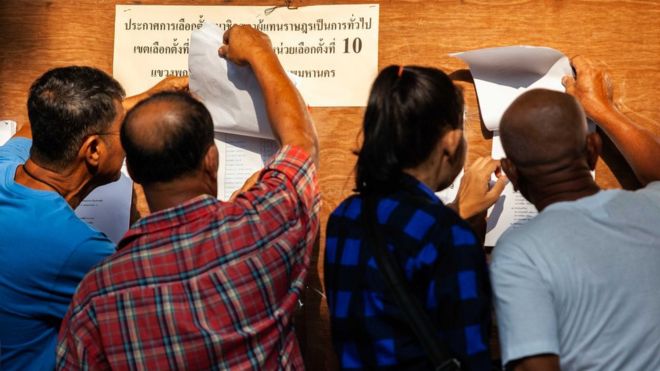
BREAKING: Thailand votes in first post-coup election

Voters go to the polls on March 24, 2019 in Bangkok, ThailandImage copyrightGETTY IMAGES
Image captionTurnout was expected to be high for this first election since 2011
by Wang Yang and Biodun Iginla, BBC News, Bangkok
About 50 million voters are heading to the polls in Thailand for the first general election since the 2014 coup.
Thailand has been buffeted by political instability for years, largely a battle between supporters of the military and ousted former PM Thaksin Shinawatra.
After seizing power the army promised to restore order and democracy, but has repeatedly postponed the vote.
Critics say a new constitution the army introduced will ensure it remains influential whatever the outcome.
Turnout is expected to be high for this first election since 2011.
More than seven million people aged between 18-26 are eligible to vote for the first time and could be key to victory, so all parties have been keen to court their vote.
On the eve of the election, Thailand's King Maha Vajiralongkorn issued a statement urging "peace and order" during the voting process.
The statement, which was featured on national television on Saturday evening, urged voters to "support the good people".
Presentational grey line

A simple choice

By Nick Beake, BBC News, Bangkok
Voters in central Bangkok faced a final obstacle as they tried to cast their ballot this morning - determined runners steaming through the park where an open-air polling station had been set up.
ADVERTISEMENT
But after waiting five years since the military coup, Thais are determined to finally have their say on their country's future - even if the electoral system has been skewered by the ruling junta to try to keep them in power.
The beaming faces of the 31 different candidates here in the Klong Toey constituency look out from a big poster which provides a last-minute visual guide for those picking up their ballot papers. Really, though, this election boils down to a simple choice - do you want the army to stay in power?
We meet Peerasin, 23, who is one of seven million first-time voters. He and his mum explain that they're hopeful for change but that dad is more conservative. Dad nods and smiles in agreement.
Next, a family of eight arrive to cast their votes. Sisters Mai, a banker and May, who works in the pharmaceutical industry, say they don't talk politics at home. But that doesn't mean they don't have passionate opinions.
So what's your message to whoever wins power, I ask.
"The county has been suffering for a long time", Mai explains. "But we hope this election will end peacefully and that there will be no corruption. We are hopeful."
Presentational grey line
The election is primarily a contest between pro-military parties and allies of Mr Thaksin.
He was ousted in a coup in 2006 and lives in self-imposed exile to avoid a conviction for abuse of power. But he still has a significant following, largely among rural and less affluent voters.
Parties loyal to Mr Thaksin have won every election since 2001, and the BBC's South East Asia correspondent Jonathan Head says crippling this movement has been a central - if unofficial - objective of the military.
Pheu Thai (For Thais) is the leading Thaksin-loyal party campaigning this time.
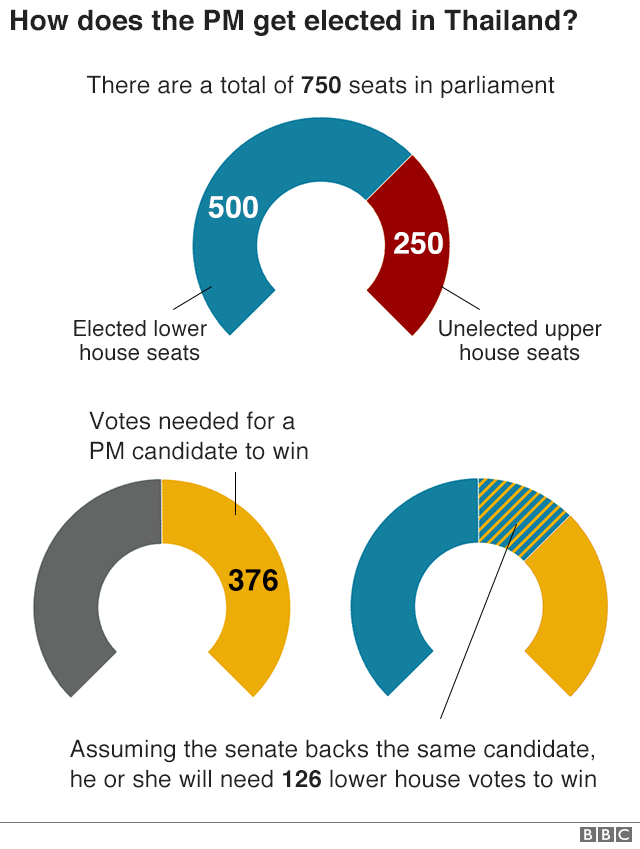
Thai election graphic showing votes needed to elect a PM
Presentational white space
General Prayuth Chan-ocha, who led the coup which ousted Mr Thaksin's sister Yingluck Shinawatra in 2014, has been nominated as the only prime ministerial candidate of the newly formed pro-military Palang Pracha Rath Party (PPRP).
Among other prominent parties are the Democrats, led by former prime minister Abhisit Vejjajiva, and the new Future Forward party, led by a young telecoms billionaire, Thanatorn Juangroongruangkit.
Media captionWhy young voters could be key in Thailand's election
At the time of the coup, the military said it wanted to restore order and stability and prevent the street protests which have broken out repeatedly over the years.
But the junta has been accused of taking an authoritarian approach to power, strictly controlling the media and arbitrarily using laws like lese majeste - which prohibits any criticism of the military - to silence opponents.
It also introduced a constitution - approved by a referendum - which its critics say is designed to ensure it remains central in Thai politics.
Presentational grey line
More news from Thailand
Presentational grey line
Voters on Sunday will be electing 500 members of the lower house of parliament. But under the constitution, a 250-seat senate has been appointed by the military.
The two houses will together elect a prime minister - a candidate only needs half the votes plus one to win.
So the military's preferred candidate - Gen Prayuth - would in theory only need 126 lower house votes to take office. The governing party or coalition can also appoint a non-MP as prime minister.
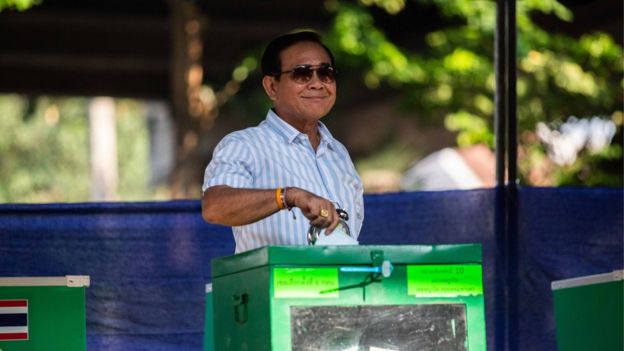
Current Prime Minister, General Prayuth Chan-o-cha, votes on March 24, 2019Image copyrightGETTY IMAGES
Image captionGeneral Prayuth Chan-ocha voted in Bangkok on Sunday
The new constitution also imposes a limit on the number of seats any one party can take, regardless of the number of votes won, and any future government is constitutionally bound to follow the military's 20-year plan for Thailand.
Voting will take place at more than 93,000 polling stations from 08:00 local time (01:00 GMT) until 17:00.
Preliminary unofficial results will emerge within hours, but correspondents say it will take some time for the future direction of Thailand to become clear, as parties negotiate deals and coalitions.

More on this story

Around the BBC