A GLOBAL DIGITAL currency would make sending money across the world as easy as texting. It would do away with fees, delays and other barriers to the flow of cash. It would give those in less developed countries access to the financial system and a way to protect hard-earned wages against runaway inflation. It could trigger a wave of innovation in finance, much like the internet did in online services.
That, in a nutshell, is what on June 18th Facebook promised to launch within a year. Libra, as the social network’s new currency is to be known in honour of an ancient Roman unit of mass (and the word for “pound” in many romance languages), professes to be all about “empower[ing] billions of people”.
The potential is indeed enormous. If each of Facebook’s 2.4bn users converted a slice of their savings into libras, it could immediately become one of the world’s most circulated currencies. It could also, if widely adopted, vest unprecedented power in the hands of its issuer. In a tacit acknowledgment that its mishandling of user data, condoning the spread of misinformation and other sins have devalued its stock with policymakers, users and potential partners—though not investors—Facebook wants to outsource the running of Libra to a consortium of trustworthies recruited from the world of finance, technology and NGOs. The consequences for the global financial system could be far-reaching. So could the impact on Facebook’s business.
If the project lives up to the mock-ups, buying, selling, holding, sending and receiving libras will be a doddle. It can be done in Facebook’s Messenger app or WhatsApp, another messaging-service-cum-social-network it owns—and, later next year, in a standalone app. All at a tap of a smartphone.
So far, so familiar. Messenger already offers payments to Americans. WhatsApp is testing a similar function in India. But these services do not cross borders, and require users to have a bank account. Fintech firms like TransferWise, which offer international transfers to the banked, take a 4-5% cut to wire $200—a third less than Western Union but not nothing. Libra will be global and cheap, and require no bank accounts: more bitcoin than Venmo.
Except that, unlike bitcoins and other cryptocurrencies, libras will change hands in seconds, not minutes, for next to nothing, not a few dollars. The system should handle 1,000 transactions a second at its launch, and more later, compared with no more than seven a second for bitcoin. The virtual coins will be bought with real money, which will top up the reserve backing the currency. This should prevent wild price swings from bitcoin-like speculation.
If it works, Libra could be a money-spinner for Facebook, albeit not directly. Notional transaction fees would not generate much revenue. But libras should allow Facebook to charge more for online ads, by making purchases of advertised products quicker and simpler. It could furnish a new source of data to target adverts, making up for user information Facebook will forgo with the “pivot to privacy”, which Mark Zuckerberg, its boss, proclaimed in March with respect to messaging. Libra would let his company catch up with WeChat, a Chinese super-app which offers payments and other financial services, and whose foreign ambitions are on hold as the Sino-American trade war rages on.
Technically and financially, Facebook could probably pull off such an ambitious undertaking on its own. Not politically. Its culture is more measured than it was in its early years, when it aspired to “move fast and break things”—but only a bit. Chary consumers may choose not to entrust their money to a social network which has, until recently, leaked their personal data left and right. Unless users appear on board, merchants may be reluctant to embrace the currency, however hassle-free.
Enter the Libra consortium. The association, to be based in reassuringly staid Geneva, will take over from Facebook before the first libra has been spent and manage the hard-currency reserves. Facebook has enlisted 28 prospective founding members out of an envisaged 100, each with equal voting rights and operating a node in a decentralised system which issues coins. They include financial firms (Visa and Stripe, among others), online services (Spotify, Uber), cryptocurrency wallets (Anchorage, Coinbase), venture capitalists (Andreessen Horowitz, Union Square Ventures) and charities (Kiva, Mercy Corps)—though, for the time being, no banks. Not a libertarian alternative to the existing financial system, in other words, but a complement.
To add credibility to its promise, broken in the past, to keep social and financial data strictly separate, Facebook has created a subsidiary, Calibra, to run Libra services within its apps. It is unlikely to face hurdles to uptake from Apple or Google. It is impossible to imagine them expelling Messenger and WhatsApp—and later other providers Facebook is inviting to the open-source project—from their app stores, as they have done with other cryptocurrency offerings, many of which have turned out to be scams.
To get Libra going, the consortium will pay merchants to offer discounts to customers who pay in the new currency, financed by a $10m one-off fee each member pays for a seat at the table. Eventually, Facebook would like anybody, not just the consortium, to be able to generate the currency, move it and offer services on top of its “blockchain” (crypto-speak for the database that keeps track of who owns what). At that point, Libra would truly turn into Bitcoin, minus the kinks and the libertarianism. Hard currency With a project with so many moving parts, much can go wrong. Although Facebook says it has a working prototype, the technology is untested; sceptics doubt that a 100-node system, let alone a bigger one, could process thousands of transactions per second. Hackers are doubtless champing at the bit.
Then there are consortium dynamics. Facebook will have to prove to the other 99 Libra members that it is truly prepared to give up control. At the same time, because important decisions need a two-thirds majority, someone has to knock heads together. The history of information technology is littered with initiatives which collapsed under the weight of internal conflict.
The biggest barrier may be political. Facebook has apparently consulted many regulators. Initially they should be able to keep tabs on Libra. The providers of digital wallets will have to comply with national rules, like those against money-laundering. Calibra, whose integration into Messenger and WhatsApp will initially make it the dominant wallet, is bound to stoke competition concerns. These may recede as the currency grows bigger and more decentralised, only to be replaced by worries about financial stability.
Libra’s success, then, is far from assured. But it could prove useful even if it flops, for it offers a blueprint for how Facebook itself could one day be governed. The Libra Association’s main task is to oversee the blockchain, ensuring, for instance, that Calibra does not enjoy privileged access to it. An equivalent Facebook Association, some observers have ventured, could be composed of representatives of users, advertisers, data-protection authorities and so on. Their job could be to oversee the “social graph”, another database, which lists all of Facebook’s users and the links between them—and to guarantee that Facebook users can post to another social network and vice versa.
Calls for a Facebook constitution along these lines have grown louder as the social network’s influence on world affairs, from election-meddling in America to genocide in Myanmar, has become apparent. Mr Zuckerberg is no stranger to such thinking. In 2009 Facebook let users vote on big changes in its privacy policies but abandoned the experiment with global democracy a few years later. Last year Mr Zuckerberg announced that Facebook wanted to set up a “content review board” of independent experts—a kind of “Supreme Court”, in his words, which would make “the final judgment call on what should be acceptable speech”.
Asked whether Libra could serve as a model for Facebook, David Marcus, who is in charge of the project, replies that it marks “a coming of age, the moment we recognise that there are some things that we shouldn’t control—and a radical departure from the traditional way of operating things”. Perhaps. But checks and balances would almost certainly make Facebook less profitable. It would be ironic if a new digital currency marked the beginning of the end of Facebook’s money-minting days.
ARTIFICIAL intelligence (AI) is barging its way into business. As our special report this week explains, firms of all types are harnessing AI to forecast demand, hire workers and deal with customers. In 2017 companies spent around $22bn on AI-related mergers and acquisitions, about 26 times more than in 2015. The McKinsey Global Institute, a think-tank within a consultancy, reckons that just applying AI to marketing, sales and supply chains could create economic value, including profits and efficiencies, of $2.7trn over the next 20 years. Google’s boss has gone so far as to declare that AI will do more for humanity than fire or electricity.
Such grandiose forecasts kindle anxiety as well as hope. Many fret that AI could destroy jobs faster than it creates them. Barriers to entry from owning and generating data could lead to a handful of dominant firms in every industry.
Get our daily newsletterUpgrade your inbox and get our Daily Dispatch and Editor's Picks.
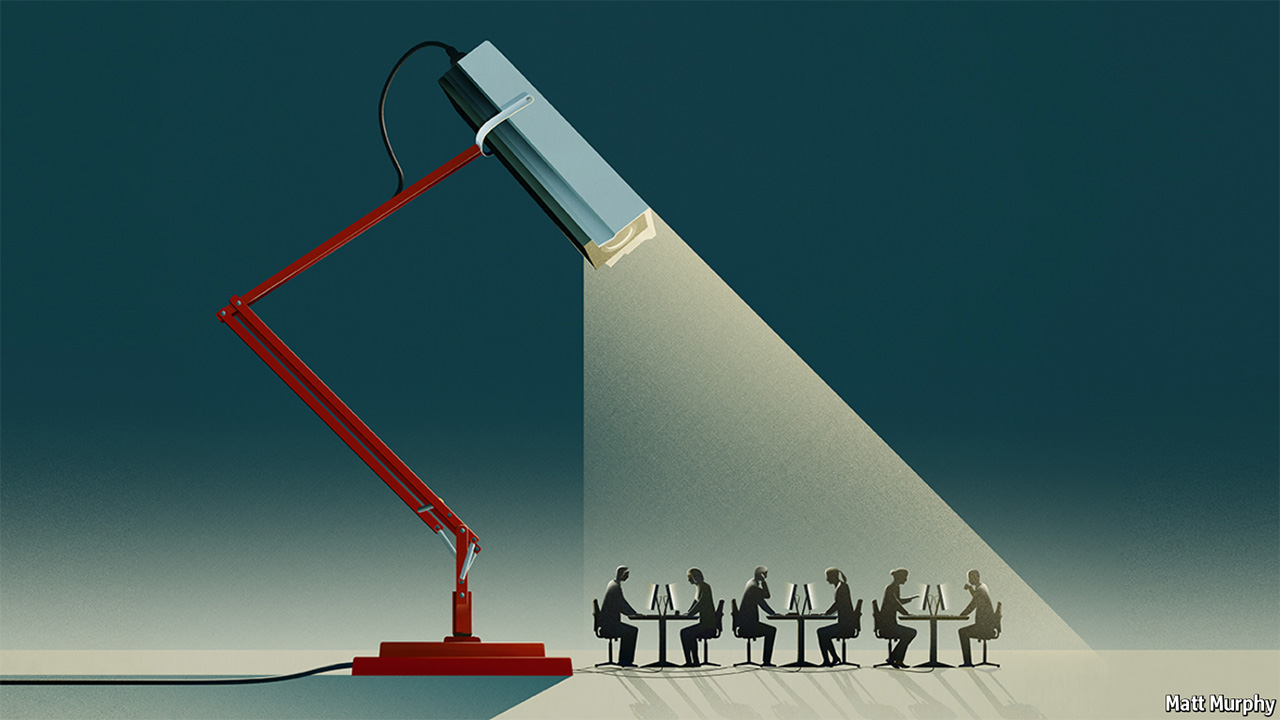
Less familiar, but just as important, is how AI will transform the workplace. Using AI, managers can gain extraordinary control over their employees. Amazon has patented a wristband that tracks the hand movements of warehouse workers and uses vibrations to nudge them into being more efficient. Workday, a software firm, crunches around 60 factors to predict which employees will leave. Humanyze, a startup, sells smart ID badges that can track employees around the office and reveal how well they interact with colleagues.
Surveillance at work is nothing new. Factory workers have long clocked in and out; bosses can already see what idle workers do on their computers. But AI makes ubiquitous surveillance worthwhile, because every bit of data is potentially valuable. Few laws govern how data are collected at work, and many employees unguardedly consent to surveillance when they sign their employment contract. Where does all this lead?
Trust and telescreens
Start with the benefits. AI ought to improve productivity. Humanyze merges data from its badges with employees’ calendars and e-mails to work out, say, whether office layouts favour teamwork. Slack, a workplace messaging app, helps managers assess how quickly employees accomplish tasks. Companies will see when workers are not just dozing off but also misbehaving. They are starting to use AI to screen for anomalies in expense claims, flagging receipts from odd hours of the night more efficiently than a carbon-based beancounter can.
Employees will gain, too. Thanks to strides in computer vision, AI can check that workers are wearing safety gear and that no one has been harmed on the factory floor. Some will appreciate more feedback on their work and welcome a sense of how to do better. Cogito, a startup, has designed AI-enhanced software that listens to customer-service calls and assigns an “empathy score” based on how compassionate agents are and how fast and how capably they settle complaints.
Machines can help ensure that pay rises and promotions go to those who deserve them. That starts with hiring. People often have biases but algorithms, if designed correctly, can be more impartial. Software can flag patterns that people might miss. Textio, a startup that uses AI to improve job descriptions, has found that women are likelier to respond to a job that mentions “developing” a team rather than “managing” one. Algorithms will pick up differences in pay between genders and races, as well as sexual harassment and racism that human managers consciously or unconsciously overlook.
Yet AI’s benefits will come with many potential drawbacks. Algorithms may not be free of the biases of their programmers. They can also have unintended consequences. The length of a commute may predict whether an employee will quit a job, but this focus may inadvertently harm poorer applicants. Older staff might work more slowly than younger ones and could risk losing their positions if all AI looks for is productivity.
And surveillance may feel Orwellian—a sensitive matter now that people have begun to question how much Facebook and other tech giants know about their private lives. Companies are starting to monitor how much time employees spend on breaks. Veriato, a software firm, goes so far as to track and log every keystroke employees make on their computers in order to gauge how committed they are to their company. Firms can use AI to sift through not just employees’ professional communications but their social-media profiles, too. The clue is in Slack’s name, which stands for “searchable log of all conversation and knowledge”.
Tracking the trackers
Some people are better placed than others to stop employers going too far. If your skills are in demand, you are more likely to be able to resist than if you are easy to replace. Paid-by-the-hour workers in low-wage industries such as retailing will be especially vulnerable. That could fuel a resurgence of labour unions seeking to represent employees’ interests and to set norms. Even then, the choice in some jobs will be between being replaced by a robot or being treated like one.
As regulators and employers weigh the pros and cons of AI in the workplace, three principles ought to guide its spread. First, data should be anonymised where possible. Microsoft, for example, has a product that shows individuals how they manage their time in the office, but gives managers information only in aggregated form. Second, the use of AI ought to be transparent. Employees should be told what technologies are being used in their workplaces and which data are being gathered. As a matter of routine, algorithms used by firms to hire, fire and promote should be tested for bias and unintended consequences. Last, countries should let individuals request their own data, whether they are ex-workers wishing to contest a dismissal or jobseekers hoping to demonstrate their ability to prospective employers.
The march of AI into the workplace calls for trade-offs between privacy and performance. A fairer, more productive workforce is a prize worth having, but not if it shackles and dehumanises employees. Striking a balance will require thought, a willingness for both employers and employees to adapt, and a strong dose of humanity.
“DESIGNED by Apple in California. Assembled in China”. For the past decade the words embossed on the back of iPhones have served as shorthand for the technological bargain between the world’s two biggest economies: America supplies the brains and China the brawn.
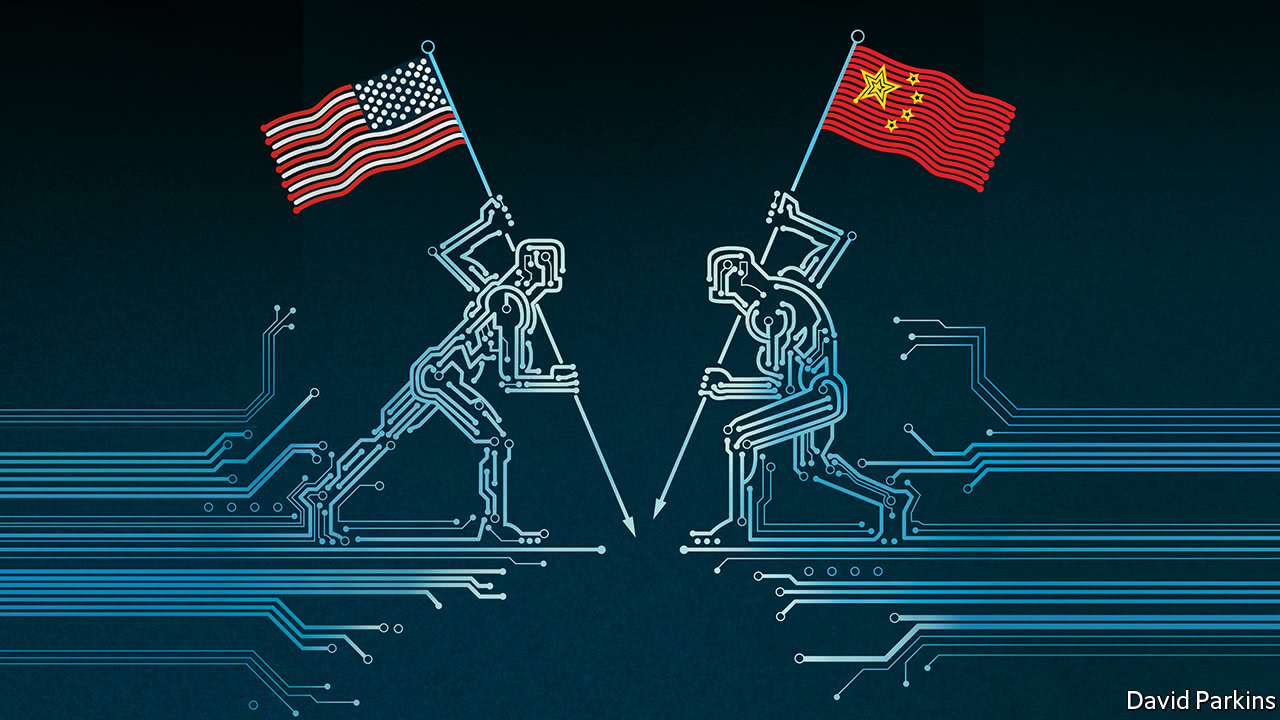
Not any more. China’s world-class tech giants, Alibaba and Tencent, have market values of around $500bn, rivalling Facebook’s. China has the largest online-payments market. Its equipment is being exported across the world. It has the fastest supercomputer. It is building the world’s most lavish quantum-computing research centre. Its forthcoming satellite-navigation system will compete with America’s GPS by 2020.
Get our daily newsletterUpgrade your inbox and get our Daily Dispatch and Editor's Picks.
America is rattled. An investigation is under way that is expected to conclude that China’s theft of intellectual property has cost American companies around $1trn; stinging tariffs may follow. Earlier this year Congress introduced a bill to stop the government doing business with two Chinese telecoms firms, Huawei and ZTE. Eric Schmidt, the former chairman of Alphabet, Google’s parent, has warned that China will overtake America in artificial intelligence (AI) by 2025.
This week President Donald Trump abruptly blocked a $142bn hostile takeover of Qualcomm, an American chipmaker, by Broadcom, a Singapore-domiciled rival, citing national-security fears over Chinese leadership in 5G, a new wireless technology. As so often, Mr Trump has identified a genuine challenge, but is bungling the response. China’s technological rise requires a strategic answer, not a knee-jerk one.
The motherboard of all wars
To understand what America’s strategy should be, first define the problem. It is entirely natural for a continent-sized, rapidly growing economy with a culture of scientific inquiry to enjoy a technological renaissance. Already, China has one of the biggest clusters of AI scientists. It has over 800m internet users, more than any other country, which means more data on which to hone its new AI. The technological advances this brings will benefit countless people, Americans among them. For the United States to seek to keep China down merely to preserve its place in the pecking order by, say, further balkanising the internet, is a recipe for a poorer, discordant—and possibly warlike—world.
Yet it is one thing for a country to dominate televisions and toys, another the core information technologies. They are the basis for the manufacture, networking and destructive power of advanced weapons systems. More generally, they are often subject to extreme network effects, in which one winner establishes an unassailable position in each market. This means that a country may be squeezed out of vital technologies by foreign rivals pumped up by state support. In the case of China, those rivals answer to an oppressive authoritarian regime that increasingly holds itself up as an alternative to liberal democracy—particularly in its part of Asia. China insists that it wants a win-win world. America has no choice but to see Chinese technology as a means to an unwelcome end.
The question is how to respond. The most important part of the answer is to remember the reasons for America’s success in the 1950s and 1960s. Government programmes, intended to surpass the Soviet Union in space and weapons systems, galvanised investment in education, research and engineering across a broad range of technologies. This ultimately gave rise to Silicon Valley, where it was infused by a spirit of free inquiry, vigorous competition and a healthy capitalist incentive to make money. It was supercharged by an immigration system that welcomed promising minds from every corner of the planet. Sixty years after the Sputnik moment, America needs the same combination of public investment and private enterprise in pursuit of a national project.
Why use a scalpel when a hammer will do?
The other part of the answer is to update national-security safeguards for the realities of China’s potential digital threats. The remit of the Committee on Foreign Investment in the US (CFIUS), a multi-agency body charged with screening deals that affect national security, should be expanded so that minority investments in AI, say, can be scrutinised as well as outright acquisitions. Worries about a supplier of critical components do not have to result in outright bans. Britain found a creative way to mitigate some of its China-related security concerns, by using an evaluation centre with the power to dig right down into every detail of the hardware and software of the systems that Huawei supplies for the telephone network.
Set against these standards, Mr Trump falls short on every count. The Broadcom decision suggests that valid suspicion of Chinese technology is blurring into out-and-out protectionism. Broadcom is not even Chinese; the justification for blocking the deal was that it was likely to invest less in R&D than Qualcomm, letting China seize a lead in setting standards.
Mr Trump has reportedly already rejected one plan for tariffs on China to compensate for forced technology transfer but only because the amounts were too small. Were America to impose duties on Chinese consumer electronics, for example, it would harm its own prosperity without doing anything for national security. An aggressively anti-China tack has the obvious risk of a trade tit-for-tat that would leave the world’s two largest economies both worse off and also more insecure.
Mr Trump’s approach is defined only by what he can do to stifle China, not by what he can do to improve America’s prospects. His record on that score is abysmal. America’s federal-government spending on R&D was 0.6% of GDP in 2015, a third of what it was in 1964. Yet the president’s budget proposal for 2019 includes a 42.3% cut in non-defence discretionary spending by 2028, which is where funding for scientific research sits. He has made it harder for skilled immigrants to get visas to enter America. He and some of his party treat scientific evidence with contempt—specifically the science which warns of the looming threat of climate change. America is right to worry about Chinese tech. But for America to turn its back on the things that made it great is no answer.