ADDIS ABABA - The captain of a doomed Ethiopian Airlines flight was unable to practice on a new simulator for the Boeing 737 MAX 8 before he died in a crash with 157 others, a pilot colleague said.
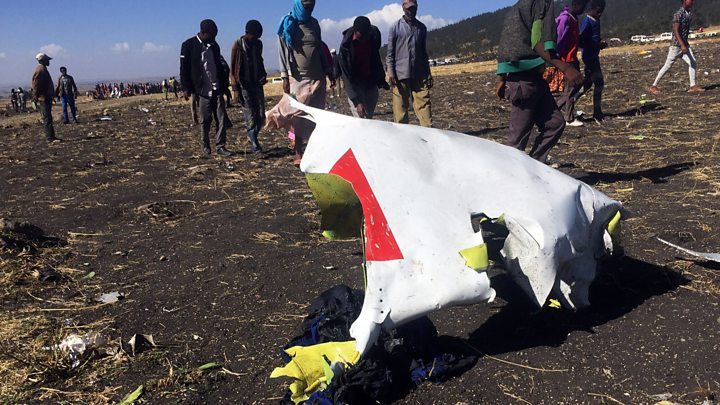
FILE PHOTO: Airplane engine parts are seen at the scene of the Ethiopian Airlines Flight ET 302 plane crash, near the town of Bishoftu, southeast of Addis Ababa, Ethiopia March 11, 2019. REUTERS/Tiksa Negeri/File Photo
Yared Getachew, 29, was due for refresher training at the end of March, his colleague told us at Reuters, two months after Ethiopian Airlines had received the simulator.
The March 10 disaster, following another MAX 8 crash in Indonesia in October, has set off one of the biggest inquiries in aviation history, focused on whether pilots were sufficiently versed on a new automated system.
In both cases, the pilots lost control soon after take-off and fought a losing battle to stop their jets plunging down.
ADVERTISEMENT
In the Ethiopian crash, it was not clear if Yared’s colleague - First Officer Ahmednur Mohammed, 25, who also died in the crash - had practiced on the new MAX simulator.
Globally, most commercial airline pilots refresh training in simulators every six months. It was not clear if Yared or Ahmednur would have been trained on the new simulator or an older one for 737s that their airline also owned.
The MAX, which came into service two years ago, has a new automated system called MCAS (Maneuvering Characteristics Augmentation System). It is meant to prevent a loss of lift which can cause an aerodynamic stall sending the plane downwards in an uncontrolled way.
“Boeing did not send manuals on MCAS,” the Ethiopian Airlines pilot told us at Reuters in a hotel lobby, declining to give his name as staff have been told not to speak in public.
ADVERTISEMENT
“Actually we know more about the MCAS system from the media than from Boeing.”
Under unprecedented scrutiny and with its MAX fleet grounded worldwide, the world’s largest planemaker has said airlines were given guidance on how to respond to the activation of MCAS software. It is also promising a swift update to the system.
Ethiopian Airlines declined to comment on the remarks of its pilot to Reuters about the simulator and MCAS system.
ADDIS ABABA - Ethiopian Airlines flight 302, which crashed killing 157 people, had an unusually high speed after take-off before the plane reported problems and asked permission to climb quickly, said a source who has listened to the air traffic control recording.
United Nations workers mourn their colleagues during a commemoration ceremony for the victims at the scene of the Ethiopian Airlines Flight ET 302 plane crash, near the town Bishoftu, near Addis Ababa, Ethiopia March 15, 2019. REUTERS/Tiksa NegerI
A voice from the cockpit of the Boeing 737 MAX requested to climb to 14,000 feet above sea level - about 6,400 feet above the airport - before urgently asking to return, the source told us at Reuters on condition of anonymity because the recording is part of an ongoing investigation.
The plane vanished from radar at 10,800 feet.
“He said he had a flight control problem. That is why he wanted to climb,” the source said, adding there were no further details given of the exact problem and the voice sounded nervous.
Experts say pilots typically ask to climb when experiencing problems near the ground in order to gain margin for maneuver and avoid any difficult terrain. Addis Ababa is surrounded by hills and, immediately to the north, the Entoto Mountains.
ADVERTISEMENT
The New York Times reported Captain Yared Getachew’s voice was on the recording but the Reuters source was not familiar with his voice or that of the first officer Ahmed Nur Mohammod Nur to verify which man was speaking. However, it was the same voice throughout, the source said.
The U.S. Federal Aviation Administration on Wednesday followed other countries in grounding the 737 MAX, citing satellite data and evidence from the scene that indicated some similarities and “the possibility of a shared cause” with October’s Lion Air crash in Indonesia that killed 189 people.
On Saturday, investigators began studying the cockpit voice recorder. Along with the flight data recorder, the information will be evaluated by Ethiopian authorities, teams from Boeing, and U.S. and EU aviation safety authorities to try to determine the cause of the crash.
HIGH SPEED, FAILED CLIMB
The Ethiopian flight was set to follow the Standard Instrument Departure (SID) from the airport and followed standard procedure with a first contact just after departure, the source said. Everything appeared normal.
ADVERTISEMENT
After one or two minutes, the voice on the air traffic control recording requested to remain on the same path as the runway and to climb to 14,000 feet, the source said.
The aircraft’s ground speed after departure was unusually high, the Reuters source said, reaching around 400 knots (460 miles per hour) rather than the 200 to 250 knots that is more typical minutes after departure.
“That is way too fast,” the source said.
No more than two minutes later, the air traffic controller was in communication with other aircraft when the voice from Ethiopian Airlines flight 302 interrupted, saying “break, break” - signaling that other non-urgent communications should cease. He sounded very scared, the source said.
“He requested permission to return. Air traffic control granted him permission to turn on the right because to the left is the city,” he said. “Maybe one minute passed before the blinking dot on the radar disappeared.”
After starting the turn, the plane disappeared from radar at an altitude of 10,800 feet above sea level, the highest it reached during the six-minute flight. Addis Ababa’s runway is at a high elevation of around 7,600 feet, suggesting the doomed jet made it about 3,000 feet into the sky.
Pompeo 'hopeful' North Korea talks will continue
Flight tracking website FlightRadar24 had data covering the first half of the flight but it dropped out at 8,600 feet.
Other satellite data tracking the plane has not been made available publicly. In the Lion Air crash, investigators are examining the behavior of a new anti-stall system installed on the 737 MAX that led to the plane gaining and losing altitude as the pilots fought for control against the automated system.
Boeing is expected to finalize a software fix for that system within a week to 10 days, sources familiar with the matter said earlier on Saturday.
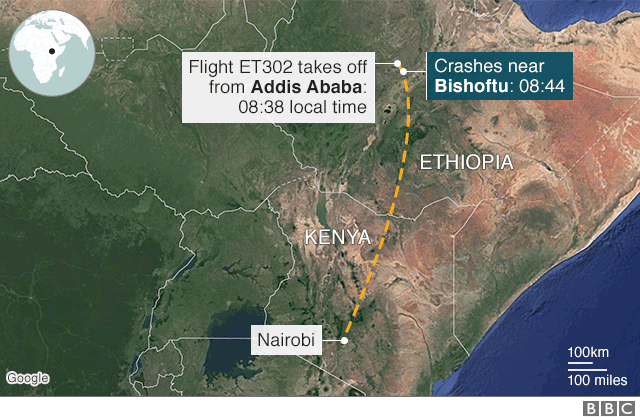
Ethiopian Airlines says the plane, flight ET302, crashed at 08:44 local time (05:44 GMT), just six minutes after it left Addis Ababa. The aircraft, bound for Nairobi, came down near the town of Bishoftu, 60km (37 miles) south-east of the capital.
The pilot had reported difficulties and had asked to return to Addis Ababa, the airline said.
"At this stage, we cannot rule out anything," Ethiopian Airlines CEO Tewolde Gebremariam told reporters at Bole International Airport in the capital.
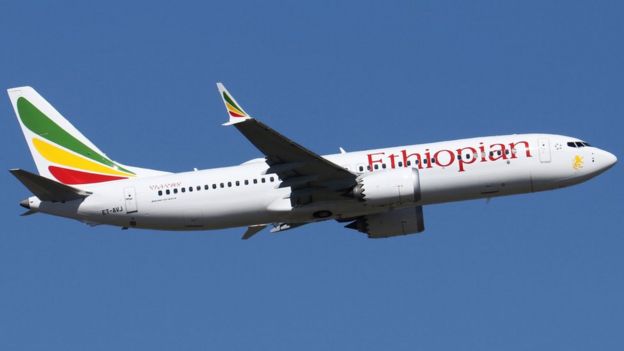
Image copyrightJONATHAN DRUIONImage captionThe Boeing 737 Max-8 aircraft that crashed on Sunday
Passengers from more than 30 countries were on board the flight, including 32 Kenyans, 18 Canadians, and seven Britons.
At least 19 victims were affiliated with the United Nations, according to a UN official.
Some passengers were heading to a session of the UN Environment Assembly in Nairobi which began with a minute's silence on Monday.
Slovak MP Anton Hrnko also confirmed via Facebook that his wife and two children were on the plane.
Meanwhile, a Greek man has said that he was due to board the flight but arrived at the gate two minutes late.
In a Facebook post, Antonis Mavropoulos shared an image of his ticket and said it was his "lucky day".
"I was angry because nobody helped me to reach the gate on time," he wrote. "I'm grateful to be alive."
In Ethiopia, Monday has been declared as a national day of mourning.
What do we know about the plane?
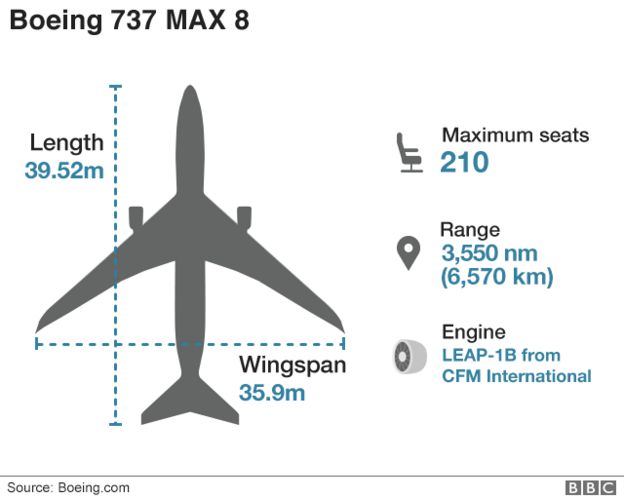
The 737 Max-8 aircraft has only been in commercial use since 2017.
The plane that crashed was among six of 30 that Ethiopian Airlines had ordered as part of its expansion. It underwent a "rigorous first check maintenance" on 4 February, the airline tweeted.
Following the Lion Air crash last October, investigators said the pilots had appeared to struggle with an automated system designed to keep the plane from stalling - a new feature of the Boeing 737 Max.
The anti-stall system repeatedly forced the plane's nose down, despite efforts by pilots to correct this, preliminary findings suggest. The crash killed 189 people.
The Lion Air plane was also new and the accident happened soon after take-off.
"It's highly suspicious," Mary Schiavo, former Inspector General of the US Transportation Department, told CNN.
"Here we have a brand-new aircraft that's gone down twice in a year. That rings alarm bells in the aviation industry, because that just doesn't happen."
After last October's crash, Boeing sent an emergency notice to airlines warning them of a problem with the anti-stall system.
Boeing is expected to release a software patch to the system to deal with this issue, according to Reuters.
However, with the Ethiopian Airlines investigation at an early stage, it is not clear whether the anti-stall system was the cause of Sunday's crash. Aviation experts say other technical issues or human error cannot be discounted.
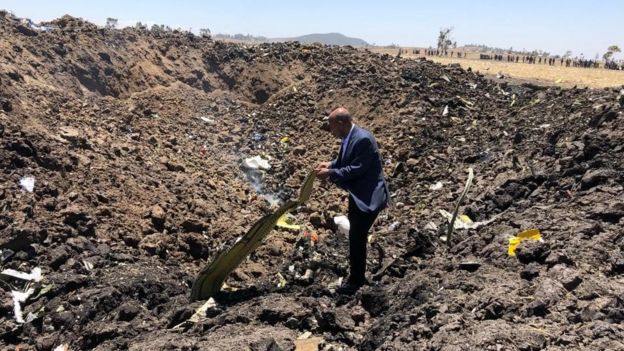
Image copyrightETHIOPIAN AIRLINESImage captionEthiopian Airlines shared this image of CEO Tewolde Gebremariam at the crash site
What happens next?
The investigation will be led by Ethiopian authorities co-ordinating with teams of experts from Boeing and the US National Transportation Safety Board.
An urgent priority for investigators will be to find the plane's two cockpit recorders - one for data and another for pilots' voice recordings.
Ethiopian Airlines said in a tweet on Monday morning that it grounded all of its 737 MAX 8s "until further notice."
"Although we don't know the cause of the accident, we had to decide to ground the particular fleet as an extra safety precaution."
The announcement came after China's aviation regulator ordered local airlines to halt the flights of 737 Max 8s.
More than 90 are in use by Chinese carriers including Air China, China Eastern Airlines, and China Southern Airlines.
Cayman Airways also grounded its two Boeings of the same type.
But a spokeswoman for FlyDubai, which operates a number of 737 Max 8s, told Reuters that the company continues to have confidence in the aircraft.
Several North American airlines operate the same aircraft and have said they are monitoring the investigation. Southwest Airlines flies 31, while American Airlines and Air Canada each have 24 in their fleet.