Biodun Iginla, BBC News

Biodun Iginla, BBC News
Showing posts with label bashar al-assad. Show all posts

Sunday, October 27, 2019

ANALYSIS: Syrian Kurdish forces say leaving Turkish border area, Damascus welcomes move

October 28, 2019  04H:08  GMT/ZULU
BEIRUT - The Kurdish-led Syrian Democratic Forces (SDF) said on Sunday it had agreed to withdraw more than 30 km (19 miles) from the Turkish border, an announcement welcomed by Damascus which said Turkey should now end its “aggression” in northeast Syria.
FILE PHOTO: Fighters of Syrian Democratic Forces (SDF) take part in the funeral procession of Kurdish fighters who were killed during clashes in the northeastern Syrian town of Ras al-Ain, in the town of Qamishli, Syria October 22, 2019. REUTERS/Muhammad Hamed
Turkey launched its cross-border offensive on Oct. 9 targeting Kurdish YPG forces in northeast Syria after President Donald Trump pulled U.S. troops out of the area.
Turkish President Tayyip Erdogan and Russia’s Vladimir Putin then agreed on Oct. 22 that Syrian border guards and Russian military police would clear the border area up to 30 km into Syria of YPG fighters over a six-day period that ends Tuesday.
The YPG is the main component of the SDF and is viewed by Ankara as terrorists due to their links to Kurdish insurgents in southeast Turkey. But the SDF has been a key ally of the United States in the fight against Islamic State militants.
“The SDF is redeploying to new positions away from the Turkish-Syrian border across northeast Syria in accordance with the terms of the (Erdogan-Putin) agreement in order to stop the bloodshed and to protect the inhabitants of the region from Turkish attacks,” the SDF said in a statement.
It urged Russia to help ensure “a constructive dialogue” between the Kurdish-led administration in northeast Syria and the government of President Bashar al-Assad in Damascus.
Moscow is Assad’s closest ally and Russian military power has proven decisive in helping him turn the tide of Syria’s eight-year civil war and recover large swathes of territory.
ADVERTISEMENT
The Sochi agreement allows Assad’s forces to return to parts of the northern border with Turkey for the first time in years.

“FLAGRANT TURKISH AGGRESSION”

The Damascus government welcomes the SDF withdrawal which removes “the main pretext for flagrant Turkish aggression on (Syrian) territory”, Syrian state news agency SANA said, citing a foreign ministry source.
The government will help citizens to re-integrate, SANA said, paving “the way for ... a return to Syrian national unity”.
Under the Erdogan-Putin agreement, clinched in the Russian Black Sea resort of Sochi, Turkish and Russian forces will start patrolling from Tuesday a section of the Turkish-Syrian border that runs 10 km deep into Syria.
On Saturday Erdogan said Turkey would not hesitate to intervene again to clear YPG forces from the border area if Russia failed to fulfill its obligations under the Sochi deal.
SANA reported on Sunday clashes between the Syrian army and Turkish forces near to Ras al-Ain, a town in northern Syria on the Turkish border.
ADVERTISEMENT
Turkey did not immediately confirm the clashes. Separately, the defense ministry in Ankara said one member of Turkey’s military had been killed and five others wounded in the Ras al-Ain area on Sunday after a YPG rocket and mortar attack.
The military was conducting reconnaissance work and responded in kind to the attack, the ministry said.

Monday, October 14, 2019

ANALYSIS: Turkey’s invasion: Things fall apart

by Nasra Ismail and Biodun Iginla, The Economist Intelligence Unit News Analysts, Beirut


Turkey’s invasion has thrown a once-stable corner of Syria into chaos

Less than a week after America removed its troops, a Kurdish-run fief has collapsed
Middle East and Africa

ALL OF IT was foreseeable: the death and displacement, the atrocities, the flight of jihadists and the return of a brutal regime. But it has happened more quickly than almost anyone predicted. In the days since Turkey invaded north-east Syria on October 9th, scores of people have been killed and more than 100,000 displaced. A brief Syrian Kurdish experiment in self-rule has come to a crashing halt. Their entity, known as Rojava, is now a carcass to be picked over by the Turks and the regime of Bashar al-Assad, Syria’s dictator. Hundreds of Islamic State (IS) supporters, once held by the Kurds, have escaped into the desert scrub.
Small though it may seem, President Donald Trump’s abrupt decision to withdraw some 100 troops from north-east Syria has reshaped the Levant. It cleared the way for a long-threatened Turkish invasion meant to dislodge the Kurdish-led militia in control of the region. Turkey views the group, the People’s Protection Units (YPG), as a mortal foe because of its ties to the militant Kurdistan Workers’ Party (PKK), which has fought a long insurgency against the Turkish state.
With America gone the Turks, backed by Syrian rebels under their command (mostly Sunni Arabs), swept across the border and quickly seized a swathe of central Rojava. They control a stretch of the M4, the main east-west highway about 30km south of the border, allowing them to bisect the Kurdish enclave and cut the YPG’s supply lines. Advancing Syrian rebels have already been accused of atrocities. One gruesome video circulated on social media showed giddy militiamen executing a bound Kurdish prisoner on the battlefield. “Photograph me,” one rebel urges the cameraman, before he turns a sniper rifle on the captive.
Though known as fierce fighters, the Kurds lack armour or air power. Their light infantry stands little chance against a modern Turkish army. Instead of fighting to the death they have asked Mr Assad for protection. For years the YPG, perhaps hedging its bets, tried to avoid open conflict with the regime. And on October 13th the Kurds struck a deal to bring the regime back to the north-east. “If we have to choose between compromises and the genocide of our people, we will surely choose life,” the Kurdish commander, Mazloum Abdi, wrote in an op-ed for Foreign Policy, an American magazine. Mr Assad wasted little time. His troops are already fanning out into territory formerly under YPG control.
While his men moved in, America moved out. On October 13th the defence secretary, Mark Esper, said America would withdraw all 1,000 troops deployed across northern Syria, fearing they would be caught between the Turkish and Syrian armies. Hopeful Pentagon officials still think they might maintain a presence elsewhere. This is wishful thinking. It will be hard to protect and resupply troops. One group of American soldiers already had to flee under Turkish shelling. America does hope to maintain its outpost at Tanf, in the badlands of south-east Syria, which is meant (rather improbably) to constrain Iranian influence in the region. Even that may be impossible, too.
Faced with a crisis of its own making, a flailing superpower has turned to economic sanctions to pretend it is still relevant. Senators have drafted a bill that takes aim at Turkey’s leadership and its armed forces, with apparent support from the president. “There is great consensus on this,” Mr Trump tweeted. Set aside the hypocrisy of America punishing Turkey for an offensive that Mr Trump himself acquiesced to earlier this month. Sanctions will not compel Turkey to halt its invasion. Nor will condemnations from European powers, some of which have also restricted arms sales to Turkey, a fellow NATO member.
If anyone can stop the fighting, it is Vladimir Putin. The Russian president finds himself in an awkward spot. Mr Assad is a client, and Russia is happy for his regime to retake territory. On the other hand, Turkey is a valued friend, and part of a Russian-led effort to find a political agreement that ends Syria’s wider civil war. “Losing Turkey means losing a solution to the Syrian problem,” says a former Russian diplomat. Mr Putin will try to push both sides towards a modus vivendi. Having thrown away his last bit of leverage in Syria, Mr Trump will be a mere bystander. Eight years after Barack Obama called for Mr Assad to go, it is America that is ignominiously leaving Syria.
Reuse this contentThe Trust Project

Wednesday, February 20, 2019

Iran will not rule out possibility of military conflict with Israel

February 21, 2019  06H32  GMT/ZULU
BERLIN  - Iran’s Foreign Minister Mohammed Javad Zarif accused Israel of engaging in “adventurism” with its bombing campaigns in Syria and said he could not rule out the possibility of a military conflict between the countries.
Zarif told the Sueddeutsche Zeitung newspaper that Iran was in Syria at the invitation of the Syrian government, while Israel was violating Lebanese and Syrian air space, as well as international law.
ADVERTISEMENT
ADVERTISING
“There is adventurism on Israel’s side, and adventurism is always dangerous,” Zarif told the newspaper in an interview to be published on Thursday.
Asked if he saw an emerging military conflict between Iran and Israel, Zarif said, “I do not, but we cannot exclude the possibility.”
ADVERTISEMENT
Israeli Prime Minister Benjamin Netanyahu has said that Israel has carried out hundreds of attacks in Syria over the past several years and will ramp up its fight following the planned withdrawal of U.S. troops from the country.
Israel is trying to counter the influence carved out in Syria by Iran, which has supported Syrian President Bashar al-Assad in the war that erupted in 2011. It said Tehran’s actions are the main destabilizing factor in the Middle East.
Zarif, speaking at the Munich Security Conference on Sunday, accused Israel of looking for war and warned that its actions and those of the United States were increasing the chances of a clash in the region.

Thursday, December 20, 2018

BREAKING AND UPDATE: Syria conflict: Trump's withdrawal plan shocks allies


December 20, 2018  10:H25  GMT/UTC/ZULU TIME
Related Topics
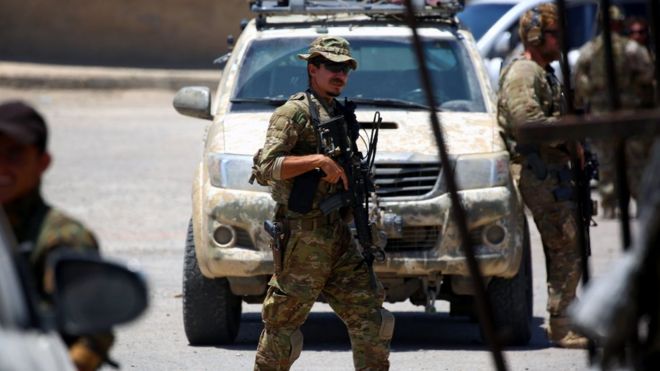
A member of the US forces stands guard in SyriaImage copyrightAFP
Image captionUS troops have largely been stationed in the Kurdish region in northern Syria
by Melissa Gruz and Biodun Iginla, BBC News, Washington
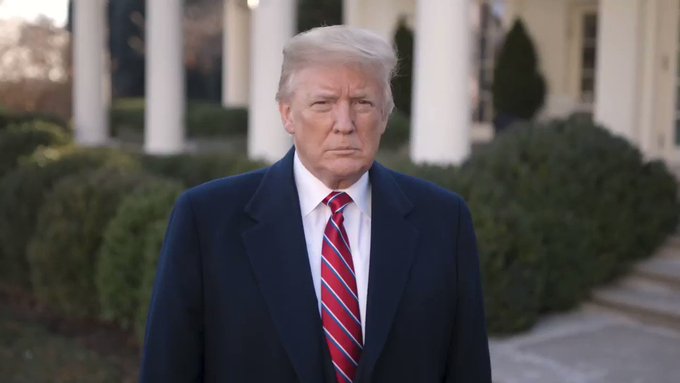
President Donald Trump's decision to withdraw all US troops from Syria has been met with strong criticism.
Mr Trump made the announcement on Wednesday, asserting that the Islamic State (IS) group had been defeated.
But major allies, including senior Republicans and foreign powers, have disputed the claim and say the move could lead to a resurgence of IS.
US troops have helped rid much of Syria's north-east of the jihadist group, but pockets of fighters remain.
Republican Senator Lindsey Graham, who is one of Mr Trump's supporters, called the withdrawal decision a "huge Obama-like mistake".
And the UK government pushed back on the president's assurance that IS had now been defeated.
The Pentagon said it was transitioning to the "next phase of the campaign" to eliminate IS but did not provide further details.
President Trump, who has long promised to pull American troops out of Syria, said on Twitter that it was time to bring them home after their "historic victories".
Presentational white space
The White House would not give a timescale for the withdrawal but defence officials quoted by the New York Times said President Trump wanted it done within 30 days.

What has the reaction been?

Senator Graham, who sits on the armed services committee, warned that the withdrawal would have "devastating consequences" both in Syria and beyond.
He said that he feared it would mean ceding influence in the region to Russia and Iran.
"An American withdrawal at this time would be a big win for ISIS [IS], Iran, Bashar al-Assad of Syria, and Russia," he said in a statement.
Meanwhile, the UK government distanced itself from President Trump's assertion that IS had now been defeated.
"Much remains to be done and we must not lose sight of the threat they pose," a statement from the Foreign Office said.
Israel said it had been told the US had "other ways to have influence in the area" but would "study the timeline [of the withdrawal], how it will be done and of course the implications for us".
Striking a different tone, Russian foreign ministry spokeswoman Maria Zakharova said the US decision could result in "genuine, real prospects for a political settlement" in Syria.
A spokesman for Kurdish-led authorities in north-eastern Syria, Aldar Xelil, said no-one was yet clear on details of the withdrawal "including US commanders here"
However, the US decision would have an impact on the entire region, he told Ronahi TV.
Presentational grey line

US allies concerned

By James Robbins, diplomatic correspondent, BBC News
The British government is stopping just short - at least in public - of condemning President Trump's decision to pull US forces out of Syria.
It said that IS remains a threat despite the "important advances" that have been made in recent days.
In Syria, Kurdish forces fighting IS feel abandoned, just as Turkey is vowing to step up attacks against the Kurds.
And the most powerful allies of Syria's President Bashar al-Assad, Russia and Iran, are pleased by the decision.
They hope it will mean they can increase their power in Syria and beyond.
Presentational grey line

What is the US presence in Syria?

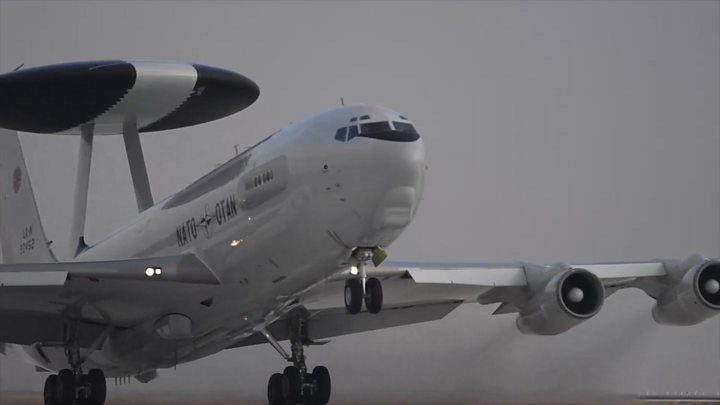
Media captionOn board the eye in the sky watching Syria
Some 2,000 US troops have largely been stationed in the Kurdish region in northern Syria.
A partnership with an alliance of Syrian Kurdish and Arab fighters, known as the Syrian Democratic Forces, is credited with playing a major role in the virtual elimination of IS after it overran large swathes of Syria four years ago.
However, the militant group has not disappeared entirely.
A recent US report said there were still as many as 14,000 IS militants in Syriaand even more in neighbouring Iraq - and there is a fear they will shift to guerrilla tactics in an attempt to rebuild their network.
But the partnership between the US and the Kurds has enraged neighbouring Turkey, which views the Kurdish YPG militia - the main fighting force in the SDF - as an extension of a banned Kurdish group fighting for autonomy in Turkey.
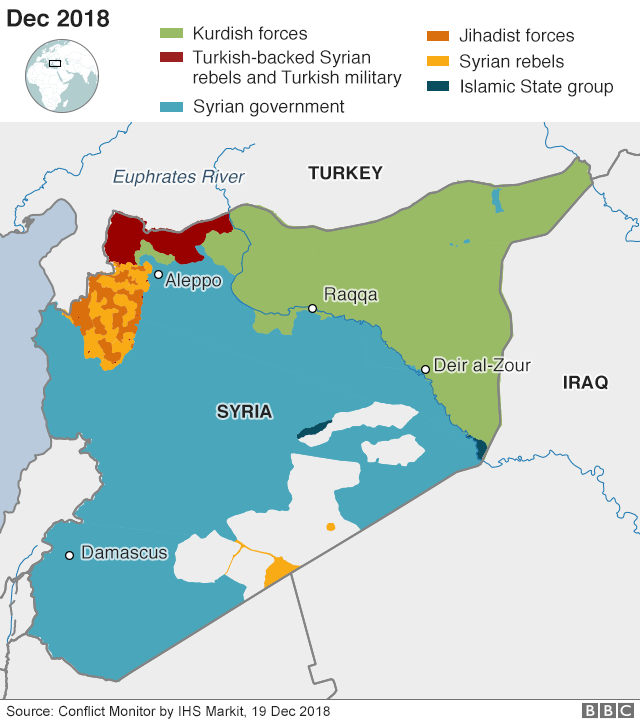
Map showing who controls where in Syria, 19 December 2018
Presentational white space
On Monday, Turkish President Recep Tayyip Erdogan said his country might soon start a new military operation against the YPG in Syria.
Mr Erdogan added that he had discussed his plan with Mr Trump by telephone and that he had given a "positive response".

More on this story