Biodun Iginla, BBC News

Biodun Iginla, BBC News
Showing posts with label digital currency. Show all posts

Sunday, December 24, 2017

Israel central bank mulls issuing digital currency for faster payments

December 24, 2017  15H:35  GMT/UTC/ZULU TIME 
JERUSALEM - The Bank of Israel is examining issuing digital currency as a means of creating a faster payments system as well as reducing the amount of cash in the economy, a central bank source said on Sunday, though he stressed no decision had yet been made.
FILE PHOTO: An Israeli flag flutters outside the Bank of Israel building in Jerusalem August 7, 2013. REUTERS/Ronen Zvulun/File Photo
The source, who spoke on condition of anonymity, also said the government was ready to legislate or include the issue in its 2019 budget and economic package if the central bank gave the green light.
The emergence of bitcoin and other so-called cryptocurrencies has led some economists to predict the technology could be used one day across entire economies, with digital currencies created by central banks.
But the Israeli source said any digital currency introduced by the country’s central bank would be centralized, safe and abide by money laundering rules - in contrast to bitcoin and its peers, which are decentralized and whose value has often oscillated wildly.
“Central banks around the world are examining (the use of digital currencies) so we should as well,” the Israeli source told us at Reuters.
The Bank of Israel declined to comment on the issue.
Cryptocurrencies allow parties to transact payments directly without a central intermediary, by means of blockchain technology that uses a shared ledger that verifies, records and settles transactions in a matter of minutes.
The Israeli government has been seeking to limit the amount of cash in the economy for a few years since the black economy is estimated at some 22 percent of national output.
Last month, the Bank of Israel published a public consultation asking for proposals for the creation of at least one infrastructure that would support immediate payments in Israel, similar to that used in Britain and Sweden.
In such a system, the initiator of the payment is debited immediately and the beneficiary is credited within a very short period of time, the central bank said, adding payments can be made 24 hours a day, 365 days a year.
A fast payments system is one option, while “a central bank- issued digital currency is another form of an advanced payments system which currently does not exist,” the source said.
Last week, Bank of England Governor Mark Carney said he saw “fundamental problems” with the idea of a digital currency issued by a central bank that could be used by the general public.

Thursday, December 7, 2017

Bitcoin breaks through the $16,000 mark

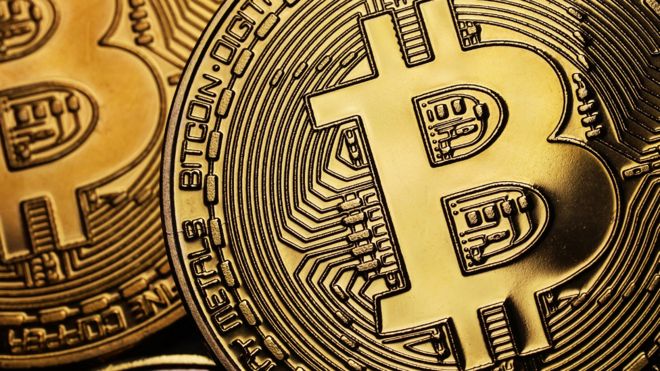
BitcoinImage copyrightGETTY IMAGES
Image captionAt the start of the year Bitcoin was valued below $1,000
by Tamara Kachelmeier and Biodun Iginla, BBC News Technology reporters, San Francisco
Bitcoin has breached the $16,000 mark, extending the digital currency's record-breaking surge.
The cryptocurrency began the year below $1,000 but continues to rise despite warnings of a dangerous bubble.
According to Coindesk.com, Bitcoin reached $16,663.18 (£12, 358.35), having soared over 50% in a week.
The new high comes days before the launch of Bitcoin futures on two exchanges, including the world's largest futures exchange, CME.
Spread betting firm CMC Markets said the rise had all the symptoms of a bubble market, warning "there is no way to know when the bubble will burst".
BitcoinsImage copyrightGETTY IMAGES
Presentational grey line

What is Bitcoin?

There are two key traits of Bitcoin: it is digital and it is seen as an alternative currency.
Unlike the notes or coins in your pocket, it largely exists online.
Secondly, Bitcoin is not printed by governments or traditional banks.
A small but growing number of businesses, including Expedia and Microsoft, accept bitcoins - which work like virtual tokens.
However, the vast majority of users now buy and sell them as a financial investment.
Presentational grey line
The digital currency's rapid ascent from around $1,000 at the start of the year has put it in the spotlight.
Critics have said Bitcoin is going through a bubble similar to the dotcom boom, whereas others say it is rising in price because it is crossing into the financial mainstream.
Financial regulators have taken a range of views on the status of digital currencies and their risks.
The UK's Financial Conduct Authority warned investors in September they could lose all their money if they buy digital currencies issued by firms, known as "initial coin offerings".
But last week a US regulator agreed to let two traditional exchanges, CME Group and CBOE Global Markets, begin trading in Bitcoin-related financial contracts.
The announcement from the Commodity Futures Trading Commission (CFTC) that it will allow investors to buy and sell "future" contracts in bitcoins - an agreement to buy the crypto-currency, for example, in three months time at a certain price - was seen as a watershed moment for Bitcoin.
Cambridge Global Payments director of global product and market strategy Karl Schamotta said that move was behind the latest rally: "The perception in households around the world that the CME and the CBOE are providing legitimacy to Bitcoin is really what is driving the massive rally here."
But Leonhard Weese, president of the Bitcoin Association of Hong Kong, said the rise in Bitcoin's value was "mostly motivated by fear of missing out and greed".
Bitcoins are created through a complex computer process known as mining, and then monitored by a network of computers across the world.
A steady stream of about 3,600 new bitcoins are created a day - with about 16.5 million now in circulation from a maximum limit of 21 million.

Related Topics

More on this story