Biodun Iginla, BBC News

Biodun Iginla, BBC News
Showing posts with label trade war with China. Show all posts

Wednesday, June 5, 2019

BREAKING: U.S. preparing to sell over $2 billion in weapons to Taiwan, testing China

June 6, 2019  05H:25  GMT/ZULU
WASHINGTON - The United States is pursuing the sale of more than $2 billion worth of tanks and weapons to Taiwan, four people familiar with the negotiations said, in a move likely to anger China as a trade war between the world’s two biggest economies escalates.
FILE PHOTO: U.S. M1A2 "Abrams" tank fires during U.S. led joint military exercise "Noble Partner 2016" near Vaziani, Georgia, May 18, 2016. REUTERS/David Mdzinarishvili/File Photo
An informal notification of the proposed sale has been sent to the U.S. Congress, the four sources said on condition of anonymity because they were not authorized to speak about the possible deal.
The potential sale included 108 General Dynamics Corp M1A2 Abrams tanks worth around $2 billion as well as anti-tank and anti-aircraft munitions, three of the sources said. Taiwan has been interested in refreshing its existing U.S.-made battle tank inventory which includes M60 Patton tanks.
The United States is a main arms supplier to Taiwan, which China deems its own and has never renounced the use of force to bring the self-ruled island under its control.
Taiwanese President Tsai Ing-wen said in March that the United States was responding positively to Taipei’s requests for new arms sales to bolster its defenses in the face of pressure from China. The United States has no formal ties with Taiwan, but is bound by law to help provide it with the means to defend itself.
China and the United States are engaged in a fierce trade war, with clashes over Taiwan and the South China Sea exacerbating tensions.
A spokesman for the State Department, which oversees foreign military sales, said the U.S. government does not comment on or confirm potential or pending arms sales or transfers before they have been formally notified to Congress.
ADVERTISEMENT
The congressional notifications included a variety of anti-tank munitions including 409 Raytheon Co and Lockheed Martin Corp-made Javelin missiles worth as much as $129 million, two of the sources said.
In addition, the notifications included 1,240 TOW anti-tank missiles worth as much as $299 million, one of the sources said adding that there were also 250 stinger missiles worth as much as $223 million in the notification.
Stingers are often used in man-portable anti-aircraft weapons systems.
In 2018, U.S. President Donald Trump’s administration rolled out a long-awaited overhaul of U.S. arms export policy aimed at expanding sales to allies, saying it would bolster the American defense industry and create jobs at home.
One of the administration’s architects of that policy was Trump’s trade adviser Peter Navarro. Navarro, a China hawk, wrote about the possible sale of tanks to Taiwan in a March opinion column in the New York Times ahead of presidential trip to the Lima, Ohio plant where they are made.
At a low point, the U.S. Army had only one tank coming from the plant a month, General Dynamics CEO Phebe Novakovic said during an April conference call with investors, but said “we’ll be rolling out 30 tanks a month by the end of this year,” partly because of international orders.
Last week, the Pentagon announced it would sell 34 ScanEagle drones, made by Boeing Co to the governments of Malaysia, Indonesia, the Philippines and Vietnam for $47 million. The drones would afford greater intelligence gathering capabilities potentially curbing Chinese activity in the region. China claims almost all of the strategic South China Sea and frequently lambastes the United States and its allies over naval operations near Chinese-occupied islands. Brunei, Indonesia, Malaysia, the Philippines, Taiwan and Vietnam have competing claims.
ADVERTISEMENT
Last weekend, at the Shangri-La Dialogue in Singapore, China’s Defense Minister Wei Fenghe warned the United States not to meddle in security disputes over Taiwan and the South China Sea.
Acting U.S. Defense Secretary Patrick Shanahan told the meeting that the United States would no longer “tiptoe” around China’s behavior in Asia.

Thursday, July 19, 2018

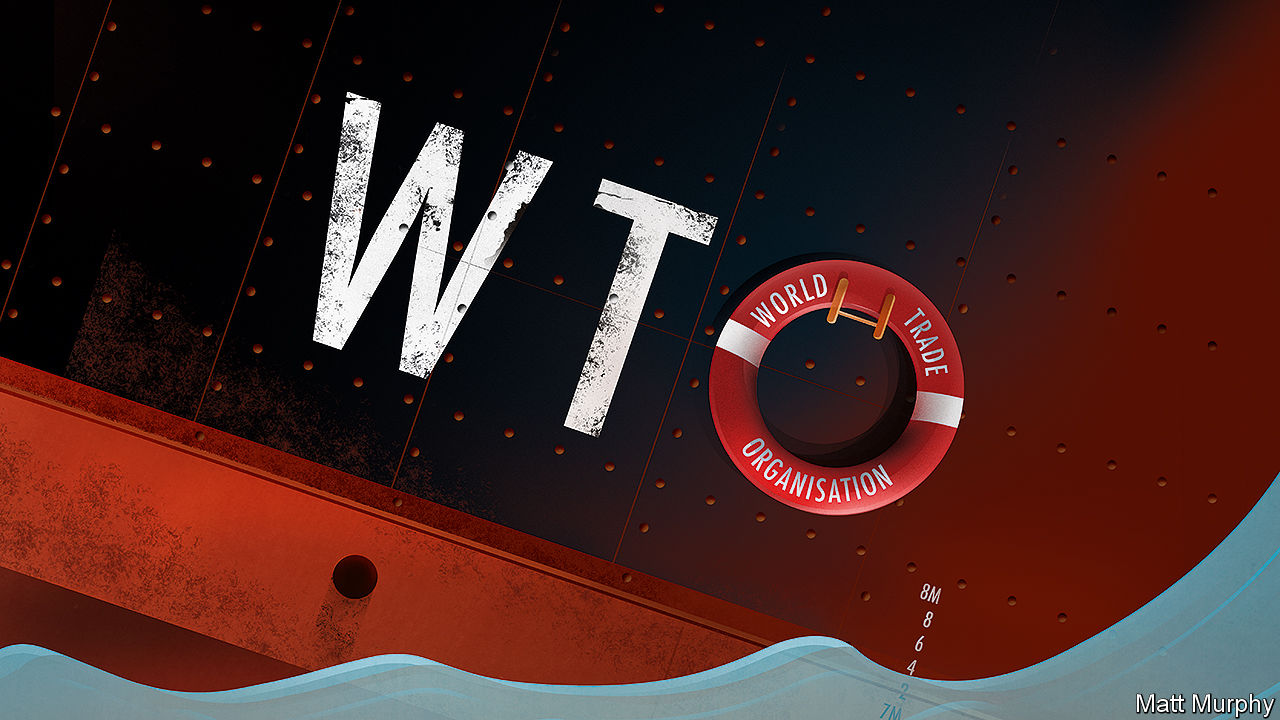
Analysis: How to rescue the WTO


by Judith Stein and Biodun Iginla, The Economist Intelligence Unit Financial News Analysts, New York
World trade

The American-led trade order is in danger. But it may yet be saved
THE headquarters of the World Trade Organisation (WTO), on the banks of Lake Geneva, once belonged to the League of Nations. That ill-fated body was crippled by American isolationism. The building’s occupant today is also at the mercy of decisions taken in Washington.
President Donald Trump has circumvented the WTO to impose tariffs on steel and aluminium imports, including those from America’s allies. Complaining of unfair treatment, the administration is blocking nominations to seats on the WTO’s appellate body, which could leave it unable to hear cases after 2019. Most ominously, America is embroiled in a . trade war with China. Both sides have imposed tariffs on goods worth tens of billions of dollars and are threatening worse.

Latest stories

See more
The WTO was supposed to contain trade disputes and prevent retaliatory pile-ups. Today it appears to be a horrified bystander as the system it oversees crumbles. Free-traders are right to be deeply worried, but not yet right to despair. For the outlines of a plan to save the system are discernible.
It’s the end of the WTO as we know it
That might seem fanciful, given Mr Trump’s belligerence, but for two things. The first is that the president is not the only person forging American trade policy. The European Union and Japan have been talking to Robert Lighthizer, his low-profile chief trade negotiator, about WTO reform. Mr Trump’s tirades make headlines, but Mr Lighthizer wants to remake the WTO, not abandon it entirely. He could use the president’s threats as leverage to make deals. Think of it as a good cop/bad cop routine, albeit one in which the bad cop has only a faint grasp that he has been allotted the role.
The second thing to understand is that the focus of much of America’s ire, China, arouses deep suspicion elsewhere, too (see Briefing). Since joining the WTO in 2001, China has not turned towards markets, as the West expected. Instead, it has distorted trade on a scale that is far bigger than the dumping and other causes of disputes between market economies that the WTO was designed to handle.
The EU and Japan share America’s desire to constrain Chinese mercantilism. China’s state-owned firms and its vast and opaque subsidies have distorted markets and caused gluts in supply for commodities such as steel. Foreign firms operating in China struggle against heavy-handed regulation, and are required to hand over their intellectual property as a condition of market access.
But holding China to account is hard with the existing rule book. The reforms being talked about by the EU, Japan and America could plug many of the gaps. They would set out how to judge the scale of government distortions to the market, make it easier to gather information on wrongdoing and set the boundaries for proportionate retaliation. They would also define what exactly counts as an arm of the government, and broaden the scope of banned subsidies. And they would lower the burden of proof for complainants, which, given the opacity of the Chinese system, is too high.
Even the sunniest optimist will be able to identify the obstacles to this plan. Most obviously, why would China ever accept a reform that jeopardises its state-run economic model? Put plainly, because America could wreak havoc otherwise. It is in China’s interests to preserve the global trading order because, if China is isolated, the Communist Party cannot achieve the prosperity that cements its legitimacy. The benefits to China of its WTO membership have come not from lower tariffs in America—they were already low—but from the certainty of stable trading relationships. Its “Made in China 2025” plan to boost vital industries sounds threatening, but if China were obliged to produce everything at home, its time frame would be delayed by decades. Sure enough, China and the EU agreed on July 16th to co-operate on WTO reform (see article).
Reaching a global agreement that covered every one of the WTO’s 164 members would also be extremely difficult. The last big round of global trade talks stalled over demands by developing economies such as India for more leeway to protect farmers. New negotiations may be held hostage to these old disputes. Luckily, negotiators can skip around them if necessary, by securing a “plurilateral” agreement between a group of big economies. The WTO would still enforce the terms, though they would not apply to its other members.
Last comes the greatest block to a grand bargain, Mr Trump himself. The president is a fierce critic of the WTO and a believer that bilateral deals suit American interests better. This week he called the EU a “foe” on trade. If he thinks Mr Lighthizer is manipulating him, he will strike back.
And I feel slightly more upbeat than you might expect
A better idea than the Trump administration’s wrecking strategy would have been to unite most of the world around a set of rules in America’s interest, forming blocs so large that China would have had to choose between compliance and isolation. That was the idea behind both the Trans-Pacific Partnership (TPP), a pact from which Mr Trump withdrew within days of taking office, and also a stalled trade deal with Europe.
Wrecking strategies do not always fail, however. Sometimes they pay off handsomely. A WTO fit to handle complaints about unfair competition would be a gift to the world. The genius of the rules-based system is that it has torn down barriers by persuading producers that the prize of access to foreign markets is worth the accompanying global competition. When that competition is deemed lawless, political support for free trade withers. A world in which China is pursued by its critics through the WTO, and faces proportionate retaliation when necessary, is far preferable to one in which a tit-for-tat trade war can escalate without limit.
Mr Trump is hard to predict. He may yet abandon the WTO. If he does, other powers will probably go on building links and writing rules—witness the trade deal that the EU and Japan signed this week. But if Mr Lighthizer is able to present Mr Trump with an agreement that the president likes, the world trading system may yet be saved. It might even be improved.
This article appeared in the Leaders section of the print edition under the headline "A plan to save the WTO"