Biodun Iginla, BBC News

Biodun Iginla, BBC News
Showing posts with label united arab emirates. Show all posts

Thursday, July 5, 2018

Analysis: Strait of Hormuz: the world's most important oil artery

July 6, 2018  07H:23  GMT/UTC/ZULU TIME
LONDON - With a third of the world’s sea-borne oil passing through it every day, the Strait of Hormuz is a strategic artery linking Middle East crude producers to key markets in Asia Pacific, Europe, North America and beyond.
This week, an Iranian Revolutionary Guards commander threatened that Tehran will block oil shipments through the waterway in response to U.S. calls to ban all Iranian oil exports.
The Strait has been at the heart of regional tensions for decades and this is not first time that Tehran has made such threats.

WHAT IS IT?

* It is a waterway separating Iran and Oman, connecting the Gulf to the Gulf of Oman and the Arabian Sea.
* It is 21 miles wide at its narrowest point, but the shipping lane is only two miles wide in either direction.
ADVERTISING

WHY IT MATTERS?

* The U.S. Energy Information Administration estimates a record 18.5 million barrels per day of sea-borne oil passed through it in 2016, a 9 percent increase on flows in 2015 which accounted for 30 pct of all sea-borne traded crude oil and other liquids during the year.
* Sea-borne crude and condensate flows transiting the Strait are estimated at around 17.2 million bpd in 2017 and around 17.4 million bpd in the first half of 2018, according to oil analytics firm Vortexa.
* Most of the crude exported from Saudi Arabia, Iran, the United Arab Emirates, Kuwait and Iraq passes through it. It is also the route for nearly all the liquefied natural gas (LNG) from lead exporter Qatar.
Graphic: Strait of Hormuz Tanker Traffic: reut.rs/2tXdToC
* Throughout the Iran-Iraq war (1980-1988) the two sides sought to disrupt each other’s oil exports in what was known as the Tanker War.
* The U.S. Fifth Fleet, based in Bahrain, is tasked with protecting the commercial ships in the area.
* Energy consultants Petromatrix who track U.S. aircraft carriers in the region say there are currently no carriers in the Arabian Gulf. They add the carrier that could have made the short trip to the Gulf from the eastern Mediterranean, turned around to sail back to the Atlantic.
* “Under the Bush administration there was always one to two carriers in the Arab Gulf, under the Obama administration there were some short times when the Arabian Gulf was left with no carriers but that was gestures made while the U.S. was negotiating with Iran,” the said on July 5

PIPELINE ALTERNATIVES

* The UAE and Saudi Arabia have sought to find alternatives to bypass the strait.
The following EIA table shows those pipeline projects.
Graphic: Pipelines Bypassing Strait of Hormuz: reut.rs/2Nr6SV7

INCIDENTS IN THE STRAIT

* In July 1988 the U.S. warship Vincennes shot down an Iranian airliner, killing all 290 on-board, in what Washington said was an accident after crew mistook the plane for a fighter. Tehran called it a deliberate attack. The U.S. said the Vincennes was in the area to protect neutral vessels against Iranian navy attacks.
* In early 2008 the United States said Iranian boats had threatened its warships after they approached three U.S. naval ships in the Strait.
* In June 2008, Revolutionary Guards commander-in-chief, Mohammad Ali Jafari, said Iran would impose controls on shipping in the Strait if it was attacked.
* In July 2010 a Japanese oil tanker called M Star was attacked in the Strait. A militant group called Abdullah Azzam Brigades, which is linked to al Qaeda, claimed responsibility.
* In January 2012, Iran threatened to block the Strait in retaliation for U.S. and European sanctions that targeted its oil revenues in an attempt to stop the nuclear program.
* In May 2015, Iranian ships fired shots at a Singapore-flagged tanker which it said damaged an Iranian oil platform, causing the vessel to flee, and seized a container ship in the Strait.
* On July 3, 2018, President Hassan Rouhani hinted Iran could disrupt oil flows through the Strait in response to U.S. calls to bring down Iran’s oil exports to zero.
* The following day, a Revolutionary Guards commander spelled out that Iran would block all exports through the Strait if Iranian exports are stopped

Friday, June 15, 2018

Yemen war: Government forces 'not attacking' Hudaydah port


June 15, 2018  13H:23  GMT/UTC/ZULU TIME
Related Topics
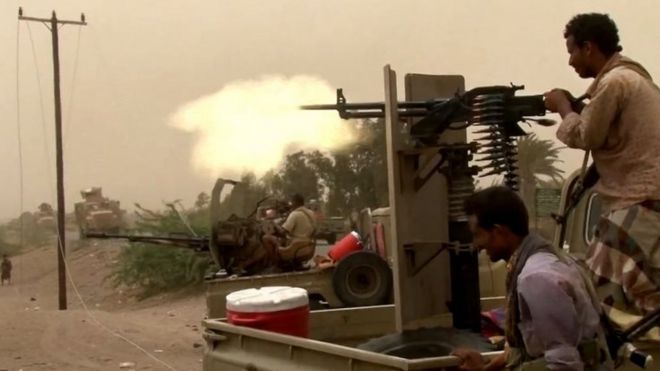
Yemen's pro-government forces fire a heavy machine gun south of Hudaydah airport, Yemen. Photo: 15 June 2018Image copyrightAFP
Image captionPro-government forces launched their offensive on Wednesday
by Leila Mohamed and Biodun Iginla, BBC News, Hudaydah, Yemen
Yemen's government says its forces are not attacking the rebel-held port of Hudaydah, the main entry point for aid to the war-torn country.
"We are not planning to destroy the infrastructure," Foreign Minister Khaled Alyemany said.
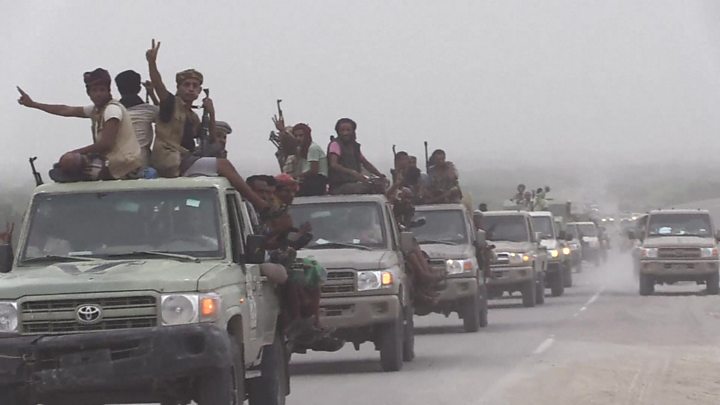
Pro-government forces, backed by a Saudi-led coalition, began an assault on the Red Sea city on Wednesday.
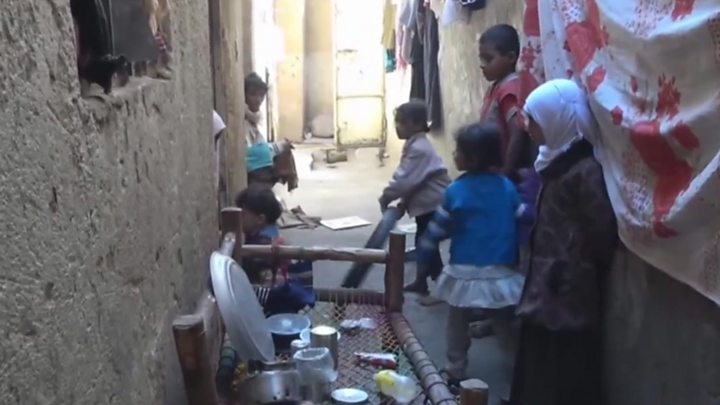
Aid agencies have said the battle threatens to cut off basic supplies to millions of people at risk of famine.
On Friday, pro-government fighters advanced on Hudaydah's airport with the support of coalition air strikes on positions held by the rebel Houthi movement.
At a news conference in New York on Thursday, Mr Alyemany said: "We are in an area close to the airport, but not to the seaport.
"The seaport is totally out of operations, today," he added.
File photo showing workers unload food aid provided by Unicef from a cargo ship at the Red Sea port of Hudaydah (27 January 2018)Image copyrightAFP
Image captionHudaydah's port is the lifeline for just under two-thirds of Yemen's population
The UN's World Food Programme said the seaport was still operational, and that its staff were still working and distributing food.
Executive Director David Beasley urged all parties "to meet their obligations to protect civilians and civilian infrastructure and take active steps to respect international humanitarian law".
Coalition warplanes have frequently bombed Hudaydah's port over the past three years despite its importance to humanitarian operations. A partial coalition blockade of Hudaydah has also significantly reduced imports of essential goods.
Presentational grey line

Key strategic goal

By Frank Gardner, BBC security correspondent, Abu Dhabi
As ever, there are two conflicting versions of events on the ground on Hudaydah.
Upbeat statements here in the Gulf talk of the coalition reaching the airport and of relentless pounding of Houthi defensive positions south of the city. But the Houthi rebels appear to be digging in for a long haul and are calling for reinforcements to defend Hudaydah from the advancing pro-government troops.
Unless the Houthis capitulate and withdraw their forces from the city, the coalition will be forced to decide whether to risk going into the city and fighting street by street, or waiting it out on the outskirts with a prolonged siege. Either scenario is likely to see further suffering for Yemen's impoverished population.
But for Saudi Arabia, the United Arab Emirates and the Yemeni government, Hudaydah is a prize they cannot afford to give up on. Their strategic goal is to force the Houthis out of it, thereby depriving them of their main source of revenue and compelling them to sue for peace.
Presentational grey line
The UN Security Council met in a closed-door session on Thursday, amid fears that the fighting could result in thousands of civilian casualties and trigger a wider humanitarian crisis.
Ahead of the talks, Sweden's permanent representative Carl Skau said it was time for the council to call for an immediate freeze to the assault on Hudaydah. There was, however, not enough support among council members.
Instead, they "reiterated their call for the ports of Hudaydah and Saleef to be kept open", according to Russian permanent representative Vasily Nebenzia, who holds the council presidency.
Media captionYemeni forces backed by a Saudi-led coalition of Gulf states are advancing on Hudaydah
Mr Nebenzia said the council members were "united in their deep concern about the risks to the humanitarian situation".
Rebel leader Abdul Malik al-Houthi meanwhile urged his supporters to mobilise to defend Hudaydah, threatening to turn the area into a "quagmire" for pro-government forces.
Heavy fighting has been reported since the offensive began two days ago, with Houthi positions coming under attack from coalition warships and aircraft.
On Thursday, Apache attack helicopters bombed a coastal area near the airport, residents told Reuters news agency.
Presentational grey line

Learn more about Yemen's war

Presentational grey line
"The fighting is getting close to the al-Manzar area near the airport and people are fleeing in fear," said Mohammed Abdullah, who works for the city's rebel-run administration.
"My family left for Sanaa [the rebel-held capital] yesterday, but I stayed behind alone to protect our home from looters," he added.
Medical sources quoted by AFP news agency said 30 Houthi rebels were killed on Thursday along with nine pro-government soldiers.
Ambulances evacuating the dead and wounded were seen heading away from the airport as reinforcements moved towards the front line, an AFP journalist reported. The UAE said on Wednesday that four of its soldiers had been killed.
Media captionFormer child soldiers, a landmine survivor and an internally displaced child tell their stories
Meanwhile, Saudi-owned news channel Al Arabiya said Yemeni President Abdrabbuh Mansour Hadi had returned to the temporary capital of Aden to oversee the battle for Hudaydah.
"The hour of victory is close and the return of justice is nearing that will lead to the triumph of the will of the Yemeni people," he was quoted as saying on arrival.
Mr Hadi has spent much of his time in neighbouring Saudi Arabia since rebels seized Sanaa and then launched an assault on Aden in March 2015.
That prompted Saudi Arabia and eight other mainly Sunni Muslim Arab states to launch a military campaign to restore Mr Hadi's government. The coalition has received logistical and intelligence support from the US, UK and France.
The coalition sees the Houthis as proxy of Shia power Iran, and says it has been supporting the rebels militarily. Tehran has denied arming the rebels.
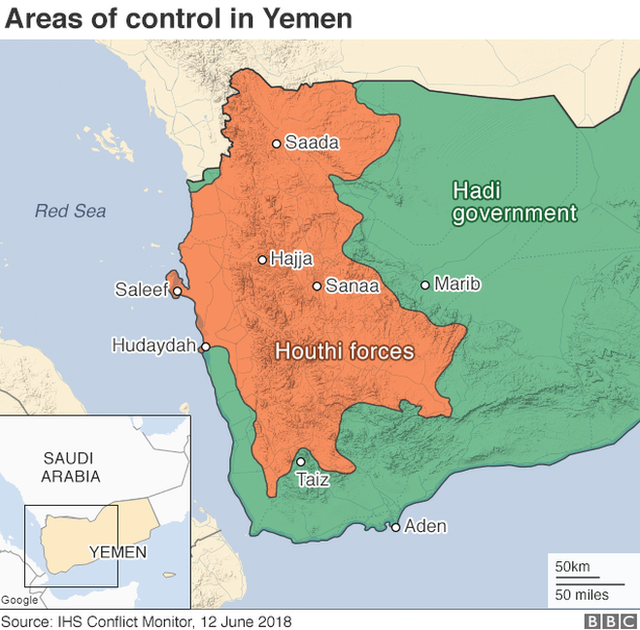
Map showing control of Yemen (13 June 2018)

Related Topics

More on this story