Biodun Iginla, BBC News

Biodun Iginla, BBC News

Tuesday, January 2, 2018

Logan Paul: Outrage over YouTuber's dead body video


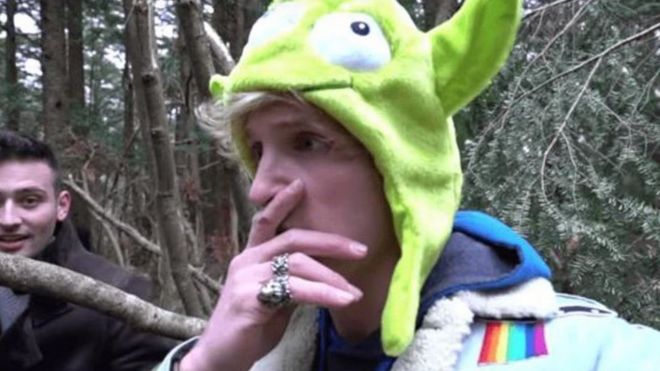
Screengrab from the video posted by Logan Paul in Japan's Aokigahara forestImage copyrightYOUTUBE/LOGAN PAUL
Image captionThe video was posted to his 15 million subscribers
by Xian Wan and Biodun Iginla, BBC News, Tokyo
An American YouTube star has prompted a barrage of criticism after he posted a video which showed the body of an apparent suicide victim in Japan.
The video showed Logan Paul and friends at the Aokigahara forest at the base of Mt Fuji, known to be a frequent site of suicides.
Going in to film the "haunted" forest, they come across a dead body and are shocked, but also make jokes.
Online comments have called the video "disrespectful" and "disgusting".
The video was uploaded on Sunday and had millions of views on Youtube before it was taken down.
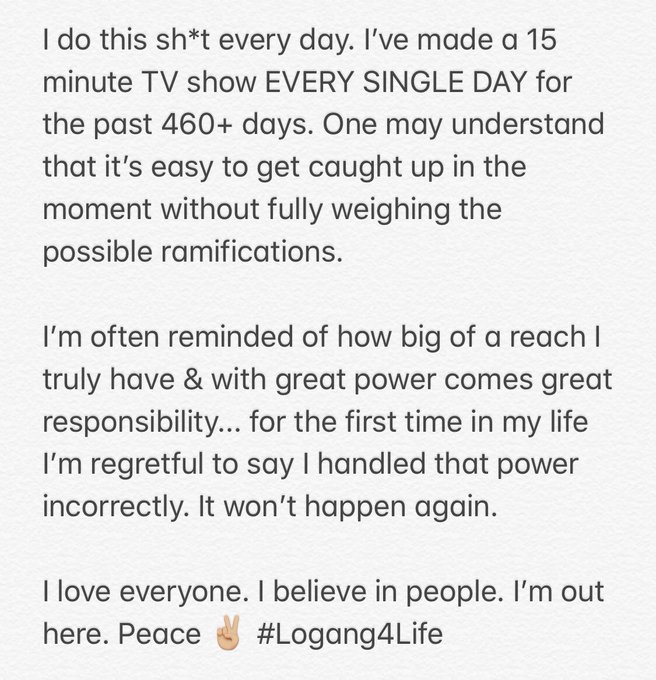
Logan Paul, who has more than 15 million subscribers on Youtube, has since posted an apology on Twitter, saying he had been "misguided by shock and awe".
Aokigahara has a tragic reputation in Japan and internationally as a destination for people who want to kill themselves.
The actual figure on suicides there each year is not made public, to avoid publicising the site. Signs are posted in the forest urging people to seek medical help rather than take their own life.
Japan has one of the highest rates of suicide in the developed world.
The 15-minute video is part of a series of posts from Japan where the US vlogger is on a trip with friends.
They go on a visit to the forest intending to focus on the "haunted" aspect of it, he says in the video.
After walking a short distance into the forest, the group come across a body.
The group is filmed approaching the body, which is shown in several close-ups where only the face is blurred out.
A member of the group is heard off camera saying he "doesn't feel good", Mr Paul then asks him: "What, you never stand next to a dead guy?". He then laughs.
The identity of the deceased man is not known.

Presentational grey line
Related stories:
Presentational grey line

'Garbage person'

By Monday, Logan Paul's name was trending globally on Twitter. Though some people said he had helped raise awareness, the comments were overwhelmingly negative.
Online comments have accused him of acting inappropriately and being disrespectful. Some have called for his entire channel to be removed from YouTube.
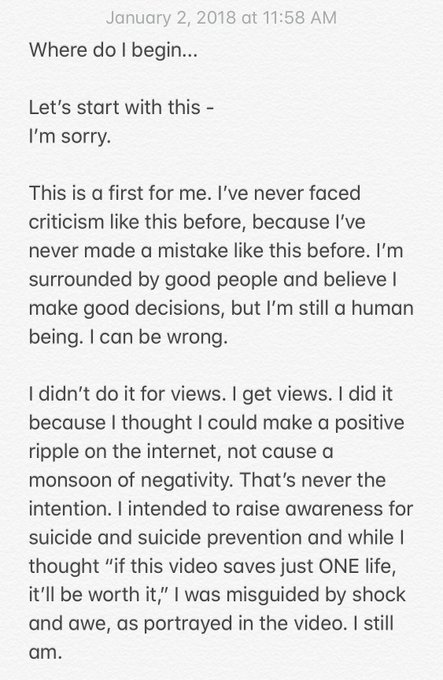
In his apology, posted on his Twitter page, Mr Paul said: "I'm surrounded by good people and believe I make good decisions, but I'm still a human being. I can be wrong."
He goes on to say he wanted to "make a positive ripple on the internet, not cause a monsoon of negativity", by raising awareness of suicide and suicide prevention.
Mr Paul says in the video that he is not making money off the content. YouTube, which pays content providers for videos that garner above a certain number of hits, did not immediately respond to the BBC's request for comment.
If you are feeling emotionally distressed and would like details of organisations which offer advice and support, click here. In the UK you can call for free, at any time, to hear recorded information on 0800 066 066. In Japan you can get help here.
Related Topics

More on this story

Pakistan summons U.S. ambassador after Trump's angry tweet

JANUARY 2, 2018 /  09H:45  GMT/UTC/ZULU TIME
ISLAMABAD - Pakistan summoned the U.S. ambassador in protest against U.S. President Donald Trump’s angry tweet about Pakistan’s “lies and deceit”, while Foreign Minister Khawaja Asif dismissed the outburst as a political stunt.
FILE PHOTO: David Hale, U.S. Ambassador to Pakistan, speaks at the Pakistan Stock Exchange in Karachi, Pakistan, July 26, 2016. REUTERS/Akhtar Soomro
David Hale was summoned by the Pakistan foreign office on Monday to explain Trump’s tweet, media said. A spokesperson for the U.S. Embassy in Islamabad confirmed the meeting took place.
In a withering attack, Trump on Monday said the United States has “foolishly” handed Pakistan more than $33 billion in aid in the last 15 years and had been rewarded with “nothing but lies and deceit”.
“They give safe haven to the terrorists we hunt in Afghanistan, with little help. No more!” Trump wrote on Twitter.
ADVERTISING
Pakistan Prime Minister Shahid Khaqan Abbasi on Tuesday will chair a cabinet meeting that will focus on Trump’s tweet, while on Wednesday the country’s top civilian and military chiefs will meet to discuss deteriorating U.S. ties.
Relations between United States and its uneasy ally Pakistan have been strained for many years over Islamabad’s alleged support for Haqqani network militants, who are allied with the Afghan Taliban.
FILE PHOTO: U.S. President Donald Trump talks to reporters before departing the White House for a visit to the Walter Reed Medical Center in Washington, DC, U.S., December 21, 2017. REUTERS/Jim Bourg/File Photo
Washington has signaled to Pakistan that it would cut aid and enact other punitive measures if Islamabad did not stop helping or turning a blind eye to the Haqqani network militants who carry out cross-border attacks in Afghanistan.
Islamabad bristles at the suggestion it is not doing enough in the war against militancy, saying that since 2001, Pakistan has suffered more than the United States from militancy as casualties at the hands of Islamists number in the tens of thousands.
Pakistani Foreign Minister Khawaja dismissed Trump’s comments as a political stunt borne out of frustration over U.S. failures in Afghanistan, where Afghan Taliban militants have been gaining territory and carrying out major attacks.
“He has tweeted against us (Pakistan) and Iran for his domestic consumption,” Asif told Geo TV on Monday.
“He is again and again displacing his frustrations on Pakistan over failures in Afghanistan as they are trapped in dead-end street in Afghanistan.”
Asif added that Pakistan did not need U.S. aid.
A U.S. National Security Council official on Monday said the White House did not plan to send $255 million in aid to Pakistan “at this time” and said “the administration continues to review Pakistan’s level of cooperation.” In August, the administration had said it was delaying the payment.

Monday, January 1, 2018

Analysis: Prague Spring: dream for 'human' socialism crushed


by Natalie de Vallieres and Biodun Iginla, France24 News Analysts, Paris

    © AFP/File / by Karinne DELORME | Future president Vaclav Havel, then a dissident leader and respected playwright, was a leading light of the opposition Civic Forum, who drafted much of Charter 77, the declaration that attracted attention to civil rights abuses in Czechoslovakia

    PARIS - 
    The Prague Spring 50 years ago sought to introduce "Socialism with a human face" in then communist Czechoslovakia but was crushed by Soviet tanks seven months later.
    Here is an account of how it unfolded:
    - Reformist elected -
    On January 5, 1968 the unpopular head of the powerful Communist Party, Moscow's pointman Antonin Novotny, is dismissed and replaced by reformist Alexander Dubcek.
    Two months later Novotny is also ousted as head of state. He is replaced by former army chief General Ludvik Svoboda.
    Dubcek, aged 46, becomes the symbol of a desire for reform that ignites the country.
    The Communist Party undergoes an overhaul, adopting a programme aimed at replacing Stalinism with "socialism with a human face", recognising freedom of expression and liberalising the economy.
    On April 8 a centre-left government is set up.
    - Press freedom -
    The media gradually secures more independence and readers snap up the first issue of "Literarni listy", a Union of Czechoslovak Writers review which publishes articles by previously censored authors.
    "In the space of several months, one of the most dull presses in the world has been transformed into a fascinating mirror on a society in full crisis of emancipation and recovery," AFP writes on April 14.
    Censorship is abolished in late June.
    - Communist partners worried -
    The reformists appear to have the upper hand as well as public support, and Dubcek is surrounded with allies.
    But alarm bells sound among orthodox communists in Czechoslovakia and in surrounding countries in the Warsaw Pact alliance who fear ideological contagion.
    The Pact's Soviet masters are determined to keep control of the strategically placed satellite.
    In May the German Democratic Republic (GDR) formally condemns the Czechoslovak "counter-revolution".
    In Moscow the Communist Party's Pravda newspaper lashes out at "anti-socialist members".
    In mid-July the parties in the Pact -- the Soviet Union, GDR, Poland, Hungary and Bulgaria -- demand from Czechoslovakia "a resolute offensive against anti-socialist forces" and the end of press freedom.
    In the "Warsaw Letter", they call for the deployment of troops at the border between Czechoslovakia and West Germany.
    - Prague Spring crushed -
    At 11:00 pm on August 20, 1968, about 200,000 Soviet soldiers backed by others from the GDR, Hungary, Poland and Bulgaria sweep into Czechoslovakia. Their numbers quickly rise to 600,000.
    NATO leaders do nothing but mouth protests at what Moscow assures them is merely an "inter-communist squabble".
    The day after the invasion, an AFP journalist reports: "Tensions are high at the Radio Prague headquarters which is surrounded by Soviet tanks, as is the Central Committee and the Hradcany Palace ... Nobody can understand this intervention -- astonishment is on everyone's faces."
    As Soviet forces spread out across the country and seal the borders, Dubcek and his allies are led off in handcuffs.
    Thanks to massive public demonstrations they escape criminal prosecution but are taken to the Kremlin to sign with Soviet leader Leonid Brezhnev the so-called Moscow Protocol that formalises Soviet occupation.
    The Soviet troops overcome rare pockets of resistance.
    More than 100 people are killed in the four months of the intervention. The country is to remain in Soviet hands for the next 20 years.
    - 'Normalisation' -
    On January 16, 1969 a 20-year-old student, Jan Palach, sets himself alight in Prague's historic centre in protest against the Soviet crackdown, dying three days later.
    Dubcek is ousted as head of the Communist Party in April by Moscow-backed Gustav Husak, who carries out a process of "normalisation", with massive purges, a ban on travelling to the West and the creation of a "crime against the socialist economy".
    Other key figures forced back into the shadows include playwright Vaclav Havel.
    He becomes the first president of Czechoslovakia after the bloodless Velvet Revolution in 1989 that heralds the departure of Soviet troops and end of communism.