On august 29th, as Hurricane Dorian tracked towards America’s east coast, Elon Musk, the boss of Tesla, an electric-car maker, announced that some of his customers in the storm’s path would find that their cars had suddenly developed the ability to drive farther on a single battery charge. Like many modern vehicles, Mr Musk’s products are best thought of as internet-connected computers on wheels. The cheaper models in Tesla’s line-up have parts of their batteries disabled by the car’s software in order to limit their range. At the tap of a keyboard in Palo Alto, the firm was able to remove those restrictions and give drivers temporary access to the full power of their batteries.
Mr Musk’s computerised cars are just one example of a much broader trend. As computers and connectivity become cheaper, it makes sense to bake them into more and more things that are not, in themselves, computers—from nappies and coffee machines to cows and factory robots—creating an “internet of things”, or iot (see Technology Quarterly). It is a slow revolution that has been gathering pace for years, as computers have found their way into cars, telephones and televisions. But the transformation is about to go into overdrive. One forecast is that by 2035 the world will have a trillion connected computers, built into everything from food packaging to bridges and clothes.
Get our daily newsletterUpgrade your inbox and get our Daily Dispatch and Editor's Picks.
Such a world will bring many benefits. Consumers will get convenience, and products that can do things non-computerised versions cannot. Amazon’s Ring smart doorbells, for instance, come equipped with motion sensors and video cameras. Working together, they can also form what is, in effect, a private cctv network, allowing the firm to offer its customers a “digital neighbourhood-watch” scheme and pass any interesting video along to the police.
Businesses will get efficiency, as information about the physical world that used to be ephemeral and uncertain becomes concrete and analysable. Smart lighting in buildings saves energy. Computerised machinery can predict its own breakdowns and schedule preventive maintenance. Connected cows can have their eating habits and vital signs tracked in real time, which means they produce more milk and require less medicine when they fall ill. Such gains are individually small but, compounded again and again across an economy, they are the raw material of growth—potentially a great deal of it.
In the long term, though, the most conspicuous effects of the iot will be in how the world works. One way to think of it is as the second phase of the internet. This will carry with it the business models that have come to dominate the first phase—all-conquering “platform” monopolies, for instance, or the data-driven approach that critics call “surveillance capitalism”. Ever more companies will become tech companies; the internet will become all-pervasive. As a result, a series of unresolved arguments about ownership, data, surveillance, competition and security will spill over from the virtual world into the real one.
Start with ownership. As Mr Musk showed, the internet gives firms the ability to stay connected to their products even after they have been sold, transforming them into something closer to services than goods. That has already blurred traditional ideas of ownership. When Microsoft closed its ebook store in July, for instance, its customers lost the ability to read titles they had bought (the firm offered refunds). Some early adopters of “smart home” gadgets have found that they ceased to work after the firms that made them lost interest.
That tilts the balance of power from the customer to the seller. John Deere, an American maker of high-tech tractors, has been embroiled in a row over software restrictions that prevent its customers from repairing their tractors themselves. And since software is not sold but licensed, the firm has even argued that, in some circumstances, a tractor-buyer may not be buying a product at all, instead receiving only a licence to operate it.
Virtual business models will jar in the physical world. Tech firms are generally happy to move fast and break things. But you cannot release the beta version of a fridge. Apple, a smartphone-maker, provides updates for its phones for only five years or so after their release; users of Android smartphones are lucky to get two. But goods such as washing machines or industrial machinery can have lifespans of a decade or more. Firms will need to work out how to support complicated computerised devices long after their original programmers have moved on.
Data will be another flashpoint. For much of the internet the business model is to offer “free” services that are paid for with valuable and intimate user data, collected with consent that is half-informed at best. That is true of the iot as well. Smart mattresses track sleep. Medical implants observe and modify heartbeats and insulin levels, with varying degrees of transparency. The insurance industry is experimenting with using data from cars or fitness trackers to adjust customers’ premiums. In the virtual world, arguments about what should be tracked, and who owns the resulting data, can seem airy and theoretical. In the real one, they will feel more urgent.
Then there is competition. Flows of data from iot gadgets are just as valuable as those gleaned from Facebook posts or a Google search history. The logic of data-driven businesses, which do ever better as they collect and process more information, will replicate the market dynamics that have seen the rise of giant platform companies on the internet. The need for standards, and for iot devices to talk to each other, will add to the leaders’ advantages—as will consumer fears, some of them justified, over the vulnerability of internet-connected cars, medical implants and other devices to hacking.
Predicting the consequences of any technology is hard—especially one as universal as computing. The advent of the consumer internet, 25 years ago, was met with starry-eyed optimism. These days it is the internet’s defects, from monopoly power to corporate snooping and online radicalisation, that dominate the headlines. The trick with the iot, as with anything, will be to maximise the benefits while minimising the harms. That will not be easy. But the people thinking about how to do it have the advantage of having lived through the first internet revolution—which should give them some idea of what to expect. ■
Ethiopia's chief of staff and at least three other senior officials have been killed during a coup attempt by an army general in the northern state of Amhara, state television said on Sunday.
ADVERTISING
Amhara's state president Ambachew Mekonnen and his advisor were also killed, according to state media, which named the region's security head, General Asamnew Tsige, as the orchestrator of the attempted coup.
Prime Minister Abiy Ahmed's government faces growing pressure from regional strongmen, including in Amhara, a flashpoint in growing ethnic violence in Ethiopia.
The shooting occurred when federal officials were meeting the state president - an ally of Abiy - to discuss how to rein in the open recruitment of ethnic militias by Asamnew, one Addis-based official told Reuters.
ADVERTISING
A week earlier, Asamnew had openly advised the Amhara people, one of Ethiopia's larger ethnic groups, to arm themselves, in a video spread on Facebook and seen by a Reuters reporter.
Abiy donned military fatigues to announce on state television late on Saturday that there had been an attempted coup in Amhara's capital Bahir Dar earlier that day and that Ethiopia's Chief of Staff General Seare Mekonnen was among the casualties. State media reported that Seare had been shot dead by his bodyguard.
Since coming to power last year, Abiy has tried to spearhead political reforms, to open up the once isolated, security-obsessed country of 100 million people on the Horn of Africa.
Abiy has released political prisoners, removed bans on political parties and prosecuted officials accused of gross human rights abuses, but his government is battling mounting violence.
Ethnic bloodshed - long held in check by the state's iron grip - has flared up in many areas, including Amhara, where the regional government was led by Ambachew Mekonnen.
According to Abiy, regional government officials were in a meeting when a coup attempt occurred.
"There are a few people who were killed while others were injured," Abiy said.
A regional television broadcaster affiliated with the Tigray People's Liberation Front (TPLF), a member of Abiy's coalition, reported Seare had been killed, alongside another senior military official, Gize Abera.
The U.S. Embassy said on Saturday that it was aware of reports of gunfire in Addis Ababa, though Reuters could not confirm those reports.
"Chief of Mission personnel are advised to shelter in place," the Embassy said on its website.
People in many parts of Ethiopia reported being unable to access the Internet beginning late Saturday although the government has not stated whether it had cut it off. Authorities have cut off the internet several times in the past for security and other reasons.
Early on Sunday, Brigadier General Tefera Mamo, the head of special forces in Amhara, told state television that "most of the people who attempted the coup have been arrested, although there are a few still at large."
Residents in Amhara's capital Bahir Dar said late on Saturday there was gunfire in some neighbourhoods and some roads had been closed off.
Ethiopia is due to hold a national parliamentary election next year. Several opposition groups have called for the polls to be held on time despite the unrest and displacement.
A Sudanese official has denied that at least 100 people were killed by a paramilitary unit during protests, saying that the number was at most 46.
Doctors linked to the opposition on Wednesday said at least 100 people had been killed in the capital, Khartoum, amid pro-democracy protests.
They said 40 bodies were pulled from the River Nile in Khartoum on Tuesday.
Authorities had initially stayed quiet, but a health ministry official put the number at 46 early on Thursday.
Sudanese opposition activists have rejected an offer of talks from the country's military council, saying it cannot be trusted amid a violent crackdown on protesters.
Residents told us at the BBC that they were living in fear in the capital.
The deputy head of the military council defended the violent suppression, claiming that the protesters had been infiltrated by rogue elements and drug dealers.
"We will not allow chaos and we will not go back on our convictions. There is no way back. We must impose the respect of the country by law," said Mohammed Hamadan - also known as Hemeti - on Wednesday.
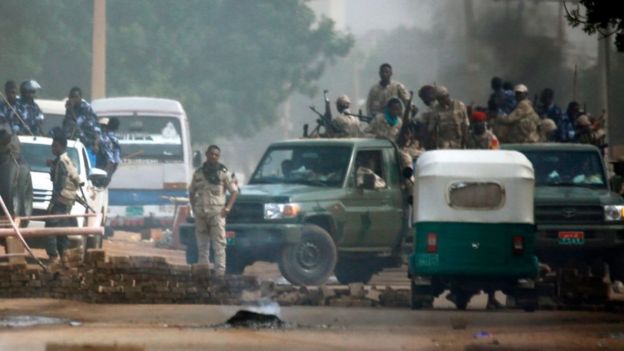
Numerous reports from Khartoum said the paramilitary unit, the feared Rapid Support Forces (RSF), was roaming the city's nearly deserted streets, targeting civilians.
Image copyrightAFPImage captionSecurity forces, seen here on Monday, moved against protesters after a long stand-off
Formerly known as the Janjaweed militia, the RSF gained notoriety for brutal atrocities in the Darfur conflict in western Sudan in 2003.
Reports continue to come in of these militia going into neighbourhoods and killing people. Their leader claims it is impostors behind the violence.
People are still coming to terms with the violence of the last few days.
At the former sit-in area - there are torn and charred posters as well as burnt-out tents.
The fear is that more of the dead could still be there.
Security forces seem to outnumber civilians on the streets of the capital.
Reports continue to come in of their brutal crackdown.
At Ibrahim Maleek Teaching Hospital - the doctors and nurses have not come to work because they're afraid of being targeted. Instead, it's the medical students who are treating patients.
Like 33-year-old Mohanned Mirghani - he says he was shot at close range by the Rapid Support Forces. "They shot me from close range; the RSF were the distance that you are from me now. Two of my friends were also shot but I don't know what happened to them."
It's hard to get a proper sense of what's happened. One big hindrance is the fact that the military rulers have cut off the internet.
What was the lead-up to the latest violence?
Sudan has been controlled by a military council since pro-democracy protests led to the ousting of veteran President Omar al-Bashir in April, after 30 years of authoritarian rule.
Demonstrators had been occupying the square in front of the military headquarters, while their representatives had negotiated with the military council and agreed a three-year transition that would culminate in elections.
But on Monday, security forces swept in and opened fire on unarmed protesters in the square. General Abdel Fattah al-Burhan, the head of the military council, announced that the agreement was cancelled and an election would take place within nine months.
Media captionSudan military attacks protesters
On Wednesday, however, after Saudi Arabia publicly called for a resumption of talks, Gen Burhan reversed course and said the military council would "open our arms to negotiate with no restriction".
The offer was rejected by the opposition. "The Sudanese people are not open for talks," said Amjad Farid, a spokesman for the Sudanese Professionals Association (SPA) which spearheaded the protests against Mr Bashir.
"The Sudanese people are not open to this TMC (Transitional Military Council) that kills people and we need justice and accountability before talks about any political process," Mr Farid told the AFP news agency.
What have residents been saying?
The Central Committee of Sudanese Doctors - one of the groups behind the protests - said on Wednesday that 40 bodies had been recovered from the River Nile.
An official from the group told the BBC that they had witnessed and verified the bodies in hospitals and that the death toll now stood at at least 100.
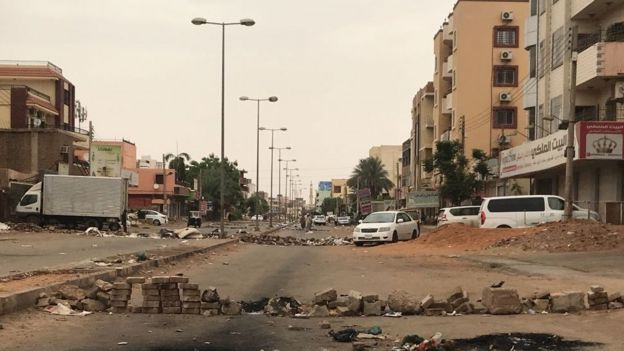
Image copyrightGETTY IMAGESImage captionMany Khartoum streets are deserted
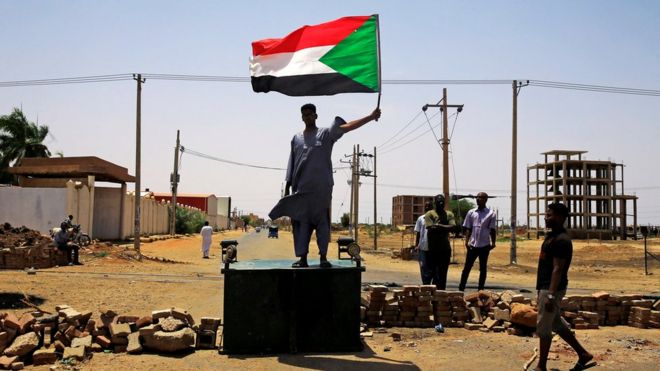
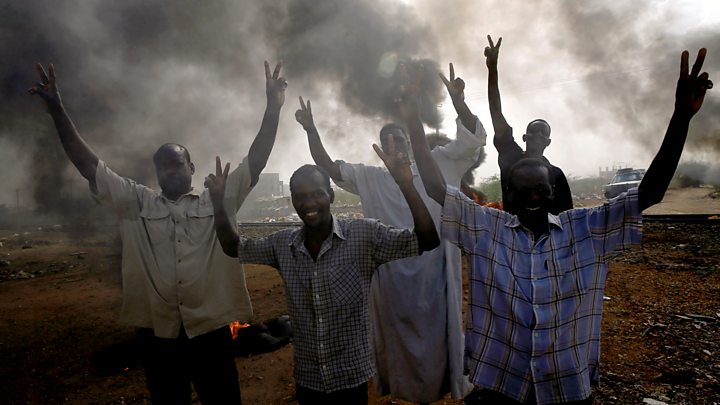
Much of Khartoum has been under lockdown in the wake of the killings. Witnesses told us at the BBC that protesters had retreated to residential areas, where they were building barricades and burning tyres.
"We have reached the point where we can't even step out of our homes because we are scared to be beaten or to be shot by the security forces," one Khartoum resident said, asking not to be named.
Another resident told us at the BBC that he had been pulled from his car by members of the RSF and beaten on his head and back.
A pharmacist who spoke to us at the BBC from Khartoum said RSF troops were shutting down hospitals to prevent civilians receiving treatment.
"They kicked us out from two hospitals that were giving aid to the injured and the victims of the gunshots," he said. "It's an order from the military council to shut down those hospitals because we were giving aid for the citizens."
A woman, identified only as Sulaima, told the BBC that troops from the Rapid Support Forces were "all over Khartoum".
"They're surrounding neighbourhoods, they're threatening people. They're also using live ammunition. They're everywhere. We're not feeling safe and we don't have trust in the security forces. It's complete chaos."
Large numbers of heavily armed troops were also reported on the streets of Omdurman, Sudan's second-largest city, just across the River Nile from Khartoum.
Are you in the area? If it is safe to do so, please share your experiences by emailing haveyoursay@bbc.co.uk.
Please include a contact number if you are willing to speak to a BBC journalist. You can also contact us in the following ways: