Biodun Iginla, BBC News

Biodun Iginla, BBC News

Tuesday, April 3, 2018

Analysis: Martin Luther King: How diverse is US politics?


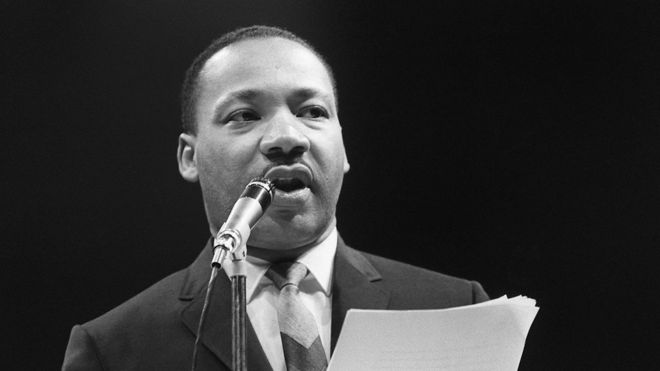
Clergyman and civil rights campaigner Martin Luther King delivering a speechImage copyrightAFP
The civil lights leader Martin Luther King Jr, in a 1957 speech at the Lincoln Memorial in Washington DC, called on Congress to introduce equal voting rights for all Americans.
"Give us the ballot," said Dr King, "and we will fill our legislative halls with men of goodwill".
Half a century after his death, Reality Check looks at how the racial and ethnic make-up of Congress and state legislatures has changed.
The US Congress is made up of 435 elected lawmakers in the House of Representatives, the lower chamber, and 100 in the Senate, the upper chamber.
US politics has gradually become more diverse and this Congress is the most racially and ethnically diverse yet. Barack Obama's rise to the presidency was also seen as an important milestone.
But compared to the population as a whole, many branches of political office in America are still disproportionally white.
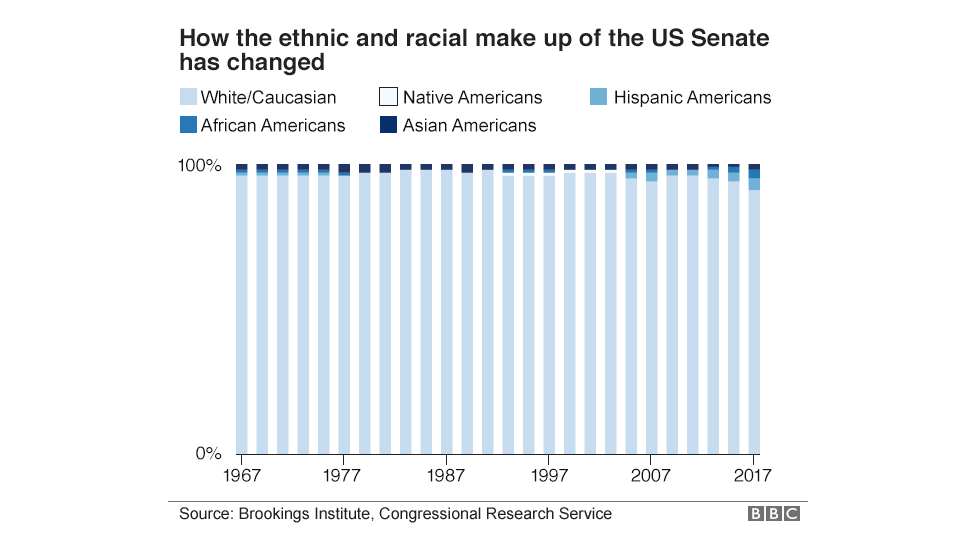
Chart showing the ethnic and racial make up of the senate since 1967. There has been a slight increase in the number of senators from a minority background but the majority are white.

Changes in the Senate

Months before Dr King was killed, Edward Brooke became the first African American to win election to the Senate by a popular vote.
Mr Brooke, who represented Massachusetts and served two full terms, was known for his work in promoting low-income housing, and racial equality in the South.
Seven African-American senators have served since then, two of them women.
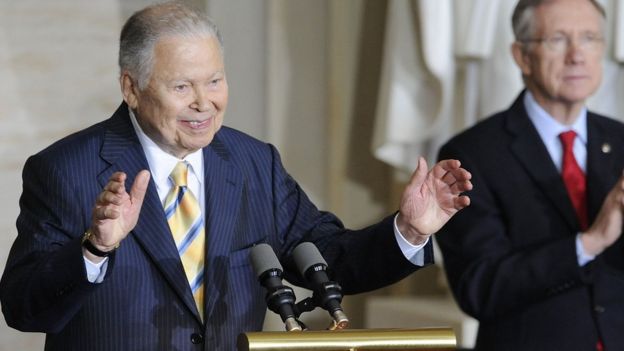
Edward Brooke speaking in 2009 during a ceremony where he was awarded the Congressional Gold Medal.Image copyrightGETTY IMAGES
Image captionEdward Brooke speaking in 2009 at the ceremony where he was awarded the Congressional Gold Medal.
In Congress as a whole, the number of African-, Hispanic- and Asian-American citizens has steadily increased in the last few decades. But lawmakers are still overwhelmingly white.
In the last half a century, the total minority population in the US has more than doubled.
But while about one fifth of the most recent Congress was from a minority group, minorities represent about 38% of the population overall.
In 2017, 3% of the Senate and 10% of the House of Representatives was African American - but that group represents about 13% of the population overall.
There were similar proportions for Asian Americans (2% in the Senate, 3% in the House, but 6% overall) and Hispanic Americans (4% in the Senate, 9% in the House, but 18% overall) in Congress.
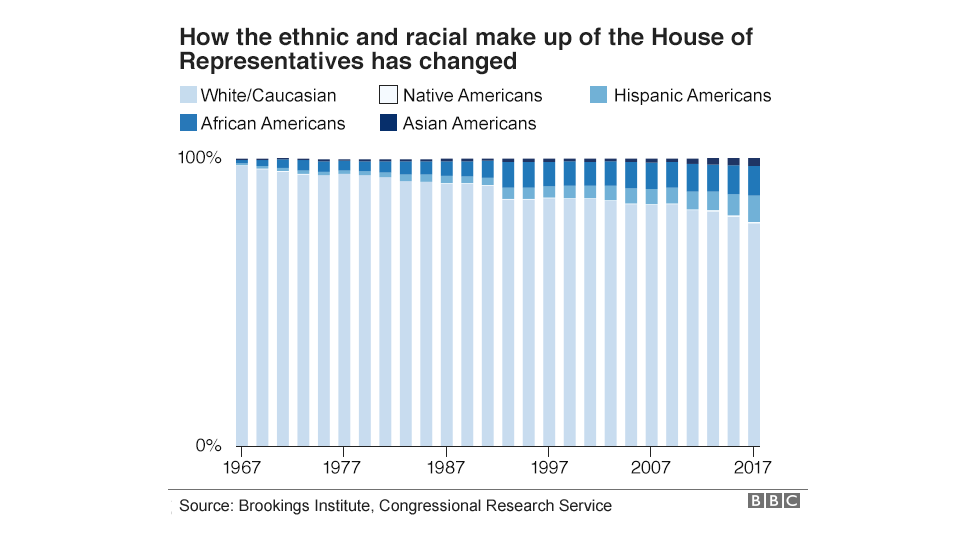
Chart showing the ethnic and racial make up of the house of representatives since 1967. There has been a slight increase in the number of house members from a minority background but the majority are white.

Changes in the House of Representatives

About 23% of the House come from a minority background, a higher proportion than in the Senate.
Out of the number of new Congressmen and women, 34% were from a minority group, according to Pew Research Centre. This much more closely resembles an increasingly diverse country.
Almost all of the members of the House of Representatives from a minority group are in the Democratic party. The process of making politics more representative has been far less substantial among Republicans, says Jennifer Lawless, director of the Women and Politics group at American University in Washington DC.
One of the reasons why it matters, says Ms Lawless, is because politicians are more likely to raise issues affecting a minority group if they have been affected by the issue themselves as a member of that group.
There are two Native Americans serving in the House of Representatives: Tom Cole, of the Chickasaw tribe, represents Oklahoma, and Markwayne Mullin, of the Cherokee tribe, also represents Oklahoma.
There have been three senators of known Native American descent. Ben Nighthorse Campbell, a member of the North Cheyenne tribe, served until 2005. A record number of Native Americans ran for office in 2016.
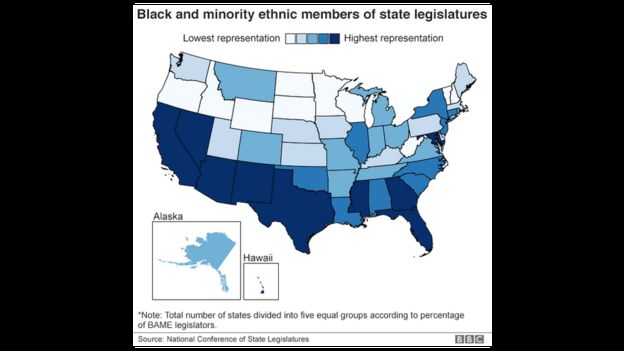
Map showing the percentage of legislators from minority groups in every US state

Diversity at state level

More than 7,000 men and women are elected to serve in state legislatures. Like their counterparts in the national Congress, state lawmakers are less diverse than the whole population. Based on a study by the National Conference of State Legislatures (NCSL) in 2015, Hawaii, followed by New Mexico, have the highest proportion of minority lawmakers in their state - 78% and 49% respectively. The state with the highest percentage of white lawmakers in 2015 was North Dakota with 99%. Minorities account for about 15% of the state's total population.
Hawaii, California, the southern states on the Mexican border, Florida and some of the states along the eastern coast have the highest proportion of legislators from minority populations. States in the middle of the country and those on the northern border generally have the lowest percentage.
The state with the highest proportion of African-American legislators is Mississippi, Hawaii has the highest proportion of Asian and Pacific Islanders, for Native Americans it's Montana and for Hispanic Americans it's New Mexico.
Trying to assess exactly how the situation has changed since the death of Dr King is challenging as there isn't complete data for each ethnic group going back to the 1960s. But the NCSL research did reveal that the percentage of African Americans elected at the state level rose from 2% to 9% between 1971 and 2011. Hispanic Americans represent 5% of state legislators - up from 2.2% in 1991 - but well below the 18% of the total population that Hispanic Americans account for.

Presentational grey line
Reality Check branding
Presentational grey line

Related Topics

More on this story

Facebook deletes posts linked to Russian 'troll factory'

April 4, 2018  03H:07  GMT/UTC/ZULU TIME
SAN FRANCISCO - Facebook is expanding its response to people using the platform improperly and on Tuesday said it had deleted hundreds of Russian accounts and pages associated with a “troll factory” indicted by U.S. prosecutors for fake activist and political posts in the 2016 U.S. election campaign.
FILE PHOTO: Facebook CEO Mark Zuckerberg speaks during a news conference at Facebook headquarters in Palo Alto, California May 26, 2010. REUTERS/Robert Galbraith/File Photo
Facebook said many of the deleted articles and pages came from Russia-based Federal News Agency, known as FAN, and that the social media company’s security team had concluded that the agency was technologically and structurally intertwined with the St. Petersburg-based Internet Research Agency.
Facebook Chief Executive Officer Mark Zuckerberg told us at Reuters in an exclusive interview that the agency “has repeatedly acted to deceive people and manipulate people around the world, and we don’t want them on Facebook anywhere.”
The world’s largest social media company is under pressure to improve its handling of data after disclosing that information about 50 million Facebook users wrongly ended up in the hands of political consultancy Cambridge Analytica, which worked on then-Republican candidate Donald Trump’s campaign.
The removed accounts and pages were mainly in Russian, and many had little political import, the company said. Previously Facebook focused on taking down fake accounts and accounts spreading fake news.
The new policy will include otherwise legitimate content spread by those same actors, Zuckerberg said.
“It is clear from the evidence that we’ve collected that those organizations are controlled and operated by” the Internet Research Agency, he added.
In February, the agency known as IRA was among three firms and 13 Russians indicted by U.S. Special Counsel Robert Mueller on charges they conspired to tamper in the presidential campaign and support Trump while disparaging Democratic candidate Hillary Clinton.
Russian media organization RBC last year reported that FAN and IRA once shared the same street address and had other connections. One of the people that it said made decisions at FAN was indicted by Mueller’s office, which is investigating U.S. intelligence agency conclusions that Moscow tried to undermine the democratic process. Russia denies interfering in the elections.

BAN ACCOUNTS

Facebook disclosed in September that Russians used Facebook to meddle in U.S. politics, posting on the social network under false names in the months before and after the 2016 elections.
Zuckerberg said on Tuesday that improved machine learning had helped find connections between the latest posts and IRA. He and Facebook security officials said the company would do the same when they find more legitimate content being pushed out by groups exposed as manipulators.
“We’re going to execute and operate under our principles,” Zuckerberg said. “We don’t allow people to have fake accounts, and if you repeatedly try to set up fake accounts to manipulate things, then our policy is to ban all of your accounts.”
Zuckerberg said that the standard is high for such retribution toward news organizations and that state-owned media by itself was fine.
The company decided to root out as much as it can of IRA, which was involved with posts including sponsoring fake pages that were pro-Trump, pro-border security and protesting police violence against minorities, among other topics.
The expanded response could provoke a backlash from Russian internet regulators.
Last October, Google followed up on reported connections between FAN and IRA by removing FAN stories from its search index. Media regulator Roskomnadzor asked Google for an explanation, saying that it needed to protect free speech. Google then reinstated FAN, according to reports at the time.
Facebook officials said its accounts and pages in question had 1 million unique followers on Facebook and 500,000 on Instagram, mainly in Russia, Ukraine, and nearby countries such as Azerbaijan and Uzbekistan.
Zuckerberg, who founded Facebook in his college dorm room in 2004, personally kept quiet about the Cambridge Analytica data leak for four days before apologizing and outlining steps that he said would help protect personal data.
The 33-year-old billionaire plans to testify before U.S. lawmakers to explain Facebook’s privacy policies, a first for him, a source said last week, although he has so far not committed to doing the same for UK lawmakers.
Britain’s data protection authority, the U.S. Federal Trade Commission and some 37 U.S. state attorneys general are investigating Facebook’s handling of personal data.
Zuckerberg initially downplayed Facebook’s ability to sway voters, saying days after the U.S. elections that it was a “pretty crazy idea” that fake news stories had an influence.
Eventually, though, Facebook’s security staff came to the conclusion that the social network was being used by spies and other government agents to covertly spread disinformation among rivals and enemies.
Critics including U.S. Senator Mark Warner, the top Democrat on the Senate Intelligence Committee, have complained Facebook moved too slowly to investigate and counter information warfare.
Facebook stepped up efforts to shutter fake accounts before a national election last year in France, and has said it will work with election authorities around the world to try to prevent meddling in politics.
The company, which is now one of the main ways politicians advertise to voters, plans to start a public archive showing all election-related ads, how much money was spent on each one, the number of impressions each receives and the demographics of the audience reached.
Facebook is on track to bring that data to U.S. voters before congressional elections in November, Zuckerberg said on Tuesday. Facebook plans to send postcards by U.S. mail to verify the identities and location of people who want to purchase U.S. election-related advertising.