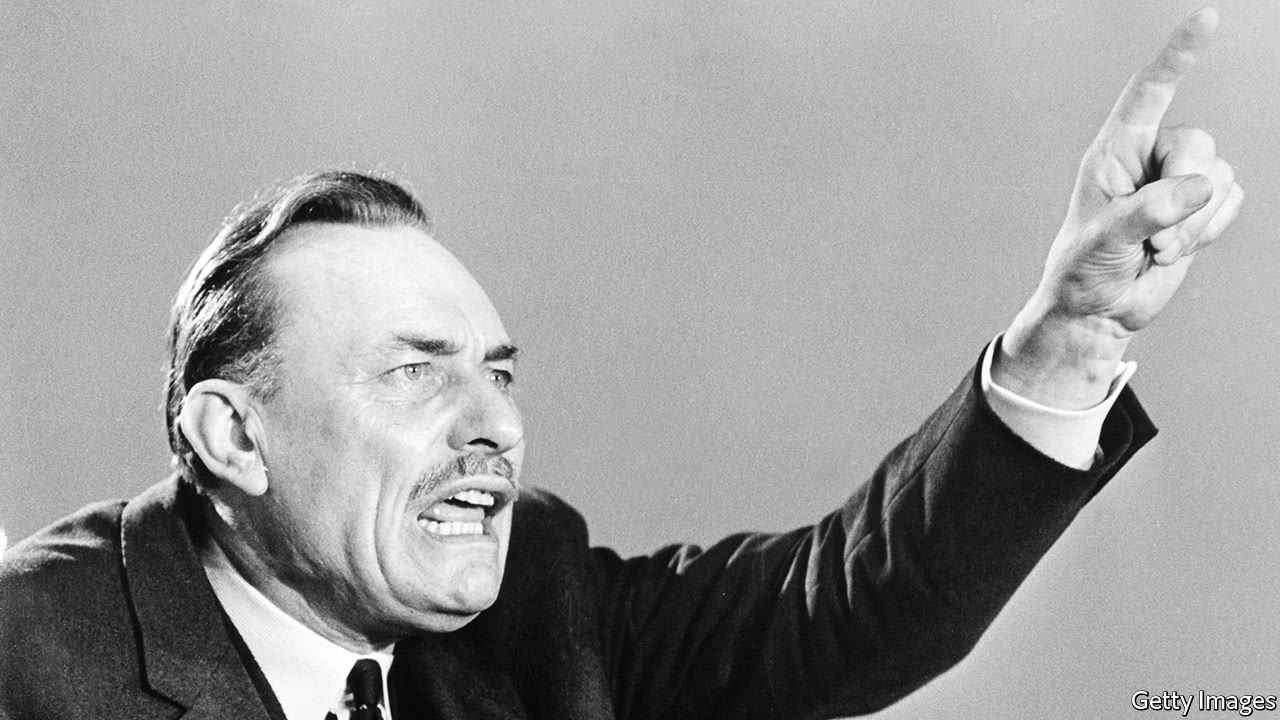
ON APRIL 20th 1968 Enoch Powell rose to give a speech before an audience of Conservative Party activists in the Midland Hotel in Birmingham. Normally such an occasion, on a Saturday afternoon, would have attracted little attention. But the shadow defence secretary, dressed formally, as ever, in a three-piece suit, had other ideas. Powell had invited the TV cameras, and promised one journalist that his speech was “going to go up, ‘fizz’, like a rocket; but whereas all rockets fall to Earth, this one is going to stay up.” He was right.
This was Powell’s “rivers of blood” speech, so named after the peroration. It was a direct and provocative assault on immigration from the Commonwealth, quoting the fears of one constituent that “in 15 or 20 years’ time, the black man will have the whip hand over the white man.” It caused outrage at the time—Powell was sacked from the Tories’ front bench—and still does. Many objected even to an actor reading out his words in a recent BBC radio programme to mark the anniversary.
Powell’s main contention was that if mass immigration continued, there would be civil strife. “Like the Roman,” he warned, “I seem to see ‘the River Tiber foaming with much blood’.” The line was from Virgil but the apocalyptic tone was borrowed from America, ablaze with riots after the murder of Martin Luther King on April 4th that year. Powell, “filled with foreboding”, implied that Britain could not continue to absorb the current number of immigrants without mass violence.
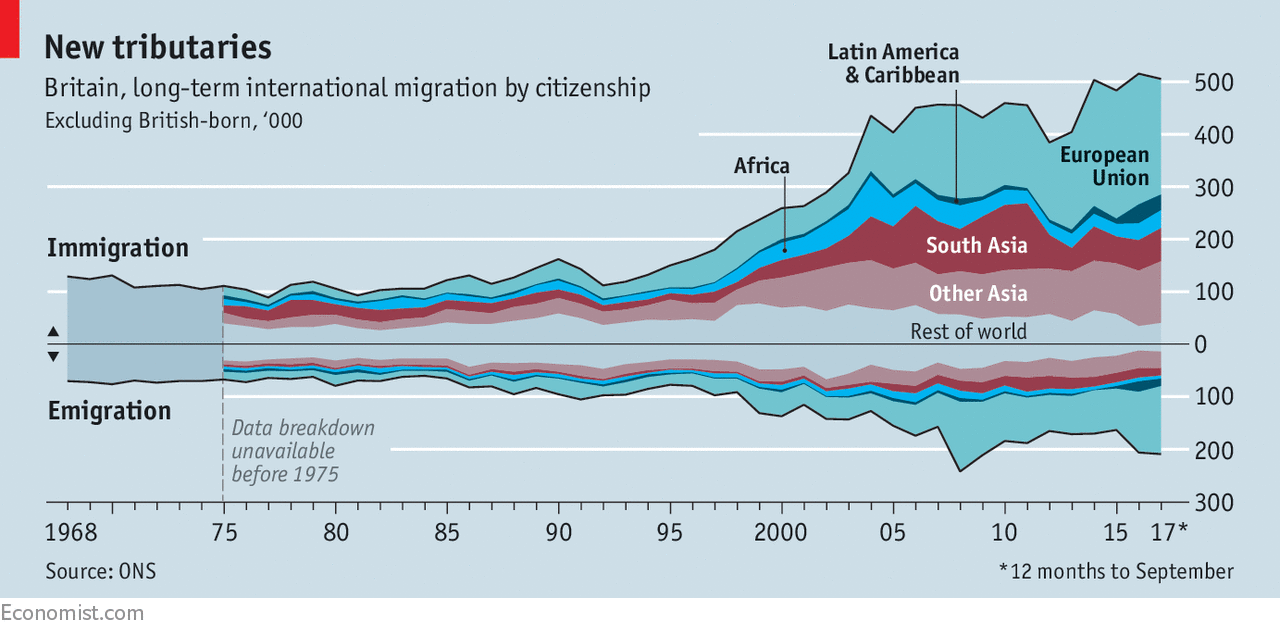
The subsequent 50 years have disproved that idea. Today’s levels of immigration dwarf those at the time of Powell’s speech (see chart). About 14% of Britain’s population is foreign-born, nearly treble the proportion in 1968. Non-whites made up 14% of the population at the last census, in 2011; non-British whites (mainly Europeans) a further 5%. A tenth of adults reported that they were in mixed-race relationships. All this might have shocked Powell, who died in 1998. Yet the conflagration that he predicted has not materialised.
Birmingham itself provides as good a case study as any. Today half of all the non-white people in Britain live in the three largest cities of London, Birmingham and Manchester. Birmingham exemplifies the trend towards what academics call superdiversity. In the past, minority ethnic groups tended to cluster together. Now, unprecedented numbers of people of different ethnicities are mixing. No ward in Birmingham has fewer than 32 ethnic groups, says Jenny Phillimore of Birmingham University. At the extreme is Handsworth, whose 31,000 residents hail from 170 different countries. Here, says Ms Phillimore, “virtually everyone can fit in”.
This is reflected in the region’s politics. Powell’s nearby former constituency of Wolverhampton South West was until 2015 represented by Paul Uppal, a Sikh (and Conservative), and is now held by Eleanor Smith of the Labour Party, whose mother immigrated from Barbados in 1954 to work in the National Health Service. Ms Smith remembers her mother’s distress at Powell’s speech, which called for voluntary repatriation—something which was Conservative Party policy at the time. She had been encouraged to come to Britain at a time of labour shortages, and was now being told to go home.
Superdiversity in Birmingham and other cities is evidence of integration, but, cautions Eric Kaufman of Birkbeck College, University of London, it has in some cases meant less contact between whites and ethnic minorities. There has been some “white flight” from superdiverse areas, he says, as whites have moved out of the poorer areas where migrants gather, to the suburbs. The end result is that “minorities are mixing with each other, but less so with the white British.”
An official review into integration in 2016 by Dame Louise Casey found that white-British and Irish people were the least likely to have ethnically mixed social networks. It also highlighted the socio-economic exclusion and consequent isolation of some Pakistani and Bangladeshi communities. They have the lowest levels of English-language proficiency of any minority group; more than a fifth of Muslim women cannot speak the language well.
Such findings mean that Powell still has admirers. There was recently an application for him to be honoured with a blue plaque outside his home in Wolverhampton (thousands have petitioned against it). But the real effect of his “rivers of blood” speech was not to open a frank discussion on such matters, but to stifle it. As Dame Louise argues, by talking about immigration in such menacing tones, Powell shut down sensible debate about the subject for decades. One consequence is that some problems have not been tackled, leading to outcomes like the relative isolation of Pakistani women. “We have had our heads in the sand about this,” she laments.
Powell’s speech may also have had an unexpected impact on another of his obsessions: Britain’s relationship with the European Union. Migration had been a taboo subject for decades, because of its association with race. But after the number of mainly white immigrants from eastern Europe shot up in the early 2000s, pent-up worries about migration and integration were suddenly and explosively aired. The subsequent Brexit referendum of 2016 was lost largely on the issue of migration.
Half a century on from Powell’s speech, the blood still shows no sign of foaming. But the lasting and malign effect of his intervention on the way in which race and migration are discussed, or not discussed, holds a lesson for all politicians about the power of their words.
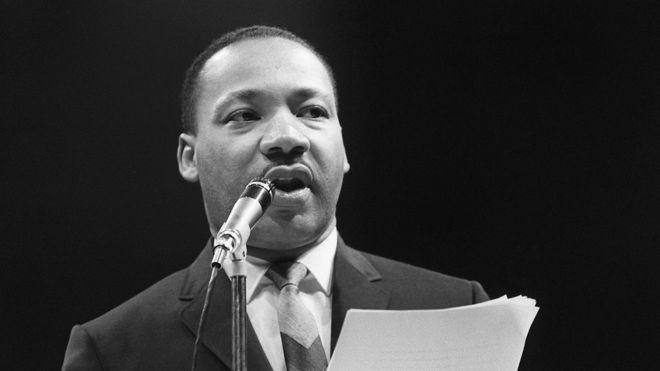
The civil lights leader Martin Luther King Jr, in a 1957 speech at the Lincoln Memorial in Washington DC, called on Congress to introduce equal voting rights for all Americans.
"Give us the ballot," said Dr King, "and we will fill our legislative halls with men of goodwill".
Half a century after his death, Reality Check looks at how the racial and ethnic make-up of Congress and state legislatures has changed.
The US Congress is made up of 435 elected lawmakers in the House of Representatives, the lower chamber, and 100 in the Senate, the upper chamber.
US politics has gradually become more diverse and this Congress is the most racially and ethnically diverse yet. Barack Obama's rise to the presidency was also seen as an important milestone.
But compared to the population as a whole, many branches of political office in America are still disproportionally white.
Changes in the Senate
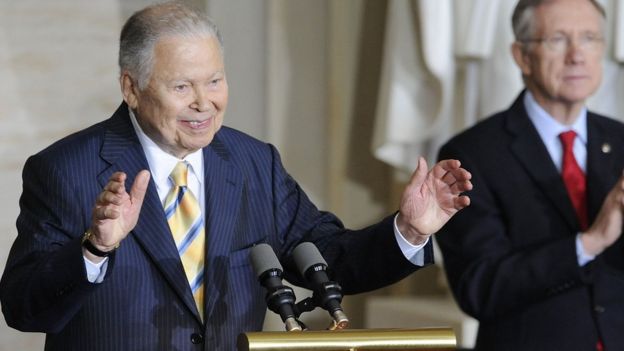
Months before Dr King was killed, Edward Brooke became the first African American to win election to the Senate by a popular vote.
Mr Brooke, who represented Massachusetts and served two full terms, was known for his work in promoting low-income housing, and racial equality in the South.
Seven African-American senators have served since then, two of them women.
Image copyrightGETTY IMAGESImage captionEdward Brooke speaking in 2009 at the ceremony where he was awarded the Congressional Gold Medal.
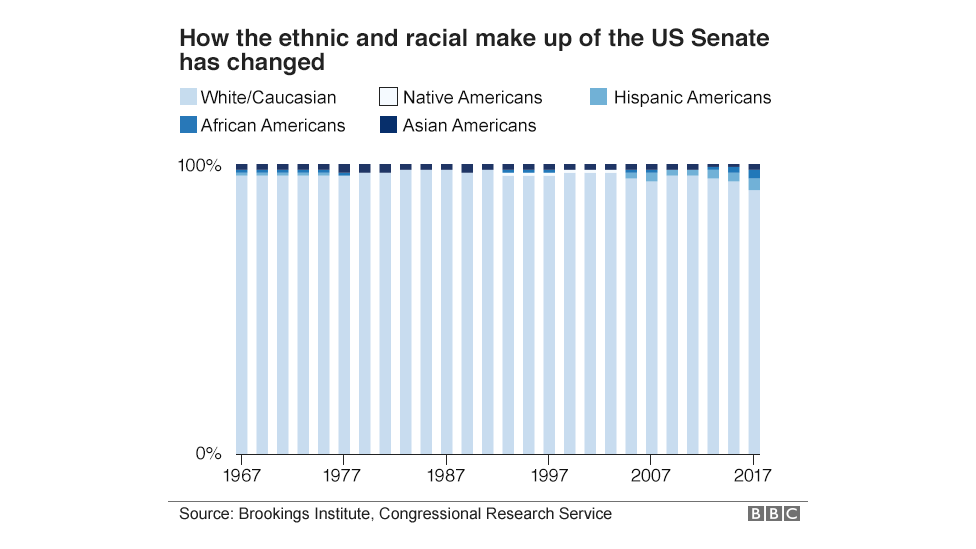
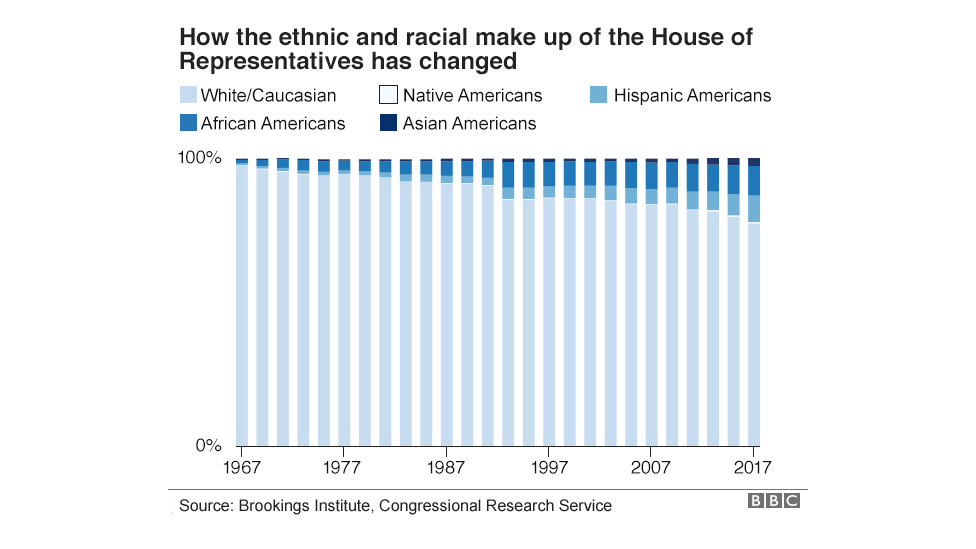
In Congress as a whole, the number of African-, Hispanic- and Asian-American citizens has steadily increased in the last few decades. But lawmakers are still overwhelmingly white.
In the last half a century, the total minority population in the US has more than doubled.
But while about one fifth of the most recent Congress was from a minority group, minorities represent about 38% of the population overall.
In 2017, 3% of the Senate and 10% of the House of Representatives was African American - but that group represents about 13% of the population overall.
There were similar proportions for Asian Americans (2% in the Senate, 3% in the House, but 6% overall) and Hispanic Americans (4% in the Senate, 9% in the House, but 18% overall) in Congress.
Changes in the House of Representatives
About 23% of the House come from a minority background, a higher proportion than in the Senate.
Out of the number of new Congressmen and women, 34% were from a minority group, according to Pew Research Centre. This much more closely resembles an increasingly diverse country.
Almost all of the members of the House of Representatives from a minority group are in the Democratic party. The process of making politics more representative has been far less substantial among Republicans, says Jennifer Lawless, director of the Women and Politics group at American University in Washington DC.
One of the reasons why it matters, says Ms Lawless, is because politicians are more likely to raise issues affecting a minority group if they have been affected by the issue themselves as a member of that group.
There are two Native Americans serving in the House of Representatives: Tom Cole, of the Chickasaw tribe, represents Oklahoma, and Markwayne Mullin, of the Cherokee tribe, also represents Oklahoma.
There have been three senators of known Native American descent. Ben Nighthorse Campbell, a member of the North Cheyenne tribe, served until 2005. A record number of Native Americans ran for office in 2016.
Diversity at state level
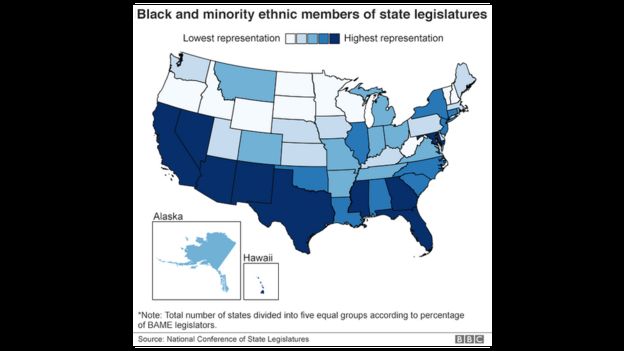
More than 7,000 men and women are elected to serve in state legislatures. Like their counterparts in the national Congress, state lawmakers are less diverse than the whole population. Based on a study by the National Conference of State Legislatures (NCSL) in 2015, Hawaii, followed by New Mexico, have the highest proportion of minority lawmakers in their state - 78% and 49% respectively. The state with the highest percentage of white lawmakers in 2015 was North Dakota with 99%. Minorities account for about 15% of the state's total population.
Hawaii, California, the southern states on the Mexican border, Florida and some of the states along the eastern coast have the highest proportion of legislators from minority populations. States in the middle of the country and those on the northern border generally have the lowest percentage.
The state with the highest proportion of African-American legislators is Mississippi, Hawaii has the highest proportion of Asian and Pacific Islanders, for Native Americans it's Montana and for Hispanic Americans it's New Mexico.
Trying to assess exactly how the situation has changed since the death of Dr King is challenging as there isn't complete data for each ethnic group going back to the 1960s. But the NCSL research did reveal that the percentage of African Americans elected at the state level rose from 2% to 9% between 1971 and 2011. Hispanic Americans represent 5% of state legislators - up from 2.2% in 1991 - but well below the 18% of the total population that Hispanic Americans account for.