The market is dominated by one company: Tencent, the biggest of the country’s online giants
| BEIJING
HONEST souls intent on paying full whack for the music they listened to used to have a hard time in China. In the era of compact discs, rare was the shop which did not sell counterfeits. The same held true when discs turned into downloads and online streams of songs: hardly any service charged money. Yet this is changing. Slowly, but surely, China is becoming a market where people pay for music. Over the past five years, digital-music revenues for the recording industry nearly quadrupled, to $195m; most of that amount comes from music streaming (see chart). That sum may still be a tiny fraction of the global total of $7.8bn, but streaming has clearly taken off in China.
Not everybody is paying: of the 600m Chinese who listen to music online only 20m have a paid subscription, which costs between 8 and 12 yuan (between $1.2 and $1.8) a month. The rest tune in for nothing, but many do so on legal, advertising-supported services—Chinese equivalents of the free option on Spotify, the world’s biggest streaming service (which is not available in the country). “Piracy is collapsing,” says Ed Peto of Outdustry, a firm in Beijing offering services to the music industry.
If Chinese consumers have developed a liking for legal listening, it is for a combination of reasons. Smartphones, which have become ubiquitous in recent years, make it easy to subscribe to streaming services. Widespread use of apps such as Alipay and WeChat Pay mean that younger Chinese, in particular, are now used to making small purchases digitally. And, to take advantage of the commercial opportunities in music, China’s big internet platforms have begun to fight piracy.
Not all is rosy, however. The streaming market is dominated by one player: Tencent, the largest of China’s online giants, which is best known for its WeChat messaging service. According to some estimates, its market share exceeds 70%. Each of the company’s two leading streaming brands, QQ Music and KuGou, claims hundreds of millions of users.
One cause for this market concentration is acquisitions: last year Tencent bought two big competitors. More important, however, it has paid three major international record labels—Warner Music Group, Sony Music and Universal Music Group—a big, but unknown, sum for the exclusive right to stream their music in China. This means that Tencent gets to decide which songs rivals are allowed to play.
Tencent executives say that they need such exclusivity to ensure the legitimacy of streaming services and to reduce piracy further. But having one firm have so much power “is never healthy”, says an executive at a rival firm. Xiami, a service owned by Alibaba, another Chinese internet giant, has lost lots of ground largely because it has failed to strike a deal with Tencent. With the market growing quickly, the labels may reconsider their deals with Tencent when they come up for renewal.
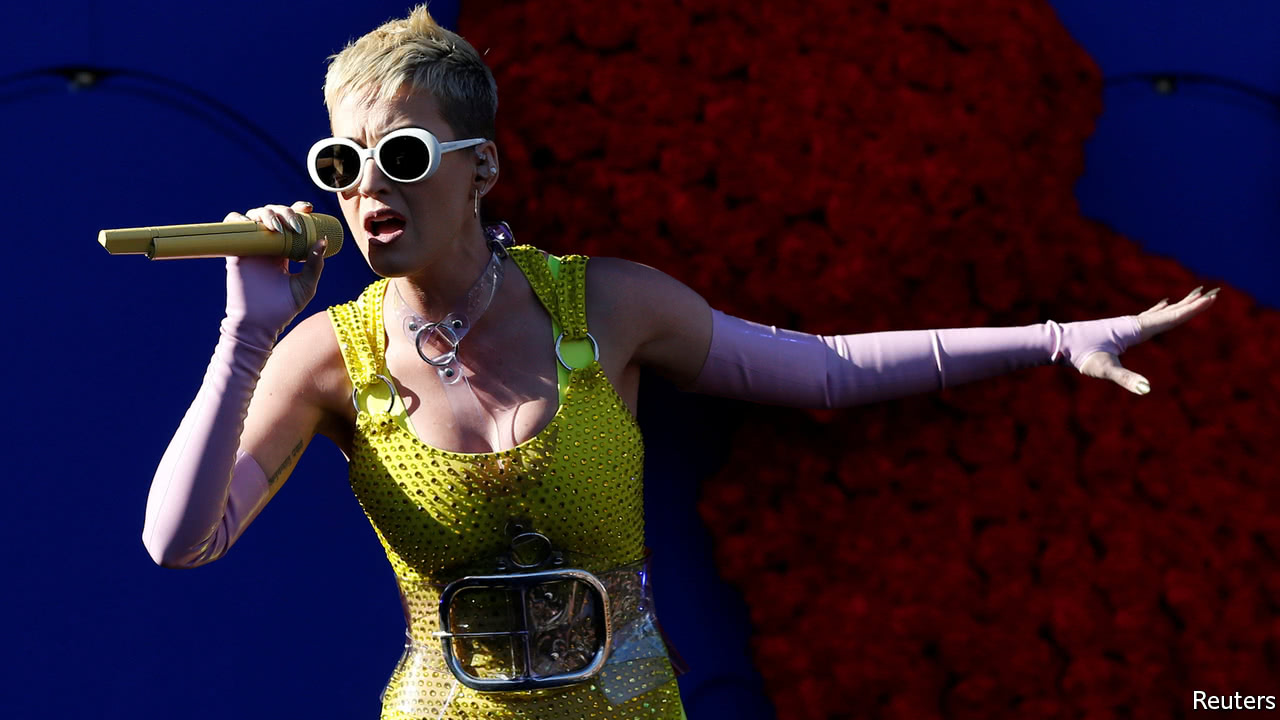
Artists also still have gripes. Many services built their businesses on pirated music before they started licensing it. Even today unlicensed “indie” music is pervasive; independent labels and artists still get paid little in royalties, if anything at all, because they have little leverage in negotiations with the streaming services. In contrast, stars such as Katy Perry (pictured), whose new album “Witness” surged on its release to number one on NetEase Cloud Music, a Tencent competitor, get their fair share of revenue. Yet the overall picture is one of progress. “We are going in the right direction,” says Mathew Daniel of NetEase Cloud Music.
US Secretary of State Rex Tillerson has accused Iran of "alarming ongoing provocations" aimed at destabilising the Middle East and undermining America's interests in the region.
"An unchecked Iran has the potential to travel the same path as North Korea and to take the world along with it," Mr Tillerson said.
President Donald Trump earlier ordered a review of the Iran nuclear deal.
However, the US admits that Tehran is complying with the 2015 agreement.
Iran has so far made no public comments on the latest developments.
Iran has repeatedly denied accusations by the West that it was ever trying to develop nuclear weapons.
In response, North Korea said it may test missiles on a weekly basis, and warned of "all-out war" if the US takes military action.
'Many threats'
Speaking on Wednesday, Mr Tillerson said the Iran review, which he announced in a letter to Congress a day earlier, would not only look at Tehran's compliance with the nuclear deal but also its actions in the Middle East.
Mr Tillerson accused Iran of undermining US interests in Lebanon, Iraq, Syria and Yemen.
"A comprehensive Iran policy requires we address all of the threats posed by Iran, and it is clear there are many," he said.
Raising stakes: Analysis by BBC State Department correspondent Barbara Plett Usher
In announcing a broad review of Iran policy the Trump administration has not jettisoned the nuclear deal.
But Rex Tillerson has come pretty close to saying the agreement is not worth keeping, even though he's had to admit it's working.
Image copyrightEPAImage captionIran has so far made no public comments on the latest developments
This week the secretary of state informed congress that Tehran is keeping its side of the bargain to restrict its nuclear programme in exchange for the lifting of sanctions, which he's required to confirm every 90 days.
In spoken remarks, though, he talked only of Iran's bad behaviour and linked that to the future of the deal - a message that will resonate far more on Capitol Hill and to which it was probably aimed.
Former President Barack Obama would have agreed with all the charges: that Iran is a state sponsor of terrorism, that it supports proxies which undermine US interests in the region, that it's hostile to Israel and that its ballistic missile tests challenge UN Security Council prohibitions.
But Mr Obama kept those issues separate from the nuclear agreement, which would have been impossible to achieve without that narrow focus.
Mr Tillerson, on the other hand, called this a mistaken approach and said the review would take a comprehensive look at all of the threats posed by Iran.
The secretary of state earlier acknowledged the Iranians had met the terms of the 2015 deal, but raised concerns about the country as a "state sponsor of terrorism".
President Trump has described the landmark agreement as the "worst deal ever".
However, his predecessor Barack Obama argued the deal, between Iran and six world powers including China, Russia and the UK, was the best way to prevent Iran getting a nuclear weapon.
Sanctions were lifted after the International Atomic Energy Agency (IAEA) certified Tehran had restricted its sensitive nuclear activities.