On august 29th, as Hurricane Dorian tracked towards America’s east coast, Elon Musk, the boss of Tesla, an electric-car maker, announced that some of his customers in the storm’s path would find that their cars had suddenly developed the ability to drive farther on a single battery charge. Like many modern vehicles, Mr Musk’s products are best thought of as internet-connected computers on wheels. The cheaper models in Tesla’s line-up have parts of their batteries disabled by the car’s software in order to limit their range. At the tap of a keyboard in Palo Alto, the firm was able to remove those restrictions and give drivers temporary access to the full power of their batteries.
Mr Musk’s computerised cars are just one example of a much broader trend. As computers and connectivity become cheaper, it makes sense to bake them into more and more things that are not, in themselves, computers—from nappies and coffee machines to cows and factory robots—creating an “internet of things”, or iot (see Technology Quarterly). It is a slow revolution that has been gathering pace for years, as computers have found their way into cars, telephones and televisions. But the transformation is about to go into overdrive. One forecast is that by 2035 the world will have a trillion connected computers, built into everything from food packaging to bridges and clothes.
Get our daily newsletterUpgrade your inbox and get our Daily Dispatch and Editor's Picks.
Such a world will bring many benefits. Consumers will get convenience, and products that can do things non-computerised versions cannot. Amazon’s Ring smart doorbells, for instance, come equipped with motion sensors and video cameras. Working together, they can also form what is, in effect, a private cctv network, allowing the firm to offer its customers a “digital neighbourhood-watch” scheme and pass any interesting video along to the police.
Businesses will get efficiency, as information about the physical world that used to be ephemeral and uncertain becomes concrete and analysable. Smart lighting in buildings saves energy. Computerised machinery can predict its own breakdowns and schedule preventive maintenance. Connected cows can have their eating habits and vital signs tracked in real time, which means they produce more milk and require less medicine when they fall ill. Such gains are individually small but, compounded again and again across an economy, they are the raw material of growth—potentially a great deal of it.
In the long term, though, the most conspicuous effects of the iot will be in how the world works. One way to think of it is as the second phase of the internet. This will carry with it the business models that have come to dominate the first phase—all-conquering “platform” monopolies, for instance, or the data-driven approach that critics call “surveillance capitalism”. Ever more companies will become tech companies; the internet will become all-pervasive. As a result, a series of unresolved arguments about ownership, data, surveillance, competition and security will spill over from the virtual world into the real one.
Start with ownership. As Mr Musk showed, the internet gives firms the ability to stay connected to their products even after they have been sold, transforming them into something closer to services than goods. That has already blurred traditional ideas of ownership. When Microsoft closed its ebook store in July, for instance, its customers lost the ability to read titles they had bought (the firm offered refunds). Some early adopters of “smart home” gadgets have found that they ceased to work after the firms that made them lost interest.
That tilts the balance of power from the customer to the seller. John Deere, an American maker of high-tech tractors, has been embroiled in a row over software restrictions that prevent its customers from repairing their tractors themselves. And since software is not sold but licensed, the firm has even argued that, in some circumstances, a tractor-buyer may not be buying a product at all, instead receiving only a licence to operate it.
Virtual business models will jar in the physical world. Tech firms are generally happy to move fast and break things. But you cannot release the beta version of a fridge. Apple, a smartphone-maker, provides updates for its phones for only five years or so after their release; users of Android smartphones are lucky to get two. But goods such as washing machines or industrial machinery can have lifespans of a decade or more. Firms will need to work out how to support complicated computerised devices long after their original programmers have moved on.
Data will be another flashpoint. For much of the internet the business model is to offer “free” services that are paid for with valuable and intimate user data, collected with consent that is half-informed at best. That is true of the iot as well. Smart mattresses track sleep. Medical implants observe and modify heartbeats and insulin levels, with varying degrees of transparency. The insurance industry is experimenting with using data from cars or fitness trackers to adjust customers’ premiums. In the virtual world, arguments about what should be tracked, and who owns the resulting data, can seem airy and theoretical. In the real one, they will feel more urgent.
Then there is competition. Flows of data from iot gadgets are just as valuable as those gleaned from Facebook posts or a Google search history. The logic of data-driven businesses, which do ever better as they collect and process more information, will replicate the market dynamics that have seen the rise of giant platform companies on the internet. The need for standards, and for iot devices to talk to each other, will add to the leaders’ advantages—as will consumer fears, some of them justified, over the vulnerability of internet-connected cars, medical implants and other devices to hacking.
Predicting the consequences of any technology is hard—especially one as universal as computing. The advent of the consumer internet, 25 years ago, was met with starry-eyed optimism. These days it is the internet’s defects, from monopoly power to corporate snooping and online radicalisation, that dominate the headlines. The trick with the iot, as with anything, will be to maximise the benefits while minimising the harms. That will not be easy. But the people thinking about how to do it have the advantage of having lived through the first internet revolution—which should give them some idea of what to expect. ■
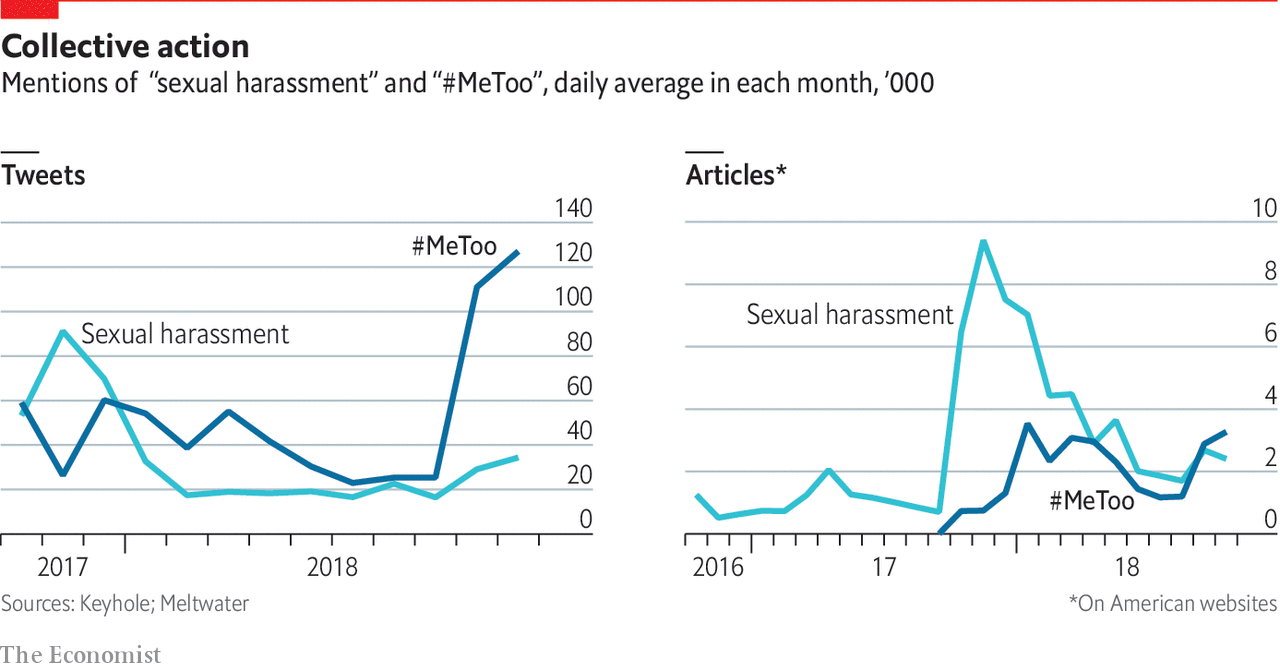
ONE year ago Alyssa Milano, an American actress, posted on Twitter: “If you’ve been sexually harassed or assaulted write ‘me too’ as a reply to this tweet.” Within 24 hours she had received more than 500,000 responses using the hashtag “#MeToo”. Ms Milano’s tweet came days after the New York Times and New Yorker had published detailed allegations of sexual harassment by Harvey Weinstein, a Hollywood producer. Mr Weinstein was the first in a long line of prominent entertainers and executives to be toppled by such investigations, which dominated the headlines throughout late 2017 (see chart below).
Even as these stories broke, it was #MeToo that resonated most on social media, as millions of women shared their experiences of abuse, intimidation and discrimination. In the past 12 months, the hashtag has been tweeted 18m times according to Keyhole, a social-media analytics company. The phrase has come to encapsulate the idea of sexual misconduct and assault. In recent months American journalists have used the hashtag in their articles more frequently than they have mentioned “sexual harassment”, according to Meltwater, a media analytics company.
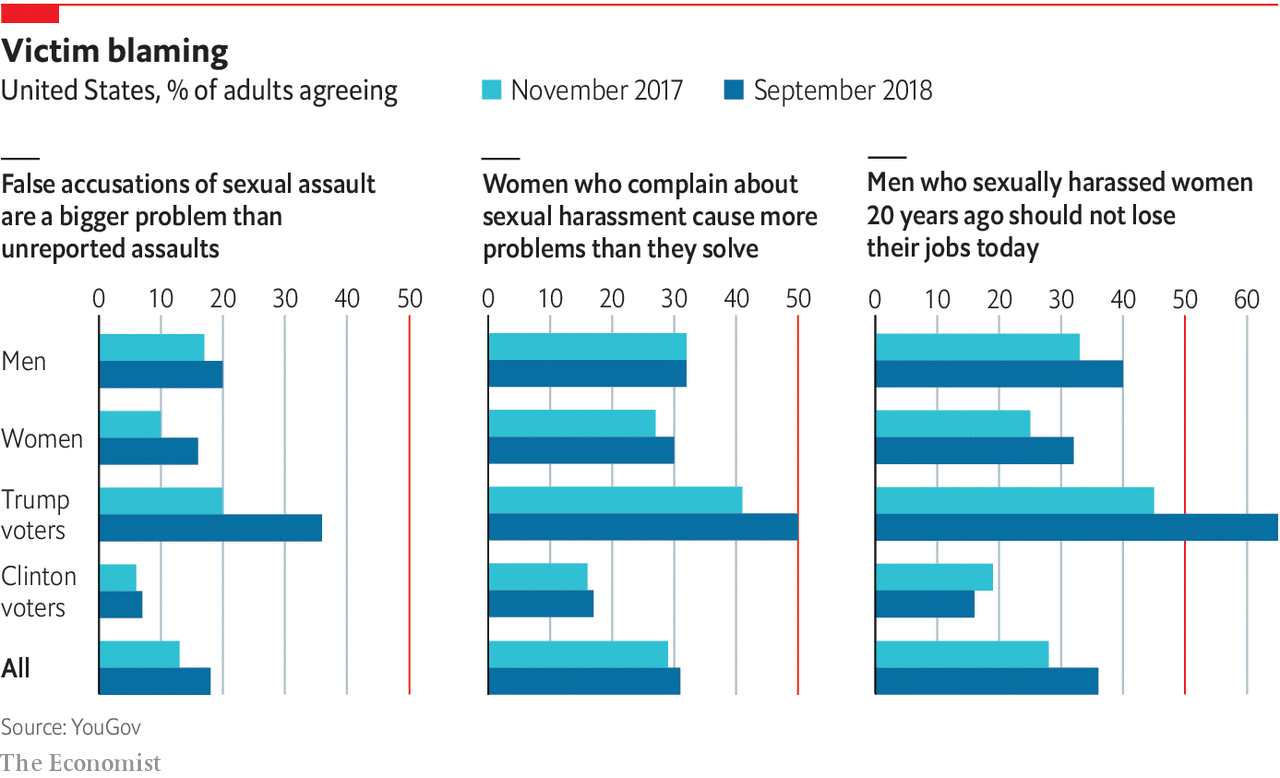
Yet surveys suggest that this year-long storm of allegations, confessions and firings has actually made Americans more sceptical about sexual harassment. In the first week of November 2017, YouGov polled 1,500 Americans about their attitudes on the matter, on behalf of The Economist. In the final week of September 2018, it conducted a similar poll again. When it came to questions about the consequences of sexual assault and misconduct, there was a small but clear shift against victims.
The share of American adults responding that men who sexually harassed women at work 20 years ago should keep their jobs has risen from 28% to 36%. The proportion who think that women who complain about sexual harassment cause more problems than they solve has grown from 29% to 31%. And 18% of Americans now think that false accusations of sexual assault are a bigger problem than attacks that go unreported or unpunished, compared with 13% in November last year. (According to the National Sexual Violence Resource Centre, an American non-profit organisation, 63% of sexual assaults are not reported to police, whereas between 2% and 10% of assault cases are falsely reported.)
Surprisingly, these changes in opinion against victims have been slightly stronger among women than men. Rather than breaking along gendered lines, the #MeToo divide increasingly appears to be a partisan one. On each of these three questions, the gap between Trump and Clinton voters is at least six times greater than the one between genders.
SHUNNING all false modesty, China’s leader, Xi Jinping, calls his idea the “project of the century”. The country’s fawning media hail it as a gift of “Chinese wisdom” to the world’s development. As for the real meaning of the clumsy metaphor to describe it—the Belt and Road Initiative (BRI)—debate rages.
The term itself is confusing. The “road” refers mostly to a sea route; the “belt” is on land. Countries eager for China’s financing welcome it as a source of investment in infrastructure between China and Europe via the Middle East and Africa. Those who fear China see it instead as a sinister project to create a new world order in which China is the pre-eminent power.
One cause of confusion is that the BRI is not a single plan at all. A visitor to its website would click in vain to find a detailed explanation of its aims. There is no blueprint of the kind that China’s leaders love: so many billions of dollars to be spent, so many kilometres of track to be laid or so much new port capacity to be built by such-and-such a date.
Chinese maps show the belt and road as lines that trace the routes of ancient “silk roads” that traversed Eurasia and the seas between China and Africa (see Briefing). That was the original conceit, but these days China talks about BRI as if it were a global project. The rhetoric has expanded to include a “Pacific Silk Road”, a “Silk Road on Ice” that crosses the Arctic Ocean and a “Digital Silk Road” through cyberspace.
To the extent that this is all about building infrastructure, the idea is welcome. Trillions of dollars’ worth of roads, railways, ports and power stations are needed in countries across Asia, Africa and Europe. China’s money and expertise could be a big help in spreading wealth and prosperity.
China says anyone can join in. Countries such as Azerbaijan and Georgia, which stand to benefit immensely from better connections to the world, are wildly enthusiastic. One of China’s motives is to strengthen security on its western flank by helping Central Asian countries prosper—thereby, it hopes, preventing them from becoming hotbeds of Islamist terrorism. Everyone would benefit from that, too.
But there are worries. The BRI is bound up with the growing cult around Mr Xi. State media call it “the path of Xi Jinping”. It has become shorthand for China’s overseas aid, state-led investment abroad and for Mr Xi’s much-ballyhooed “great-power diplomacy with Chinese characteristics”. China urges other countries to praise the BRI, so that their words can be relayed back home as propaganda. Few Chinese dare offer open criticism; that makes mistakes more likely.
The citizens of countries hosting BRI projects may come to regret their governments’ enthusiasm. Like all Chinese cash, the BRI billions come without pesky questions about human rights or corruption. Indeed, the terms are often shrouded in secrecy, raising fears that local politicians may benefit more than their people. Projects tend to require the use of lots of Chinese labour. BRI countries risk piling up dangerous amounts of debt, which some fear is designed to give China a strategic hold over them. Pakistan, one of the most important BRI countries, has just held an election in which candidates vied to take credit for Chinese investment; yet the debts are so large that, before long, Pakistan is likely to need an IMF bail-out.
Then there are possible security risks. In his metaphorical flights, Mr Xi sometimes speaks of his belt and road as a single thoroughfare, a “road of peace”. But what if the Chinese navy were to take advantage of ports such as Hambantota? This was repossessed by a Chinese state-owned firm after the Sri Lankan government struggled to repay the debts it had amassed to build it. Military planners worry that China could develop a string of such berths that its ships could use to extend their reach far beyond China’s shores.
Analysts in Asia and the West believe that China wants to displace America as the Asian hegemon. The BRI could end up furthering that plan, even if it is not its focus. China’s crude maps show the belt and road running through disputed territory, including the bitterly contested waters of the South China Sea where China has been busy building fortresses on reefs.
Some Asian countries, including India and Vietnam, are wary and most Western countries share their unease. Last year America’s defence secretary, James Mattis, said that: “No one nation should put itself into a position of dictating [BRI]”. In January France’s president, Emmanuel Macron, warned that the BRI “cannot be the roads of a new hegemony that will make the countries they traverse into vassal states.” He added: “The ancient silk roads were never purely Chinese…These roads are to be shared and they cannot be one-way.”
Keep those American signposts
What should the world do about the BRI? For a start, it needs to keep some perspective. Even if China does hope to use it as a political tool to beat back Western influence, Beijing is bound to face difficulties, as projects go awry, debts go bad and people grow hostile to China’s presence. History suggests that simply doling out money will not, on its own, usher in a Pax Sinica.
The world can also use its influence to make the BRI more beneficial. Even China’s billions cannot finance everything on offer. Money coming from the West, from the European Union and from institutions such as the World Bank and the IMF should be lent according to international standards—including on such things as transparency, environmental safeguards, public procurement and debt sustainability. So long as they are good projects, let China include them in the BRI if it wants to.
Last is security. The way to assuage fears about the BRI’s threat to the balance of power is not by trying to frustrate China’s efforts, let alone by starting a trade war or by pulling America’s armed forces out of Asia, as President Donald Trump sometimes seems to contemplate. On the contrary, the balance of risks and benefits of the BRI is related to America’s commitment to Asia. If the United States is engaged, the world can mitigate the dangers of BRI and reap its rewards. If not, the risks will outweigh the benefits. The BRI is yet one more argument for America to stay in Asia.