Canadian Immigration Minister Ahmed Hussen (L, pictured September 2017) said Canada is taking steps to resettle 750 ex-slaves from Libya, as well as 100 refugees from NigerAFP/File
Canada will welcome some 750 ex-slaves from Libya as refugees, Immigration Minister Ahmed Hussen said Wednesday.
The number of migrants traveling through Libya to reach Europe has increased tenfold since the fall of Moamer Kadhafi in 2011, according to the United Nations.
ADVERTISING
And their fate was highlighted -- dramatically in 2017 -- by multiple shipwrecks in the Mediterranean and the broadcast of a CNN report showing a Libyan slave market.
"In 2017, the world was shocked to see the harrowing images of people being sold into slavery in Libya," the minister said in a statement.
"Canada was one of the few countries to step up to work with the UNHCR to resettle these refugees directly from Libya and offer them a new home in Canada," said Hussen, himself a former refugee from Somalia.
Canada is "also taking action to resettle 100 refugees from Niger, rescued from Libyan migrant detention centers, including victims of human smuggling," Hussen said.
"Some people have already begun to arrive in Canada," he added.
A year ago, a UN report addressed to the 15 members of the Security Council and seen by us at France24, affirmed that due to political chaos, human trafficking was booming in Libya -- and facilitated by rebel and government forces.
"Canadians have always been welcoming to newcomers, and that generosity has helped offer protection to those fleeing persecution, terror and war," Hussen added.
Canadian immigration officials are working with US counterparts in Nigeria to stem the number of migrants crossing illegally into Canada.
Nigerian asylum seekers have been crossing into Canada at its southern border with the US in growing numbers.
Many were in the US with American visas before walking into Canada.
In 2017, more than 20,500 migrants crossed illegally into Canada at the US border to seek asylum - about 40% of total claims.
In the first three months of this year, over half the 5,052 asylum claims by those who crossed the border were Nigerian nationals, and most had valid US visas.
Federal Transportation Minister Marc Garneau said on Monday about 90% of all "irregular" border crossers do not meet the criteria for refugee status and will eventually be deported.
Avoiding an official border checkpoint lets migrants circumvent the Safe Third Country Agreement, an accord between the US and Canada that forces people to claim asylum in their first country of arrival.
The policy is meant to better manage refugee claims and to avoid "asylum shopping" between countries, but is also among the reasons asylum seekers are avoiding official border points.
Three Canadian immigration officials are now in Lagos working with American authorities to combat abuse of US travel documents.
Canada says it has already seen an increase in US travel visa denials for Nigerians citizens it believes want the document solely for the purpose of coming to Canada.
Federal Immigration Minister Ahmed Hussen is also travelling to Nigeria this month to meet with government officials there.
Nigeria has struggled to contain Islamist militant group Boko Haram, which has waged a campaign of violence since 2009 that has displaced over two million people. LGBT Nigerians also face possible persecution for their sexuality.
The country is awaiting a possible influx of migrants now the weather is warmer.
Media captionHundreds of migrants are illegally crossing the US border into Canada each day
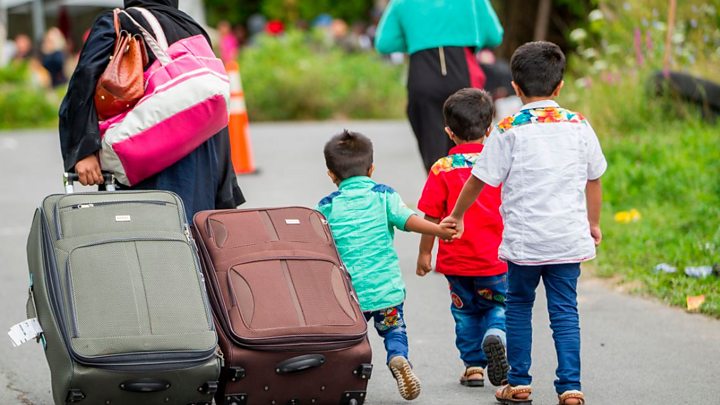
The federal government is building extra physical facilities at the popular crossing into the province of Quebec at the end of a road in New York state, where the vast majority of migrants enter Canada.
The number of asylum applications received by Canada in 2017 is the highest since the country's Immigration and Refugee Board was created in 1989, according to Pew Research.
This has strained government resources, especially in Quebec.
Those facilities will be able to handle about 500 migrants at a time for short-term accommodations.
According to Canadian government figures, last year most asylum seekers were from Haiti (8,286) followed by those from Nigeria (5,575).
Government officials reached out directly to the Haitian community in the US in an effort to dispel myths being circulated on social media about the ease of getting Canadian residency.
Ottawa has earmarked C$173.2m ($135m; £99.5m) to improve border security and speed up processing of asylum claims.
Authorities are also fast-tracking work permits for claimants so they can work while they wait to see whether their claims are granted.