Biodun Iginla, BBC News

Biodun Iginla, BBC News
Showing posts with label Al Jazeera. Show all posts

Sunday, July 2, 2017

BREAKING: Gulf row: Qatar is given a further 48 hours to agree to demands

  • July 3, 2017  04:H14  GMT/UTC/ZULU TIME
  •  
  • From the sectionMiddle East

A man writes on a painting depicting Qatar's Emir Sheikh Tamim Bin Hamad Al-Thani in Doha, Qatar, 2 July 2017Image copyrightREUTERS
Image captionA letter from the Qatari emir, depicted in this picture, will be delivered to Kuwait on Monday

by Leila Mohamed and Biodun Iginla, BBC News, Qatar
Saudi Arabia and three other Arab states have extended the deadline for Qatar to accept a list of demands or face further sanctions by 48 hours.
The initial deadline for Qatar to agree to the group's 13 demands, including the shutting down of the Al Jazeera news network, expired on Sunday.
The Gulf state has said that it will submit its formal response in a letter delivered to Kuwait on Monday.
Qatar denies accusations from its neighbours that it funds extremism.
The state's foreign minister will travel to Kuwait on Monday morning to deliver the letter, sent from the emir of Qatar to the emir of Kuwait, who is the main mediator in the Gulf crisis.
On Saturday, Qatari Foreign Minister Sheikh Mohammed bin Abdulrahman bin Jassim Al-Thani said the state had rejected the demands, but was ready to engage in dialogue under the right conditions.
Qatar has been under unprecedented diplomatic and economic sanctions for weeks from Saudi Arabia and its allies, Egypt, the United Arab Emirates (UAE) and Bahrain.
On 23 June, the four countries, whose foreign ministers will meet on Wednesday to discuss the situation, set a deadline of 10 days for Qatar to agree to their requirements, which include the closure of a Turkish military base and the curbing of diplomatic relations with Iran.
The imposed restrictions have caused turmoil in Qatar, an oil- and gas-rich nation dependent on imports to meet the basic needs of its population of 2.7 million. As a result, Iran and Turkey have been increasingly supplying it with food and other goods.
Saudi Arabia, Egypt, the UAE and Bahrain have accused Qatar of harbouring their opponents - including political Islamists such as the Muslim Brotherhood, which is viewed as a particular threat by the absolute monarchies - and giving them a platform on the Al Jazeera satellite channel, which is funded by the Qatari state.
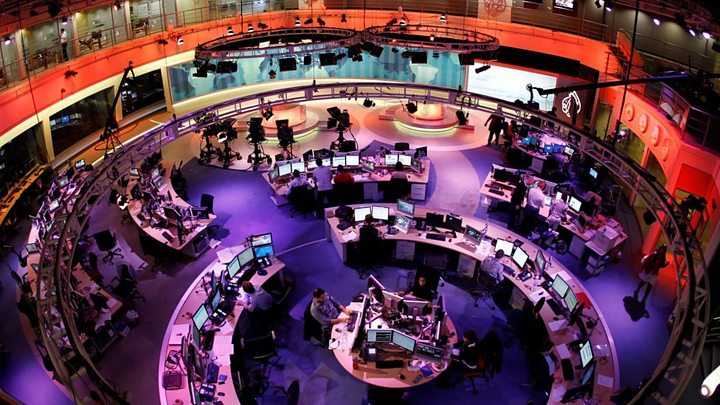


Media captionAl Jazeera has defended itself after four Arab states called for it to be shut down

The four countries severed diplomatic and travel ties with Qatar one month ago, accusing it of supporting terrorism and being an ally of regional foe Iran, charges that Doha denies.
They have since threatened further sanctions.
The situation is the worst political crisis among Gulf countries in decades.

What are the other demands?

According to the Associated Press news agency, which obtained a copy of the list, Qatar must also:
  • Sever all ties with the Muslim Brotherhood, which has been banned in a handful of Arab states
  • Refuse to naturalise citizens from the four countries and expel those currently on its territory, in what the countries describe as an effort to keep Qatar from meddling in their internal affairs
  • Hand over all individuals who are wanted by the four countries for terrorism
  • Stop funding any extremist entities that are designated as terrorist groups by the US
  • Provide detailed information about opposition figures whom Qatar has funded, ostensibly in Saudi Arabia and the other nations
  • Align itself politically, economically and otherwise with the Gulf Co-operation Council (GCC)
  • Stop funding other news outlets in addition to Al Jazeera, including Arabi21 and Middle East Eye
  • Pay an unspecified sum in compensation
An unnamed official from one of the four countries told Reuters news agency that Qatar was also being asked to sever links with so-called Islamic State, al-Qaeda and Lebanese Shia militant group Hezbollah.
The demands have not been officially unveiled. Their publication has increased the friction between the two sides.
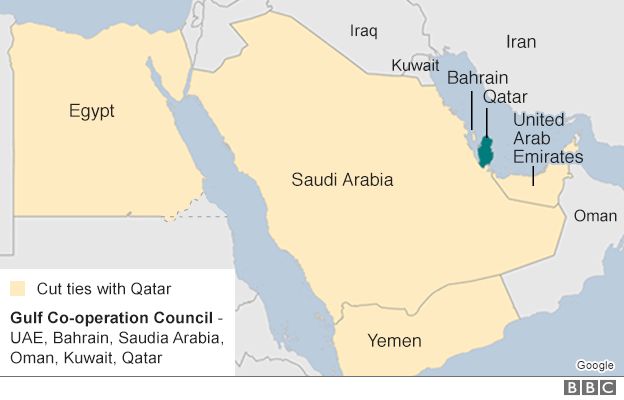
Map

More on this story

Monday, June 5, 2017

Saudi Arabia cuts off Qatar--analysis

A family feud
by Leila Mohamed and Biodun Iginla, Political News Analysts, The Economist Intelligence Unit, Riyadh

The kingdom is raising tensions with its immediate neighbours as well as with Iran and Yemen
SAUDI ARABIA and its satellites have repeatedly put their neighbour Qatar on notice, but never as severely as this. In 2014, they temporarily recalled their ambassadors from the tiny, rich Gulf statelet: but on June 5th, Saudi Arabia, the UAE and Bahrain announced they were not only severing diplomatic relations with Qatar, but their air, sea and land links too—meaning that Qatar’s only land border is to be closed. Panic buying is already reported in Qatari shops. Qataris must leave Saudi Arabia within days, and will henceforth be denied entry. For good measure the ambitious young Saudi defence minister and deputy crown prince, Muhammad bin Salman, expelled Qatar’s 1,000-strong force from the coalition he leads against rebels in Yemen.
Qatar is the world’s second-largest exporter of natural gas and will host the football World Cup in 2022, and it has sought to exert influence across the region. Saudi news outlets say the measures are reprisals for Qatar’s support for terrorism, including al-Qaeda. That said, other Gulf states, including Saudi Arabia and Kuwait, have also had to fend off claims that they—or their citizens—have helped to fund jihadists.
There are broader and older grievances at play, rooted in geopolitics and the place of Islam in politics. For decades, Saudi and Emirati officials have blamed Qatar, which protrudes like a sore thumb from the western Gulf, for breaking ranks with the Saudi-dominated six-nation Gulf Co-operation Council (GCC).

Latest updates

See all updates
Qatar is one of three GCC states that still maintains cordial relations with Iran (Kuwait and Oman are the other two). Its emir, Tamim bin Hamad Al Thani, was quoted expressing reservations about Saudi Arabia’s increasingly belligerent posture against Iran. Qatar also sponsors and provides sanctuary to the Muslim Brotherhood, particularly irking the UAE, which deems the Brotherhood a terrorist group. And it also funds and hosts Al Jazeera, a broadcaster that offers a platform to Arab dissidents everywhere but in Qatar, and which fanned the flames of revolution and armed revolt during the Arab Spring.
For all their ambition, the Al Thanis have little appetite for confrontation. Qatar’s foreign ministry has meekly expressed “deep regret” at the severing of ties. In recent years Qatar has scaled back its public support for the Brotherhood. As tensions mounted in recent days it ejected senior members of the Palestinian branch of the Brotherhood, Hamas, and repatriated a dissident wanted in Saudi Arabia. It has disclaimed a headline criticising Saudi Arabia’s stance on Iran, and described the quote attributed to the emir as “fake news”.
But the isolation is unlikely to end soon. Saudi Arabia has yet to define its demands for restoring ties, and Qatar can expect little solace from other Arab states. Most of them are likely to welcome Qatar’s comeuppance. Egypt’s president and his fellow generals still fume at Al Jazeera for opposing their overthrow of the Brotherhood’s elected president in 2013; so Egypt quickly joined Saudi Arabia in cutting its links with Qatar. Yemen’s Saudi-supported government, and the UAE-backed authority in eastern Libya also declared they are following suit.
Historically, Qatar looked overseas for protection against Saudi bullying. The British kept the Saudis from extending their rule to its coastal protectorates in the 1920s. More recently, Qatar has reached out to an unlikely assembly of Israel, Iran, Turkey and America for support. Of late, though, its alliances have seemed to fray. Israel has deepened its security relationship with Qatar’s rivals, the UAE, and to a lesser extent, Saudi Arabia.
American support may also be less certain. Qatar hosts the largest American base in the Middle East, al-Udeid. Located on the road to the Saudi border, Qataris have long viewed it as their best defence against invasion by land. But many Qataris now fear that America under Donald Trump might be less a regional referee than a Saudi cheerleader. Last month Mr Trump chose Riyadh, the Saudi capital, as the first foreign destination of his presidency, and in return was greeted with Saudi pomp and arms contracts. His foreign policy advisers are reckoned to maintain close ties with Muhammad bin Zayed, the UAE’s de facto ruler, who has been urging America to move its forces there from Qatar for years.
Qatar could look to Turkey, which shares its favourable view of the Muslim Brotherhood and opened a base in the sheikhdom last year. Given his troubles at home, though, Recep Tayyip Erdogan, the Turkish president, might shy from a confrontation with the Al Sauds. That leaves Iran. The two countries jointly manage South Pars, the world’s largest gasfield. In addition, says a cleric close to Iran’s Supreme Leader, Ayatollah Ali Khamenei, Iran has a defence pact with Qatar which commits it to the latter’s defence in the event of a Saudi attack. Already, Iranian officials have offered to send food shipments across the Gulf. Saudi Arabia’s impetuous actions risk further driving Qatar into the arms of Iran, and increasing the danger of armed confrontation with Shia state. In response to nervousness about both outcomes, oil and gas prices are rising.
View comments
Reuse this content