Biodun Iginla, BBC News

Biodun Iginla, BBC News
Showing posts with label Andres Manuel Lopez Obrador. Show all posts

Saturday, July 27, 2019

Mexico to help Honduras create 20,000 jobs

July 28, 2019  07H24  GMT/ZULU
MEXICO CITY - Mexico’s government said on Saturday it would help Honduras create 20,000 jobs this year and support its coffee farmers as the two countries seek to curb migration to the United States that has created tensions with U.S. President Donald Trump.

FILE PHOTO: People belonging to a caravan of migrants from Honduras en route to the United States walk by an immigration checkpoint in Huehuetan, Mexico April 15, 2019. REUTERS/Jose Cabezas
Mexican President Andres Manuel Lopez Obrador and his Honduran counterpart, Juan Orlando Hernandez, pledged to work together to lift prosperity in Central America, where poverty and violence have fueled an exodus of people north.
That migration has angered Trump, who has made border security a priority, and issued economic threats against Mexico and Central America if more is not done to contain the flows.
Speaking after the Honduran and Mexican leaders met in the eastern state of Veracruz, Mexican Foreign Minister Marcelo Ebrard said Lopez Obrador had given instructions to help Honduras create 20,000 jobs between now and December.
ADVERTISEMENT
He did not provide further details, but afterwards the two presidents offered more insights into their plans in speeches in the eastern city of Minatitlan.
Hernandez said he was hoping a “great international coalition for mass job creation” in Central America could be forged, while Lopez Obrador stressed that Mexico would support the region with funds and employment schemes.
In particular, Lopez Obrador said, Mexico would assist Honduran coffee farmers, whose businesses have suffered this year from a drop in international prices.
“We’ll help improve coffee production in whatever is needed,” he said, “so you have no problem selling coffee.”
ADVERTISEMENT
Lopez Obrador did not offer more details, but also said schemes he has championed in Mexico to create jobs via youth apprenticeships and tree planting would come to Honduras too.
There has been a surge this year in migrant apprehensions on the U.S. southern border with Mexico. Most of the people caught trying to enter the United States illegally come from Guatemala, Honduras and El Salvador.
On Friday, Trump said he had reached a deal with Guatemala to curb migration, though that plan was called into question on Saturday by the two politicians vying to become Guatemala’s next president in an election next month.

Tuesday, July 2, 2019

Mexico deports 33 percent more migrants after deal with US


Some of the 250 Central American migrants arrested during an operation in Veracruz, Mexico, are pictured in June 2019
Some of the 250 Central American migrants arrested during an operation in Veracruz, Mexico, are pictured in June 2019 AFP/File
ADVERTISING
Mexico City 
Mexico deported 33 percent more foreigners month-on-month in June, officials said Tuesday, after the country agreed to take "unprecedented" steps to reduce migration in order to avoid tariffs threatened by US President Donald Trump.
The total number of deportations from Mexico in June was 21,912, up from 16,507 in May, according to preliminary figures from the Mexican migration authority.
ADVERTISING
The upswing came after Trump threatened in May to impose tariffs on all Mexican goods if the country did not do more to slow the flow of Central American migrants crossing the US-Mexican border.
After a week of tense negotiations, the two sides announced a deal on June 7 under which Mexico agreed to send thousands of National Guardsmen to secure its borders and expand its policy of taking back asylum-seekers while the US processes their claims.
The deal appears to be delivering Trump's desired result: the number of migrants taken into custody at the US southern border is expected to drop by 25 percent for June, the acting head of the Department of Homeland Security, Kevin McAleenan, said Friday.
Under the deal, Mexico has 45 days to show results.
Trump said Monday in Washington that Mexico is doing a "great job."
Mexican President Andres Manuel Lopez Obrador, who has sought to avoid confrontation with the Republican billionaire, welcomed the comment.
"I'm glad President Trump recognizes that we're making an effort to live up to our commitment to apply our laws and, without violating human rights, reduce the flow of migrants," he told a news conference.
Lopez Obrador, an anti-establishment leftist, took office in December promising to welcome migrants. But he has taken a more hardline turn under pressure from Trump.
In his first month in office, Mexico deported 5,717 foreigners -- down from 10,180 the month before.
However, deportations rose sharply after Trump renewed his threat to close the US-Mexican border.
In April -- the month after Trump made the threat -- deportations from Mexico rose 66 percent, to 14,940.
The United States has seen a surge in Central American asylum-seekers fleeing chronic poverty and brutal gang violence in recent months. In May, it apprehended 144,000 migrants at the border, up 32 percent from April and 278 percent from May 2018.

Friday, January 18, 2019

New caravan of Central American migrants crosses into Mexico

January 18, 2019  23H:32  GMT/UTC/ZULU
TAPACHULA, Mexico - Hundreds of mostly Honduran migrants entered southern Mexico on Friday, joining around 1,000 other people from Central America who crossed a day earlier and putting to the test Mexico’s vows to guarantee the safe and orderly flow of people.
People belonging to a caravan of migrants from Honduras en route to the United States, walk at the border crossing to Mexico in Hidalgo, Mexico, January 18, 2019. REUTERS/Jose Cabezas
The cohort crossed into Chiapas state before dawn without needing the wrist bands that officials on Thursday gave migrants to wear until they could register with authorities, several migrants and an official told us at Reuters.
“The road today was open,” said Marco Antonio Cortez, 37, a baker from Honduras traveling with his wife and children, ages 2 and 9. “They didn’t give us bracelets or anything, they just let us pass through Mexico migration.”
A migration official at the entry point, who asked not to be named because she was not authorized to speak to media, said that at least 1,000 people crossed from Guatemala into Mexico by around 5 a.m., without needing wrist bands.
Migration officials did not reply to requests for comment on why the wrist bands were not required on Friday.
The migrant group proceeded on foot alongside cars on a highway, accompanied by federal police officers, arriving at a shelter in the city of Tapachula around midday.
Sitting by the side of the road rubbing cream onto his children’s feet, 40-year-old Honduran migrant Santos Pineda said he and his family entered Mexico easily, and without having to provide documents or wear any wrist bands. The family’s plan was to press on to the United States, he said.
Ash-smeared holy men attract crowds at India's Kumbh Mela
Mexico’s migration institute said in a statement the migrants can stay in temporary shelters in Mexico until they receive humanitarian visas allowing them to remain in the country, or they wait in Guatemala for their document to be ready.
Groups of migrants left El Salvador and Honduras earlier in the week, the latest in a string of caravans of people largely fleeing poverty and violence.
The caravans have inflamed the debate over U.S. immigration policy, with President Donald Trump using the migrants to try to secure backing for his plan to build a wall covering the country’s southern border with Mexico.
Mexican President Andres Manuel Lopez Obrador is pursuing a “humanitarian” approach to the problem, vowing to stem the flow of people by finding jobs for the migrants. In exchange, he wants Trump to help spur economic development in the region.

Sunday, July 1, 2018

BREAKING: Mexico elections: Polls due to open after campaign marred by violence

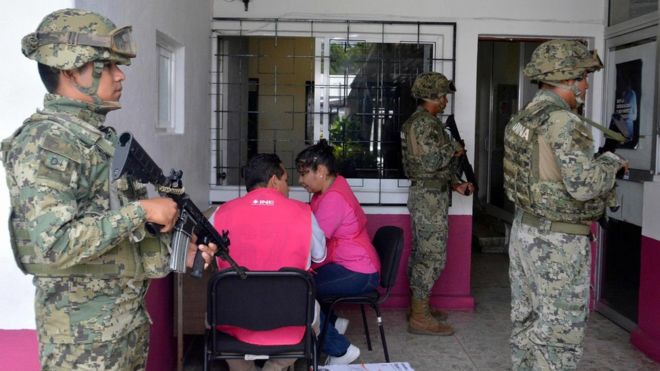
Members of the Mexican Navy stand guard next to electoral material, on June 30, 2018, in AcapulcoImage copyrightAFP
Image captionSecurity is tight in polling centres across Mexico after months of violence
by Renee Celeste and Biodun Iginla, BBC News, Mexico City
Polls are due to open across Mexico for Sunday's presidential, parliamentary and local elections.
Front-runner for president is Andres Manuel Lopez Obrador, the left-wing former mayor of Mexico City who has pledged to crack down on corruption.
If he wins he will oust the two parties that have governed Mexico for nearly a century.
However, campaigning has been marred by some of the worst political violence in the country for decades.
BBC Mexico correspondent Will Grant says many voters are keen to replace the government of incumbent President Enrique Peña Nieto. They are angry at Mexico's sluggish economy as well as widespread corruption and crime, he adds.
Andres Manuel Lopez Obrador - often referred to by his initials Amlo - has made tackling corruption the central plank of his campaign, promising to improve wages and pensions by stamping out rampant abuse by the state and by political and business elites.
Mr Lopez Obrador, 64, was runner-up in the last two elections and if he wins this time he will end the dominance of the two parties that have governed Mexico for decades - the Institutional Revolutionary Party (PRI) and the National Action Party (PAN).
He has referred to them as being part of the same "mafia of power", putting forward a left-wing coalition led by his party, Morena, as a chance to make a radical break with the past.
His closest rival looks to be Ricardo Anaya of PAN who heads a centre-right coalition. He has tried to paint Mr Lopez Obrador as a populist and a maverick who cannot be trusted to run the economy.
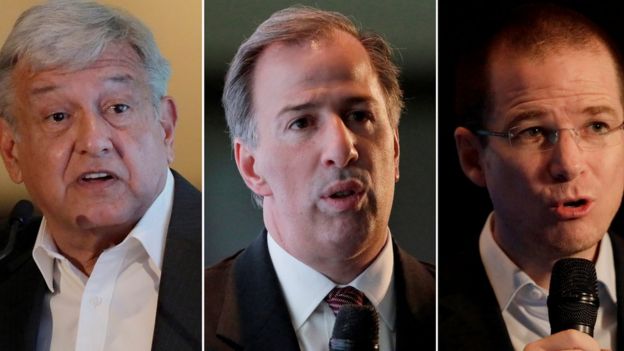
(L to R) Leftist front-runner Andres Manuel Lopez Obrador, Jose Antonio Meade and Ricardo AnayaImage copyrightREUTERS
Image captionAndres Manuel Lopez Obrador, (L) has been the front-runner ahead of Jose Antonio Meade (C) and Ricardo Anaya
The candidate for the governing PRI party is José Antonio Meade, a former finance minister.
As well as a new president, Mexican will be voting for 128 senators and 500 deputies in Congress as well as state and local officials. In all, 88 million people will be eligible to vote.
Mexico is the second largest economy in Latin America and a major oil exporter. However, oil prices have dropped and the Mexican currency, the peso, has fallen sharply against the dollar.
More than 40% of the population lives in poverty and high levels of corruption and violence have led some companies to pull out of the worst affected areas.
The run-up to Sunday's elections has seen some of the worst violence in living memory, our correspondent says, as criminal groups attempt to control local politics.
More than 130 candidates and political workers have been killed across the country since campaigning began in September.
On Saturday, a journalist was shot dead in a bar in the village of Saban in the southern state of Quintana Roo, officials said. Mexico has a reputation for being one of the most dangerous countries in the world for journalists.

More on this story