Biodun Iginla, BBC News

Biodun Iginla, BBC News
Showing posts with label Central America. Show all posts

Friday, August 9, 2019

ANALYSIS AND BREAKING: Mexico detains migrant children in cramped holding center despite court ruling

August 10, 2019  001h12  GMT/ZULU
MEXICO CITY - Overcrowding, prison-like conditions, bed bugs and illness are among the complaints of migrants in a Mexico City detention center that holds dozens of minors two months after a court ruled it was unconstitutional.
Under the threat of economic sanctions from U.S. President Donald Trump, Mexico has stepped up migrant detentions this year to stem a surge in asylum-seekers from Central America.
Known as Las Agujas, the Mexico City holding center enclosed by spike-topped walls in the eastern district of Iztapalapa held about 108 minors as of this week, some of whom are unaccompanied, said Jesus Quintana, who monitors the station for the Mexican human rights ombudsman’s office (CNDH).
In June, a court ruled it unconstitutional for Las Agujas to hold children after a 10-year-old Guatemalan girl died in its custody. Mexico’s National Migration Institute (INM), which runs the center, has not appealed the decision, but told us at Reuters that it observes the laws protecting migrants in “each and every case”.
Las Agujas is part of a network of centers the government has vowed to upgrade. The detention of minors has increased concerns about treatment of migrants by the Mexican government in its push to reduce the flow of people north.
“What they have are facilities similar to prisons,” said Ana Saiz, director of Sin Fronteras, one of four migrant advocacy groups that took Las Agujas to court after the Guatemalan girl died in May. “This practice (of detaining children) goes against human rights and is illegal in Mexico.”
The government said the girl, who was held with her mother, died in official custody after falling out of a bunk bed at the center, which has a capacity of 464 people.
On June 10, a panel of judges ordered Las Agujas to stop holding children, citing migration laws and minors’ rights.
On July 24, an administrative court said the director of Las Agujas, Miguel Angel Hernandez, had not heeded the order, referencing five unaccompanied minors from India at the center.
ADVERTISEMENT
Hernandez told the court he had complied by re-housing 38 minors identified by the groups that brought the case, court documents seen by Reuters show. The INM said on July 27 that it “at no time failed to comply with a court order”.
In a statement, the INM said it prioritized family unity, and that unaccompanied minors are only in the centers “temporarily.”
Hernandez could not be reached directly for comment.

CRYING CHILDREN

Mexican government figures show 32,507 migrating minors were detained between January and June 2019.
The migration authority picks up minors along with adults, said Rosalba Rivera, migrant children’s coordinator at the Institute for Migrant Women.
Rivera said the INM sometimes contacts the national agency for family development to find alternative housing for children, such as shelters, once they are in facilities like Las Agujas.
But Mexican law is explicit that migrant children should not spend “even a day” in detention, she added.
ADVERTISEMENT
In the United States, unaccompanied minors can be held in border patrol custody for 72 hours before being transferred to children’s shelters.
Detainees and visitors told us at Reuters that minors are still being brought to Las Agujas.
Guarded watch towers overlook the four corners of the high-walled compound in the heart of a residential neighborhood. Its concrete walls and green metal spikes contrast with a flower-muraled elementary school down the block.
Detainees often cannot leave for weeks or months before they are deported or file for asylum, according to monitoring groups.
A July report from a federal watchdog found the center to be over capacity, ridden with bed bugs and short of food.
The INM told us at Reuters that each of the center’s detainees is given basic hygiene equipment, drinking water and three meals a day. It did not respond to the bed bug or capacity claims.
“The kids cry all the time,” said a Venezuelan migrant in his 30s who left Las Agujas recently. He spoke on condition of anonymity for fear of reprisals from authorities.
He described a crowded, “prison-like” facility and said he often saw a long line of mothers and their kids waiting to see a doctor, since children often fell ill.
Sister Maria Josefa Martinez, a nun who visits the center weekly, said children “have a hard time,” often getting stomach and throat infections, and have little to do.
ADVERTISEMENT
Saiz of Sin Fronteras said her staff learned of a chicken pox outbreak among children in the center on a visit in July.
Without commenting on the illnesses, the INM said Las Agujas provides free medical assistance to detainees 24 hours a day.

Saturday, July 27, 2019

Mexico to help Honduras create 20,000 jobs

July 28, 2019  07H24  GMT/ZULU
MEXICO CITY - Mexico’s government said on Saturday it would help Honduras create 20,000 jobs this year and support its coffee farmers as the two countries seek to curb migration to the United States that has created tensions with U.S. President Donald Trump.

FILE PHOTO: People belonging to a caravan of migrants from Honduras en route to the United States walk by an immigration checkpoint in Huehuetan, Mexico April 15, 2019. REUTERS/Jose Cabezas
Mexican President Andres Manuel Lopez Obrador and his Honduran counterpart, Juan Orlando Hernandez, pledged to work together to lift prosperity in Central America, where poverty and violence have fueled an exodus of people north.
That migration has angered Trump, who has made border security a priority, and issued economic threats against Mexico and Central America if more is not done to contain the flows.
Speaking after the Honduran and Mexican leaders met in the eastern state of Veracruz, Mexican Foreign Minister Marcelo Ebrard said Lopez Obrador had given instructions to help Honduras create 20,000 jobs between now and December.
ADVERTISEMENT
He did not provide further details, but afterwards the two presidents offered more insights into their plans in speeches in the eastern city of Minatitlan.
Hernandez said he was hoping a “great international coalition for mass job creation” in Central America could be forged, while Lopez Obrador stressed that Mexico would support the region with funds and employment schemes.
In particular, Lopez Obrador said, Mexico would assist Honduran coffee farmers, whose businesses have suffered this year from a drop in international prices.
“We’ll help improve coffee production in whatever is needed,” he said, “so you have no problem selling coffee.”
ADVERTISEMENT
Lopez Obrador did not offer more details, but also said schemes he has championed in Mexico to create jobs via youth apprenticeships and tree planting would come to Honduras too.
There has been a surge this year in migrant apprehensions on the U.S. southern border with Mexico. Most of the people caught trying to enter the United States illegally come from Guatemala, Honduras and El Salvador.
On Friday, Trump said he had reached a deal with Guatemala to curb migration, though that plan was called into question on Saturday by the two politicians vying to become Guatemala’s next president in an election next month.

Saturday, February 9, 2019

U.S. Border Patrol overwhelmed by large groups of migrant families

February 9, 2019  14H:26  GMT/ZULU
U.S. Border Patrol said on Friday its resources were being stretched thin by larger and larger groups of Central American families left by smugglers in remote locations along the U.S. Mexico border.
So far in fiscal year 2019, which began last October, the Border Patrol has apprehended 60 groups of 100 or more migrants, compared with 13 during the entire 2018 fiscal year and just two large groups caught in the 2017 fiscal year, a U.S. Customs and Border Protection (CBP) official said on a call with reporters.
Until recently, most people caught crossing the border illegally were men from Mexico, but now Central American families and unaccompanied minors make up some 60 percent of those apprehended, data from the agency show.
Facilities built decades ago are struggling to cope with the influx of migrant families, many with young children, who are often in need of medical care.
SPONSORED
“Large bus loads of individuals are being bussed up to the border and we don’t have any infrastructure in that area,” the official said on the call with reporters.
Many of the migrants who may seek passage with smugglers in their journey through Mexico cross the border and turn themselves into U.S. authorities to seek asylum in the United States, a drawn-out court process that can take months or years to resolve.
The border patrol official said smugglers drop off large groups as a diversion tactic to tie up law enforcement resources in order to move drugs across other parts of the border.
The Trump administration has tried to curb access to asylum, including by starting a program that would require applicants to wait out their legal proceedings in Mexico.
Human rights advocates say increased border security and daily quotas put on asylum requests at ports of entry are among factors pushing large groups of migrants to cross the border in risky, remote areas.
U.S. lawmakers see 'progress' in border talks
Just how dangerous these crossings can be was highlighted in December when a 7-year-old girl from Guatemala died in U.S. custody after she and her father crossed in a large group in a remote area of New Mexico. Weeks later, an 8-year-old Guatemalan boy died after crossing the border with his father near El Paso, Texas.
Overall, illegal crossings at the southern border have dropped dramatically compared to previous decades but in recent years the number of families and unaccompanied children heading to the United States has increased.
(For an interactive graphic titled 'Crisis on the Border?', see: here)

Thursday, January 24, 2019

U.S. will return asylum seekers to Mexico today


January 25, 2019  09H:08  GMT/UTC/ZULU
MEXICO CITY/NEW YORK - The U.S. government will return the first group of migrants seeking asylum in the United States to the Mexican border city of Tijuana on Friday, U.S. and Mexican officials said, marking the start of a major policy shift by the Trump administration.
Migrants from Central America are seen escorted by U.S. Customs and Border Protection (CBP) officials after crossing the border from Mexico to surrender to the officials in El Paso, Texas, U.S., in this picture taken from Ciudad Juarez, Mexico December 3, 2018. REUTERS/Jose Luis Gonzalez
The policy dubbed the Migrant Protection Protocols (MPP) and first announced on Dec. 20 will return non-Mexican migrants who cross the U.S. southern border back to wait in Mexico while their asylum requests are processed in U.S. immigration courts.
The plan is aimed at curbing the increasing number of families arriving mostly from Central America who say they fear returning to their home countries due to threats of violence. The Trump administration says many of the claims are not valid.
The program will apply to arriving migrants who ask for asylum at ports of entry or who are caught crossing illegally and say they are afraid to return home.
Children traveling on their own and some migrants from “vulnerable populations” could be excluded on a case-by-case basis, the Department of Homeland Security said in a fact sheet.
SPONSORED
ADVERTISING
“The MPP will provide a safer and more orderly process that will discourage individuals from attempting illegal entry and making false claims to stay in the U.S., and allow more resources to be dedicated to individuals who legitimately qualify for asylum,” the DHS said.
(graphic: tmsnrt.rs/2Rhk5VT)
Illegal crossings at the southern border have dropped dramatically since highs reached in previous decades, but in recent years more families and unaccompanied children from El Salvador, Honduras and Guatemala are migrating to the United States and asylum applications have ballooned.
Last year, about 93,000 people sought asylum at the southern border, up 67 percent from 2017, according to U.S. government data.
Asylum seekers are typically granted the right to stay in the United States while their cases are decided by a U.S. immigration judge, but a backlog of more than 800,000 cases means the process can take years.
Now, the U.S. government says migrants will be turned away with a “notice to appear” in immigration court. They will be able to enter the United States for their hearings but will have to live in Mexico in the interim. If they lose their cases, they will be deported to their home countries.
Mexico has said it will not accept anybody facing a credible threat in Mexican territory.
But immigration advocates fear Mexican territory is not safe for migrants who are regularly kidnapped by criminal gangs and smugglers, and have raised concerns that applicants will not be able to access proper legal counsel to represent them in U.S. courts.
It is unclear how Mexico plans to house what could be thousands of asylum seekers for the lengthy duration of their immigration proceedings. Some Mexican border towns are more violent than the cities the Central Americans left behind.
The Trump administration says it is relying on a U.S. law that allows migrants attempting to enter the United States from a contiguous country to be removed to that country. But the policy will likely be challenged in court since claiming asylum is protected under both international and U.S. law.
Several of Trump’s signature immigration policies, including some attempting to reduce asylum applications, have been halted by U.S. federal courts.
Trump backs Maduro rival amid massive protests
Trump argues that the asylum system is abused, calling a process by which many migrants are freed in the United States to await immigration trial “catch and release.”
Trump is demanding $5.7 billion in funding for a wall along the Mexican border, triggering a U.S. partial government shutdown that stretched to its 34th day on Thursday and has left 800,000 federal workers without pay.

Thursday, November 22, 2018

BREAKING: Trump renews threat to close Mexico border over migrants


November 23, 2018  00H22  GMT/UTC/ZULU TIME
Related Topics
Media captionTrump and the facts about the migrant caravan
by Melissa Gruz and Biodun Iginla, BBC News, Washington
Donald Trump has threatened to close the whole US-Mexico border, including halting trade with Mexico, if the arrival of migrants from central America there leads to disorder.
He also said he had given troops at the border the go-ahead to use lethal force if needed.
On Monday the US briefly closed a busy crossing to install new barriers.
Thousands of migrants are at the border after travelling more than 4,000km (2,500 miles) from Central America.
They say they are fleeing persecution, poverty and violence in their home countries of Honduras, Guatemala, and El Salvador.
Mr Trump has deployed about 5,800 troops to the border and has previously described the migrants as an "invasion".

What did Trump say?

"If we find that it gets to a level where we are going to lose control or where people are going to start getting hurt, we will close entry into the country for a period of time until we can get it under control," he told reporters.
"The whole border. I mean the whole border. Mexico will not be able to sell their cars into the United States where they make so many cars," he added.
ADVERTISEMENT
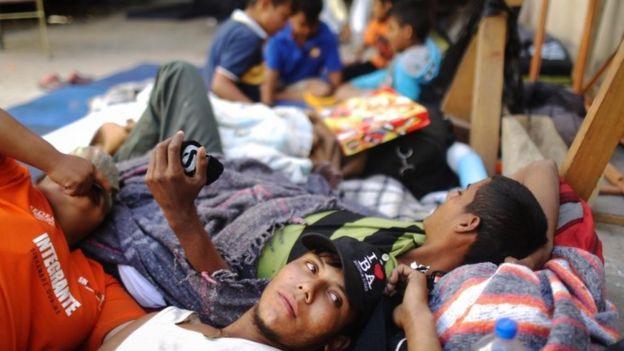
migrants in MexicaliImage copyrightGETTY IMAGES
Image captionThe migrants say they are fleeing poverty, violence and persecution
"They don't have guns in their hands, there is no armed element going in," he told reporters on Wednesday.
On Thursday Mr Trump also warned that the US government could shut down next month if no more money was provided for a wall between the US and Mexico.
"Could there be a shutdown? There certainly could and it will be about border security, of which the wall is a part," he said.

What has Trump said about the judiciary?

He has renewed his attacks after earlier saying a federal judge who blocked his executive order to deny illegal migrants the right to seek asylum was an "Obama judge".
"Judges must not legislate security and safety at the border. They know nothing about it and are making our country unsafe," he said in a tweet.
It comes after Supreme Court Chief Justice John Roberts took the unusual step of rebuking Mr Trump's criticism, telling the Associated Press that "We do not have Obama judges or Trump judges, Bush judges or Clinton judges".
Presentational white space

Where are the migrants now?

Almost 3,000 Central American migrants have arrived in the Mexican border city of Tijuana after crossing Mexico and parts of Central America. More than 2,750 have sought refuge in a shelter set up by the mayor's office.
Media captionAnti-migrant protesters clashed with a pro-migrant demonstrator in the Mexican city of Tijuana
The town's mayor has said he expects the number of migrants in the city to reach 10,000 in the coming weeks.
US officials have warned that anyone found entering the country illegally will face arrest, prosecution and deportation.

What do the migrants want?

The migrants say they are leaving their respective countries in the hope of building a better future for themselves and their families.
Some say they have been threatened or mistreated by criminal gangs operating in their home towns. Many are travelling with their children whom they say they do not want to fall prey to the gangs.
Others hope to get jobs abroad which will pay enough for them to send money to their relatives who stayed behind.
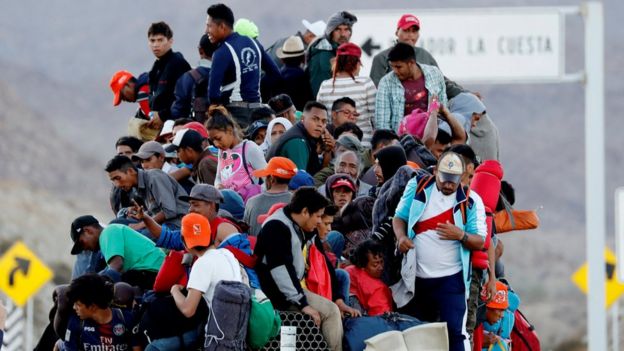
Migrants, part of a caravan of thousands travelling from Central America to the US, sit on the back of a truck en route to the Mexican border city of Tijuana, 20 November 2018Image copyrightREUTERS
Image captionMigrants, part of the caravan, en route to the Mexican border city of Tijuana
Many say their dream is to reach the US. Some of them have relatives there already whom they hope to join; others have chosen it as their destination because they think they will earn higher salaries there than in Latin America.
While Central Americans have long fled their homelands for the US and have sometimes joined forces along the way, the organised nature of this caravan is relatively new.
Migrants are often kidnapped by people traffickers and drug gangs which force them to work for them. A large group such as this one is harder to target and therefore offers more protection.

More on this story