Biodun Iginla, BBC News

Biodun Iginla, BBC News
Showing posts with label Annapolis. Show all posts

Saturday, July 7, 2018

As facial recognition use grows, so do privacy fears

by Tamara Kachelmeier and Biodun Iginla, France24 Technology reporters, San Francisco

    © AFP/File | A display shows a facial recognition system for law enforcement during the NVIDIA GPU Technology Conference in 2017 in Washington

    SAN FRANCISCO - 
    The unique features of your face can allow you to unlock your new iPhone, access your bank account or even "smile to pay" for some goods and services.
    The same technology, using algorithms generated by a facial scan, can allow law enforcement to find a wanted person in a crowd or match the image of someone in police custody to a database of known offenders.
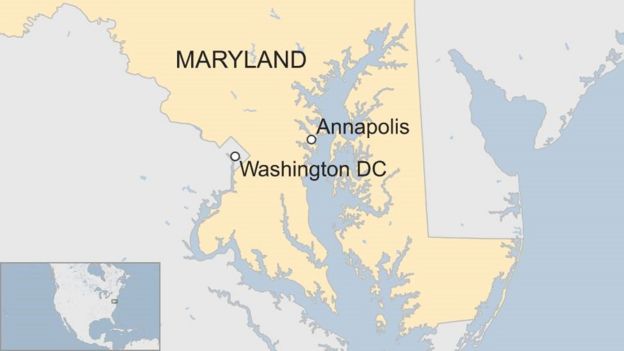
    Facial recognition came into play last month when a suspect arrested for a shooting at a newsroom in Annapolis, Maryland, refused to cooperate with police and could not immediately be identified using fingerprints.
    "We would have been much longer in identifying him and being able to push forward in the investigation without that system," said Anne Arundel County police chief Timothy Altomare.
    Facial recognition is playing an increasing role in law enforcement, border security and other purposes in the US and around the world.
    While most observers acknowledge the merits of some uses of this biometric identification, the technology evokes fears of a "Big Brother" surveillance state.
    Heightening those concerns are studies showing facial recognition may not always be accurate, especially for people of color.
    A 2016 Georgetown University study found that one in two American adults, or 117 million people, are in facial recognition databases with few rules on how these systems may be accessed.
    A growing fear for civil liberties activists is that law enforcement will deploy facial recognition in "real time" through drones, body cameras and dash cams.
    "The real concern is police on patrol identifying law-abiding Americans at will with body cameras," said Matthew Feeney, specialist in emerging technologies at the Cato Institute, a libertarian think tank.
    "This technology is of course improving but it's not as accurate as science fiction films would make you think."
    - 'Aggressive' deployments -
    China is at the forefront of facial recognition, using the technology to fine traffic violators and "shame" jaywalkers, with at least one arrest of a criminal suspect.
    Clare Garvie, lead author of the 2016 Georgetown study, said that in the past two years, "facial recognition has been deployed in a more widespread and aggressive manner" in the US, including for border security and at least one international airport.
    News that Amazon had begun deploying its Rekognition software to police departments sparked a wave of protests from employees and activists calling on the tech giant to stay away from law enforcement applications.
    Amazon is one of dozens of tech firms involved in facial recognition. Microsoft for example uses facial recognition for US border security, and the US state of Maryland uses technology from German-based Cognitec and Japanese tech firm NEC.
    Amazon maintains that it does not conduct surveillance or provide any data to law enforcement, but simply enables them to match images to those in its databases.
    The tech giant also claims its facial recognition system can help reunite lost or abducted children with their families and stem human trafficking.
    - 'Slippery slope' -
    Nonetheless, some say facial recognition should not be deployed by law enforcement because of the potential for errors and abuse.
    That was an argument made by Brian Brackeen, founder and the chief executive officer of the facial recognition software developer Kairos.
    "As the black chief executive of a software company developing facial recognition services, I have a personal connection to the technology, both culturally and socially," Brackeen said in a blog post on TechCrunch.
    "Facial recognition-powered government surveillance is an extraordinary invasion of the privacy of all citizens -- and a slippery slope to losing control of our identities altogether."
    The Georgetown study found facial recognition algorithms were five to 10 percent less accurate on African Americans than Caucasians.
    - Policy questions -
    Microsoft announced last month it had made significant improvements for facial recognition "across skin tones" and genders.
    IBM meanwhile said it was launching a large-scale study "to improve the understanding of bias in facial analysis."
    While more accurate facial recognition is generally welcomed, civil liberties groups say specific policy safeguards should be in place.
    In 2015, several consumer groups dropped out of a government-private initiative to develop standards for facial recognition use, claiming the process was unlikely to develop sufficient privacy protections.
    Cato's Feeney said a meaningful move would be to "purge these databases of anyone who isn't currently incarcerated or wanted for violent crime."
    Jennifer Lynch, an attorney with the Electronic Frontier Foundation, said that the implications for police surveillance are significant.
    "An inaccurate system will implicate people for crimes they did not commit. And it will shift the burden onto defendants to show they are not who the system says they are," Lynch said in a report earlier this year.
    Lynch said there are unique risks of breach or misuse of this data, because "we can't change our faces."
    Evan Selinger, a philosophy professor at the Rochester Institute of Technology, says facial recognition is too dangerous for law enforcement.
    "It's an ideal tool for oppressive surveillance," Selinger said in a blog post.
    "It poses such a severe threat in the hands of law enforcement that the problem cannot be contained by imposing procedural safeguards."

    Friday, June 29, 2018

    UPDATE AND BREAKING: Maryland shooting: Gazette staff publish Friday edition


    Media captionPolice describe how the shooting at the newspaper office ended
    by Rochelle van Amber and Biodun Iginla, BBC News, Annapolis, Maryland
    Staff at the Capital Gazette have published a Friday edition, after a gunman killed five people and injured more at the local paper's office.
    Chase Cook, a reporter at the Annapolis publication, had tweeted: "We are putting out a damn paper tomorrow."
    His post came just hours after the attacker, armed with a shotgun and smoke grenades, shot through a glass door into the newsroom.
    Police called the shooting a "targeted attack".
    The paper has tweeted the front page of their Friday paper, as well as obituaries for their colleagues.
    Presentational white space
    First reports of the shooting came at 14.40 local time (19.40 BST).
    Journalists inside the building posted on social media as the gunman fired through the glass door of the office with a shotgun and shot at staff inside.
    An intern at the paper, Anthony Messenger, tweeted as the attacker opened fire.
    Presentational white space
    Another staff member at the Capital Gazette, Selene San Felice, told CNN that her first reaction to the shooting was to lie down under her desk, adding that she attempted to exit through a rear door but it was locked.
    Crime reporter Phil Davis was also in the building and told The Baltimore Sun - part of the same media group as the Gazette - that he and his colleagues hid under their desks.
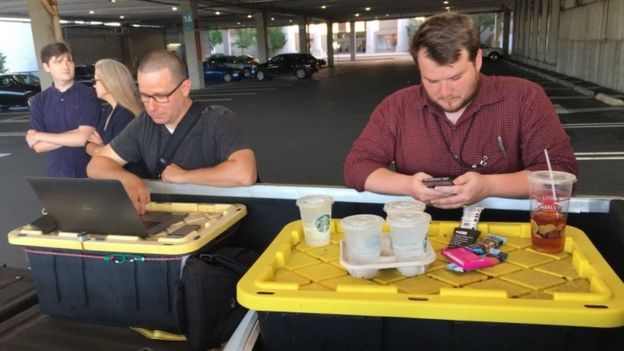
    Capital Gazette reporter Chase Cook (R) and photographer Joshua McKerrow (L) work on the next days newspaper while awaiting news from their colleagues in Annapolis, Maryland, on 28 June 2018.Image copyrightAFP
    Image captionCapital Gazette reporters were pictured working on the next day's newspaper from the car park
    "I don't know why he stopped [shooting]," he told the paper.
    He described the scene as "like a war zone" and tweeted about his experiences as he waited to be interviewed by police.
    Presentational white space
    Presentational white space
    County executive Steve Schuh told CNN that the suspect was hiding under a desk in the building when police officers arrived "within 60 seconds" of receiving news of the incident. He said there was "no exchange of fire".
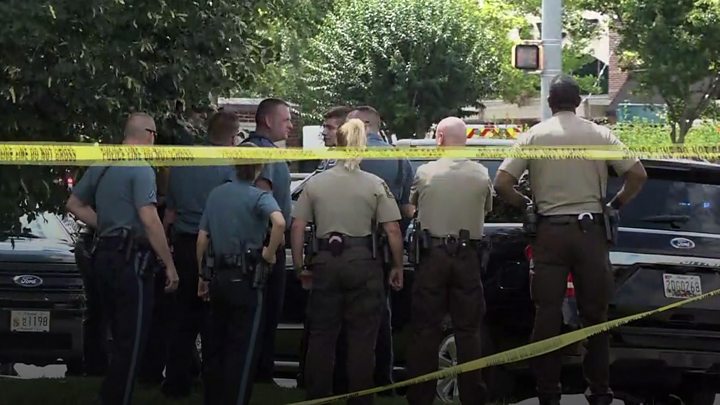
    "This was a targeted attack on the Capital Gazette," said William Krampf, deputy chief of Anne Arundel County Police. He added that the gunman "entered the building with a shotgun and looked for his victims as he walked through the lower level".
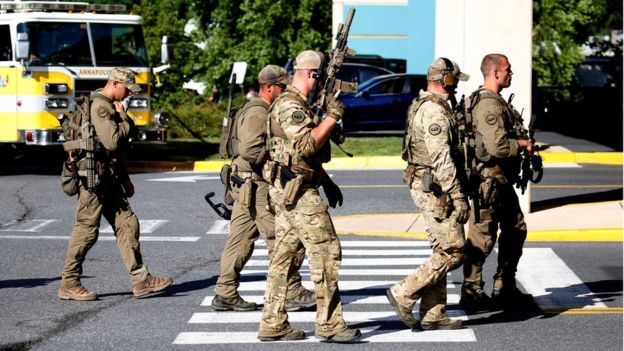
    Tactical police gather at shooting scene outside the Capital Gazette newspaper in Annapolis, Maryland, 28 June 2018Image copyrightREUTERS
    Image captionArmed officers escorted more than 170 people from the building in Annapolis
    Speaking to reporters, Mr Krampf said an item "we believed to be an explosive device" had been found at the premises and destroyed. He said it turned out to be a smoke bomb.
    Police said they safely evacuated 170 people from the building, which housed 30 other businesses.

    Who are the victims?

    Authorities have named the victims of the shooting:
    • Wendi Winters, 65, editor and community reporter
    • Rebecca Smith, 34, sales assistant
    • Robert Hiaasen, 59, assistant editor and columnist
    • Gerald Fischman, 61, editorial writer
    • John McNamara, 56, reporter and editor
    Author and Miami Herald columnist Carl Hiaasen paid tribute to his brother, who was killed in the shooting, calling him "one of the most gentle and funny people I've ever known".
    Presentational white space
    Jimmy DeButts, the editor at the Capital Gazette, tweeted that he was "heartbroken" following the incident.
    Presentational white space
    The Committee to Protect Journalists tweeted that before the Maryland shooting, seven journalists had been killed in the US in relation to their work since 1992.
    Most recently, TV reporter Alison Parker and cameraman Adam Ward were killed in 2015 during an interview in Moneta, Virginia.

    Who is the suspect?

    US media have named a suspect held by police as Jarrod Ramos, who is reported to have unsuccessfully sued the newspaper group in 2012 for defamation.
    Police have not confirmed a motive. They said a white male suspect in his late 30s was taken into custody at the scene of the shooting and was being questioned.
    Federal agencies, including the FBI and the Bureau of Alcohol, Tobacco, Firearms and Explosives, were involved in the response to the attack.
    Maryland governor Larry Hogan said on Twitter he was "absolutely devastated" and was in contact with authorities.
    Democratic senator Chris Van Hollen responded to Mr Davis on Twitter, saying "journalists shouldn't have to fend off bullets in the newsroom".
    Presentational white space
    President Donald Trump was briefed on the attack. He tweeted that his "thoughts and prayers" were with the victims and their families.
    White House Press Secretary Sarah Sanders later condemned the attack on "innocent journalists doing their job".
    The New York City Police Department (NYPD) said it had deployed counterterrorism teams to media organisations in and around New York City as a precaution.
    Presentational grey line

    Read more about US gun violence

    Media captionHow US mass shootings are getting worse
    Presentational grey line
    Map showing Annapolis in Maryland

    More on this story