Biodun Iginla, BBC News

Biodun Iginla, BBC News
Showing posts with label .Sam Poser. Show all posts

Sunday, March 10, 2019

ANALYSIS: Main points of draft Brexit agreement


The Brexit deal provides for a transition period ending on December 31, 2020
The Brexit deal provides for a transition period ending on December 31, 2020 AFP
ADVERTISING
Brussels 
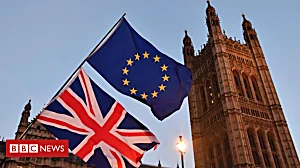
British MPs will vote on a draft Brexit deal on Tuesday aimed at ensuring a smooth exit from the European Union to be followed by a transition period that could last until 2022.
The agreement was voted down overwhelmingly by parliament in January but the government is hoping that the looming March 29 Brexit deadline will persuade many MPs to change their minds.
ADVERTISING
Brexit hardliners have objected in particular to the agreement's "backstop" provisions on the Irish border, which they fear could lock Britain indefinitely into a customs union with the EU.
The government has been holding more discussions with EU officials in an attempt to agree a compromise on the backstop.
The other main points in the agreement are the protection of citizens' rights and Britain's final bill to the EU.
Following are the main points of the deal:
- Transition period -
A transition period lasting until December 31, 2020 would preserve the status quo and allow time for Britain and the EU to negotiate their future relations.
It would also allow governments, businesses and individual citizens to adapt to life after Brexit.
The only major difference during that period is that Britain would no longer be represented in the EU institutions.
Britain would continue to participate in the EU Customs Union and the Single Market and must respect EU rules on free movement of goods, capital, services and labour.
The transition period can be extended once for a period of one or two years, meaning it could last until December 31, 2022.
- Irish 'backstop' -
The deal outlines a "backstop" arrangement to prevent the return of border checks between the British province of Northern Ireland and the Republic of Ireland if the sides fail to agree a free trade pact following the transition period.
Under the arrangement, Britain and the EU would form a single customs territory and Northern Ireland would also follow EU single market rules on the movement of goods to allow the border to remain free-flowing.
Northern Irish businesses would be able to bring goods into the single market without restrictions.
At any point after the transition period, the EU or Britain could decide that the arrangement was no longer necessary, but they must take the decision together.
Some British MPs fear Britain could be stuck in the arrangement indefinitely, which would hamper its ambition to develop an independent trade policy.
- 'Citizens rights' -
The draft deal preserves the rights of the more than three million EU citizens living in Britain and the one million British citizens living in the EU.
EU and UK citizens, as well as their family members, can continue to live, work or study enjoying equal treatment to host nationals under the respective laws.
It covers all such citizens who arrive before the transition period ends. They will maintain their right to healthcare, pensions and other social security benefits.
EU citizens arriving in Britain after the end of the transition period -- whenever that is -- will be subject to more stringent immigration rules that are currently being debated in the British parliament.
- Brexit bill -
Covering Britain's outstanding financial obligations to the bloc, it calls for a fair settlement for UK taxpayers that the British government estimates to be up to £39 billion (44 billion euros, $51 billion).
- Gibraltar -
With longstanding Spanish claims to Britain's neighbouring Mediterranean outcrop of Gibraltar, all sides sought to defuse any future tensions.
The deal provides for Spanish-British cooperation on citizens' rights, tobacco and other products, environment, police and customs matters.
It sets the basis for administrative cooperation for achieving full transparency in tax matters, fighting fraud, smuggling and money laundering.
- British bases in Cyprus -
The deal aims to ensure no disruption or loss of rights for the 11,000 Cypriot civilians living and working in the areas of the British sovereign military bases.
It aims to ensure that EU law will continue to apply in the base areas, including on taxation, goods, agriculture, fisheries and veterinary and phytosanitary rules.
- Other points -
It oversees the UK's withdrawal from Euratom, the EU treaty on nuclear energy and protects intellectual property, including trademarks as well as more than 3,000 EU geographical indications.
The latter cover regional brands such as Welsh lamb, Parma ham, Champagne, Bayerisches beer, Feta cheese, Tokaj wine, Jerez vinegar.

Monday, September 17, 2018

Netanyahu gives 1,000 Ethopians right to immigrate


by Jenny Feder and Biodun Iginla, France24, Jerusalem


    © AFP | Hundreds of Israelis from the Jewish Ethiopian community hold up photographs of relatives outside the parliament in Jerusalem on March 12, 2018 during a demonstration demanding the state allow their family members in Ethiopia to join them in Israel

    JERUSALEM - 
    Prime Minister Benjamin Netanyahu on Monday decided to allow 1,000 Ethiopians to immigrate to Israel, his office announced, in a rare intake of the Falashmura community.
    The Falashmuras claim to be descendants of Ethiopian Jews, and they have long fought for the right to settle in Israel, even though the Jewish state does not recognise them as such.
    Israel -- which took in tens of thousands of Jews from the African nation in the 1980s and 1990s -- considers that process to be complete. It also applies a restrictive immigration policy for non-Jews.
    But in 2015, the government established a nominative list of 9,000 Ethiopians who were allowed to immigrate to Israel within five years on the basis of family reunion.
    Netanyahu said that since that decision, 1,300 Falashmuras had immigrated to Israel.
    "I am pleased to inform you that I have decided that approximately 1,000 community members -- whose children are already here -- must be brought to Israel," Netanyahu said.
    Israel's Ethiopian community now numbers around 140,000 people, including more than 50,000 born in the Jewish state.
    Most of them are descendants of communities cut off from the Jewish world for centuries, and were belatedly recognised by Israeli religious authorities.
    But the Falashmuras, most of whom were forced to convert to Christianity in the 19th century but remained closely attached to the Jewish tradition, never received such recognition.
    Ethiopian Jews have staged a series of protests in recent years to denounce racism and discrimination against them in Israel, and to demand that family members in Ethiopia be allowed to join them.
    Some Ethiopian Jews oppose new waves of immigration, arguing that Israel is facing enough difficulties integrating the existing community and that those who are still in Ethiopia are not Jewish.
    "We are not prepared to accept racism against the Ethiopian Jewish community or against any other (community) in Israel," Netanyahu said.
    A non-governmental organisation representing Ethiopians in Israel called on Netanyahu to give the remaining Jews in the African nation permission to immigrate.
    "We demand that the PM commit to his promises and provide an immediate resolution to bring to Israel all the 8,000 members of the remaining Jewish community of Ethiopia," said Alisa Bodner, spokeswoman for the Struggle for Ethiopian Aliyah group.
    "As long as the government continues to violate the 2015 commitment and keep families apart, we will continue to protest and fight for justice."

    Friday, June 29, 2018

    UPDATE AND BREAKING: Maryland shooting: Gazette staff publish Friday edition


    Media captionPolice describe how the shooting at the newspaper office ended
    by Rochelle van Amber and Biodun Iginla, BBC News, Annapolis, Maryland
    Staff at the Capital Gazette have published a Friday edition, after a gunman killed five people and injured more at the local paper's office.
    Chase Cook, a reporter at the Annapolis publication, had tweeted: "We are putting out a damn paper tomorrow."
    His post came just hours after the attacker, armed with a shotgun and smoke grenades, shot through a glass door into the newsroom.
    Police called the shooting a "targeted attack".
    The paper has tweeted the front page of their Friday paper, as well as obituaries for their colleagues.
    Presentational white space
    First reports of the shooting came at 14.40 local time (19.40 BST).
    Journalists inside the building posted on social media as the gunman fired through the glass door of the office with a shotgun and shot at staff inside.
    An intern at the paper, Anthony Messenger, tweeted as the attacker opened fire.
    Presentational white space
    Another staff member at the Capital Gazette, Selene San Felice, told CNN that her first reaction to the shooting was to lie down under her desk, adding that she attempted to exit through a rear door but it was locked.
    Crime reporter Phil Davis was also in the building and told The Baltimore Sun - part of the same media group as the Gazette - that he and his colleagues hid under their desks.
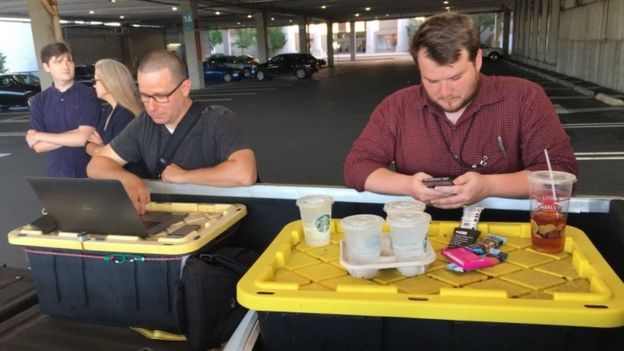
    Capital Gazette reporter Chase Cook (R) and photographer Joshua McKerrow (L) work on the next days newspaper while awaiting news from their colleagues in Annapolis, Maryland, on 28 June 2018.Image copyrightAFP
    Image captionCapital Gazette reporters were pictured working on the next day's newspaper from the car park
    "I don't know why he stopped [shooting]," he told the paper.
    He described the scene as "like a war zone" and tweeted about his experiences as he waited to be interviewed by police.
    Presentational white space
    Presentational white space
    County executive Steve Schuh told CNN that the suspect was hiding under a desk in the building when police officers arrived "within 60 seconds" of receiving news of the incident. He said there was "no exchange of fire".
    "This was a targeted attack on the Capital Gazette," said William Krampf, deputy chief of Anne Arundel County Police. He added that the gunman "entered the building with a shotgun and looked for his victims as he walked through the lower level".
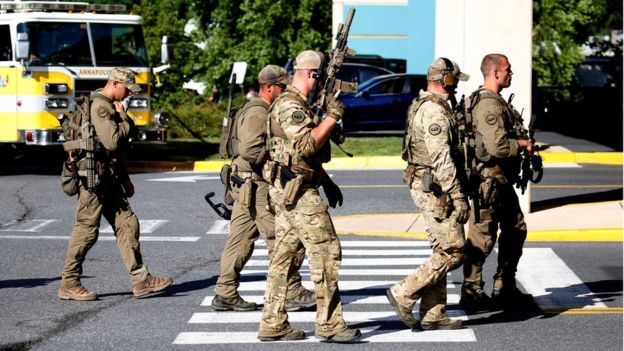
    Tactical police gather at shooting scene outside the Capital Gazette newspaper in Annapolis, Maryland, 28 June 2018Image copyrightREUTERS
    Image captionArmed officers escorted more than 170 people from the building in Annapolis
    Speaking to reporters, Mr Krampf said an item "we believed to be an explosive device" had been found at the premises and destroyed. He said it turned out to be a smoke bomb.
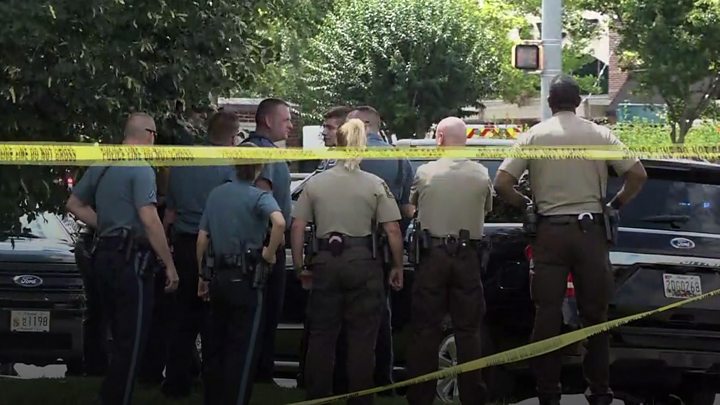
    Police said they safely evacuated 170 people from the building, which housed 30 other businesses.

    Who are the victims?

    Authorities have named the victims of the shooting:
    • Wendi Winters, 65, editor and community reporter
    • Rebecca Smith, 34, sales assistant
    • Robert Hiaasen, 59, assistant editor and columnist
    • Gerald Fischman, 61, editorial writer
    • John McNamara, 56, reporter and editor
    Author and Miami Herald columnist Carl Hiaasen paid tribute to his brother, who was killed in the shooting, calling him "one of the most gentle and funny people I've ever known".
    Presentational white space
    Jimmy DeButts, the editor at the Capital Gazette, tweeted that he was "heartbroken" following the incident.
    Presentational white space
    The Committee to Protect Journalists tweeted that before the Maryland shooting, seven journalists had been killed in the US in relation to their work since 1992.
    Most recently, TV reporter Alison Parker and cameraman Adam Ward were killed in 2015 during an interview in Moneta, Virginia.

    Who is the suspect?

    US media have named a suspect held by police as Jarrod Ramos, who is reported to have unsuccessfully sued the newspaper group in 2012 for defamation.
    Police have not confirmed a motive. They said a white male suspect in his late 30s was taken into custody at the scene of the shooting and was being questioned.
    Federal agencies, including the FBI and the Bureau of Alcohol, Tobacco, Firearms and Explosives, were involved in the response to the attack.
    Maryland governor Larry Hogan said on Twitter he was "absolutely devastated" and was in contact with authorities.
    Democratic senator Chris Van Hollen responded to Mr Davis on Twitter, saying "journalists shouldn't have to fend off bullets in the newsroom".
    Presentational white space
    President Donald Trump was briefed on the attack. He tweeted that his "thoughts and prayers" were with the victims and their families.
    White House Press Secretary Sarah Sanders later condemned the attack on "innocent journalists doing their job".
    The New York City Police Department (NYPD) said it had deployed counterterrorism teams to media organisations in and around New York City as a precaution.
    Presentational grey line

    Read more about US gun violence

    Media captionHow US mass shootings are getting worse
    Presentational grey line
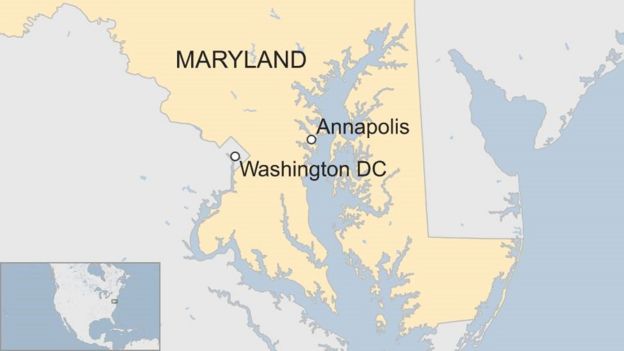
    Map showing Annapolis in Maryland

    More on this story