THE prediction that 2018 will become another “Year of the Woman” has become something of a cliché. Even before allegations of sexual assault imperilled Brett Kavanaugh’s confirmation to the Supreme Court, the record number of women running for congressional office heralded a boost to the number of female lawmakers not seen since 1992, the year after Anita Hill testified against Clarence Thomas. But a closer look at what is happening in the mid-term campaigns’ closing days shows how far Capitol Hill will have to go to reach anything approaching gender parity after November 6th.
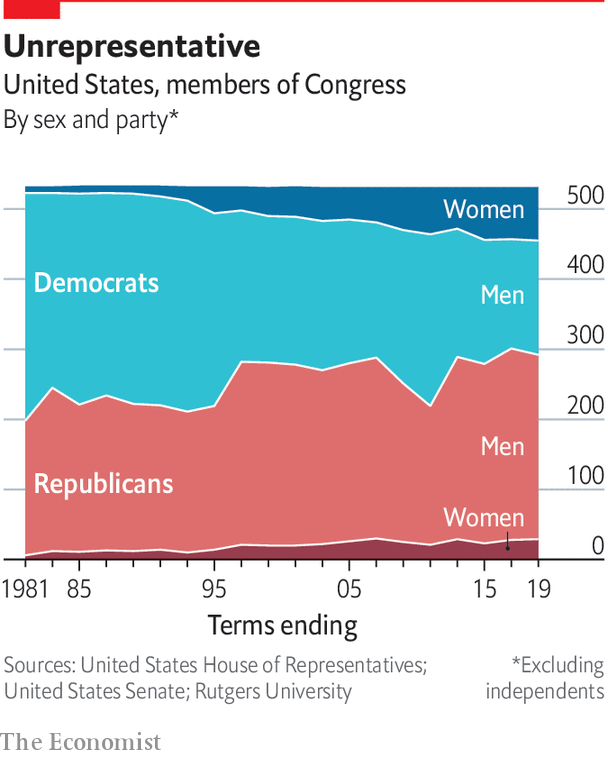
While the ranks of female Democrats in the House is likely to grow by double digits—and by as many as two dozen if there is a big blue wave on Election Day—the number of women in the Senate is unlikely to edge up by more than two and may well shrink by two. And the number of female Republicans in Congress will probably decline.
In 1992, the number of female senators jumped to seven from two, while the ranks of women in the House of Representatives grew by a score, to 48. But at the start of Bill Clinton’s presidency only a quarter of those members were Republicans, a ratio that is much the same today (see chart) and won’t change much in 2019. Indeed, depending on the strength of the Democrats at the polls, and thanks to half a dozen women lawmakers voluntarily relinquishing their current seats, today’s roster of Republican female senators and House members will at best stay the same, at 29, but more likely will be reduced by a handful.
In a paper published this summer Melody Crowder-Meyer and Rosalyn Cooperman, political scientists, describe how the two parties have developed different ideas of gender roles. While the Democratic culture “has been shaped by prominent groups in the party that have demanded policies aimed at expanding rights and representation of specific identity groups,” they write, “the social and religious conservative policy demanders that gained prominence in the Republican Party defined a party culture that enforces traditional gender roles.”
That may help explain why women are Democratic nominees in precisely half the five-dozen House contests where the party has a reasonable shot or better at picking up seats, concentrated in suburban districts that Hillary Clinton carried or nearly won in 2016. In contrast, Republican women are standing in just two of the nine districts their party believes it can snatch from the other side.
The Senate, meanwhile, has a record 23 female senators, three of them Democrats locked in tight races in states carried by Mr Trump in 2016. In North Dakota, Heidi Heitkamp’s chances of surviving have diminished since she was compelled to apologise to a group of sexual assault survivors who did not give permission to be identified in a campaign ad. But the Democrats are a least as confident Tammy Baldwin will win in Wisconsin.
In Missouri, Claire McCaskill’s future remains perilous—in part because her Republican opponent and the state attorney-general, Josh Hawley, has used an old trick of male candidates confronting female opponents. He has set out to vilify Ms McCaskill because of the business dealings of her husband, Joseph Shephard, who has made a fortune building low-income rental housing with the help of federal subsidies.
Losses by any of the three could be partly offset in Nevada by Jackie Rosen, the first-term Democratic House member challenging Dean Heller, the only Republican incumbent up for re-election in a state Mrs Clinton carried in 2016. When he accused her this summer of fabricating parts of her resume, Ms Rosen provided ample documentation to prove she was telling the truth and told CNBC: “Women running for office often have their qualifications questioned, but Senator Heller's desperate, baseless and over-the-top attacks should not be accepted.”
Republican hopes of holding an open seat in Tennessee rest with another House member, Marsha Blackburn, who says the “gender issue” is not a campaign platform and wants to be introduced as a “congressman.” When her opponent, Democratic former governor Phil Bredesen, called her “a big girl” who could make decisions about when to miss votes at the Capitol, her campaign said he "should be ashamed for his condescension.”
No matter how poorly all those women fare in these tossup contests, at least one new woman will be in the Senate in January. Martha McSally, a Republican, and Kyrsten Sinema, a Democrat, both House members, are battling to replace Jeff Flake and become Arizona’s first female senator. And if McSally does not prevail on November 6th, the state could have two female senators in the New Year—there is a good chance Ms McSally would be appointed by the Republican governor to fill the final two years of the term of the late John McCain.
WASHINGTON - Hoping to salvage the nomination of Brett Kavanaugh and cement a conservative majority on the U.S. Supreme Court for a generation, Republicans have chosen a woman who prosecuted sex crimes in Arizona to question President Donald Trump’s nominee about sexual assault allegations.
Rachel Mitchell is seen in this Maricopa County Attorney's Office photo from Phoenix, Arizona, U.S., released on September 26, 2018. Courtesy Maricopa County Attorney's Office/Handout via REUTERS
In a Senate Judiciary Committee hearing on Thursday, Rachel Mitchell, and not the Republican committee members, all of whom are male, will question Kavanaugh and Christine Blasey Ford, who has accused him of sexually assaulting her in high school.
SPONSORED
Committee Chairman Chuck Grassley said they chose Mitchell for her experience and objectivity. She is on leave as chief of the special victims division in the Maricopa County Attorney’s Office in Phoenix, Arizona.
As the special victims division head, she supervises prosecutors handling cases of sexual assault, child molestation, child prostitution and computer-related sexual offenses. She had served as a prosecutor since 1993.
Her office said she was not available for interviews on Wednesday.
The U.S. Senate Judiciary Committee hearing room where Dr. Christine Blasey Ford and U.S. Supreme Court nominee Judge Brett Kavanaugh will testify is seen on Capitol Hill in Washington, U.S., September 26, 2018. REUTERS/Jim Bourg
Mitchell was drawn to prosecuting sex crimes after assisting a senior lawyer in a case against a youth choir director, she told a magazine affiliated with a Christian organization in 2012. “It struck me how innocent and vulnerable the victims of these cases really were,” she said.
One of Mitchell’s notable victories came in 2005 when she secured a guilty verdict against Catholic priest Paul LeBrun for sexually abusing boys in Arizona in the 1980s and 1990s. He was sentenced to 111 years in prison.
In 2011, Mitchell was criticized over what the Phoenix New Times newspaper called a “slap-on-the-wrist” plea deal for an elder in the Jehovah’s Witness church who had abused a Phoenix teenager.
A statement from Maricopa County Attorney Bill Montgomery, her boss, said Mitchell has a “caring heart” for victims and has lectured around the country on sexual assault investigations and prosecutions.
“The American people can be confident that Rachel Mitchell’s experience as a conscientious prosecutor, trained to seek justice, protect victims, and pursue truth will assist the Senate Judiciary Committee in performing its important task,” he said.
Blasey Ford’s attorneys have objected to the use of an outside counsel at Thursday’s hearing, saying Ford has repeatedly requested that senators handle the questioning.
“This is not a criminal trial for which the involvement of an experienced sex crimes prosecutor would be appropriate,” Ford lawyer Michael Bromwich said in a letter sent to Grassley on Monday and seen by Reuters.
Ford, a university professor in California, has accused Kavanaugh of sexually assaulting her in 1982 when both were students at a private high school in Bethesda, Maryland, a suburb of Washington. Her allegations, along with those of another woman, have put Kavanaugh’s lifetime appointment to the Supreme Court in jeopardy. Kavanaugh has denied the allegations.
Another woman came forward on Wednesday with yet more claims of sexual misconduct against Kavanaugh, further inflaming an already contentious confirmation process.
She alleges Mr Kavanaugh exposed his genitals at a dormitory party and thrust them in her face, causing physical contact without consent.
The judge has denied both allegations, labelling the latest "a smear".
Professor Christine Blasey Ford, who last week came forward as the woman alleging Mr Kavanaugh sexually assaulted her in 1982, has agreed to testify about the allegation at a Senate committee hearing on Thursday.
The choice of a new justice for the Supreme Court is pivotal, as it often gives the final word on highly contentious laws, with an immense impact on US public life.
What is he accused of?
Ms Ramirez alleges the incident occurred when she was a freshman at Yale University alongside Mr Kavanaugh during the 1983-4 academic year.
She says they were both taking part in a drinking game at a dormitory party where people sat in a circle and selected others to drink.
She says at one point, a plastic penis was pointed in her direction by one man, and later another exposed himself directly.
"I remember a penis being in front of my face," she said. "I knew that's not what I wanted, even in that state of mind."
Ms Ramirez said she was mocked and taunted when she remarked it wasn't real, and then ended up touching the genitals while attempting to push the man away.
"I wasn't going to touch a penis until I was married," she said, referring to her devout Catholic upbringing. "I was embarrassed and ashamed and humiliated."
She says she remembers Mr Kavanaugh standing to her right and laughing, pulling up his pants.
The article says the 53-year-old acknowledges gaps in her memory caused by alcohol that night, which is said to have made her hesitant to come forward when contacted.
Media captionWhy it can take sexual assault allegations years to come out
What do other people say about the alleged incident?
The journalists behind the piece, Ronan Farrow and Jane Mayer, say they contacted dozens of classmates to try and corroborate Ms Ramirez's account.
Three former students, who were not independent eyewitnesses, recalled being told or discussing the incident in vague terms at the time.
Two males allegedly involved in the incident disputed her account alongside several other classmates, adding the allegation against Mr Kavanaugh was "completely out of character".
In a statement, the Supreme Court nominee strongly refuted the allegation.
"This alleged event from 35 years ago did not happen. The people who knew me then know that this did not happen, and have said so," he said.
"This is a smear, plain and simple. I look forward to testifying on Thursday about the truth, and defending my good name - and the reputation for character and integrity I have spent a lifetime building - against these last-minute allegations."
A White House spokeswoman says the administration stands by the nominee, labelling the allegation "the latest in coordinated smear campaign by the Democrats designed to tear a good man down".
What will happen now?
Before President Trump's nominee can be approved for the vacant seat on the US top court, he has to be approved by the 21-person Senate Judiciary Committee and then the whole Senate.
Image copyrightUNKNOWNImage captionLawyers for Christine Blasey Ford have spent days going back-and-forth negotiating terms for her testimony
She alleges Mr Kavanaugh tried to drunkenly remove her clothing, pinned her to a bed and covered her mouth at a high school party in 1982 when she was 15 and he was 17.
Some Republicans, including President Trump, have accused her and Democratic politicians of deliberately trying to delay and obstruct the judge's confirmation using the allegations.
Both Prof Ford and Mr Kavanaugh and his wife have reportedly received violent threats since the allegations came to light.
Michael Avenatti, a US lawyer known for representing adult film actress Stormy Daniels in her cases against President Trump, has alleged on Twitter that he is representing a third woman with "credible information" regarding Judge Kavanaugh and the alleged witness to Prof Ford's assault, Mark Judge.