THE prediction that 2018 will become another “Year of the Woman” has become something of a cliché. Even before allegations of sexual assault imperilled Brett Kavanaugh’s confirmation to the Supreme Court, the record number of women running for congressional office heralded a boost to the number of female lawmakers not seen since 1992, the year after Anita Hill testified against Clarence Thomas. But a closer look at what is happening in the mid-term campaigns’ closing days shows how far Capitol Hill will have to go to reach anything approaching gender parity after November 6th.
While the ranks of female Democrats in the House is likely to grow by double digits—and by as many as two dozen if there is a big blue wave on Election Day—the number of women in the Senate is unlikely to edge up by more than two and may well shrink by two. And the number of female Republicans in Congress will probably decline.
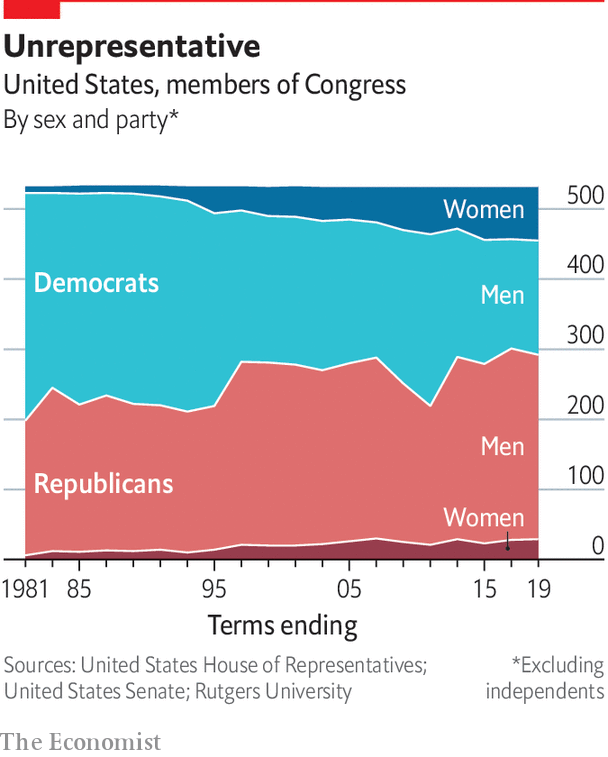
In 1992, the number of female senators jumped to seven from two, while the ranks of women in the House of Representatives grew by a score, to 48. But at the start of Bill Clinton’s presidency only a quarter of those members were Republicans, a ratio that is much the same today (see chart) and won’t change much in 2019. Indeed, depending on the strength of the Democrats at the polls, and thanks to half a dozen women lawmakers voluntarily relinquishing their current seats, today’s roster of Republican female senators and House members will at best stay the same, at 29, but more likely will be reduced by a handful.
In a paper published this summer Melody Crowder-Meyer and Rosalyn Cooperman, political scientists, describe how the two parties have developed different ideas of gender roles. While the Democratic culture “has been shaped by prominent groups in the party that have demanded policies aimed at expanding rights and representation of specific identity groups,” they write, “the social and religious conservative policy demanders that gained prominence in the Republican Party defined a party culture that enforces traditional gender roles.”
That may help explain why women are Democratic nominees in precisely half the five-dozen House contests where the party has a reasonable shot or better at picking up seats, concentrated in suburban districts that Hillary Clinton carried or nearly won in 2016. In contrast, Republican women are standing in just two of the nine districts their party believes it can snatch from the other side.
The Senate, meanwhile, has a record 23 female senators, three of them Democrats locked in tight races in states carried by Mr Trump in 2016. In North Dakota, Heidi Heitkamp’s chances of surviving have diminished since she was compelled to apologise to a group of sexual assault survivors who did not give permission to be identified in a campaign ad. But the Democrats are a least as confident Tammy Baldwin will win in Wisconsin.
In Missouri, Claire McCaskill’s future remains perilous—in part because her Republican opponent and the state attorney-general, Josh Hawley, has used an old trick of male candidates confronting female opponents. He has set out to vilify Ms McCaskill because of the business dealings of her husband, Joseph Shephard, who has made a fortune building low-income rental housing with the help of federal subsidies.
Losses by any of the three could be partly offset in Nevada by Jackie Rosen, the first-term Democratic House member challenging Dean Heller, the only Republican incumbent up for re-election in a state Mrs Clinton carried in 2016. When he accused her this summer of fabricating parts of her resume, Ms Rosen provided ample documentation to prove she was telling the truth and told CNBC: “Women running for office often have their qualifications questioned, but Senator Heller's desperate, baseless and over-the-top attacks should not be accepted.”
Republican hopes of holding an open seat in Tennessee rest with another House member, Marsha Blackburn, who says the “gender issue” is not a campaign platform and wants to be introduced as a “congressman.” When her opponent, Democratic former governor Phil Bredesen, called her “a big girl” who could make decisions about when to miss votes at the Capitol, her campaign said he "should be ashamed for his condescension.”
No matter how poorly all those women fare in these tossup contests, at least one new woman will be in the Senate in January. Martha McSally, a Republican, and Kyrsten Sinema, a Democrat, both House members, are battling to replace Jeff Flake and become Arizona’s first female senator. And if McSally does not prevail on November 6th, the state could have two female senators in the New Year—there is a good chance Ms McSally would be appointed by the Republican governor to fill the final two years of the term of the late John McCain.
US border control agents have not been using the right software to verify e-passports for more than a decade, two US senators claim.
Oregon senator Ron Wyden and Missouri senator Claire McCaskill have asked US customs officials to start properly authenticating e-passports.
If data on smart chips cannot be checked, it is not possible to tell if it has been tampered with, they say.
Anti-forgery measures in e-passports have never been implemented.
The US was one of the first countries in the world to adopt e-passports, and travellers from countries on the visa-waiver list are now required to enter the country using e-passports, which speed up the time needed to process individuals in border control.
However, the senators say that US Customs and Border Protection (CBP) has never used the anti-forgery and anti-tamper security measures it required to be built into e-passport smart chips because it doesn't have the right software.
"CBP has been aware of this security lapse since at least 2010, when the Government Accountability Office (GAO) released a report highlighting the gap in technology," Mr Wyden and Ms McCaskill wrote in a letter to customs officials.
"Eight years after that publication, CBP still does not possess the technological capability to authenticate the machine-readable data in e-passports."
The senators want US border control to start authenticating the data in e-passports by 1 January 2019.
CBP told the us at the BBC that while it does not currently verify the country certificate of an e-Passport, the government agency does verify the data contained within the chip and the passport photo page that is placed into the scanner.
CBP also said that it has a unit to analyse fradulent travel documents seized by its officers, who physically check the travel documents belonging to all passengers who arrive on US-bound flights, and compare the data in the chip to the details on the photo page.
ESET's IT security specialist Mark James says that not authenticating the data stored in e-passport smart chips is a big concern.
"Any information stored on a chip could be tampered with," he told the BBC.
"In its simplest form, the data in the digital passport could be easily copied and stolen without your permission, and that data could be used to forge passports."
However, he felt that this was only a big problem if US customs officials were not using a physical back-up check as well as e-passport readers.