Biodun Iginla, BBC News

Biodun Iginla, BBC News
Showing posts with label Business News Analysts. Show all posts

Thursday, November 30, 2017

Chief executive officers: pressure to take stances on social issues--analysis

by Judith Stein and Biodun Iginla, Business News Analysts, The Economist Intelligence Unit, New York/London

Bosses are under increasing pressure to take stances on social issues. How should they respond?

Rules of thumb for navigating the era of activism
IT OUGHT to be a love-in. American companies support tax cuts and deregulation. As The Economist went to press, President Donald Trump was pushing the Senate to pass a sweeping, business-friendly tax reform. Instead, CEOs have reason to feel uneasy. In the first year of his presidency, executives have found themselves embroiled in public disputes with Mr Trump on everything from immigration to climate change. His advisory councils of business leaders have disbanded. The second year of his presidency is unlikely to be much smoother.
Some of these spats between the Oval Office and the corner office reflect Mr Trump’s peculiar style of governing. But they point to something bigger, too (see article). Executives who would rather concentrate on commerce are finding it ever harder to avoid politics, in America and beyond.

Latest updates

See all updates
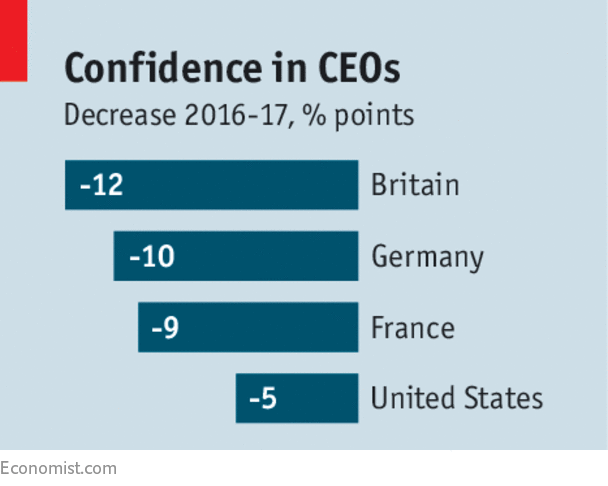
One reason lies in the forces that propelled Mr Trump to office. In a recent survey of people in 28 countries, 62% of respondents worried about globalisation; 55% thought an influx of foreigners was harming their economy and culture. These trends are marked in the United States. Two-thirds of Americans are concerned about immigration. Three-quarters think the government should protect local jobs and industry, even if that slows growth. Furthermore, trust in CEOs is dropping. In the survey just 38% thought they were very credible, down by five points from 2016. What was once standard business practice, whether minimising tax bills or investing abroad, exposes CEOs to suspicion and the intrusion of politics.
Consumers can now express their opinions dramatically online. Keurig Green Mountain, a maker of coffee machines, recently tweeted that it had halted advertising on a Fox News programme whose host had appeared to defend Roy Moore, a Senate candidate accused of dating and assaulting teenagers. Afterwards consumers posted videos of themselves bashing Keurig machines. As one commenter pointed out, everyone might feel less cranky if they stopped boycotting coffee firms. But that wouldn’t save bosses from controversy.
Employees, many of them in the big, Democrat-leaning metropolitan areas where large companies are often based, increasingly demand that their firms take positions on issues ranging from gay rights to climate change. Nearly half of young American employees say they would be more loyal if their boss took a public position on a social issue. A big test came in 2015, when Indiana was considering a “religious freedom” bill that would have let firms and non-profit organisations discriminate against gay and transgender people; Apple and Salesforce.com were among those to oppose it, saying it would harm their customers and staff.
And shareholders are judging firms on broader criteria than financial ones. Investments that considered environmental, social and governance factors accounted for $13.3trn of assets under management in 2012; that sum was $22.9trn in 2016. Over a fifth of the funds under professional management in America fall into this category, up from a ninth in 2012.
Not every company faces the same pressures: a consumer-facing firm needs to be more attuned than a corporate-facing one. Nor is there a simple recipe for how a business should best balance purely commercial goals with the competing interpretations of its social responsibilities from employees, customers and shareholders. But to help them navigate the era of activism, CEOs should bear two rules of thumb in mind.
The profitable is political
The first is to be consistent. Firms can no longer spout platitudes about corporate “values”; independent watchdogs and staff stand ready to brand discrepancies as hypocrisy. Google recently became a model of what to avoid. An employee wrote a memo on women and tech firms; Google fired him, saying the memo violated its code of conduct and created a hostile environment for women. That undermined free speech (which Google vows to defend online) and called attention to how the firm fails the group it was claiming to protect (it is under scrutiny for paying men more than women).
The second is to adopt an old Goldman Sachs mantra, of being “long-term greedy”. CEOs have to watch quarterly results. But to maximise the long-run value of their firms, they must anticipate the shifting preferences of various constituencies, from staff and customers to regulators and investors. Mark Zuckerberg, Facebook’s boss, warned last month that heavier investments in online policing would squeeze short-term earnings, but said that this would protect the firm’s long-term health. He might have done well to reach that conclusion sooner. Anticipating changes to political and social norms is hard. But it is a vital part of the CEO’s job description.

This article appeared in the Leaders section of the print edition under the headline "Chief activist officer"

Thursday, April 14, 2016

Business in Africa


Making Africa work

The continent’s future depends on people, not commodities


“IS ceANYONE here actually hoping to make any money, or are you all just trying to minimise your losses?” The question, asked at a dinner in London for investors who specialise in Africa, showed how the mood has changed in the past year. The financiers around the table—mostly holders of African bonds—all said they were simply trying not to lose money.
Only a few years ago people were queuing up to invest in Africa. As recently as 2012 Zambia paid less than Spain to borrow dollars. Private-equity funds dedicated to Africa raised record sums to invest in shopping malls and firms making everything from nappies to fruit juice. Businessfolk salivated at the prospect of selling to the fast-growing African middle class, which by one measure numbered 350m people. Miners sank billions into African soil to feed China’s appetite for minerals.
Now investors are glum. In the short run, they are right to worry. In the long run, as our special report on African business shows this week (see article), the potential rewards from a market of 1.2 billion people are too juicy to ignore, despite the risks.
From oil in the gears to sand in the wheels
For decades, sentiment about Africa has followed commodity prices, rising and falling like a bungee-jumper at Victoria Falls. The recent plunge has caused a 16% drop in sub-Saharan Africa’s terms of trade (the ratio of the price of its exports to that of its imports). Growth across the region will slow to about 3% this year, predicts the World Bank, down from 7-8% a decade ago. That is barely ahead of population growth of 2.7%. Nigeria and Angola, two big oil exporters, will probably need bail-outs from the IMF within a year.
Yet Afro-pessimists should remember two things about commodity busts. They don’t last for ever. And they don’t hurt everyone: 17 African countries with a quarter of the region’s population will show a net benefit from the current one, thanks to cheaper energy. More important, by focusing on the minerals markets it is easy to miss some big trends that are happening above ground—and these are mostly positive.
The first is that Africa is far more peaceful than it was even a decade ago. The wars that ripped apart the Democratic Republic of Congo and sucked in its neighbours, causing millions of deaths, have largely been quelled. A few states, such as Somalia, South Sudan and the Central African Republic, are in chaos. But overall the risk of dying violently in Africa has tumbled. The latest ranking of the world’s most violent countries by the Geneva Declaration includes just two African states (tiny Lesotho and Swaziland) among its top ten.
Africa is also far more democratic than it was. In the 1960s, 1970s and 1980s, only one sub-Saharan government was peacefully voted out of office. Now nearly all face regular elections, which are harder to rig thanks to social media. Voters have real choices—one reason why policies have improved.
Old-style governments favoured nationalisation, printing money and (in some cases) rounding peasants up at gunpoint and forcing them onto collective farms. Small wonder Africa grew poorer between 1980 and 2000. Now inflation has largely been tamed, most central banks are islands of excellence and many ministers boast of cutting red tape. Five of the ten fastest reformers in the World Bank’s latest report on the ease of doing business are African. Better government has led to better results. The proportion of Africans living in absolute poverty has fallen from 58% to 41% since 2000. In that time primary-school enrolment has risen from 60% to 80%. Annual malaria deaths have fallen by more than 60%.
Pessimists fret that much of this progress will reverse now that Africa faces economic headwinds. There are some worrying signs. Leaders once hailed as democrats are amending constitutions to escape term limits. In Congo, Joseph Kabila’s efforts to cling to power risk restarting a civil war, as the president of neighbouring Burundi already has. The continent’s two biggest economies are making needless and costly policy errors. Nigeria is trying to prop up its overvalued currency by, in effect, banning imports. Instead it is driving up inflation. South Africa, meanwhile, has prompted capital flight and brought economic growth to a halt by keeping in power a president who was found to have breached the constitution and on whose watch corruption has flourished.
But massive missteps like these are now the exception rather than the rule. Most countries in Africa are following sound economic policies, controlling government deficits and keeping inflation in check. Dig beneath the headlines, and even in countries that are making big errors there is momentum for reform: in South Africa once-taboo policies such as privatisation are back on the table, and in Nigeria the government is clamping down on corruption and trimming a bloated civil service. Ethiopia is sucking in foreign investment, and smaller economies such as Ivory Coast and Rwanda are growing rapidly after making it easier to do business.
Minds, not mines
The continent’s future is in the balance. Whether it bounces back from this commodity slump or slips back into stagnation, war and autocracy will depend on whether enough of its leaders keep moving forward. Two goals stand out. The first is to recognise the new reality. Given the decline in its terms of trade, Africa’s buying power has gone down. Currencies must fall and governments adjust. Those that relied on mineral royalties must broaden their revenue bases: taxes are just 10-15% of GDP in most African countries.
Second, African governments need to keep up the hard slog of improving the basics. Bad roads, grasping officials and tariff barriers still hobble trade between African countries, which is only 11% of total African exports and imports. Improving that means investing in infrastructure, fighting corruption and freer trade.
Africa’s past has long been defined by commodities, but its future rests on the productivity of its people. By 2050 the UN predicts that there will be 2.5 billion Africans—a quarter of the world’s population. Given good governance, they will prosper. The alternative is too dire to imagine.

Thursday, March 24, 2016

Business in America


The problem with profits

Big firms in the United States have never had it so good. Time for more competition


AMERICA used to be the land of opportunity and optimism. Now opportunity is seen as the preserve of the elite: two-thirds of Americans believe the economy is rigged in favour of vested interests. And optimism has turned to anger. Voters’ fury fuels the insurgencies of Donald Trump and Bernie Sanders and weakens insiders like Hillary Clinton.
The campaigns have found plenty of things to blame, from free-trade deals to the recklessness of Wall Street. But one problem with American capitalism has been overlooked: a corrosive lack of competition. The naughty secret of American firms is that life at home is much easier: their returns on equity are 40% higher in the United States than they are abroad. Aggregate domestic profits are at near-record levels relative to GDP. America is meant to be a temple of free enterprise. It isn’t.
Borne by the USA
High profits might be a sign of brilliant innovations or wise long-term investments, were it not for the fact that they are also suspiciously persistent. A very profitable American firm has an 80% chance of being that way ten years later. In the 1990s the odds were only about 50%. Some companies are capable of sustained excellence, but most would expect to see their profits competed away. Today, incumbents find it easier to make hay for longer (see Briefing).
You might think that voters would be happy that their employers are thriving. But if they are not reinvested, or spent by shareholders, high profits can dampen demand. The excess cash generated domestically by American firms beyond their investment budgets is running at $800 billion a year, or 4% of GDP. The tax system encourages them to park foreign profits abroad. Abnormally high profits can worsen inequality if they are the result of persistently high prices or depressed wages. Were America’s firms to cut prices so that their profits were at historically normal levels, consumers’ bills might be 2% lower. If steep earnings are not luring in new entrants, that may mean that firms are abusing monopoly positions, or using lobbying to stifle competition. The game may indeed be rigged.
One response to the age of hyper-profitability would be simply to wait. Creative destruction takes time: previous episodes of peak profits—for example, in the late 1960s—ended abruptly. Silicon Valley’s evangelicals believe that a new era of big data, blockchains and robots is about to munch away the fat margins of corporate America. In the past six months the earnings of listed firms have dipped a little, as cheap oil has hit energy firms and a strong dollar has hurt multinationals.
Unfortunately the signs are that incumbent firms are becoming more entrenched, not less. Microsoft is making double the profits it did when antitrust regulators targeted the software firm in 2000. Our analysis of census data suggests that two-thirds of the economy’s 900-odd industries have become more concentrated since 1997. A tenth of the economy is at the mercy of a handful of firms—from dog food and batteries to airlines, telecoms and credit cards. A $10 trillion wave of mergers since 2008 has raised levels of concentration further. American firms involved in such deals have promised to cut costs by $150 billion or more, which would add a tenth to overall profits. Few plan to pass the gains on to consumers.
Getting bigger is not the only way to squish competitors. As the mesh of regulation has got denser since the 2007-08 financial crisis, the task of navigating bureaucratic waters has become more central to firms’ success. Lobbying spending has risen by a third in the past decade, to $3 billion. A mastery of patent rules has become essential in health care and technology, America’s two most profitable industries. And new regulations do not just fence big banks in: they keep rivals out.
Having limited working capital and fewer resources, small companies struggle with all the forms, lobbying and red tape. This is one reason why the rate of small-company creation in America has been running at its lowest levels since the 1970s. The ability of large firms to enter new markets and take on lazy incumbents has been muted by an orthodoxy among institutional investors that companies should focus on one activity and keep margins high. Warren Buffett, an investor, says he likes companies with “moats” that protect them from competition. America Inc has dug a giant defensive ditch around itself.
Most of the remedies dangled by politicians to solve America’s economic woes would make things worse. Higher taxes would deter investment. Jumps in minimum wages would discourage hiring. Protectionism would give yet more shelter to dominant firms. Better to unleash a wave of competition.
The first step is to take aim at cosseted incumbents. Modernising the antitrust apparatus would help. Mergers that lead to high market share and too much pricing power still need to be policed. But firms can extract rents in many ways. Copyright and patent laws should be loosened to prevent incumbents milking old discoveries. Big tech platforms such as Google and Facebook need to be watched closely: they might not be rent-extracting monopolies yet, but investors value them as if they will be one day. The role of giant fund managers with crossholdings in rival firms needs careful examination, too.
Set them free
The second step is to make life easier for startups and small firms. Concerns about the expansion of red tape and of the regulatory state must be recognised as a problem, not dismissed as the mad rambling of anti-government Tea Partiers. The burden placed on small firms by laws like Obamacare has been material. The rules shackling banks have led them to cut back on serving less profitable smaller customers. The pernicious spread of occupational licensing has stifled startups. Some 29% of professions, including hairstylists and most medical workers, require permits, up from 5% in the 1950s.
A blast of competition would mean more disruption for some: firms in the S&P 500 employ about one in ten Americans. But it would create new jobs, encourage more investment and help lower prices. Above all, it would bring about a fairer kind of capitalism. That would lift Americans’ spirits as well as their economy.