Biodun Iginla, BBC News

Biodun Iginla, BBC News
Showing posts with label Central Committee of Sudanese Doctors. Show all posts

Monday, June 3, 2019

ANALYSIS: Sudan: five months of anti-government protests


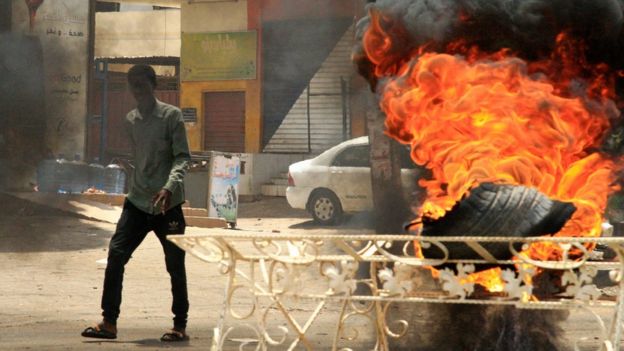
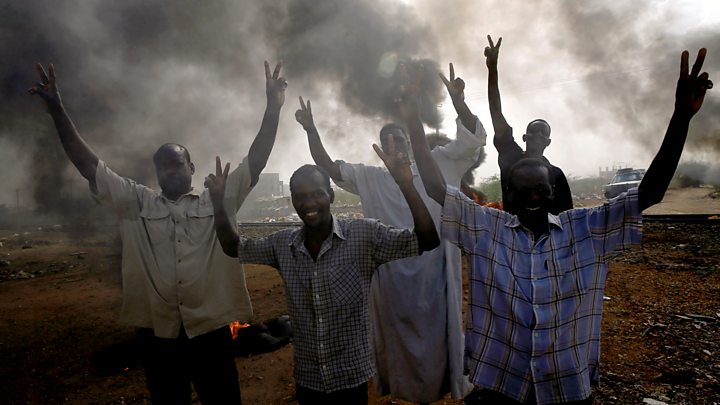
Sudanese protesters close Street 60 with burning tyres and pavers as military forces tried to disperse a sit-in outside Khartoum's army headquarters on June 3, 2019.At least two people were killed Monday as Sudan's military council tried to break up a sit-in outside Khartoum's army headquarters, a doctors' committee said as gunfire was heard from the protest site
Sudanese protesters close Street 60 with burning tyres and pavers as military forces tried to disperse a sit-in outside Khartoum's army headquarters on June 3, 2019.At least two people were killed Monday as Sudan's military council tried to break up a sit-in outside Khartoum's army headquarters, a doctors' committee said as gunfire was heard from the protest site Sudanese protesters close Street 60 with burning tyres and pavers as military forces tried to disperse a sit-in outside Khartoum's army headquarters on June 3, 2019.At least two people were killed Monday as Sudan's military council tried to break up a sit-in outside Khartoum's army headquarters, a doctors' committee said as gunfire was heard from the protest site AFP
ADVERTISING
Khartoum 
The sit-in protest outside army headquarters in the Sudanese capital, dispersed on Monday, began in April and stayed put even after president Omar al-Bashir's ouster.
The thousands of demonstrators at the camp were demanding civilian rule in the tightly controlled and impoverished country, in a popular uprising that first began in December.
Here is a timeline:
- Bread prices -
Protests erupted in various cities on December 19, 2018 against a government decision to triple bread prices.
They spread and morph into calls for Bashir to quit after three decades of iron-fisted rule.
The protests reach Khartoum on December 20, with demonstrators chanting "freedom, peace, justice".
Clashes break out as police try to disperse the crowds. Eight demonstrators are killed in two cities, the first of dozens of deaths in protest-related violence over the following months.
- Army HQ sit-in -
On February 22, Bashir declares a nationwide state of emergency. He swears in a new prime minister two days later, as riot police confront hundreds of protesters calling for him to resign.
On April 6, thousands gather for the first time outside military headquarters in Khartoum, chanting "one army, one people" in a plea for the military's support.
They defy attempts by police to dislodge them with tear gas and gunshots fired into the air.
- Bashir ousted -
On April 11, authorities announce Bashir has been removed from power and that a transitional military council will govern for two years.
Elation turns to anger as protesters denounce a "military coup" that leaves the regime in place, thousands remaining camped outside army headquarters.
On April 14, protest leaders demand that the new military rulers transfer power to a civilian government.
- Talks start -
Sudan's military rulers hold a first round of talks with protest leaders on April 20.
In an April 27 breakthrough, the two sides agree to establish a joint civilian-military ruling council. However differences remain over the composition of the council, with each side demanding a majority.
Tensions flare and on April 30, the military says six security force members are killed in protests. Demonstrators reinforce their sit-in outside the army HQ.
Demonstrators mass in the capital on May 2 as protest leaders say the army is not serious about handing over power.
On May 15, amid expectations that agreement will be reached on a three-year transition to a civilian administration, military leaders suspend talks, insisting demonstrators remove barricades they have set up in the capital.
- Talks break down -
The talks resume on May 19 but break down the following day, deadlocked over who should head the new governing body with the Alliance for Freedom and Change, the umbrella group of the protest movement, demanding the post goes to a civilian.
On May 28, thousands of workers in government offices, banks, private sector firms and the docks begin a two-day strike to pressure the military rulers.
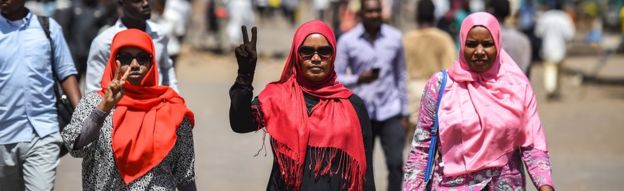
Two days later, hundreds of women march to the military headquarters calling for civilian government, followed by a protest by thousands more people the next day.
- Sit-in broken up -
On June 3 protest leaders say the military rulers have forcefully broken up the sit-in outside army headquarters in Khartoum.
The Central Committee of Sudanese Doctors, which is close to the protesters, says in a provisional toll that at least 13 were killed and 116 injured.
The military rulers deny trying to break up the sit-in "by force", saying their forces were targeting a "dangerous" area near the protest.
Protest leaders say they have cut all contact with the military rulers and call for "total civil disobedience".

UPDATE: Sudan crisis: Security forces condemned for deady violence against protesters


Media captionSudan military attacks protesters
by Rashida Adjani and Biodun Iginla, BBC News, Khartoum/New York
Sudan's military have been condemned for their violent attack on protesters in the capital, Khartoum, which reportedly left at least 30 dead.
UN Secretary General António Guterres called for an independent investigation saying he was "alarmed" by reports that officers had opened fire in a hospital.
The US said it was a "brutal attack" while the UK called it "outrageous".
Sudan has been governed by a military council since President Omar al-Bashir was overthrown in a coup in April.
The leaders of the pro-democracy movement, who demand that a civilian government take over the running of the country, said they were stopping all contact with the Transitional Military Council (TMC) and called a general strike.

What happened at the protest sites?

The security services moved on the main protest site early on Monday, activists said, and heavy gunfire could be heard in video footage.
In a statement read on national television, the military council expressed its "sorrow for the way events escalated", saying the operation had targeted "trouble makers and petty criminals" .
"During the execution of the campaign, large numbers of these groups took shelter in the sit-in square, which led some of the square's officers, based on their judgment, to follow and chase them, which led to losses and injuries."
The military, the statement added, was dedicated to protecting civilians.
Earlier, activists said the security forces had surrounded one hospital in Khartoum and had opened fire at another.
The Central Committee of Sudanese Doctors, which is close to the protesters, said 30 people - including an eight-year-old child - had been killed, and that the toll was likely to rise as not all casualties had been accounted for.
Hundreds of people had been injured, it added.
A Sudanese protester walks past a burning tyre near Khartoum's army headquartersImage copyrightAFP
Image captionProtesters set ablaze tyres to try to stop Sudan's security forces
Some residents blame the notorious paramilitary unit known as the Rapid Support Forces, set up to help keep Mr Bashir in power and with roots in the Darfur conflict in western Sudan, which began in 2003.
Then known as the "janjaweed", this militia carried out frequent massacres.
The Sudanese Professionals Association (SPA), which is spearheading nationwide protests, called for a campaign of "sweeping civil disobedience to topple the treacherous and killer military council".

What has the reaction been?

The UN secretary general urged the Sudanese authorities to facilitate an independent investigation and to hold those responsible accountable.
"He condemns the use of force to disperse the protesters at the sit-in site and he is alarmed by reports that security forces have opened fire inside medical facilities," a statement for Mr Guterres said.
In other reaction:
  • UK Foreign Secretary Jeremy Hunt said this was "an outrageous step that will only lead to more polarisation and violence" and that the military council "bears full responsibility"
  • Tibor Nagy, US assistant secretary of state for Africa, said: "This was a brutal and coordinated attack, led by the Rapid Support Forces militia, that mirrors some of the worst offenses of the Bashir regime"
  • The African Union called for an immediate and transparent investigation
Sudan's state news agency said the public prosecutor had set up a committee to investigate the violence.

'People power' takes big hit

Analysis by Tomi Oladipo, BBC's Africa security correspondent
It is back to square one for Sudan's political process. The hardening stances that stalled the talks between the protest groups and the TMC have been further cemented on both sides.
Expect more resolute protests and a possibly even more ruthless crackdown from the men in uniform. It is the latter who are governing right now. What matters is which faction of the security forces has the upper hand in the TMC.
The hardliners, particularly the Rapid Support Forces - led by the deputy head of the regime, Mohamed "Hemeti" Hamdan Dagalo - appear to be leading the way and could display more ruthlessness than has been seen so far.
There has been a total lockdown in Khartoum, indicating something has shifted within the regime. "People power" is taking a big hit, but protesters could be willing to take greater risks to force the military's hand, if possible.

What is the background?

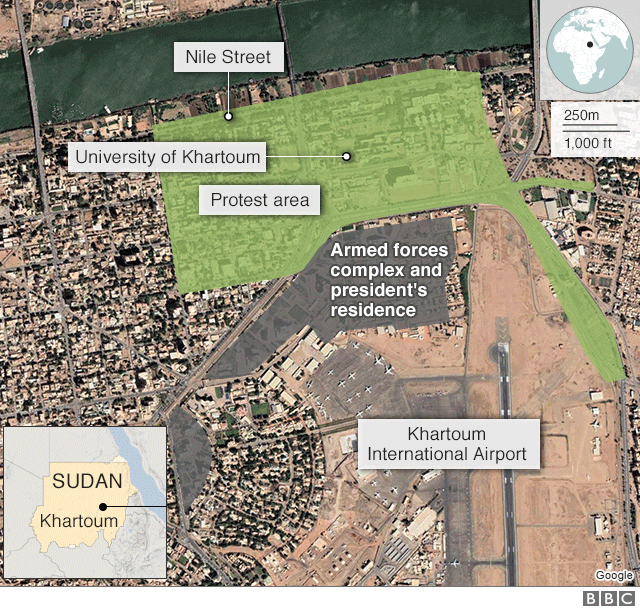
The demonstrators have been occupying the square in front of the military headquarters since 6 April, five days before Mr Bashir was overthrown.
Last month, organisers and the ruling generals announced they had agreed on the structure of a new administration and a three-year transition period to civilian rule.
But they still need to decide on the make-up of what has been called the sovereign council, which will be the highest decision-making body in the transition period.
They cannot agree on whether civilians or the military should have the majority of positions.
Presentational grey line

Road to transition

Women protestingImage copyrightAFP
  • 19 December 2018 - Protests erupt after fuel and bread price rises announced
  • 22 February 2019 - President Bashir dissolves the government
  • 24 February - Protests continue as security forces respond by firing live bullets
  • 6 April - Activists begin sit-in at military headquarters, vowing not to move until Mr Bashir steps down
  • 11 April - army generals announce that Mr Bashir has been toppled but sit-in continues as people demand civilian rule
  • 20 April - Talks between the military rulers and civilian representatives begin
  • 13 May - Shooting outside the military headquarters leaves six people dead
  • 14 May - Military and civilians announce a deal on a three-year transition period
  • 16 May - Talks postponed as military demands some barricades are removed
  • 3 June - Activists announce the suspension of talks with the military, accusing them of using force to disperse their sit-in
map
presentational grey line
Are you in the area? If it is safe to do so, please share your experiences by emailing haveyoursay@bbc.co.uk.
Please include a contact number if you are willing to speak to a BBC journalist. You can also contact us in the following ways:
Or use the form below
Your contact details
If you are happy to be contacted by a BBC journalist please leave a telephone number that we can contact you on. In some cases a selection of your comments will be published, displaying your name as you provide it and location, unless you state otherwise. Your contact details will never be published. When sending us pictures, video or eyewitness accounts at no time should you endanger yourself or others, take any unnecessary risks or infringe any laws. Please ensure you have read the terms and conditions.

More on this story

Around the BBC