Biodun Iginla, BBC News

Biodun Iginla, BBC News
Showing posts with label anti-government protests. Show all posts

Monday, June 3, 2019

ANALYSIS: Sudan: five months of anti-government protests


Sudanese protesters close Street 60 with burning tyres and pavers as military forces tried to disperse a sit-in outside Khartoum's army headquarters on June 3, 2019.At least two people were killed Monday as Sudan's military council tried to break up a sit-in outside Khartoum's army headquarters, a doctors' committee said as gunfire was heard from the protest site
Sudanese protesters close Street 60 with burning tyres and pavers as military forces tried to disperse a sit-in outside Khartoum's army headquarters on June 3, 2019.At least two people were killed Monday as Sudan's military council tried to break up a sit-in outside Khartoum's army headquarters, a doctors' committee said as gunfire was heard from the protest site Sudanese protesters close Street 60 with burning tyres and pavers as military forces tried to disperse a sit-in outside Khartoum's army headquarters on June 3, 2019.At least two people were killed Monday as Sudan's military council tried to break up a sit-in outside Khartoum's army headquarters, a doctors' committee said as gunfire was heard from the protest site AFP
ADVERTISING
Khartoum 
The sit-in protest outside army headquarters in the Sudanese capital, dispersed on Monday, began in April and stayed put even after president Omar al-Bashir's ouster.
The thousands of demonstrators at the camp were demanding civilian rule in the tightly controlled and impoverished country, in a popular uprising that first began in December.
Here is a timeline:
- Bread prices -
Protests erupted in various cities on December 19, 2018 against a government decision to triple bread prices.
They spread and morph into calls for Bashir to quit after three decades of iron-fisted rule.
The protests reach Khartoum on December 20, with demonstrators chanting "freedom, peace, justice".
Clashes break out as police try to disperse the crowds. Eight demonstrators are killed in two cities, the first of dozens of deaths in protest-related violence over the following months.
- Army HQ sit-in -
On February 22, Bashir declares a nationwide state of emergency. He swears in a new prime minister two days later, as riot police confront hundreds of protesters calling for him to resign.
On April 6, thousands gather for the first time outside military headquarters in Khartoum, chanting "one army, one people" in a plea for the military's support.
They defy attempts by police to dislodge them with tear gas and gunshots fired into the air.
- Bashir ousted -
On April 11, authorities announce Bashir has been removed from power and that a transitional military council will govern for two years.
Elation turns to anger as protesters denounce a "military coup" that leaves the regime in place, thousands remaining camped outside army headquarters.
On April 14, protest leaders demand that the new military rulers transfer power to a civilian government.
- Talks start -
Sudan's military rulers hold a first round of talks with protest leaders on April 20.
In an April 27 breakthrough, the two sides agree to establish a joint civilian-military ruling council. However differences remain over the composition of the council, with each side demanding a majority.
Tensions flare and on April 30, the military says six security force members are killed in protests. Demonstrators reinforce their sit-in outside the army HQ.
Demonstrators mass in the capital on May 2 as protest leaders say the army is not serious about handing over power.
On May 15, amid expectations that agreement will be reached on a three-year transition to a civilian administration, military leaders suspend talks, insisting demonstrators remove barricades they have set up in the capital.
- Talks break down -
The talks resume on May 19 but break down the following day, deadlocked over who should head the new governing body with the Alliance for Freedom and Change, the umbrella group of the protest movement, demanding the post goes to a civilian.
On May 28, thousands of workers in government offices, banks, private sector firms and the docks begin a two-day strike to pressure the military rulers.
Two days later, hundreds of women march to the military headquarters calling for civilian government, followed by a protest by thousands more people the next day.
- Sit-in broken up -
On June 3 protest leaders say the military rulers have forcefully broken up the sit-in outside army headquarters in Khartoum.
The Central Committee of Sudanese Doctors, which is close to the protesters, says in a provisional toll that at least 13 were killed and 116 injured.
The military rulers deny trying to break up the sit-in "by force", saying their forces were targeting a "dangerous" area near the protest.
Protest leaders say they have cut all contact with the military rulers and call for "total civil disobedience".

Friday, December 29, 2017

Iran cities hit by anti-government protests

December 29, 2017  20H50 GMT/UTC/ZULU TIME

Media captionDemonstrators turned out in several large Iranian cities, including Rasht
by Sunita Kureishi and Biodun Iginla, BBC News, Tehran
Anti-government demonstrations that began in one city on Thursday have now spread to several major cities in Iran.
Large numbers reportedly turned out in Rasht, in the north, and Kermanshah, in the west, with smaller protests in Isfahan, Hamadan and elsewhere.
The protests began against rising prices but have spiraled into a general outcry against clerical rule and government policies.
A small number of people have been arrested in Tehran, the capital.
They were among a group of 50 people who gathered in a city square, Tehran's deputy governor-general for security affairs told the Iranian Labour News Agency.
The governor-general of Tehran earlier said that any such gatherings would be firmly dealt with by the police, who are out in force on main intersections.
An initial BBC report of a demonstration in the southern city of Shiraz was not confirmed.
The demonstrations are the most serious and widespread expression of public discontent in Iran since protests in 2009 that followed a disputed election, correspondents say.
Demonstrators were reportedly heard yelling slogans including "The people are begging, the clerics act like God". Protests have even been held in Qom, a holy city home to powerful clerics.
The biggest protest on Thursday was in the north-eastern city of Mashhad, where there were 52 arrests.
There have been calls on social media for protests up and down the country, despite warnings from the government against illegal gatherings.
Videos posted on social media purport to show clashes between security forces and some demonstrators in Kermanshah on Friday.

'Harsh slogans'

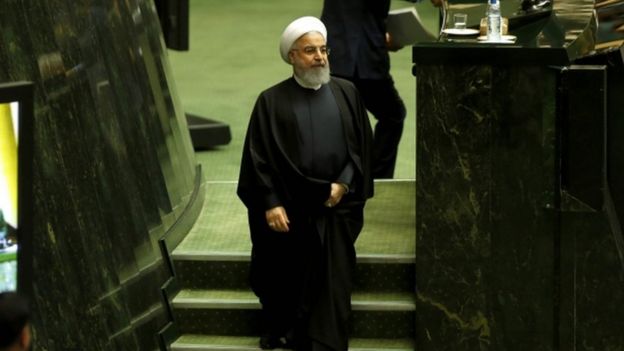
The protests on Thursday started with anger at the inability of the government of President Hassan Rouhani to control prices - the cost of eggs has doubled in a week.
However, some developed into broader anti-government protests, calling for the release of political prisoners and an end to police beatings.
Map showing several cities in Iran where protests have occurred
There were also chants in Mashhad of "not Gaza, not Lebanon, my life for Iran", a reference to what protesters say is the administration's focus on foreign policy rather than domestic issues.
The arrests in Mashhad were for chanting "harsh slogans", officials said.

'Seething discontent'

Analysis by Kasra Naji, BBC Persian
The demonstrations have taken the Iranian authorities by surprise. Impromptu anti-government demonstrations are rare in a country where the Revolutionary Guard and numerous intelligence agencies have a strong grip on the population.
Predictably they are blaming anti-revolutionary elements and foreign agents. But the protests clearly stem from seething discontent in Iran, mainly because of the worsening economic conditions faced by ordinary Iranians.
A BBC Persian investigation has found that Iranians, on average, have become 15% poorer in the past ten years alone.
Many believe that money that should be used to improve their lives is being spent by Iran's leaders on conflicts in Syria, Yemen and Iraq. Billions are also being spent on spreading religious propaganda and Shia Islam around the world.
But it seems that the hardliners opposed to President Rouhani may have triggered the unrest by holding a demonstration that quickly grew out of control and spread to cities and towns across the country.

The head of Mashhad's revolutionary court, Hossein Heidari, said: "We consider protest to be the people's right but if some people want to abuse these emotions and ride this wave, we won't wait and will confront them."
President Rouhani promised that the deal he signed with world powers in 2015, which saw Iran limit its nuclear activities in return for the lifting of international sanctions, would boost economic growth.
The economy has risen out of recession and inflation has been reduced, but businesses are still struggling from a lack of investment and the official unemployment rate is 12.4%.
Hassan Rouhani, 10 December, TehranImage copyrightAFP
Image captionPresident Hassan Rouhani continues to be dogged by economic problems

Related Topics

More on this story