Biodun Iginla, BBC News

Biodun Iginla, BBC News
Showing posts with label Congress. Show all posts

Thursday, March 26, 2020

ANALYSIS: A $2trn bazooka


Congress puts aside its habitual dysfunction and responds to covid-19


The fiscal stimulus is impressive, but America may need another one before too long

United States

Editor’s note: The Economist is making some of its most important coverage of the covid-19 pandemic freely available to readers of The Economist Today, our daily newsletter. To receive it, register here. For more coverage, see our coronavirus hub

EVEN TO THE housebound and socially distant, the signs of a contraction are apparent. The 18th Street corridor of Adams Morgan, a typically bustling stretch of restaurants and shops in Washington, DC, is filled with shuttered businesses—closed as part of the nationwide effort to contain the epidemic of covid-19 that had, as of March 24th, infected 53,740 Americans and killed 706, according to official counts. One fledgling business—a new bar calling itself Death Punch—never managed to open its doors. Down the road, an established whiskey bar called Jack Rose has been selling off its gargantuan collection at discount to support its staff. The queue for it snaked several blocks—a long dotted line of aficionados standing a careful six feet apart.
These are just the premonitions of the pain to come. Unemployment will rocket as much of the economy is put into a sort of medically induced coma. So many unemployment claims are being filed in Ohio that the state website has crashed. The national weekly unemployment numbers that will be released on March 26th are widely expected to be the worst in history. Goldman Sachs has predicted that there could be 2.25m new claims over the week—triple the previous record. And just as the covid-19 epidemic has not yet reached its apex, neither has the economic crisis. Morgan Stanley predicts that GDP will fall 30% year-on-year in the second quarter and unemployment will rise to 12.8%, compared with just 3.5% in February.
To head off the damage, Congress is preparing the largest fiscal stimulus in modern history. Its provisions—including bail-outs for firms both big and small, expanded unemployment-insurance benefits and a straight cash transfer to many Americans—are expected to cost close to $2trn, roughly one-tenth of GDP. This is the third substantial piece of legislation to deal with covid-19. Depending on the harm to come, even that may not be enough.
Whole industries rely on congregating people. So too, unfortunately, does the virus. As of March 24th, 12 states had ordered all non-essential businesses closed. Seventeen states, covering half the country’s population, had urged residents to stay home. Many white-collar tasks can just about be performed remotely. But cruelly, those likeliest to lose income or their jobs are in more precarious, less well-paid industries—restaurant staff (of which there are 9.6m), retailers (8.8m) or hotel workers (2m). If they lose their jobs, the effects will ripple through the economy.
One corrective for this problem is unemployment insurance. Yet this is not as robust as in other parts of the rich world. The American version replaces a smaller share of previous income than the average in the OECD, a club of mostly rich countries, and declines faster with time. Individual states, which administer the programme jointly with the federal government, differ in their generosity: Mississippi caps its maximum benefits at a paltry $235 a week.
At the insistence of Democrats, Congress would make this part of the safety-net decidedly more European, at least temporarily. The federal government would pay to top up unemployment-benefit levels by $600 a week—an enormous increase, given that the current weekly average is $385. The set of people eligible for benefits would also be expanded to include independent contractors, such as gig-economy workers. Those who have been laid off but not fired could receive compensation for lost hours. And the length of the benefit period would be extended from the usual 26 weeks to 39 weeks. The cost of all of this is thought to be $260bn: a serious expansion of a targeted programme.
A similarly gargantuan wad of cash—$250bn—will be spent on a less targeted scheme, sending cheques to Americans direct from Uncle Sam. Below some generous income thresholds ($75,000 a year for a single person and $150,000 for a married couple) every family can expect $1,200 per adult and $500 per child. This is the best version of a cash transfer that was proposed. Previously the White House had pushed the idea of a payroll-tax holiday; an early version of the stimulus bill ignored people who did not file taxes. Both would have excluded those with the lowest incomes from an ostensibly universal programme. Reaching everyone eligible now will require ingenuity, such as using administrative data from states, says Sam Hammond of the Niskanen Centre, a think-tank. But even if sent quickly, the cheques could be both too small for those who need them and too big for those who do not.
The government is also expected to set aside $500bn to stabilise firms and states. The capital could faciliate lending several times larger than that. Democrats in Congress and the White House got stuck on a (relatively) small portion of the programme, the $75bn set aside to bail out big embattled firms like airlines and those deemed critical to national security—because of the latitude the treasury secretary would have to set and disclose the terms of loans. A compromise struck in the dead of night bulked up independent oversight.
A more intriguing scheme is the $350bn set aside to save small and medium-size firms (those with fewer than 500 employees). The programme would give loans of up to $10m without interest or fees to pay for employees, rental costs and sundry other expenses. These would then be forgiven in proportion to the share of staff spared the sack: a firm that kept all employees would owe nothing; one that dispensed with half would owe half, and so on.
This is a more complicated idea than those devised by European finance ministers facing down the pandemic. Rishi Sunak, the British chancellor, pledged to pay up to 80% of wages for furloughed workers; the Danish government could pay up to 90% of the costs. The added hurdle in America may mean that the most sophisticated operations get the grant-loans (or “groans” in bureaucratic argot), while mom-and-pop operations languish. It may also mean that even more money will be needed. Research from Glenn Hubbard, an economist at Columbia Business School, and Michael Strain of the American Enterprise Institute, a think-tank, estimates that total needs could amount to $1.2trn—roughly triple the sum allocated. With the ink not yet dry on the phase-three bill, bigger bail-outs may be broached in a future phase-four bill.
The extraordinary legislation is not intended to avoid the recession that already seems to have arrived, but to spur the fastest possible rebound. This of course requires that the cause—the covid-19 pandemic—is effectively dealt with first.
But after a brief period of taking the virus seriously, President Donald Trump seems eager to lift restrictions as soon as possible. He has taken to saying that “the cure cannot be worse than the problem itself”, and that he wants the country “opened up and just raring to go by Easter”, which epidemiological projections suggest is unwise. The collapse of the stockmarket, which used to be Mr Trump’s barometer of success, may be spooking the president. Markets rose in anticipation of the coming stimulus package. But pre-emptively relaxing the restrictions would result in deep harm both to public health and the economy.
Because health authority is devolved to the states, it is unlikely that Mr Trump would pre-empt local declarations of emergency. But some states could follow suit, and the president’s supporters might not adhere to the recommended course of social distancing. Already, the lieutenant-governor of Texas has suggested that the elderly might risk death for the sake of the economy. Liberty University, an evangelical Christian institution led by a devotee of the president’s, is proudly inviting thousands of students back to campus in defiance of public-health advice.
Mr Trump appears to be defaulting into an old playbook—vacillating wildly in the hope of winning concessions. What may work with Democrats or North Korean dictators has no chance against a virus, however. And as things worsen, as seems likely, such irresolution may look like political malpractice. Already, New York appears to be a new disease epicentre. “The apex is higher than we thought and the apex is sooner than we thought,” said Andrew Cuomo, the governor of New York, in his address to citizens. He is warning that the city’s health system could be overwhelmed by lack of ventilators and protective equipment for staff. The medicine—a controlled, national shutdown of the economy—may be strong stuff. But a premature reopening, leading to rampant transmission of the virus, could produce something far worse.

Dig deeper:

For our latest coverage of the covid-19 pandemic, register for The Economist Today, our daily newsletter, or visit our coronavirus hub

Reuse this contentThe Trust Project

Friday, February 28, 2020

ANALYSIS: America’s nightmare Bernie Sanders


America’s nightmare
Bernie Sanders, nominee

The senator from Vermont would present America with a terrible choice

LeadersFeb 27th 2020 edition


SOMETIMES PEOPLE wake from a bad dream only to discover that they are still asleep and that the nightmare goes on. This is the prospect facing America if, as seems increasingly likely, the Democrats nominate Bernie Sanders as the person to rouse America from President Donald Trump’s first term. Mr Sanders won the primary in New Hampshire, almost won in Iowa, trounced his rivals in Nevada and is polling well in South Carolina. Come Super Tuesday next week, in which 14 states including California and Texas allot delegates, he could amass a large enough lead to make himself almost impossible to catch.
Moderate Democrats worry that nominating Mr Sanders would cost them the election. This newspaper worries that forcing Americans to decide between him and Mr Trump would result in an appalling choice with no good outcome. It will surprise nobody that we disagree with a self-described democratic socialist over economics, but that is just the start. Because Mr Sanders is so convinced that he is morally right, he has a dangerous tendency to put ends before means. And, in a country where Mr Trump has whipped up politics into a frenzy of loathing, Mr Sanders’s election would feed the hatred.
On economics Mr Sanders is misunderstood. He is not a cuddly Scandinavian social democrat who would let companies do their thing and then tax them to build a better world. Instead, he believes American capitalism is rapacious and needs to be radically weakened. He puts Jeremy Corbyn to shame, proposing to take 20% of the equity of companies and hand it over to workers, to introduce a federal jobs-guarantee and to require companies to qualify for a federal charter obliging them to act for all stakeholders in ways that he could define. On trade, Mr Sanders is at least as hostile to open markets as Mr Trump is. He seeks to double government spending, without being able to show how he would pay for it. When unemployment is at a record low and nominal wages in the bottom quarter of the jobs market are growing by 4.6%, his call for a revolution in the economy is an epically poor prescription for what ails America.
In putting ends before means, Mr Sanders displays the intolerance of a Righteous Man. He embraces perfectly reasonable causes like reducing poverty, universal health care and decarbonising the economy, and then insists on the most unreasonable extremes in the policies he sets out to achieve them (see article). He would ban private health insurance (not even Britain, devoted to its National Health Service, goes that far). He wants to cut billionaires’ wealth in half over 15 years. A sensible ecologist would tax fracking for the greenhouse gases it produces. To Mr Sanders that smacks of a dirty compromise: he would ban it outright.
Sometimes even the ends are sacrificed to Mr Sanders’s need to be righteous. Making university cost-free for students is a self-defeating way to alleviate poverty, because most of the subsidy would go to people who are, or will be, relatively wealthy. Decriminalising border-crossing and breaking up Immigration and Customs Enforcement would abdicate one of the state’s first duties. Banning nuclear energy would stand in the way of his goal to create a zero-carbon economy.
So keenly does Mr Sanders fight his wicked rivals at home, that he often sympathises with their enemies abroad. He has shown a habit of indulging autocrats in Cuba and Nicaragua, so long as the regime in question claims to be pursuing socialism. He is sceptical about America wielding power overseas, partly from an honourable conviction that military adventures do more harm than good. But it also reflects his contempt for the power-wielders in the Washington establishment.
Last is the effect of a President Sanders on America’s political culture. The country’s political divisions helped make Mr Trump’s candidacy possible. They are now enabling Mr Sanders’s rise. The party’s leftist activists find his revolution thrilling. They have always believed that their man would triumph if only the neoliberal Democratic Party elite would stop keeping him down. His supporters seem to reserve almost as much hatred for his Democratic opponents as they do for Republicans.
This speaks to Mr Sanders’s political style. When faced with someone who disagrees with him, his instinct is to spot an establishment conspiracy, or to declare that his opponent is confused and will be put straight by one of his political sermons. When asked how he would persuade Congress to eliminate private health insurance (something which 60% of Americans oppose), Mr Sanders replies that he would hold rallies in the states of recalcitrant senators until they relented.
A presidency in which Mr Sanders travelled around the country holding rallies for a far-left programme that he could not get through Congress would widen America’s divisions. It would frustrate his supporters, because the president’s policies would be stymied by Congress or the courts. On the right, which has long been fed a diet of socialist bogeymen, the spectacle of an actual socialist in the White House would generate even greater fury. Mr Sanders would test the proposition that partisanship cannot get any more bitter.
The mainstream three-quarters of Democrats have begun to tell themselves that Mr Sanders would not be so bad. Some point out that he would not be able to do many of the things he promises. This excuse-making, with its implication that Mr Sanders should be taken seriously but not literally, sounds worryingly familiar. Mr Trump has shown that control of the regulatory state, plus presidential powers over trade and over foreign policy, give a president plenty of room for manoeuvre. His first term suggests that it is unwise to dismiss what a man seeking power says he wants to do with it.

Enter Sandersman

If Mr Sanders becomes the Democratic nominee, America will have to choose in November between a corrupt, divisive, right-wing populist, who scorns the rule of law and the constitution, and a sanctimonious, divisive, left-wing populist, who blames a cabal of billionaires and businesses for everything that is wrong with the world. All this when the country is as peaceful and prosperous as at any time in its history. It is hard to think of a worse choice. Wake up, America!
Dig deeper:
Sign up and listen to Checks and Balance, our new newsletter and podcast on American politics
This article appeared in the Leaders section of the print edition under the headline "America’s nightmare"

Reuse this contentThe Trust Project

Thursday, February 20, 2020

ANALYSIS: Trump ally Roger Stone sentenced to prison


Roger StoneImage copyrightGETTY IMAGES
Image captionRoger Stone has maintained all along that the case against him is politically motivated
by Rachel Rubin and Biodun Iginla, BBC News Analysts, New York
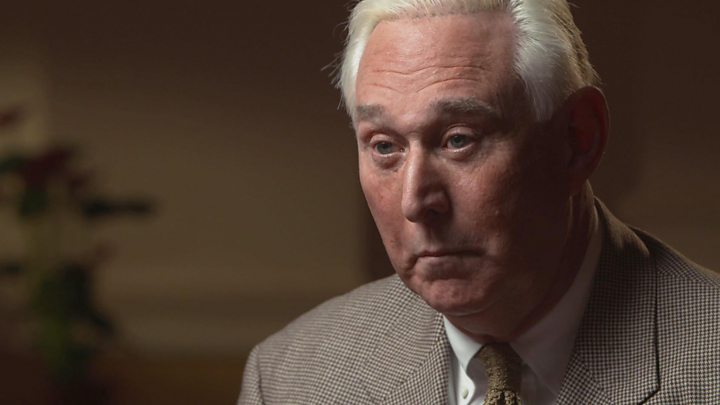
Roger Stone, long-time adviser and ally to President Donald Trump, has been sentenced to 40 months in jail.
Stone, 67, was found guilty in November on seven counts of lying to Congress, obstruction and witness tampering.
He is the sixth Trump aide convicted in a criminal case resulting from Robert Mueller's investigation into alleged collusion between Russia and the Trump campaign during the 2016 election.
Mr Trump has hinted he may pardon his ally.
Stone has maintained the case against him was politically motivated.
Explaining the sentence, Judge Amy Berman Jackson said Stone had engaged in "intolerable" "threatening and intimidating conduct" toward her.
Last week, prosecutors on the case quit after the Justice Department said it planned to reduce the amount of prison time sought for the president's long-time ally.
The prosecutors had recommended a sentence of seven to nine years.
In a tweet, Mr Trump had called the recommendation "very horrible and unfair".
The court heard that Stone had told five lies under oath, including about his conversations with Trump campaign officials and a supposed "intermediary" with WikiLeaks in early August 2016.
Roger StoneImage copyrightGETTY IMAGES
He also lied about the existence of certain texts or emails.
Speaking in a Washington courtroom on Thursday, Judge Jackson said Stone "knew exactly what he was doing" when he posted an image to social media last year of a gun sight over the judge, calling the proceedings a "show trial".
"This is intolerable to the rule of justice," Judge Jackson said. "The court cannot just sit idly by and say 'that's just Roger being Roger.'"
Stone told the court that he thought the crosshairs in the picture he posted of Judge Jackson on Monday actually depicted a Celtic cross.
"I am kicking myself over my own stupidity but not more than my wife is kicking me," he said.
The image of Judge Amy Berman Jackson that Roger Stone posted to InstagramImage copyrightINSTAGRAM
Image captionStone said he thought the crosshairs actually depicted a Celtic cross
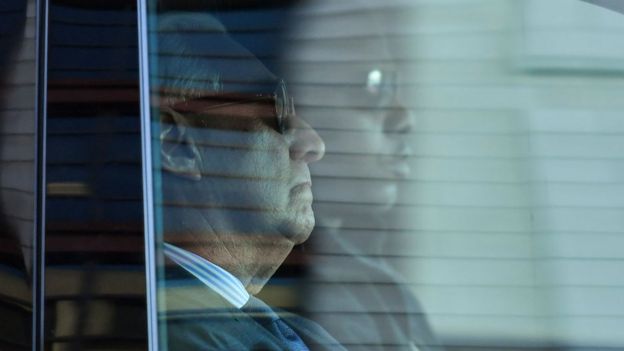
Stone, wearing sunglasses and a dark fedora, declined to speak at Thursday's hearing.
His lawyer, Seth Ginsberg, said Stone's public persona - that of a self-described "dirty trickster" - masked the true "human being", a spiritual man, devoted to his family.
Mr Ginsberg had argued that Stone did not deserve the tougher sentencing guidelines demanded by federal guidelines.
Media captionWATCH: US politics is not beanbag says Roger Stone
Stone will serve two years' probation after his custodial sentence. He has also been fined $20,000 (£15,500) and must serve 250 hours of community service. He will not have to report to prison until Judge Jackson rules on a pending defence motion for a new trial, based on a claim of juror bias.
As Judge Jackson handed down the sentence, she seemed to allude to Mr Trump, saying Stone "was not prosecuted for standing up for the president, he was prosecuted for covering up for the president".
She continued: "The dismay and disgust at the defendant's belligerence should transcend party."
"At his core, Mr. Stone is an insecure person who craves and recklessly pursues attention."
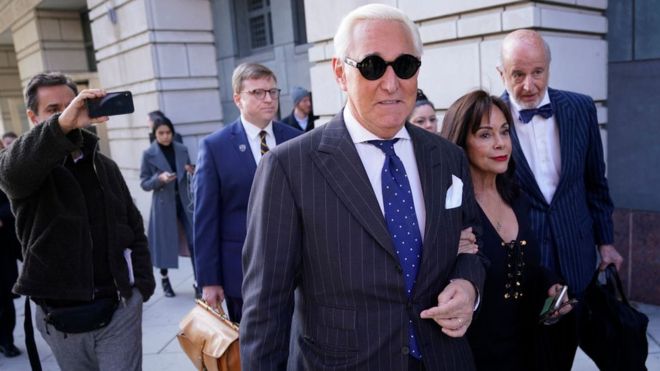
Entering the courthouse flanked by his wife, family and friends, Stone walked past several protesters, including one giant inflatable rat dressed as Mr Trump, another demonstrator shouting "traitor".
Awaiting Stone's sentencing, Mr Trump sent a tweet that seemed to question his ally's conviction and name-checking a host of perceived enemies.
Presentational white space
The sentence delivered by Judge Jackson falls short of the seven- to nine-year recommendation from prosecutors.
This initial sentencing suggestion was quickly overruled by the US Department of Justice after Mr Trump's public complaints. This reversal led all four prosecutors to quit the case, one leaving the justice department entirely.
At trial on Thursday, Judge Jackson called the Justice Department intervention "unprecedented". But she said the politics surrounding the case did not inform her ultimate decision.
"The truth still exists. The truth still matters," she said.
Roger StoneImage copyrightGETTY IMAGES
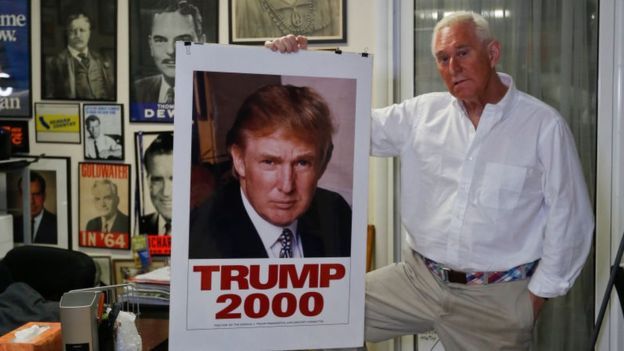
Image captionStone helped Donald Trump in his failed bid for the presidency in 2000
Stone, a political veteran, has worked with Republicans since the 1970s and has a tattoo of Richard Nixon on his back.
In the 1990s, Stone worked as a lobbyist for Mr Trump's casino business, and later helped Mr Trump's unsuccessful White House run in 2000.
According to the Netflix documentary Get Me Roger Stone, the strategist reportedly encouraged Mr Trump to run for the presidency.
Stone declined questions as he left the courthouse on Thursday, making his way through a crowd of people to a waiting vehicle, with a small smile on his face.
"I have nothing to say," he said.