Biodun Iginla, BBC News

Biodun Iginla, BBC News
Showing posts with label The Economist Intelligence Unit Business News. Show all posts

Thursday, March 26, 2020

ANALYSIS: Covid-19 could devastate poor countries

The next calamity


It is in the rich world’s self-interest to help


Leaders

Mar 27th 2020 edition

Editor’s note: The Economist is making some of its most important coverage of the covid-19 pandemic freely available to readers of The Economist Today, our daily newsletter. To receive it, register here. For more coverage, see our coronavirus hub

THE NEW coronavirus is causing havoc in rich countries. Often overlooked is the damage it will cause in poor ones, which could be even worse. Official data do not begin to tell the story. As of March 25th Africa had reported only 2,800 infections so far; India, only 650. But the virus is in nearly every country and will surely spread. There is no vaccine. There is no cure. A very rough guess is that, without a campaign of social distancing, between 25% and 80% of a typical population will be infected. Of these, perhaps 4.4% will be seriously sick and a third of those will need intensive care. For poor places, this implies calamity.
Social distancing is practically impossible if you live in a crowded slum. Hand-washing is hard if you have no running water (see article). Governments may tell people not to go out to work, but if that means their families will not eat, they will go out anyway. If prevented, they may riot.
So covid-19 could soon be all over poor countries. And their health-care systems are in no position to cope. Many cannot deal with the infectious diseases they already know, let alone a new and highly contagious one. Health spending per head in Pakistan is one two-hundredth the level in America. Uganda has more government ministers than intensive-care beds. Throughout history, the poor have been hardest-hit by pandemics. Most people who die of AIDS are African. The Spanish flu wiped out 6% of India’s entire population.
Dozens of developing countries have ordered lockdowns. India has announced a “total ban” on leaving home for 21 days (see article). South Africa has deployed the army to help enforce one. They may slow the disease, but they are unlikely to stop it.
Many places are still in denial. Street markets in Myanmar are packed. Brazil’s populist president, Jair Bolsonaro, dismisses covid-19 as just “a sniffle” (see article). Some leaders are clueless. Tanzania’s president, John Magufuli, said churches should stay open because the coronavirus is “satanic” and “cannot survive in the body of Christ”. Many autocrats see covid-19 as a handy excuse to tighten their grip. Expect some to ban political rallies, postpone elections and extend surveillance over citizens’ daily lives—all to protect public health, of course.
Granted, there are some reasons for hope. Poor countries are young—the median age in Africa is under 20—and the young appear less likely to die from an infection. The poorest are very rural: two-thirds of people in countries with incomes per head below $1,000 a year live in the countryside, compared with less than a fifth in rich countries. Farmers can grow yams without breathing viral droplets on each other. The climate may help. It is possible, though far from certain, that hot weather slows the spread of covid-19. Some places have useful experience. Countries that endured Ebola learned a lot about hand-washing, contact-tracing and securing public trust.
Alas, even the good news comes with caveats. People in poor countries may be young, but they often have weak lungs or immune systems, because of malnutrition, tuberculosis or HIV. Rural folk may get the virus later, but they will probably still get it. Lockdowns will be hard to sustain unless governments can provide a generous safety-net. Firms need credit to avoid laying off staff. Informal workers need cash to tide them over. Unfortunately, poor countries do not have the financial muscle to provide these things, and covid-19 has just made it much harder.
Demand has collapsed for the commodities on which many emerging markets depend, from crude oil to fresh flowers. Tourism has tanked. No one wants to visit the Masai Mara or Machu Picchu just now. Foreign investors have pulled $83bn from emerging markets since the start of the crisis, the largest capital outflow ever recorded, says the Institute of International Finance, a trade group. Remittances, usually a safety-net in hard times, may tumble as migrants in rich countries lose their jobs.
Many poor and middle-income countries face a balance-of-payments crisis and a collapse in government revenues as they need to raise health-related spending and imports (to reduce the death toll) and welfare (so that workers can isolate themselves without running out of money). Whereas governments in rich countries can borrow cheaply in a crisis as investors flock to safety, poor countries see their borrowing costs soar. The trade-off between saving lives and saving livelihoods is excruciating. The worry, as Imran Khan, Pakistan’s prime minister says, is that “if we shut down the cities...we will save [people] from corona at one end, but they will die from hunger.”
Far from helping, many better-off countries have taken a nationalist turn. Some places, such as the EU, are restricting the export of medical kit. That goes against the values they profess to hold. Other countries, such as Kazakhstan, are curbing exports of food, which is not in short supply. If global trade is gummed up, the economic damage will be far greater. For poor countries that rely on imported food, it could be deadly.
Since so much remains unknown about covid-19, any response must be based on imperfect information. But some things are both urgent and obvious. Governments in poor countries, as elsewhere, should supply people with timely, accurate information, by any means practical. No cover-ups, no internet shut-downs, no arresting of those who share unwelcome news.

Time to be generous

The rich world, meanwhile, should help the poor world swiftly and copiously. The IMF says it is ready to deploy its $1trn lending capacity. Much more may be needed. As The Economist went to press, the G20 was about to set out a plan. It should be generous. Some of those vast rich-world bail-out pots should be used to cushion the suffering of the global south. China is winning influence with high-profile deliveries of medical equipment. Poor countries will remember who helped them.
As past campaigns against malaria and HIV showed, it takes a co-ordinated global effort to roll back a global scourge. It is too late to avoid a large number of deaths, but not too late to avert catastrophe. And it is in rich countries’ interests to think globally as well as locally. If covid-19 is left to ravage the emerging world, it will soon spread back to the rich one.

Dig deeper:
For our latest coverage of the covid-19 pandemic, register for The Economist Today, our daily newsletter, or visit our coronavirus hub
This article appeared in the Leaders section of the print edition under the headline "The next calamity"

Reuse this contentThe Trust Project

ANALYSIS: A $2trn bazooka


Congress puts aside its habitual dysfunction and responds to covid-19


The fiscal stimulus is impressive, but America may need another one before too long

United States

Editor’s note: The Economist is making some of its most important coverage of the covid-19 pandemic freely available to readers of The Economist Today, our daily newsletter. To receive it, register here. For more coverage, see our coronavirus hub

EVEN TO THE housebound and socially distant, the signs of a contraction are apparent. The 18th Street corridor of Adams Morgan, a typically bustling stretch of restaurants and shops in Washington, DC, is filled with shuttered businesses—closed as part of the nationwide effort to contain the epidemic of covid-19 that had, as of March 24th, infected 53,740 Americans and killed 706, according to official counts. One fledgling business—a new bar calling itself Death Punch—never managed to open its doors. Down the road, an established whiskey bar called Jack Rose has been selling off its gargantuan collection at discount to support its staff. The queue for it snaked several blocks—a long dotted line of aficionados standing a careful six feet apart.
These are just the premonitions of the pain to come. Unemployment will rocket as much of the economy is put into a sort of medically induced coma. So many unemployment claims are being filed in Ohio that the state website has crashed. The national weekly unemployment numbers that will be released on March 26th are widely expected to be the worst in history. Goldman Sachs has predicted that there could be 2.25m new claims over the week—triple the previous record. And just as the covid-19 epidemic has not yet reached its apex, neither has the economic crisis. Morgan Stanley predicts that GDP will fall 30% year-on-year in the second quarter and unemployment will rise to 12.8%, compared with just 3.5% in February.
To head off the damage, Congress is preparing the largest fiscal stimulus in modern history. Its provisions—including bail-outs for firms both big and small, expanded unemployment-insurance benefits and a straight cash transfer to many Americans—are expected to cost close to $2trn, roughly one-tenth of GDP. This is the third substantial piece of legislation to deal with covid-19. Depending on the harm to come, even that may not be enough.
Whole industries rely on congregating people. So too, unfortunately, does the virus. As of March 24th, 12 states had ordered all non-essential businesses closed. Seventeen states, covering half the country’s population, had urged residents to stay home. Many white-collar tasks can just about be performed remotely. But cruelly, those likeliest to lose income or their jobs are in more precarious, less well-paid industries—restaurant staff (of which there are 9.6m), retailers (8.8m) or hotel workers (2m). If they lose their jobs, the effects will ripple through the economy.
One corrective for this problem is unemployment insurance. Yet this is not as robust as in other parts of the rich world. The American version replaces a smaller share of previous income than the average in the OECD, a club of mostly rich countries, and declines faster with time. Individual states, which administer the programme jointly with the federal government, differ in their generosity: Mississippi caps its maximum benefits at a paltry $235 a week.
At the insistence of Democrats, Congress would make this part of the safety-net decidedly more European, at least temporarily. The federal government would pay to top up unemployment-benefit levels by $600 a week—an enormous increase, given that the current weekly average is $385. The set of people eligible for benefits would also be expanded to include independent contractors, such as gig-economy workers. Those who have been laid off but not fired could receive compensation for lost hours. And the length of the benefit period would be extended from the usual 26 weeks to 39 weeks. The cost of all of this is thought to be $260bn: a serious expansion of a targeted programme.
A similarly gargantuan wad of cash—$250bn—will be spent on a less targeted scheme, sending cheques to Americans direct from Uncle Sam. Below some generous income thresholds ($75,000 a year for a single person and $150,000 for a married couple) every family can expect $1,200 per adult and $500 per child. This is the best version of a cash transfer that was proposed. Previously the White House had pushed the idea of a payroll-tax holiday; an early version of the stimulus bill ignored people who did not file taxes. Both would have excluded those with the lowest incomes from an ostensibly universal programme. Reaching everyone eligible now will require ingenuity, such as using administrative data from states, says Sam Hammond of the Niskanen Centre, a think-tank. But even if sent quickly, the cheques could be both too small for those who need them and too big for those who do not.
The government is also expected to set aside $500bn to stabilise firms and states. The capital could faciliate lending several times larger than that. Democrats in Congress and the White House got stuck on a (relatively) small portion of the programme, the $75bn set aside to bail out big embattled firms like airlines and those deemed critical to national security—because of the latitude the treasury secretary would have to set and disclose the terms of loans. A compromise struck in the dead of night bulked up independent oversight.
A more intriguing scheme is the $350bn set aside to save small and medium-size firms (those with fewer than 500 employees). The programme would give loans of up to $10m without interest or fees to pay for employees, rental costs and sundry other expenses. These would then be forgiven in proportion to the share of staff spared the sack: a firm that kept all employees would owe nothing; one that dispensed with half would owe half, and so on.
This is a more complicated idea than those devised by European finance ministers facing down the pandemic. Rishi Sunak, the British chancellor, pledged to pay up to 80% of wages for furloughed workers; the Danish government could pay up to 90% of the costs. The added hurdle in America may mean that the most sophisticated operations get the grant-loans (or “groans” in bureaucratic argot), while mom-and-pop operations languish. It may also mean that even more money will be needed. Research from Glenn Hubbard, an economist at Columbia Business School, and Michael Strain of the American Enterprise Institute, a think-tank, estimates that total needs could amount to $1.2trn—roughly triple the sum allocated. With the ink not yet dry on the phase-three bill, bigger bail-outs may be broached in a future phase-four bill.
The extraordinary legislation is not intended to avoid the recession that already seems to have arrived, but to spur the fastest possible rebound. This of course requires that the cause—the covid-19 pandemic—is effectively dealt with first.
But after a brief period of taking the virus seriously, President Donald Trump seems eager to lift restrictions as soon as possible. He has taken to saying that “the cure cannot be worse than the problem itself”, and that he wants the country “opened up and just raring to go by Easter”, which epidemiological projections suggest is unwise. The collapse of the stockmarket, which used to be Mr Trump’s barometer of success, may be spooking the president. Markets rose in anticipation of the coming stimulus package. But pre-emptively relaxing the restrictions would result in deep harm both to public health and the economy.
Because health authority is devolved to the states, it is unlikely that Mr Trump would pre-empt local declarations of emergency. But some states could follow suit, and the president’s supporters might not adhere to the recommended course of social distancing. Already, the lieutenant-governor of Texas has suggested that the elderly might risk death for the sake of the economy. Liberty University, an evangelical Christian institution led by a devotee of the president’s, is proudly inviting thousands of students back to campus in defiance of public-health advice.
Mr Trump appears to be defaulting into an old playbook—vacillating wildly in the hope of winning concessions. What may work with Democrats or North Korean dictators has no chance against a virus, however. And as things worsen, as seems likely, such irresolution may look like political malpractice. Already, New York appears to be a new disease epicentre. “The apex is higher than we thought and the apex is sooner than we thought,” said Andrew Cuomo, the governor of New York, in his address to citizens. He is warning that the city’s health system could be overwhelmed by lack of ventilators and protective equipment for staff. The medicine—a controlled, national shutdown of the economy—may be strong stuff. But a premature reopening, leading to rampant transmission of the virus, could produce something far worse.

Dig deeper:

For our latest coverage of the covid-19 pandemic, register for The Economist Today, our daily newsletter, or visit our coronavirus hub

Reuse this contentThe Trust Project

Saturday, March 21, 2020

ANALYSIS: Paying to stop the pandemic

Closed by covid-19


The struggle to save lives and the economy is likely to present agonising choices


Leaders

Mar 21st 2020 edition

Editor’s note: The Economist is making some of its most important coverage of the covid-19 pandemic freely available to readers of The Economist Today, our daily newsletter. To receive it, register here.

PLANET EARTH is shutting down. In the struggle to get a grip on covid-19, one country after another is demanding that its citizens shun society. As that sends economies reeling, desperate governments are trying to tide over companies and consumers by handing out trillions of dollars in aid and loan guarantees. Nobody can be sure how well these rescues will work.
But there is worse. Troubling new findings suggest that stopping the pandemic might require repeated shutdowns. And yet it is also now clear that such a strategy would condemn the world economy to grave—perhaps intolerable—harm. Some very hard choices lie ahead.
Barely 12 weeks after the first reports of people mysteriously falling ill in Wuhan, in central China, the world is beginning to grasp the pandemic’s true human and economic toll. As of March 18th SARS-CoV-2, the virus behind covid-19, had registered 134,000 infections outside China in 155 countries and territories. In just seven days that is an increase of almost 90,000 cases and 43 countries and territories. The real number of cases is thought to be at least an order of magnitude greater.
Spooked, governments are rushing to impose controls that would have been unimaginable only a few weeks ago. Scores of countries, including many in Africa and Latin America, have barred travellers from places where the virus is rife. Times Square is deserted, the City of London is dark and in France, Italy and Spain cafés, bars and restaurants have bolted their doors. Everywhere empty stadiums echo to absent crowds.
It has become clear that the economy is taking a much worse battering than analysts had expected (see Briefing). Data for January and February show that industrial output in China, which had been forecast to fall by 3% compared with a year earlier, was down by 13.5%. Retail sales were not 4% lower, but 20.5%. Fixed-asset investment, which measures the spending on such things as machinery and infrastructure, declined by 24%, six times more than predicted. That has sent economic forecasters the world over scurrying to revise down their predictions. Faced with the most brutal recession in living memory, governments are setting out rescue packages on a scale that exceeds even the financial crisis of 2007-09 (see leader).
This is the backdrop for fundamental choices about how to manage the disease. Using an epidemiological model, a group from Imperial College in London this week set out a framework to help policymakers think about what lies ahead. It is bleak.
One approach is mitigation, “flattening the curve” to make the pandemic less intense by, say, isolating cases and quarantining infected households. The other is to suppress it with a broader range of measures, including shutting in everybody, other than those who cannot work from home, and closing schools and universities. Mitigation curbs the pandemic, suppression aims to stop it in its tracks.
The modellers found that, were the virus left to spread, it would cause around 2.2m deaths in America and 500,000 in Britain by the end of summer. In advanced economies, they concluded, three months of curve-flattening, including two-week quarantines of infected households, would at best prevent only about half of these. Moreover, peak demand for intensive care would still be eight times the surge capacity of Britain’s National Health Service, leading to many more deaths that the model did not attempt to compute. If that pattern holds in other parts of Europe, even its best-resourced health systems, including Germany’s, would be overwhelmed.
No wonder governments are opting for the more stringent controls needed to suppress the pandemic. Suppression has the advantage that it has worked in China. On March 18th Italy added 4,207 new cases whereas Wuhan counted none at all. China has recorded a total of just over 80,000 cases in a population of 1.4bn people. For comparison, the Imperial group estimated that the virus left to itself would infect more than 80% of the population in Britain and America.
But that is why suppression has a sting in its tail. By keeping infection rates relatively low, it leaves many people susceptible to the virus. And since covid-19 is now so widespread, within countries and around the world, the Imperial model suggests that epidemics would return within a few weeks of the restrictions being lifted. To avoid this, countries must suppress the disease each time it resurfaces, spending at least half their time in lockdown. This on-off cycle must be repeated until either the disease has worked through the population or there is a vaccine which could be months away, if one works at all.
This is just a model, and models are just educated guesses based on the best evidence. Hence the importance of watching China to see if life there can return to normal without the disease breaking out again. The hope is that teams of epidemiologists can test on a massive scale so as to catch new cases early, trace their contacts and quarantine them without turning society upside down. Perhaps they will be helped by new drugs, such as a Japanese antiviral compound which China this week said was promising.
But this is just a hope, and hope is not a policy. The bitter truth is that mitigation costs too many lives and suppression may be economically unsustainable. After a few iterations governments might not have the capacity to carry businesses and consumers. Ordinary people might not tolerate the upheaval. The cost of repeated isolation, measured by mental well-being and the long-term health of the rest of the population, might not justify it.
In the real world there are trade-offs between the two strategies, though governments can make both more efficient. South Korea, China and Italy have shown that this starts with mass-testing. The more clearly you can identify who has the disease, the less you must depend upon indiscriminate restrictions. Tests for antibodies to the virus, picking up who has been infected and recovered, are needed to supplement today’s which are only valid just before and during the illness (see article). That will let immune people go about their business in the knowledge that they cannot be a source of further infections.
A second line of attack is to use technology to administer quarantines and social distancing. China is using apps to certify who is clear of the disease and who is not. Both it and South Korea are using big data and social media to trace infections, alert people to hotspots and round up contacts. South Korea changed the law to allow the state to gain access to medical records and share them without a warrant. In normal times many democracies might find that too intrusive. Times are not normal.
Last, governments should invest in health care, even if their efforts take months to bear fruit and may never be needed. They should increase the surge capacity of intensive care. Countries like Britain and America are desperately short of beds, specialists and ventilators. They should define the best treatment protocols, develop vaccines and test new therapeutic drugs. All this would make mitigation less lethal and suppression cheaper.
Be under no illusions. Such measures might still not prevent the pandemic from extracting a heavy toll. Today governments seem to be committed to suppression, whatever the cost. But if the disease is not conquered quickly, they will edge towards mitigation, even if that will result in many more deaths. Understandably, just now that is not a trade-off any government is willing to contemplate. They may soon have no choice.
Dig deeper:
For our latest coverage of the covid-19 pandemic, register for The Economist Today, our daily newsletter, or visit our coronavirus hub
This article appeared in the Leaders section of the print edition under the headline "Closed"

Reuse this contentThe Trust Project

Wednesday, October 30, 2019

ANALYSIS: America’s economy

by Judith Stein and Biodun Iginla, The Economist Intelligence Unit Business News Analysts


Easy now
America’s economy is resisting the pull of recession

A healthy jobs market keeps Americans spending, helping to make up for a shortfall in business investment
United States


THIS WAS not the way it was supposed to go. “Four, five, and maybe even six percent” growth was what President Donald Trump promised in December 2017. Even within the relatively sober pages of the budget proposal released by the administration in March this year, Mr Trump’s team forecast economic growth rates of 3% or more right through 2024—which would be the last full year of a second Trump term, were one to occur. Instead, the American economy, which just missed the 3% growth target in 2018 despite the boost from the president’s budget-busting tax bill, continues to lose steam. In the third quarter of this year GDP, adjusted for inflation, rose at an annualised rate of 1.9%, down from 2% in the previous three months. The question hanging over Mr Trump, and millions of American workers, is just how far the slowdown will run and how deep it will go.
The first signs of trouble for America’s economy appeared in late 2018. Housing construction slumped as higher mortgage rates (pushed upward by Federal-Reserve interest-rate hikes) combined with rising home prices to drive buyers from the market. At the same time, a global slowdown in manufacturing and trade weighed on American producers. New manufacturing orders dropped fairly steadily from September of 2018 until May of this year, and parts of America’s manufacturing heartland experienced declines in factory employment. Economy-watchers have waited anxiously in the months since to see whether weakness in industry and construction would bleed into the service sector, where most Americans work.
Mounting anxiety eventually roused the Fed to action. The central bank spent most of 2018 raising its benchmark interest rates in order to keep inflation in check, despite some withering criticism emanating from the president’s Twitter account. As the world economy sputtered, the Fed slowly changed course: first halting its cycle of increasing rates, then cutting them by 0.25% in both July and September of this year. Jerome Powell, the Fed’s chairman, insisted that the moves represented a “mid-cycle adjustment”, lest markets interpret the cuts as a sign that the end of the boom—America’s longest on record—was nigh.
The cuts appear to have helped. Mortgage rates have retreated; the average rate on 30-year loans, which rose to near 5% a year ago, has dropped back to 3.75%. That has put a bit of wind back in the sails of the residential construction industry, which began work on about 20,000 more homes in September of this year than in the same month last year. Residential investment contributed positively to GDP growth in the third quarter, the first time it had done so in nearly two years. Rate cuts also seem to have switched off the bright, blinking recession-warning light which is the “yield curve”. “Inversions” of the yield curve, which occur when rates on long-term government bonds fall below those on short-term government debt, frequently appear a year or so before the onset of recession. The curve inverted over the summer, fuelling recession worries, but has since flipped back. Stock prices, which looked sickly in May, have roared back to touch record highs, buoyed by better than expected earnings reports, as well as the prospect of a trade truce between America and China.
On October 30th the Fed reduced its benchmark rate once more, by another 0.25%. But in doing so it very nearly declared victory in the battle to ward off a downturn. Markets now expect the Fed to hold its ground for at least the next six months. Mr Powell, while emphasising that the Fed will be watching the data closely, said, “We see the current stance of monetary policy as likely to remain appropriate...We believe monetary policy is in a good place.” A majority of members of the rate-setting committee reckon the Fed should resume rate increases in 2020.
The Fed’s confidence, while understandable, may be premature. The conditions which weighed on the economy earlier in the year have eased a little, but the growth scare did its damage. Consumers have been the motor driving the economy forward through its headwinds. They continue to spend, but their faith seems to have been shaken. Personal consumption spending grew at a 2.9% annual pace in the third quarter: not bad, but down from a blistering 4.6% pace in the second. Retail sales in September dropped by 0.3%, suggesting that the quarter ended on a particularly weak note. Measures of consumer confidence—a guide to how spending may evolve in future—have also slipped.
Firms, too, are behaving cautiously. Measures of business confidence have been softening. Anxiety among bosses is affecting investment: the boost to third-quarter GDP from investment in housing was more than offset by a hefty drop in investment in non-residential building and equipment. Weak investment figures are particularly irksome to economists in the Trump administration, who argued that the president’s tax reform would encourage a boom in business spending. Business enthusiasm could recover a bit in the months to come, if indeed a trade-war ceasefire is declared. But the trade war is only partly responsible for firms’ woes. More important is the worldwide slowdown. Both Europe and Japan have slipped close to the brink of recession, and the deceleration in Chinese growth shows few signs of abating. A turnaround in American economic fortunes, if it occurs, will begin with homegrown optimism.
Hopes for that hinge in turn on the health of the labour market. The jobs picture has been the most enduring source of encouragement to those looking on the bright side. The pace of hiring has slowed; payrolls have risen by 1.4% over the past 12 months, down from 1.8% over the year before that. But that is not an unexpected development this deep into an economic expansion, when fewer jobless workers remain to be hired. The unemployment rate, at 3.5%, remains extraordinarily low. So long as firms continue to hire and wages to grow, consumers are likely to keep spending at rates sufficient to steer the economy clear of a downturn.
Given the uncertainty surrounding the path of the economy, the Fed might have been expected to signal its readiness to keep cutting rates, if necessary, more clearly. Confidence is easier to maintain than to restore, and the risks of a surge in inflation have fallen in recent months. The price index for personal consumption expenditures, the Fed’s preferred inflation measure, rose at a 1.5% annual pace in the third quarter: below the Fed’s 2% target and down from 2.4% in the second. Instead, the central bank seems content to wait and see how conditions develop—and to allow a president facing threats from all sides to twist in the wind.
Reuse this contentThe Trust Project

Thursday, May 17, 2018

Analysis: Europe and American sanctions

by Judith Stein and Biodun Iginla, The Economist Intelligence Unit Business News Analysts, New York/London
What the OFAC?

But the Trump administration is playing fast and loose with a dangerous weapon
“DONALD TRUMP is the sort of guy who punches you in the face and if you punch him back, he says ‘Let’s be friends’. China punched back and he retreated. The Europeans told him how beautiful he was, but they got nothing.” This is how an American official-turned-executive describes the latest twists in the Trump administration’s sanctions policy, which this year has roiled business from America to Europe, Russia, China and Iran. What business leaders see, analysts say, is a punitive approach that is capricious, aggressive and at times ill-prepared. But unless companies or their governments take the fight all the way to the White House, they have little choice but to abide by the long—and sometimes wrong—arm of American law.
The capriciousness was evident on May 13th when President Trump executed a handbrake turn on ZTE, the world’s fourth-biggest telecoms-equipment maker, which is strongly supported by the Chinese government. It had been brought to the brink of bankruptcy after the American government in April banned its firms from supplying it with components. That was punishment for ZTE’s violation of American sanctions against Iran and North Korea and for its subsequent lies about how it censured the staff involved.

Latest stories

See more
In two surprise tweets, Mr Trump said he was working with China’s president, Xi Jinping, to bring ZTE “back into business, fast” and that the lifeline was part of a larger trade deal with China. American congressmen said this smacked of submission to retaliatory pressure from China.
Not only was Mr Trump’s move an unusual intervention in a law-enforcement matter. It also came on the day that his national security adviser, John Bolton, threatened to punish European firms that violate new sanctions the Trump administration is imposing on Iran after withdrawing from the Joint Comprehensive Plan of Action (JCPOA), a nuclear deal implemented in 2016. In other words, a convicted Iran sanctions-buster allied to China might be let off, whereas firms allowed by European law to trade with Iran will be under the cosh—unless their leaders fight back.
Whether or not there is the stomach for such a battle is the question haunting businesses in Europe. French carmakers, Total, an oil supermajor, and Airbus, an aircraft manufacturer, developed stronger business ties with Iran after European sanctions were lifted in 2016. Peugeot and Renault sold more than 600,000 cars there last year. Total has signed a $5bn deal to extract natural gas in Iran, in partnership with PetroChina, a Chinese counterpart. Iran has ordered 100 planes from Airbus. SWIFT, an international bank messaging system based in Belgium that is used for business payments, reconnected Iranian banks to the global system in 2016.
Can the bloc block?
European leaders attempted this week to work out a plan for keeping the JCPOA alive without America that would enable their businesses to continue to trade with Iran. Ali Vaez, of the International Crisis Group, a consultancy, said that to keep Iran on board with an amended agreement, the Europeans may need to promise that it could keep selling its oil to them, as well as keep access to SWIFT. But in order to do that, Europe faces “a set of ugly choices”. These include threatening to impose tariffs on American imports if the Trump administration slaps secondary sanctions on European firms trading with Iran, or imposing “blocking legislation” of the kind introduced in 1996 to protect its companies from Cuba-related sanctions. “The exemption for ZTE is a good example that if the EU were to bring out the big guns...then it can negotiate exemptions,” Mr Vaez says.
But many doubt Europe’s appetite for a fight. “In my wildest dreams, I can’t imagine Europe doing it,” says Amos Hochstein, who, as a member of the Obama administration, led the move to put sanctions on Iranian oil in 2012. Patrick Murphy of Clyde and Co, a law firm, says the proposed Iranian sanctions are too different from the Cuban ones for a similar remedy.
Moreover, says Mr Murphy, in an increasingly dollarised world, businesses and banks are so worried about being shut out of the financial system that there is in fact “over-compliance” with the legal requirements imposed by America. He says this explains the sluggish pace of European investment in Iran in 2016-18, even though European sanctions had been lifted. On May 16th Total said it would unwind its investment in Iran by November unless American authorities granted it a waiver. It said it could not afford to be exposed to sanctions, which might include the loss of financing in dollars by American banks.
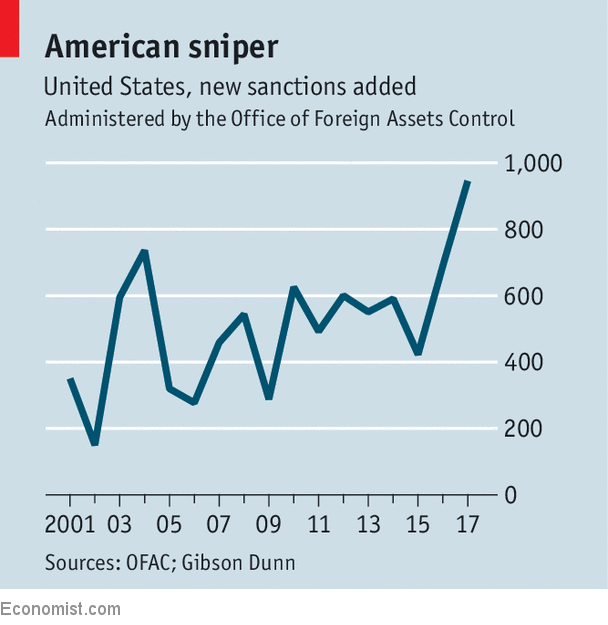
Firms face many other complications. According to Gibson Dunn, a law firm, America’s reliance on sanctions to tackle terrorism, nuclear proliferation, human-rights abuses and corruption has ballooned since Mr Trump took office. Last year it put about 1,000 entities on its “blacklist”, almost 30% more than in Barack Obama’s final year (see chart). The Office of Foreign Assets Control (OFAC), which enforces sanctions from Washington, has attracted unprecedented attention from Steven Mnuchin at the Treasury. “To the best of our knowledge, there has never been a treasury secretary so clearly enamoured with the sanctions tool,” says Gibson Dunn.
As a result, OFAC is “incredibly stretched”, says Elizabeth Rosenberg of the Centre for a New American Security, a think-tank. That makes it harder for businesses to seek clarity on the reach of sanctions. OFAC has recently lost its director, John Smith, and another senior official. This staffing shortfall may contribute to a further difficulty for business: the Trump administration has, at times, imposed sanctions without appreciating the consequences of its actions. Its crackdown on Rusal, Russia’s biggest aluminium producer, in April was aimed at punishing Oleg Deripaska, a Russian oligarch, who owns it through EN+, a company recently floated in London. But it caused immediate disruption of the world’s aluminium market, of which Rusal supplies about 6%.
Higher aluminium prices hurt carmakers, manufacturers of cans and other users of the metal, leading to a strong lobbying effort in Washington. Less than three weeks later, the Treasury watered down the sanctions by extending the “wind-down” period for firms to finish doing business with Rusal. It also gave EN+ a chance to save itself and Rusal from the sanctions if it sold off Mr Deripaska’s stake to below 50%—provided it can find an investment bank brave enough to help it with the transaction.
Ms Rosenberg says it is the Treasury’s job to anticipate what the market and political reaction will be, rather than imposing sanctions and then “walking back in the face of protests”. Others say that the more sanctions are seen as “transactional”, the more their credibility is damaged.
Yet however murky America’s system has become, businesses are in no mood to dismiss it. Doing business in countries that have been labelled as rogue regimes is not much good for their reputations. And much as they may dislike being a tool of Mr Trump’s unorthodox foreign policy, they know that they cannot disregard it.
This article appeared in the Business section of the print edition under the headline "What the OFAC?"
Reuse this content