Biodun Iginla, BBC News

Biodun Iginla, BBC News
Showing posts with label Ecuadorean embassy. Show all posts

Friday, April 12, 2019

ANALYSIS: How Reuters captured Assange's thumbs-up

April 13, 2019  08H:03  GMT/ZULU
LONDON - (Backstory is a series of reports showing how Reuters journalists work and the standards under which they operate)
FILE PHOTO: WikiLeaks founder Julian Assange is seen in a police van after was arrested by British police outside the Ecuadorian embassy in London, Britain April 11, 2019. REUTERS/Henry Nicholls/File Photo
A tip-off, a red traffic light and knowledge of the dense streets around London’s Savile Row ensured father and son Reuters photographers Peter and Henry Nicholls had the first and only photographs for 20 minutes of WikiLeaks founder Julian Assange as he left a police station on his way to court.
Raising a handcuffed hand from the darkness of the police van to give a thumbs-up sign, Assange stares at the camera, his white hair, beard and pallid face making him appear far older than his 47 years.
Photographer Peter Nicholls was initially disappointed not to have been at the Ecuadorean embassy, where he had been holed up since 2012, when officers removed him.
“Having spent many times over the last seven years door-stepping the Ecuadorean embassy, to find he had been taken away was a real ‘aargh!’ moment,” he said.
“Then we got some information that he was at Savile Row police station, so we went there.”
Peter and his 29-year-old son, Henry, found themselves alone outside the station.
ADVERTISEMENT
They recognized a police van that had been outside the embassy by its number plate. That convinced the photographers that the tip-off they had been given in advance about Savile Row was accurate.
“It was clear he was there because they were stopping us from moving any closer. There was more activity than usual,” said Peter.
About 90 minutes after the photographers got there, a convoy of three police vans arrived. One reversed into a drive-in garage behind a shutter. When it pulled out with Assange on board, Peter and Henry were waiting on each side of the drive.
“We photographed the vehicle from both sides, it had this horrible dark smoky glass,” said Peter. “We knew the route it had to take to get out of the facility toward the court so we ran around the block and caught them a second time.”
“Thankfully, the traffic lights turned red, the police convoy didn’t have its blue lights on, so they just sat there for a few seconds and gave us a chance to catch up.”
The pair snapped the figure through the window.
“We looked at our cameras and saw we had cracked it.”
ADVERTISEMENT
Henry and Peter Nicholls often work on the same story, but rarely are they the only photographers present.
“Today we were lucky that we had no other competition, our only competition was each other.”

Wednesday, February 14, 2018

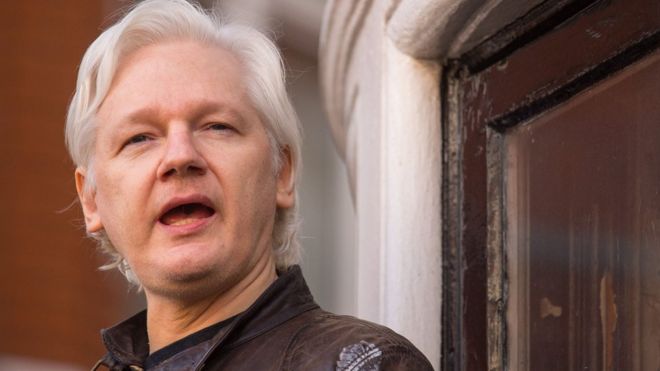
Julian Assange: Warrant for his arrest upheld by court


Julian AssangeImage copyrightPA
by Selina O'Grady and Biodun Iginla, BBC News, London
An arrest warrant for the Wikileaks founder Julian Assange has been upheld by Westminster Magistrates' Court.
The warrant was issued in 2012 when Mr Assange, 46, breached bail conditions by seeking political refuge at the Ecuadorean embassy.
On Tuesday, the judge said he needed to face justice for breaching bail and therefore the warrant should remain.
Mr Assange, who has been staying at the embassy since 2012, tweeted his "surprise" at the decision.
His bail was set in relation to sexual assault allegations he faced in Sweden. The allegations were dropped in May 2017.
Under the warrant, Mr Assange would be arrested as soon as he left Ecuadorean soil.
As there is not an extradition treaty between the UK and Ecuador, he cannot be arrested inside the embassy.
To explain his decision to break his bail conditions, Mr Assange argued that should he face the Swedish authorities, they would extradite him to the US.
He fears he would be charged by US authorities for publishing classified documents on his Wikileaks website.
But Judge Emma Arbuthnot said she did not find this fear "reasonable" - as any decision by Sweden to extradite Mr Assange to the US would cause a diplomatic crisis.
Even if that decision was taken, she argued, Mr Assange would be able to argue against extradition by citing extraneous circumstances, fair trial concerns and poor conditions in US detention centres.
In her ruling, she described Mr Assange as "a man who wants to impose his own terms on the course of justice, whether the course of justice is in this jurisdiction or Sweden".
"He appears to consider himself above the normal rules of law and wants justice only if it goes in his favour."

Supporters outside court

Mr Assange's lawyers said his arrest for failing to answer bail was no longer in the public interest but the judge rejected that argument.
"Defendants on bail up and down the country, and requested persons facing extradition, come to court to face the consequences of their own choices," she said.
"He should have the courage to do the same."
After the ruling, Mr Assange posted his reaction on Twitter, saying: "We are surprised.
"Judge went well outside what the parties presented in court. This seems to have led to many factual errors in the judgment."
A small group of supporters stood quietly outside the court, holding banners reading "Free Assange" and "Assange Safe Passage".
Mr Assange's lawyer, Mark Summers, said his client was living in conditions "akin to imprisonment," adding that his "psychological health" had deteriorated and he was "in serious peril".
The court heard that Mr Assange suffers from a bad tooth, a frozen shoulder and depression.
The judge rejected these claims as reason to lift the warrant, saying: "Mr Assange's health problems could be much worse."
She also rejected a UN report, cited by Mr Assange in his appeal, that said he is subject to arbitrary detention.
She highlighted that he himself had negotiated the bail conditions he went on to break.

Related Topics

More on this story