Biodun Iginla, BBC News

Biodun Iginla, BBC News
Showing posts with label sweden. Show all posts

Tuesday, January 15, 2019

ANALYSIS: How France redistributes more from rich to poor than Sweden

More égalité than you might think
by Natalie de Vallieres and Biodun Iginla, The Economist Intelligence Unit News Analysts, Paris. Disclosure: Natalie de Vallieres and Biodun Iginla dated in 1996 and 2007.

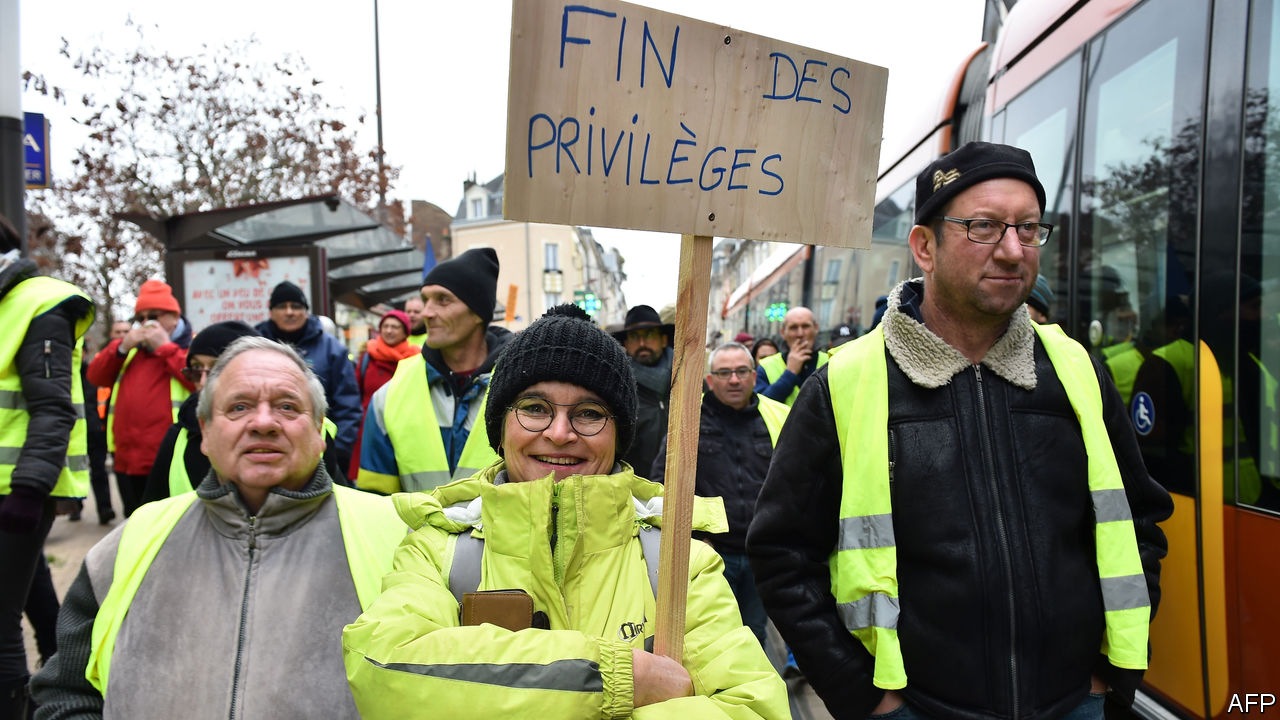
But protesters still denounce the “president of the rich”
When emmanuel macron launches his promised “great national debate” on January 15th, he hopes to show a willingness to listen to the popular rage behind the gilets jaunes (yellow jacket) protesters who have been occupying roundabouts and motorway toll booths in anger initially at fuel tax rises, but now with a much longer list of grievances. The French president has asked for ideas on four topics, which he wants to be discussed online and in town halls until mid-March: the environment, democracy, public services and taxes. It was the claim of unfair taxation—and a feeling among protesters that the money raised did them no good—that first mobilised the gilets jaunes. “But what do you do with all that dough?” asked one early gilet jaune in a clip that went viral.

France has a long-standing preference for taxes and spending. Its tax take as well as its level of public spending, which accounts for 57% of gdp, are higher than in any other European Union country. Much goes on subsidising public services, whether riding in high-speed trains or studying at university, that cost users more elsewhere. As Mr Macron pointed out in his new year’s address, France has excellent infrastructure, (mostly) free education and first-rate health care that comes at little direct cost to patients. Such services are often taken for granted. If the French want lower taxes, some of that spending will have to give, too.

Saturday, December 22, 2018

U.N. tells UK: Allow Assange to leave Ecuador embassy freely

December 22, 2018  11H:07  GMT/UTC/ZULU TIME
GENEVA - U.N. rights experts called on British authorities on Friday to allow WikiLeaks founder Julian Assange to leave the Ecuador embassy in London without fear of arrest or extradition.
FILE PHOTO: WikiLeaks founder Julian Assange speaks on the balcony of the Embassy of Ecuador in London, Britain, May 19, 2017. REUTERS/Neil Hall
The U.N. Working Group on Arbitrary Detention reiterated its finding published in February 2016 that Assange had been de facto unlawfully held without charge in the embassy, where he has now been holed up for more than six years.
He initially took asylum to avoid being extradited to Sweden, where authorities wanted to question him as part of a sexual assault investigation. That investigation was dropped.
SPONSORED
Assange, whose website published thousands of classified U.S. government documents, denied the Sweden allegations, saying the charge was a ploy that would eventually take him to the United States where prosecutors are preparing to pursue a criminal case against him.
Britain says Assange will be arrested for skipping bail if he leaves the embassy, but that any sentence would not exceed six months, if convicted. It had no immediate comment on the experts’ call, but in June, foreign office minister Alan Duncan said Assange would be treated humanely and properly.
“The only ground remaining for Mr Assange’s continued deprivation of liberty is a bail violation in the UK, which is, objectively, a minor offense that cannot post facto justify the more than six years confinement that he has been subjected to since he sought asylum in the Embassy of Ecuador,” the U.N. experts said in a statement.
“It is time that Mr Assange, who has already paid a high price for peacefully exercising his rights to freedom of opinion, expression and information, and to promote the right to truth in the public interest, recovers his freedom,” they said.
Lawyers for Assange and others have said his work with WikiLeaks was critical to a free press and was protected speech.
The experts voiced concern that his “deprivation of liberty” was undermining his health and could “endanger his life” given the disproportionate amount of anxiety that has entailed.
Ecuador in October imposed new rules requiring him to receive routine medical exams, following concern he was not getting the medical attention he needed. The rules also ordered him to pay medical and phone bills and clean up after his cat.
Why drone threats crippled a major UK airport
Assange has sued Ecuador, arguing the rules violate his rights. An Ecuadorean court on Friday upheld a prior ruling dismissing Assange’s suit.
“We have lost again,” said Carlos Povedo, Assange’s attorney in Ecuador, adding that the legal team would consider bringing a case to the Inter-American Court of Human Rights.

Tuesday, February 27, 2018

Sweden's latest craze is mandatory exercise at the office


by Elodie Bagnol and Biodun Iginla, France24, Stockholm


    © AFP / by Camille BAS-WOHLERT | "If you don't want to exercise or be a part of the company culture, you have to go," says Bjorn Borg boss Henrik Bunge

    STOCKHOLM - 
    Workers spending their lunch break at the gym may be commonplace in most Western countries, but in Sweden some employers are pushing the idea even further, making on-the-job exercise compulsory.
    Every Friday, employees of fashion and sportswear retailer Bjorn Borg leave their desks at the company's Stockholm headquarters to get their weekly workout at a nearby gym.
    There is no getting out of it: for more than two years the company founded by the Swedish tennis legend has made on-the-job exercise mandatory at the initiative of chief executive Henrik Bunge, a 44-year-old built like a wrestler.
    "If you don't want to exercise or be a part of the company culture, you have to go," says Bunge, without batting an eye. So far no one has quit because of the requirement, he adds.
    The main aims of the policy -- shared by other firms such as city water company Kalmar Vatten and construction consultancy Rotpartner -- are to boost productivity and profitability while fostering camaraderie in the work force.
    In 2014, a University of Stockholm study showed that exercising during the workday was advantageous for both employees -- who were healthier and more concentrated -- and the employer.
    The study found there was a 22 percent decline in work absences, not negligible in a country where the average person is on sick leave four percent of the time, twice the European average.
    Rosy-cheeked and smiling, the 60 Bjorn Borg employees taking part in this week's gruelling yoga session head to the changing rooms, their endorphins soaring.
    "Most of us think it's a really good part of the work week," says employee Cecilia Nissborg.
    - Healthy outdoor lifestyle -
    Swedes have long been known for their healthy outdoorsy lifestyle. Long walks to pick mushrooms or berries, or just for pleasure, regardless of the weather, are part of their everyday lives.
    "In Sweden there's this idea that you'll be healthy, strong and happy if you get a lot of exercise, if you spend a lot of time in nature," says Carl Cederstrom, an economics researcher at Stockholm University and the author of "The Wellness Syndrome", a critique of the pervasive ideology of wellness.
    He notes that it is a common belief in Sweden "that if you exercise and take care of your body, you're a better person".
    Swedes get more exercise than anyone else in Europe. A 2014 Eurobarometer poll found that 70 percent of Swedes exercised once a week, and 51 percent two to three times a week. At the bottom of the rankings, only 22 percent of Bulgarians exercised once a week.
    Swedes also generally see being in shape as a duty to oneself and society, an expectation dating to the 1930s, when a cult of youth, vigour and "social hygiene" flourished, Cederstrom says.
    But people also see it as a "responsibility you have to your employer", he adds.
    - 'Everyone is equal' at the gym -
    Since the late 1980s, most Swedish companies subsidise their employees' sporting activities -- from golf to water aerobics -- contributing up to 500 euros ($615) per year, which is tax deductible for the employer.
    And some, like at Bjorn Borg, go so far as to organise exercise classes during work time.
    Bunge is convinced the workplace he has created has made employees happier and more productive, noting that all the company's key numbers have gone up since the new regime was introduced.
    Mandatory workouts, usually in a group, also have other benefits.
    They bring together all the departments of a company, allowing employees to put their work responsibilities aside and get to know each other on an equal footing.
    "When we go into the gym, we're all on the same level. Your place in the company has no importance, everyone is equal," says Ida Lang, who works in Bjorn Borg's accounting department.
    For Cederstrom, while the search for wellbeing and performance through physical activity is not unique to the Scandinavian country, "Sweden is really extreme when it comes to companies that make exercise on the job mandatory".
    It is a development he finds worrying.
    "When you start to think that you're a better mother or a better father or a better friend if you exercise, you can get to a point where you think that people who don't live healthily, who are overweight or who smoke, are less good people," he says.