Biodun Iginla, BBC News

Biodun Iginla, BBC News
Showing posts with label Eritrea. Show all posts

Friday, October 11, 2019

ANALYSIS: Assessing Abiy Ahmed, winner of the Nobel Peace Prize

by Rashida Adjani and Biodun Iginla, The Economist Intelligence Unit News Analysts

The record of Ethiopia’s prime minister remains incomplete, at home and abroad
Middle East and Africa

THERE ARE two types of Nobel Peace Prize winner. The uncontroversial ones are often campaigners, such as Nadia Murad (who won last year for her work highlighting rape during war) or the Organisation for the Prohibition of Chemical Weapons (which won in 2013). The controversial ones are often the politicians who actually negotiate peace deals—think of Yasser Arafat or F.W. de Klerk. Politics in violent places is a nasty, messy affair, and peace deals don’t always last. The award of the prize on October 11th to Abiy Ahmed, Ethiopia’s prime minister, will spark more debate than most.
On the plus side, Abiy has tried hard to be a unifier since he took office last year. He often uses the Amharic word medemer (to add together) in speeches. Millions of Ethiopians have welcomed his promises of democracy, reconciliation and reform in a country that had long been oppressed.
In June 2018 he signed a historic peace deal with Eritrea, a smaller neighbour that seceded from Ethiopia in 1993. The accord brought to a close two decades of pointless conflict over a scrap of barren land. The war had led to tens of thousands of deaths, ripped apart families and severed the deep ties of blood, culture and language between the two countries.
Abiy broke the deadlock by promising to withdraw from the disputed territories, thus implementing the findings of a UN commission that Ethiopia had long rejected. He also took advantage of his close relationship with Saudi Arabia and the United Arab Emirates, whose financial largesse may have helped nudge Issaias Afwerki, Eritrea’s president, to the negotiating table. After the peace agreement, families and friends were reunited and cross-border trade flourished.
Berit Reiss-Andersen, the Nobel committee’s chair, said the prize recognised Abiy’s “efforts to achieve peace and international co-operation, and in particular his decisive initiative to resolve the border conflict with neighbouring Eritrea”. He has also been praised for helping to mediate a power-sharing accord between pro-democracy protesters and a military junta that took power earlier this year in Sudan.
But the peace he forged with Eritrea is far from complete. In early 2019 Eritrea once again closed all its border crossings with Ethiopia. A trade agreement drafted by Ethiopian negotiators has gathered dust in the Eritrean capital, Asmara, for almost a year. Physical demarcation of the border, the trickiest part of the deal, has not begun: the disputed areas remain under Ethiopian administration.
The lack of progress highlights some of Abiy’s shortcomings as a peace-broker. Ahmed Soliman of Chatham House, a think-tank in London, notes his reliance on “charm and bold personal initiatives” at the expense of institutions. He bypassed Ethiopia’s foreign ministry to strike his deal with Issaias (the details of which were never made public). And his attempts to foster goodwill between Kenya and Somalia, which are embroiled in a spat over their maritime border, as well as between warring factions in South Sudan, have yet to show results.
The prime minister’s record as a peacemaker in Ethiopia is also worryingly mixed. He has released political prisoners and promised fair elections. But he has failed to keep order. In 2018 almost 3m Ethiopians were forced from their homes by ethnic conflict. The causes were complex and many of the tensions long predate his term in office. But his government was slow to react, and at times appeared more concerned with its public image than with tackling the spiralling humanitarian crisis in the country’s south. For several months it blocked aid from reaching shelters for the homeless, and forced people to return against their will to areas that were not yet safe. This contributed to more violence, as well as starvation.
The Nobel prize will be a boost for the prime minister, who faces a national election next year. “At home we’re always squabbling but when it comes to the outside world, we’ll stand with any Ethiopian,” says a resident of the capital, Addis Ababa. Abel Abate Demissie, a political analyst, suggests that international recognition might keep Abiy honest, especially as his administration shows signs of reverting to the authoritarian tactics of its predecessor. “Hopefully, it will encourage him to live up to the prize,” he says. “He knows all eyes will be on him now.”
Reuse this contentThe Trust Project

Friday, July 26, 2019

BREAKING: Scores of migrants' bodies recovered off Libya after deadliest Mediterranean shipwreck of 2019


Ayman al-Sahili, REUTERS | Bags containing the bodies of migrants who died after their wooden boat capsized off the coast of Komas, east of Tripoli, on July 25, 2019.Text by:
Libya's coast guard recovered the bodies of scores of migrants who perished at sea as search operations continued Friday, a day after up to 150 people, including women and children, went missing after their boats capsized in the Mediterranean Sea.
ADVERTISING
A top UN official described Thursday's shipwreck as "the worst Mediterranean tragedy" so far this year.
The Anti-Illegal Immigration Agency in the Libyan capital said that up to 350 migrants were on board the boats that capsized off the town of Khoms, around 120 kilometers (75 miles) east of Tripoli.
The migrants included nationals from Eritrea, Egypt, Sudan and Libya, the agency said. Libyan officials said more than 130 have been rescued since Thursday.
One of the survivors, from Eritrea, said his vessel started to capsize after an hour of sailing. Most of the migrants on board were women, he said, and most of them drowned.
ADVERTISING
"All of them (who drowned) were ladies ... only two girls rescued themselves," he said, speaking on condition of anonymity for fears for his safety.
Two other survivors, reached at a disembarking facility in Tripoli, told The Associated Press over the phone they had each paid between $200 and $400 to smugglers who promised they would reach Italy's shores by sunset Thursday.
Ahmed al-Tayeb, a 32-year-old from Sudan, said he was on one of three boats that capsized an hour after setting off from Libya on Wednesday night.
Egyptian Mustafa Mahmoud, 26, said Libyan fishermen were first to come to their rescue. "I saw lots of bodies, dozens, in the water," he said. "Most of them were children and women who were not able to swim."
At least a dozen of the survivors were taken to a hospital in Khoms while the rest were transferred to different detention centers, including Tajoura, located near the front lines of the fighting between rival Libyan factions, the Libyan officials said, speaking on condition of anonymity because they were not authorized to talk to the media.
The Tajoura detention center was hit by an airstrike on July 3 that killed more than 50 people and raised new concerns over the treatment of migrants in Libya. The UN refugee agency has demanded the center be closed, but that hasn't happened.
"This is putting intentionally the life of these people at risk," Vincent Cochetel, UNHCR's special envoy for the Central Mediterranean tweeted Friday.
The UN migration agency said later Friday that once they arrived, the 84 migrants were turned back from the detention center and were instead being "released gradually" into the town of Tajoura.
Separately from the shipwreck, Ayoub Gassim, a spokesman for Libya's coast guard, said it had intercepted three rubber boats off Tripoli on Thursday, carrying 269 Europe-bound migrants, including nine women and two children. The 269 were taken to refugee camps in Tripoli, Gassim said.
Amnesty International called Friday on EU leaders to "show some courage" and reverse their decision to halt migrant rescues in the Mediterranean. The rights group appealed on European nations to change their approach and not "condemn those who survive to detention in Libya."
"People are still risking their lives to come to Europe," said Amnesty's Massimo Moratti.
The European Union has over the past years partnered with Libya to prevent migrants from making the dangerous journey by sea to Europe. Rights groups say those efforts have left migrants at the mercy of brutal armed groups or confined in squalid detention centers that lack adequate food and water.
The EU released a statement Friday saying it was deeply saddened by the tragedy off Libya's coast and added that "sustainable solutions for search and rescue are urgently needed in the Mediterranean."
However, it also said "Libya's current system of managing irregular migration and arbitrarily detaining refugees and migrants has to end."
UN Secretary-General Antonio Guterres reiterated that "Libya is not a safe country of asylum" and stressed that "refugees must be treated with dignity and respect, and in accordance with international law," UN deputy spokesman Farhan Haq said Friday.
After the NATO-backed uprising that toppled and killed longtime ruler Moammar Gadhafi in 2011, Libya became a major conduit for African migrants and refugees seeking a better life in Europe. Traffickers and armed groups have exploited Libya's chaos since Gadhafi's overthrow, and have been implicated in widespread abuses of migrants, including torture and abduction for ransom.
Thursday's shipwreck was "the worst Mediterranean tragedy" so far this year, said UN High Commissioner for Refugees Filippo Grandi.
In January, some 117 died or went missing off Libya's coast and around 65 people drowned after their boat sank off the coast of Tunisia in May.
At least 2,500 migrants have been detained in centers in and around Tripoli, where forces loyal to commander Khalifa Haftar are battling an array of militias loosely aligned with a UN-recognized government.
Haftar's attempt to seize Tripoli started in April and has so far killed more than 1,000 people, mainly combatants but also civilians, the US said earlier this month.
The Tripoli-based government blamed the Tajoura airstrike on Haftar's forces, which denied responsibility and accused government-linked militias of storing weapons at the facility.
The UN refugee agency says 164 migrants have died traveling from Libya to Europe since the start of the year, fewer than in previous years. But the agency says the journey is becoming more dangerous for those who attempt it, with one out of four perishing at sea before reaching Europe.
The UN's death toll of 154 did not include the scores who drowned Thursday.

Sunday, June 10, 2018

Italy's Matteo Salvini shuts ports to migrant rescue ship


Migrants picked up by the AquariusImage copyrightSOS MEDITERRANEE
Image captionSOS Méditerranée posted photos of rescued migrants
by Elodie Bagnol and Biodun Iginla, BBC News, Rome
A rescue vessel carrying 629 migrants is stranded in the Mediterranean after Italy's new interior minister refused permission for it to dock.
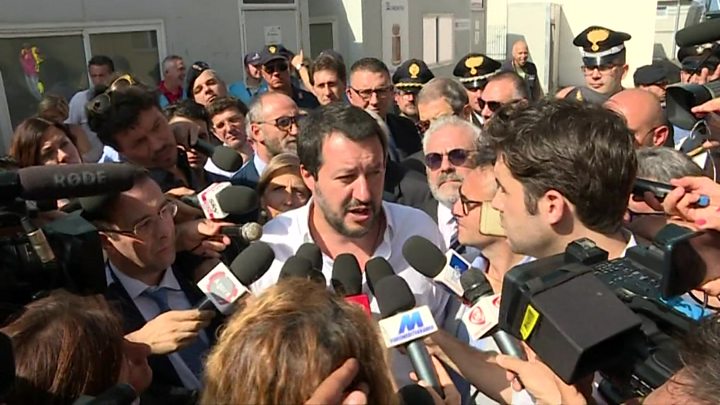
Matteo Salvini, leader of the right-wing League, said Malta should accept the Aquarius but he was rejected.
Malta says the German charity SOS Méditerranée picked up the migrants in Libyan waters, which means they fall under Italy's jurisdiction.
Italy is the main entry for migrants crossing from North Africa to Europe.
The League promised voters during Italy's recent general election that it would take a tough stance on immigration.
SOS Méditerranée, which runs the Aquarius, said the ship had been instructed by the Italian Maritime Rescue Coordination Centre to stand by in its current position, 35 nautical miles from Italy and 27 nautical miles from Malta.
Map showing the approximate location of the ship Aquarius
Image captionThe approximate location of the Aquarius early on Monday
It reports that the migrants were picked up in six different rescue operations off Libya's coast.
"Our objective is the disembarkation in a port of safety of the 629 people now on board the Aquarius - some we rescued yesterday night in difficult conditions," charity spokesperson Mathilde Auvillain was quoted as saying by Reuters news agency.
The UN refugee agency in Italy has called on "states and actors involved" to "rapidly find solutions to allow migrants and refugees on board the Aquarius to disembark safely and quickly".
Media captionHow I smuggle people from Nigeria to Europe

Who is on the ship?

Many of the migrants were rescued in waters controlled by Libya, a common route for undocumented migrants attempting to enter Europe from sub-Saharan Africa.
Some 400 were rescued by the Italian Navy, the Italian coastguard and merchant vessels before being transferred to the Aquarius.
Among those saved and brought on board the Aquarius are 123 unaccompanied minors, 11 younger children and seven pregnant women, SOS Méditerranée says.
The minors are aged between 13 and 17 and come from Eritrea, Ghana, Nigeria and Sudan. according to a journalist on the ship, Anelise Borges.
Tweeting during the night, she added that the situation on board was calm and most of the people rescued were asleep.
Map showing the country of origin for migrants arriving in Italy in 2017 - Nigeria, Bangladesh, Ivory Coast, Guinea and Mali.
One Aquarius crew member, Alessandro Porro, told Italian news channel Sky TG24 that they desperately needed to know which port to go to.
"The people we saved yesterday were in a difficult condition, at least 50 were at risk of drowning," he added.
The Aquarius vessel in a rescue run by charity SOS MéditerranéeImage copyrightSOS MEDITERRANEE
Image captionSOS Méditerranée said the Aquarius was heading north awaiting instructions

What is Salvini's position?

He said on Sunday that Italy was saying "no to human trafficking, no to the business of illegal immigration".
"Malta takes in nobody," he said. "France pushes people back at the border, Spain defends its frontier with weapons."
Chart showing migrant arrivals from Italy, Greece and Spain since 2014.
"It is not possible for Malta to say 'no' to every request for help. The Good Lord put Malta closer than Sicily to Africa."
Last week, Mr Salvini said Rome should increase its deportations of migrants and the Italian government also wants to relocate asylum seekers EU-wide - a scheme already rejected by some member states.
Mr Salvini says he is considering action against organisations rescuing migrants at sea. He has previously accused them of being in cahoots with people-smugglers.
Media captionOn a visit to Sicily, Matteo Salvini said Italy must increase its deportations of migrants.
The government's critics say its plan to repatriate migrants is unworkable and risks fomenting racism and politicising a humanitarian issue.
A controversial deal between Italy's former government and authorities in Libya has led to a drop in overall arrivals since last summer but Italian officials say 13,500 migrants have been registered so far this year.

How has Malta responded?

A spokesman for the Maltese government told AFP news agency Malta was "neither the coordinating nor the competent authority" in the rescue operation.
Mr Salvini earlier accused the Maltese government of not doing its fair share when another rescue ship, the Seefuchs, was stranded in volatile seas with 126 migrants on board.
Malta reportedly refused to send assistance to the vessel and it was allowed to dock in the Sicilian port of Pozzallo on Saturday, the non-governmental organisation Sea Watch reported.
Malta's government insisted it had adhered to all its obligations regarding immigration.
A note on terminology: The BBC uses the term migrant to refer to all people on the move who have yet to complete the legal process of claiming asylum. This group includes people fleeing war-torn countries such as Syria, who are likely to be granted refugee status, as well as people who are seeking jobs and better lives, who governments are likely to rule are economic migrants.

More on this story