
Biodun Iginla, BBC News

Biodun Iginla, BBC News
Showing posts with label Ethereum. Show all posts

Tuesday, December 5, 2017

CryptoKitties craze slows down transactions on Ethereum


Cartoon catsImage copyrightWWW.CRYPTOKITTIES.CO
by Tamara Kachelmeier and Biodun Iginla,  BBC News Technology reporters, San Francisco
A new craze for virtual kittens is slowing down trade in one of the largest crypto-currencies.
CryptoKitties lets players buy and breed "crypto-pets" on Ethereum's underlying blockchain network.
The game's developers told the Bloomberg news agency that CryptoKitties was a "key step" to making blockchains more accessible.
But its popularity has underscored one of the technology's biggest downsides: its lack of scalability.
Etherscan has reported a sixfold increase in pending transactions on Ethereum since the game's release, by the Axiom Zen innovation studio, on 28 November.
"CryptoKitties has become so popular that it's taking up a significant amount of available space for transactions on the Ethereum platform," said Garrick Hileman, from the Cambridge Centre for Alternative Finance.
"Some people are concerned that a frivolous game is now going to be crowding out more serious, significant-seeming business uses."
An estimated $4.5m (£3.35m) has been spent on the cartoon cats at the time of writing, according to Crypto Kitty Sales.
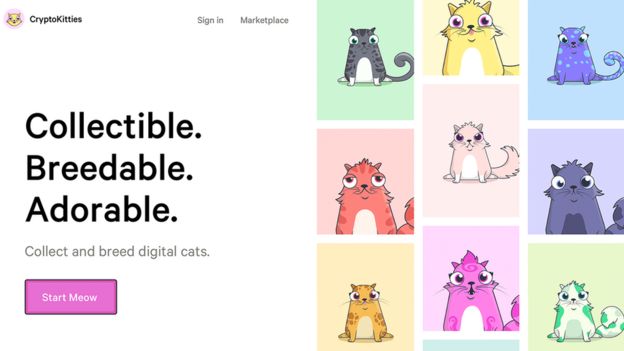
Screenshot of CryptoKitties siteImage copyrightWWW.CRYPTOKITTIES.CO
Image captionCryptoKitties is the first game built on Ethereum
What is a CryptoKitty?
Think of these rather unpalatable cartoon kittens as unique digital Pokemon cards. The game's developers describe them as "breedable Beanie Babies", each with its own unique 256-bit genome.
These crypto-collectibles are also gender-fluid, able to play the role of either the "dame" or the "sire" when bred together. The kitties' unique DNA can lead to four billion possible genetic variations.
Some of the varieties created so far look lifelike, with grey striped fur and bulging green eyes. Others are speckled with neon-blue spots or magenta-patterned swirls.

orange cartoon catImage copyrightWWW.CRYPTOKITTIES.CO
Image captionOne of the less attractive CryptoKitties
How much are CryptoKitties worth?
At the time of writing, the median, or mid-range, price of a CryptoKitty is approximately $23.06 (£17.19), according to Crypto Kitty Sales.
The game's top cat brought in $117,712.12 (£87,686.11) when it sold on Saturday, 2 December.
How can I pay for my own litter?
CryptoKitties can be bought using only Ether, a crypto-currency that acts as the fuel of the Ethereum blockchain network.
To get started, users must install a Chrome extension called MetaMask, which acts as a digital wallet and lets players send and receive Ether from their computers.
Ether must be purchased from a crypto-currency exchange before it can be added to MetaMask.
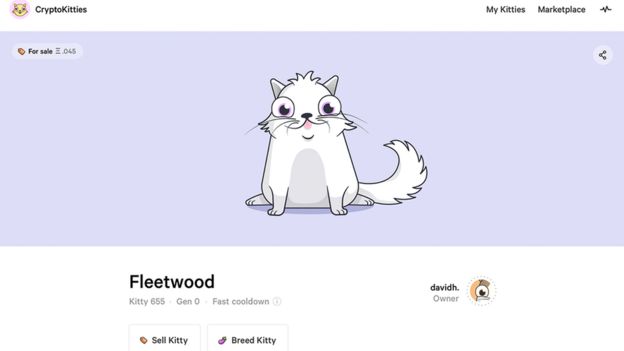
Screenshot of a page with a cartoon kitten for saleImage copyrightWWW.CRYPTOKITTIES.CO
Image captionThe sale page for a CryptoKitty
Where do the CryptoKitties come from?
Axiom Zen releases a new CryptoKitty every 15 minutes, but the rest of the supply is powered by the breeding of existing crypto-pets. Owners of kittens can put them up for sale and set their own price in ethers.
Why does it matter if CryptoKitties is slowing down Ethereum?
According to ETH Gas Station, the CryptoKitties game accounts for over 10% of network traffic on Ethereum. As traffic increases, transactions become more expensive to execute quickly.
"The real big issue is other major players looking for alternatives to Ethereum and moving to different systems," Mr Hileman said.
"There's definitely an urgency for Ethereum to try and address this issue."

Related Topics

More on this story

Friday, June 2, 2017

What if the bitcoin bubble bursts?--analysis

by Tamara Kachelmeier and Biodun Iginla, Technology News Analysts, The Economist Intelligence Unit, New York
Virtual vertigo

Is the latest frenzy like tulip-mania, a gold rush or the dotcom boom?
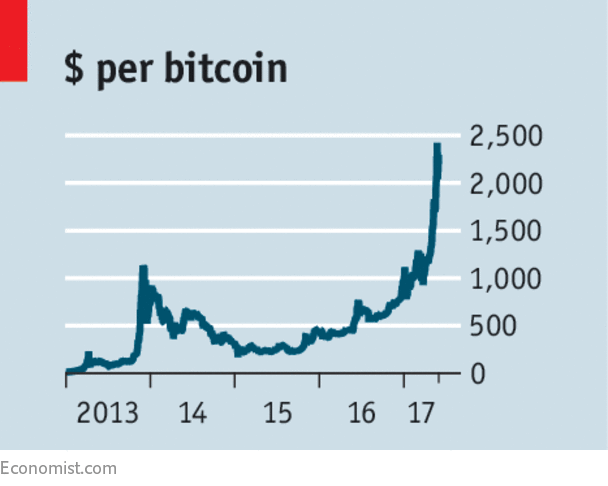
MARKETS frequently froth and bubble, but the boom in bitcoin, a digital currency, is extraordinary. Although its price is down from an all-time high of $2,420 on May 24th, it has more than doubled in just two months. Anyone clever or lucky enough to have bought $1,000 of bitcoins in July 2010, when the price stood at $0.05, would now have a stash worth $46m. Other cryptocurrencies have soared, too, giving them a collective market value of about $80bn.
Ascents this steep are rarely sustainable. More often than not, the word “bitcoin” now comes attached to the word “bubble”. But the question of what has driven up the price is important. Is this just a speculative mania, or is it evidence that bitcoin is taking on a more substantial role as a medium of exchange or a store of value? Put another way, is bitcoin like a tulip, gold or the dollar—or is it something else entirely?

Latest updates

See all updates
Start with the case that this is nothing more than a virtual tulipmania, a speculative hysteria in which a rising price encourages ever more buyers, no matter what the asset is. Bitcoin’s recent trajectory certainly seems manic. Retail investors have piled in. Many already familiar with bitcoin investing have moved on to bet on alternatives, such as Ethereum, and “initial coin offerings” (ICOs), in which firms issue digital tokens of their own.
It looks like a scammers’ paradise, yet unlike tulips, bitcoins have real uses. They now buy everything from pizzas to computers. So if a tulip isn’t the right analogue, how about gold? Bitcoins certainly seem to bear more than a passing resemblance. Goldbugs mistrust governments and their money-printing tendencies; so too do bitcoinesseurs: no central bank is in charge of bitcoin. But a store of value should not bounce around as much as this one does: bitcoin swung from more than $1,100 in late 2013 to less than $200 a year later, before climbing, in fits and starts, to its current dizzying heights.
Rather than being just a form of digital gold, bitcoin aspires to loftier goals: to be a means of exchange like the euro, yen or the dollar. Regulators are starting to take bitcoin seriously. Some of the price surge can be explained by Japan’s decision to treat bitcoin more like any other currency. Yet the bitcoin system is operating at its limits and its developers cannot agree on how to increase the number of exchanges the system is able to handle. As a result, a transaction now costs nearly $4 in fees on average and takes many tedious hours to confirm. For convenience, a dollar bill beats it hands down.
Not so dotty
If bitcoin and the other cryptocurrencies are unlike anything else, what are they? The best comparison may be with the internet and the dotcom boom it created in the late 1990s. Like the internet, cryptocurrencies both embody innovation and give rise to more of it. They are experiments in themselves of how to maintain a public database (the “blockchain”) without anybody in particular, a bank, say, being in charge. Georgia, for instance, is using the technology to secure government records (see article). And blockchains are platforms for further experiments. Take Ethereum, for example. It allows all kinds of projects, from video games to online markets, to raise funds by issuing tokens—essentially private money that can be traded and used within these projects. Although such ICOs need to be handled with care, they could also generate intriguing inventions. Fans hope that they will give rise to decentralised upstarts taking aim at today’s oligopolistic technology giants, such as Amazon and Facebook.
This may seem like a dangerous way to generate innovation. Investors could lose their shirts; a crash in one asset class could spread to others, creating wobbles in the financial system. But in the case of cryptocurrencies such risks seem limited. It is hard to argue that those buying cryptocurrencies are unaware of the risks. And since they are still a fairly self-contained system, contagion is unlikely.
If there is such a thing as a healthy bubble, this is it. To be sure, regulators should watch out that cryptocurrencies do not become even more of a conduit for criminal activity, such as drug dealing. But they should think twice before coming down hard, particularly on ICOs. Being too spiky would not just prick a bubble, but also prevent a lot of the useful innovation that is likely to come about at the same time.
This article appeared in the Leaders section of the print edition under the headline "Virtual vertigo"
View comments
Reuse this content