Biodun Iginla, BBC News

Biodun Iginla, BBC News
Showing posts with label Francisco Yanez. Show all posts

Saturday, February 9, 2019

Analysis: U.S. in direct contact with Venezuelan military, urging defections

February 9, 2019  22H:43  GMT/ZULU
WASHINGTON - The United States is holding direct communications with members of Venezuela’s military urging them to abandon President Nicolas Maduro and is also preparing new sanctions aimed at increasing pressure on him, a senior White House official said.
FILE PHOTO: Venezuelan Colonel Jose Luis Silva, Venezuela’s Military Attache at its Washington embassy to the United States, is interviewed by Reuters after announcing that he is defecting from the government of President Nicolas Maduro in Washington, U.S., January 26, 2019. REUTERS/Joshua Roberts/File Photo
The Trump administration expects further military defections from Maduro’s side, the official told us at Reuters in an interview, despite only a few senior officers having done so since opposition leader Juan Guaido declared himself interim president last month, earning the recognition of the United States and dozens of other countries.
“We believe these to be those first couple pebbles before we start really seeing bigger rocks rolling down the hill,” the official said this week, speaking on condition of anonymity. “We’re still having conversations with members of the former Maduro regime, with military members, although those conversations are very, very limited.”
SPONSORED
The official declined to provide details on the discussions or the level at which they are being held, and it was unclear whether such contacts could create cracks in the Venezuelan socialist leader’s support from the military, which is pivotal to his grip on power.
With the Venezuelan military still apparently loyal to Maduro, a source in Washington close to the opposition expressed doubts whether the Trump administration has laid enough groundwork to spur a wider mutiny in the ranks where many officers are suspected of benefiting from corruption and drug trafficking.
Members of the South American country’s security forces fear they or their families could be targeted by Maduro if they defect, so the U.S. would need to offer them something that could outweigh those concerns, said Eric Farnsworth, vice president of the Council of the Americas think tank in Washington.
“It depends on what they’re offering,” Farnsworth said. “Are there incentives built into these contacts that will at least cause people to question their loyalty to the regime?”
Guaido says the May 2018 vote in which Maduro won a second term as president was a sham and on Jan. 23 invoked a constitutional provision to declare himself president, promising free and fair elections.

VENEZUELAN ASSETS

The U.S. government also sees European allies as likely to do more to prevent Maduro from transferring or hiding Venezuela government assets held outside the country, the U.S. official said.
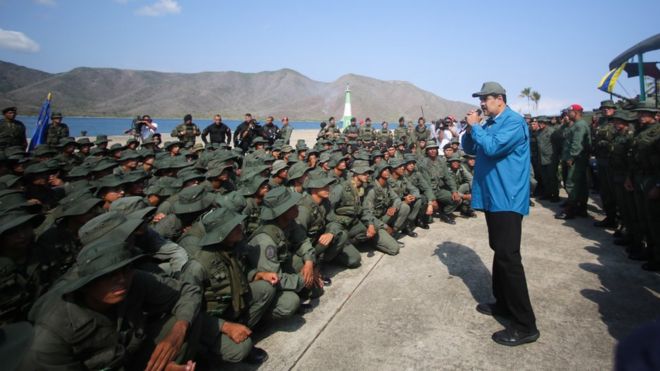
Venezuela's President Nicolas Maduro speaks to soldiers while he attends a military exercise in Turiamo, Venezuela February 3, 2019. Miraflores Palace/Handout via REUTERS
Major European countries have joined the United States in backing Guaido but they have stopped short of the sweeping oil sanctions and financial measures that Washington has imposed.
At the same time, the Trump administration is readying further possible sanctions on Venezuela, the official said.
Previous rounds have targeted dozens of Venezuelan military and government officials, including Maduro himself, and last month finally hit the OPEC member’s vital oil sector. But the administration has stopped short of imposing so-called “secondary” sanctions, which would punish non-U.S. companies for doing business with the Venezuela government or the state oil monopoly PDVSA.
The U.S. official said that Washington had every tool available to apply pressure on Maduro and his associates “to accept a legitimate democratic transition.”
'Death to America' really 'Death to Trump': Iran
The U.S. government is also weighing possible sanctions on Cuban military and intelligence officials whom it says are helping Maduro remain in power, a second U.S. official and person familiar with the deliberations have told Reuters.
Maduro’s government has accused Guaido, who has galvanized Venezuela’s opposition, of attempting to stage a U.S.-directed coup.
General Francisco Yanez of the air force’s high command became the first active Venezuelan general to recognize Guaido, but he is one of about 2,000 generals. Venezuela’s chief military attache to the United States also said he was defecting late last month.
Guaido has actively courted members of the military with promises of amnesty and preferential legal treatment if they disavow Maduro and disobey his orders, and Washington this week raised the prospect of dropping sanctions on senior Venezuelan officers if they recognize Guaido.
Maduro still has the support of the military high command, and now routinely appears in pre-recorded events at military bases where officers stand behind him and chant triumphal slogans such as “Loyal always, traitors never.”

Sunday, February 3, 2019

BREAKING AND UPDATE: Venezuela crisis: Maduro defiant as pressure builds


Miraflores press office shows Venezuelan President Nicolás Maduro during an event with members of the military, in Turiamo, Venezuela, 3 February 2019Image copyrightEPA
Image captionNicolás Maduro has retained the support of the Venezuelan military
by Renee Celeste and Biodun Iginla, BBC News, Caracas
Venezuelan President Nicolás Maduro has said he cannot rule out the possibility of civil war as pressure mounts on him to stand down.
In a TV interview, he warned that US President Donald Trump would leave the White House "stained with blood" if he intervened in the crisis.
He also defiantly rejected the EU's Sunday deadline to call snap elections.
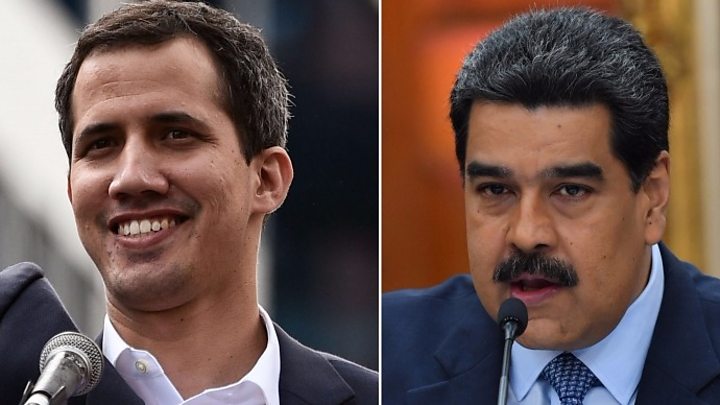
Opposition leader Juan Guaidó declared himself interim president and won the backing of the US and others.
Mr Guaidó said on Sunday he would build an international coalition to deliver humanitarian aid to Venezuelans. But Mr Maduro has accused him of organising a coup.

What did Mr Maduro say?

In the interview with Spanish television programme Salvados, broadcast on Sunday, Mr Maduro was asked if the crisis in Venezuela could result in civil war.
"Today no-one could answer that question with certainty," he said.
"Everything depends on the level of madness and aggressiveness of the northern empire (the US) and its Western allies.
"We ask that nobody intervenes in our internal affairs... and we prepare ourselves to defend our country."
President Trump has told US broadcaster CBS that the use of military force remains "an option".
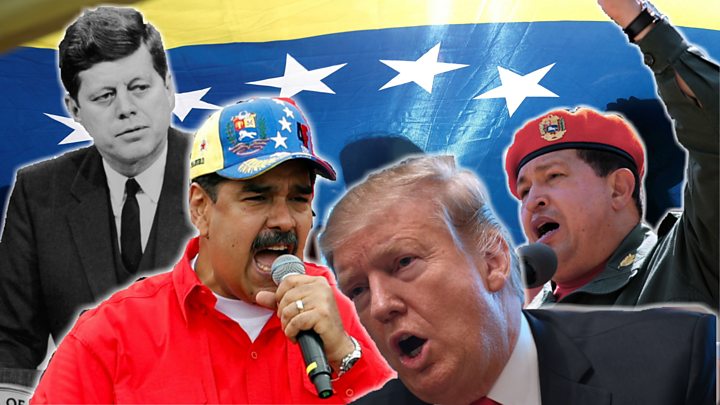
But Mr Maduro warned the US leader he risked a repeat of the Vietnam war if he intervened.
Media captionWho is really in charge in Venezuela?
"Stop. Stop. Donald Trump! You are making mistakes that are going to stain your hands with blood and you are going to leave the presidency stained with blood," he said.
"Let's respect each other, or is it that you are going to repeat a Vietnam in Latin America?"
Sunday saw the expiry of a deadline set by several European countries - including France, Britain, Germany and Spain - for Mr Maduro to call early presidential elections. They said that they would recognise Mr Guaidó as interim president if no such pledge was forthcoming.
But Mr Maduro responded: "We don't accept ultimatums from anyone. It's like if I told the European Union: 'I give you seven days to recognise the Republic of Catalonia, and if you don't, we are going to take measures'.
"No, international politics can't be based on ultimatums. That was the era of empires and colonies."

What is the situation in Venezuela?

Thousands took to the streets of the capital Caracas on Saturday for protests in support of both President Maduro and Mr Guaidó.
Mr Maduro retains the support of the military, but ahead of the demonstrations Mr Guaidó received a boost when an air force general - Francisco Yanez - became the highest-ranking military official yet to pledge support for him.
Mr Guaidó says he has held private meetings with the military to win support for ousting Mr Maduro. He says he has also reached out to China, one of Mr Maduro's most important backers.

What is Juan Guaidó's aid plan?

Mr Guaidó does not control any territory in Venezuela, so instead he plans to set up collection centres in neighbouring countries where Venezuelans have fled to.
He said he wanted to set up an international coalition to gather aid at three points, and press Venezuela's army to let it into the country.
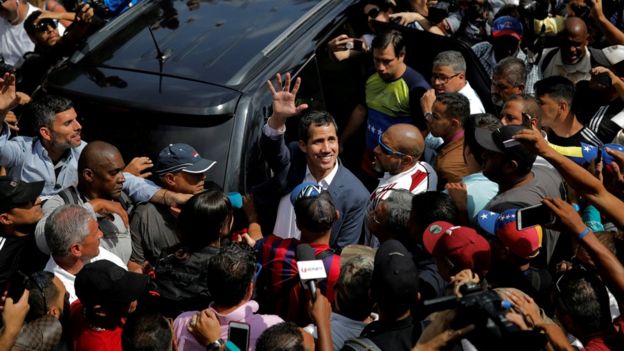
Venezuelan opposition leader Juan Guaido waves to supporters in Caracas, Venezuela February 2, 2019Image copyrightREUTERS
Image captionJuan Guaidó is head of Venezuela's National Assembly
US National Security Adviser John Bolton said on Twitter that plans were being advanced over the weekend.
Mr Maduro has rejected letting aid into the country, telling supporters on Saturday "we've never been nor are we a country of beggars".

What's the background?

Venezuela has suffered economic turmoil for years, with hyperinflation and shortages of essentials such as food and medicine. Millions have fled.
Media captionWhy Venezuela matters to the US... and vice versa
In January, Mr Maduro was sworn in for a second term following disputed elections which many opposition leaders did not contest because they were in jail or boycotting them.
Later that month, Mr Guaidó, who is head of Venezuela's National Assembly, declared himself president.
He says the constitution allows him to assume power temporarily when the president is deemed illegitimate. On Saturday he said protests would continue until his supporters had achieved "freedom".
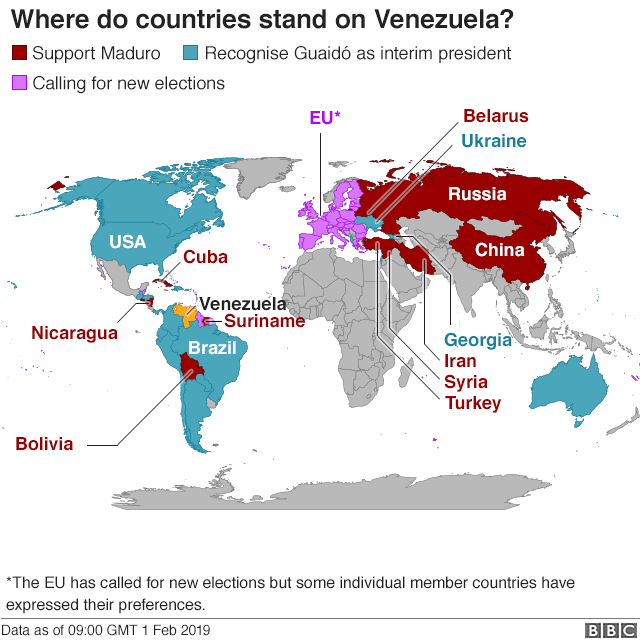
Map shows where countries stand on Venezuela presidency
Presentational white space

More on this story