Biodun Iginla, BBC News

Biodun Iginla, BBC News
Showing posts with label Islamic State group (IS). Show all posts

Friday, June 14, 2019

ANALYSIS: IS focus on millennial women is worry for future: Europol


In a report on IS propaganda focussed on women, Europol said that this could "pave the way" for a change in the role of female jihadists in future terror organisations
In a report on IS propaganda focussed on women, Europol said that this could "pave the way" for a change in the role of female jihadists in future terror organisations AFP/File
ADVERTISING
The Hague 
The Islamic State group is targeting women from the millennial generation as it seeks new recruits after the fall of its so-called caliphate, the EU's police agency said Friday.
In a report on IS propaganda focussed on women, Europol said that this could "pave the way" for a change in the role of female jihadists in future terror organisations.
"We are talking about especially millennials," Manuel Navarette, Head of Europol's European Counter Terrorism Centre, told reporters in The Hague as he unveiled the report.
"IS propaganda is focussed on women between 16 to 25, a group more vulnerable to these activities and they have access to social media. IS has adapted to the new target".
IS had in particular assigned new and "more active" roles to female jihadists within the organisation, while keeping its fundamentalist ideas about the position of women in society.
"They kept somehow the traditional role given to women: being supportive, taking care of men," Navarette said.
"But then they start asking women to take a different role, to assist as a doctor, to assist in a different way, not only as the traditional housewife."
The Islamic State's "caliphate" in Iraq and Syria fell in March but the group remains active in several countries in the Middle East, Africa, and Asia, as well as still inspiring jihadists through an online presence.
The international community is also torn over what to do with around 4,000 foreign women and 8,000 children linked to IS who remain stranded in Syria and Iraq.
The fear is that the targeting by IS of women for propaganda could pay dividends for jihadists in years to come.
"The worry is that this increase in the involvement of women could pave the way for potentially major changes in the role of jihadi women in the future," the Europol report said.
Navarette said there had been an increase in arrests of women connected to jihadism in France and Britain in particular.
"There could be a kind of relation between the propaganda machine of IS asking, demanding, for more active of specific groups of women and children to be a part of terrorism," he added.
Europol director Catherine De Bolle said that despite the findings law enforcement agencies needed to take a "gender neutral approach" looking at the reasons for radicalisation.
"It's the way to paradise, for both men and women," she added.

Thursday, April 25, 2019

BREAKING AND UPDATE: Sri Lanka attacks: Death toll revised down by 'about 100'


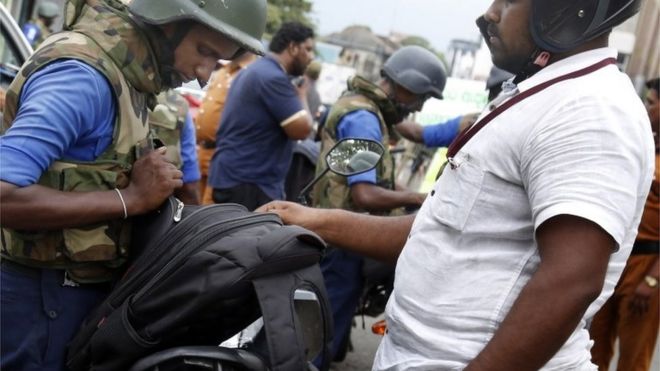
Security personnel check bags in Colombo in the aftermath of the Easter Sunday bomb attacks, 25 April 2019Image copyrightEPA
Image captionSecurity is tight in the aftermath of the attacks
by Susan Kumar and Biodun Iginla, BBC News, Colombo
Sri Lanka has revised down the death toll from Sunday's blasts by more than 100, to "about 253", the health ministry says.
It has blamed a calculation error.
Suicide bombers struck hotels and churches in the Colombo area and the eastern city of Batticaloa. Hundreds were injured, officials said.
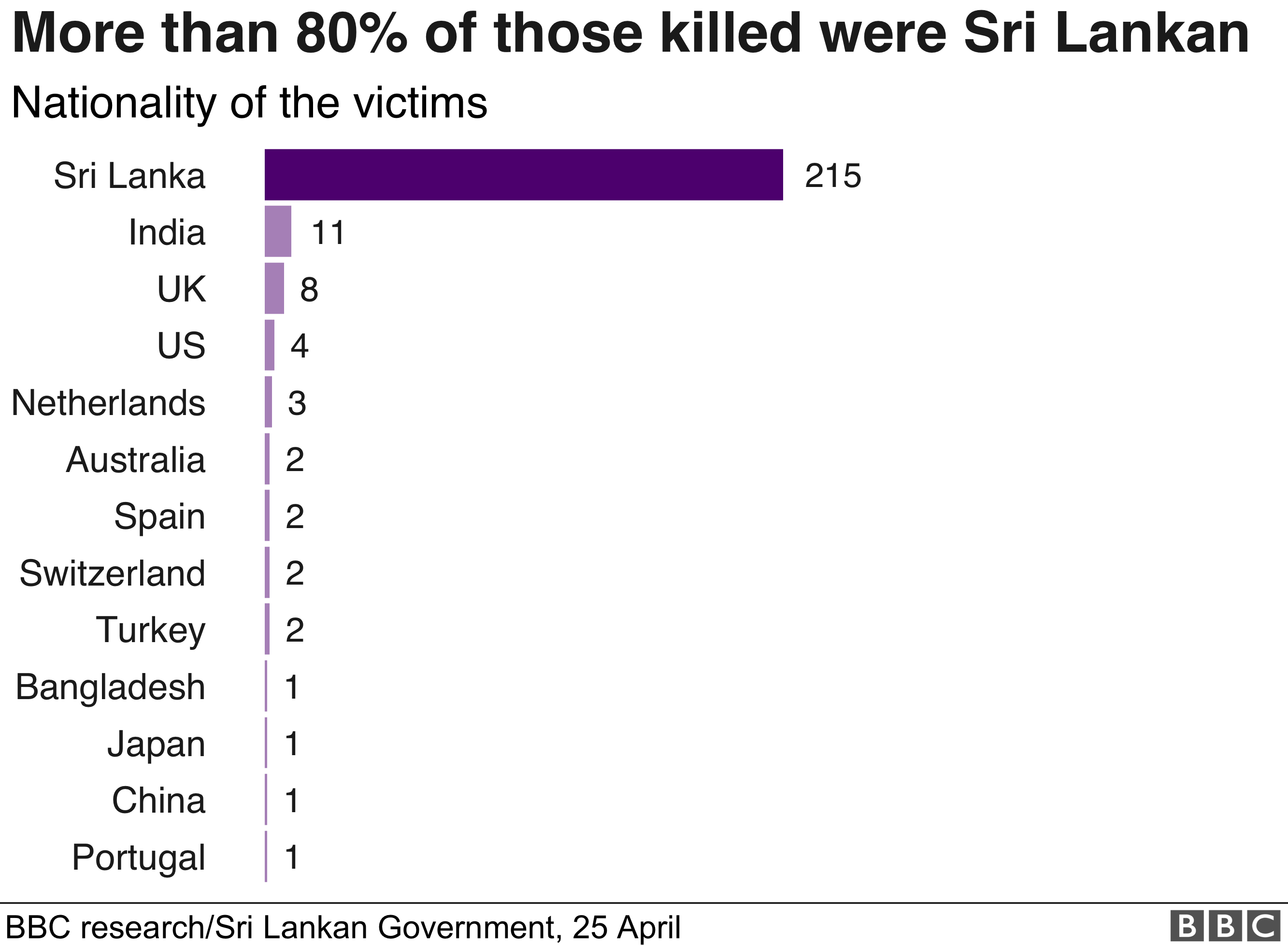
Most of those killed were Sri Lankans, but dozens of foreigners were also casualties. Nine people are suspected of carrying out the attacks.
Police have continued carrying out raids and have issued photographs of seven people wanted in connection with the attacks.
The authorities blamed a local Islamist extremist group, National Thowheed Jamath (NTJ), soon after the blasts but say the bombers must have had outside help.
The Islamic State group said it was behind the attacks and published a video showing eight men but provided no evidence of direct involvement.
In other developments:
  • Hundreds of Muslims, fearing revenge attacks, have been fleeing the city of Negombo, site of one of the attacks
  • Sri Lanka's defence secretary, Hemasiri Fernando, the top non-elected official at the department, announced his resignation on Thursday in response to intelligence failures
  • The country's Catholic Church has announced the suspension of all church services
  • Police say more than 70 people have now been arrested

Why was the initial death toll wrong?

Sri Lankan Deputy Defence Minister Ruwan Wijewardene said morgues had provided inaccurate figures.
Another official, the head of health services, told Reuters news agency there had been so many body parts it was "difficult to give a precise figure".
According to the health ministry, all autopsies had been completed late on Thursday and it transpired that some victims had been counted more than once.
BBC World Service South Asia editor Jill McGivering says the revised figure comes as the government is struggling to restore its credibility - amid criticism of its apparent failure to respond to intelligence warnings before the attacks.
It's also battling to counter fake news and false rumours about the crisis, she says. This sudden dramatic revision is unlikely to help.
BBC graphic showing death toll from the Easter Sunday bomb attacks in Sri Lanka, 25 April 2019

What is the situation with the Muslim minority?

Muslims in Sri Lanka are reporting feeling fearful and say they are facing persecution.
Many of those in Negombo belong to a minority sect, the Ahmadi. Some have been sheltering in a mosque under police protection.
Ahmadi Muslims identify as Muslim and follow the Koran, but are viewed by many orthodox Muslims as heretical.
Many of those living in Sri Lanka have fled from persecution elsewhere, including Pakistan.
However since Sunday's attacks some have reported physical attacks, being kicked out by landlords or having their homes broken into.
"Today these refugees have become refugees again in Sri Lanka. They have been displaced for a second time," Ruki Fernando from Inform, a Sri Lankan rights group, said.
Auranzeb Zabi, an Ahmadi Pakistani refugee who has lived in Sri Lanka for two years, told the New York Times he had been forced from his home in Negombo on Wednesday by a mob with weapons.
Mr Zabi reported being followed, and along with his son, beaten.
Associated Press reports that a group of 200 have been sheltering inside their mosque inside Negombo while 500 more are said to have sought shelter 20 miles away.
"The people in Pakistan attacked us and say we're not Muslims," Tariq Ahmed, 58, told AP. "Then in Sri Lanka, people attack us because they say we are Muslims."
The Prime Minister, Ranil Wickremesinghe, has admitted that some Ahmadi have been subject to attacks.
Of Sri Lanka's 21-million population, just under 10% are Muslims.

Related Topics