April 11, 2018 13H:13 GMT/UTC/ZULU TIME
MOSCOW - Russia has warned that any U.S. missiles fired at Syria over a suspected chemical weapons attack on a rebel enclave would be shot down and the launch sites targeted, raising the possibility of a U.S.-Russian confrontation.
Issuing the warning on Tuesday evening, the Russian ambassador to Lebanon also said such a clash should be avoided and Moscow was ready for negotiations. But his remarks could raise fears of direct conflict for the first time between major powers backing opposing sides in Syria’s protracted civil war.
Moscow and Washington sparred at the United Nations on Tuesday over the use of chemical weapons in Syria as Washington and its allies considered whether to strike at Syrian government forces over the alleged poison gas assault.
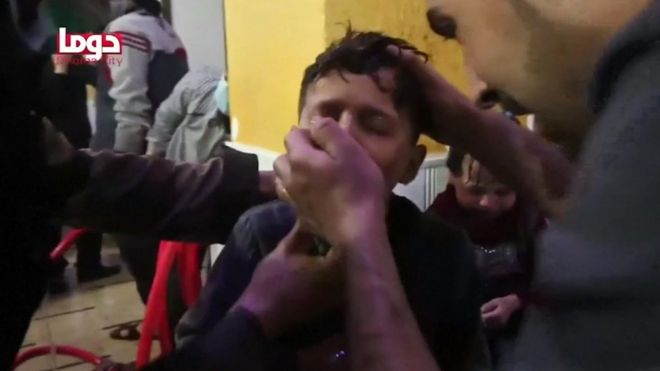
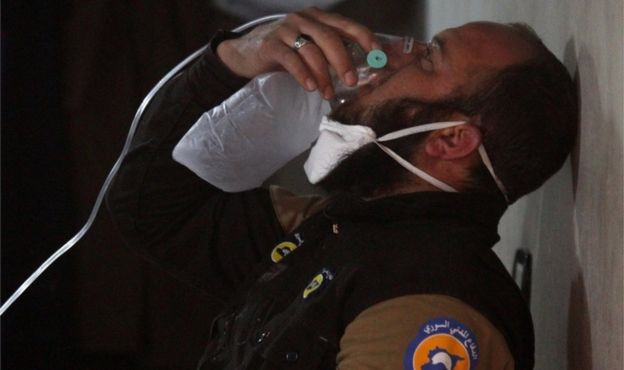
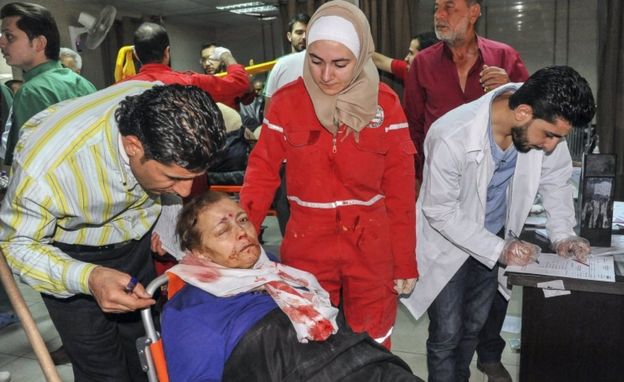
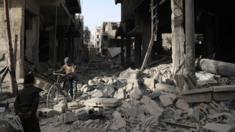
At least 60 people were killed in Saturday’s suspected chemical weapons attack on the town of Douma, Syrian relief workers said. An estimated 500 people were being treated for “symptoms consistent with exposure to toxic chemicals”, the World Health Organization said on Wednesday.
The Syrian government and Russia say the reports are bogus. The Kremlin said on Wednesday it hoped all sides involved in Syria would avoid doing anything that could destabilize an already fragile situation in the Middle East, and made clear it strongly opposed any U.S. strike on its ally.
After the attack, the rebel group holed up in Douma - Jaish al-Islam - finally agreed to withdraw from the town. That sealed a big victory for President Bashar al-Assad, who has now crushed the rebellion in the eastern Ghouta region near Damascus.
On the diplomatic front, Moscow and Washington stymied attempts by each other in the U.N. Security Council on Tuesday to set up international investigations into chemical weapons attacks in Syria. [
U.S. President Donald Trump on Tuesday canceled a planned trip to Latin America later this week to focus instead on talks with Western allies about possible military action to punish Assad for the suspected gas attack on a rebel-held town that had long withstood a devastating Syrian government siege.
Trump had on Monday warned of a quick, forceful response once responsibility for the attack was established.
“If there is a strike by the Americans, then ... the missiles will be downed and even the sources from which the missiles were fired,” Alexander Zasypkin, the Russian ambassador in Beirut, told Hezbollah’s al-Manar TV, speaking in Arabic.
He said he was referring to a statement by Russian President Vladimir Putin and the Russian armed forces chief of staff.
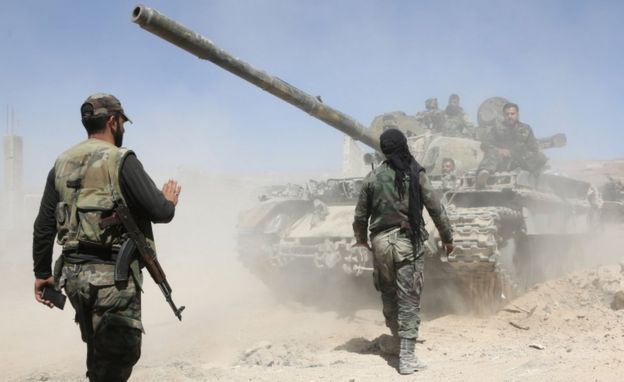
The Russian military said on March 13 that it would respond to any U.S. strike on Syria by targeting any missiles and launchers involved. Russia is Assad’s most powerful ally and its devastating air power has helped him wrest back large swathes of territory from rebels since 2015.
Zasypkin also said a clash between Russia and the United States over Syria “should be ruled out and therefore we are ready to hold negotiations”.
Earlier in the week, Russian Deputy Foreign Minister Mikhail Bogdanov said there was no threat of the situation in Syria spiraling into U.S.-Russian hostilities. TASS news agency quoted him as saying he believed common sense would prevail.
MISSILE SALVO FROM MEDITERRANEAN?
Any U.S. strike is likely to involve the navy, given the risk to aircraft from Russian and Syrian air defense systems. A U.S. Navy guided-missile destroyer, the USS Donald Cook, is in the Mediterranean.
With tensions mounting, pan-European air traffic control agency Eurocontrol warned airlines to exercise caution in the eastern Mediterranean due to the possible launch of air strikes into Syria over the next 72 hours.
Eurocontrol said that air-to-ground and cruise missiles could be used within that period and there could be intermittent disruptions of radio navigation equipment.
Both Russia and Iran, Assad’s other main ally, have warned his enemies against military action in recent days, underlining their commitment to the Syrian government they have armed and supported through years of conflict.
Ali Akbar Velayati, the top adviser to Iranian Supreme Leader Ayatollah Ali Khamenei, said during a visit to Damascus on Tuesday that an Israeli attack on an air base in Syria earlier this week would “not remain without response”.
RISK OF “UNCONTROLLABLE ESCALATION”
On Monday, U.N. Syria peace envoy Staffan de Mistura cited the air base strike along with other recent events in Syria in a briefing to the Security Council, cautioning against a “situation of uncontrollable escalation”.
Syria’s Russian-supplied air defenses shot down an Israeli F-16 jet in February during a previous bombing run against what Israel described as Iranian-backed positions in Syria.
Last year, the United States carried out strikes from two Navy destroyers against a Syrian air base after another toxic gas attack on a rebel-controlled pocket.
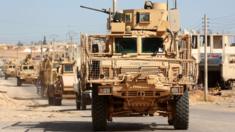
The U.S. and Russian militaries have sought to avoid conflict in Syria, notably last year in the Euphrates River Valley where they supported rival sides in the campaign against Islamic State militants.
However, U.S. forces in February killed or injured hundreds of Russian contractors fighting on Assad’s side during a confrontation in Deir al-Zor province.
U.S. officials said last month pro-Syrian government forces including Russian mercenaries massed near U.S. and U.S.-backed forces in the same region, but a potential confrontation was defused after the U.S. military contacted Russian officers.
French President Emmanuel Macron said on Tuesday that any military action would not target the Syrian government’s allies or anybody in particular, but rather the Syrian government’s chemical facilities.
Any U.S. strike similar to the limited one launched last year would not cause a shift in the course of the war that has been going Assad’s way since Russia intervened on his side.
DEADLY CHEMICAL ATTACK
Syrian aid workers reported more than 1,000 people injured in the reported gas attack on Douma. Doctors and witnesses said victims showed symptoms of poisoning, possibly by a nerve agent, and reported the smell of chlorine gas.
France and Britain discussed with the Trump administration how to respond to the Douma attack. Both stressed that the culprit still needed to be confirmed.
The Hague-based Organisation for the Prohibition of Chemical Weapons said Assad’s government had been asked to make necessary arrangements for an OPCW investigation team to visit shortly.
The mission will aim to determine whether banned munitions were used but not assign blame.
The Assad government and Russia both urged the OPCW to investigate the allegations, a move by the two countries that was apparently aimed at averting any U.S.-led military action.
A European source said European governments were waiting for the OPCW to carry out its inquiry and for more solid forensic evidence from the attack to emerge. Any plan by Washington and its allies to take military action was likely to be on hold until then, the source told us at Reuters.
Despite the international revulsion over chemical weapons attacks, the death toll from such incidents in Syria is only a fraction of the hundreds of thousands of combatants and civilians killed since the war erupted in 2011.